
Edible
Jujube
Ziziphus jujuba
Also known as Chinese date, Red date, Hong zao, Annab
How to grow jujube, Ziziphus jujuba. A thorny tree that fruits like a small apple and dries like a date, needing more summer heat than most cool temperate gardens give.
At a glance
- Difficulty
- Difficult
- Water
- Fortnightly in dry spells, and it is very drought-tolerant
- Light
- Full sun, against the hottest wall available
- Temperature
- Dormant wood hardy to -25 deg C
- Hardiness
- USDA 6-10, RHS H5, hardy to -20 C
- Type
- Deciduous tree, very long-lived, suckering
- Height
- 5-10 m, less in a cool climate
- Native to
- China, Central Asia
- Best month
- September and October in the Northern Hemisphere, March and April in the Southern Hemisphere
Northern China, and the outlier on this shelf. It takes about -20 deg C, which is colder than an olive or a fig, and it still demands a long hot summer to ripen, so it succeeds in continental climates with hard winters and fierce summers and disappoints in a mild damp one.
Hardiness zones describe winter cold alone. Summer heat, humidity, rainfall and the length of the growing season decide as much, so treat the range as the outer limit rather than as a recommendation.
Every month named in this guide is for the temperate Northern Hemisphere. If you garden in the Southern Hemisphere, shift each one by six months, so September becomes March. Closer to the equator the wet and dry seasons matter more than the calendar, and the shift stops being a useful guide.
Not known to be toxic
- Safe to eat
- The fruit, fresh or dried
The fruit is food and is eaten fresh and dried across China, Korea and the Middle East, where it is also a staple of traditional medicine. Neither the RHS nor the ASPCA lists Ziziphus jujuba as harmful, and no toxicity to cats or dogs is recorded. The stone is hard and pointed and should be discarded rather than chewed. The thorns are the practical hazard on this plant, sharp and paired at the leaf joints, and they warrant gloves when pruning. Some varieties are close to thornless, which is worth seeking out.
Sources: RHS potentially harmful garden plants, ASPCA toxic and non-toxic plants
About
A fresh jujube tastes like a slightly sweet apple with a crisp texture, which surprises anyone expecting the sticky dried version sold in Chinese shops. Left on the tree it wrinkles, darkens and turns into that date-like fruit by itself.
The tree is hardy to -25 deg C when dormant, so cool winters are no obstacle. The summer is. Jujube needs long stretches of real heat to ripen, and a cool damp August leaves the fruit green and hard.
It handles conditions that kill other fruit. Drought, poor stony soil, alkaline ground and salt are all tolerated, and the tree is grown across deserts from China to Iran on exactly that basis.
Outside its climate it is a hot-wall plant in the south, or a large container that can spend summer outside and winter under cover.
Appearance and character
An upright deciduous tree with a light open crown and distinctive zigzag branching, suckering from the roots.
Most varieties carry paired thorns at the leaf joints, one straight and one hooked, though some named selections are nearly thornless.
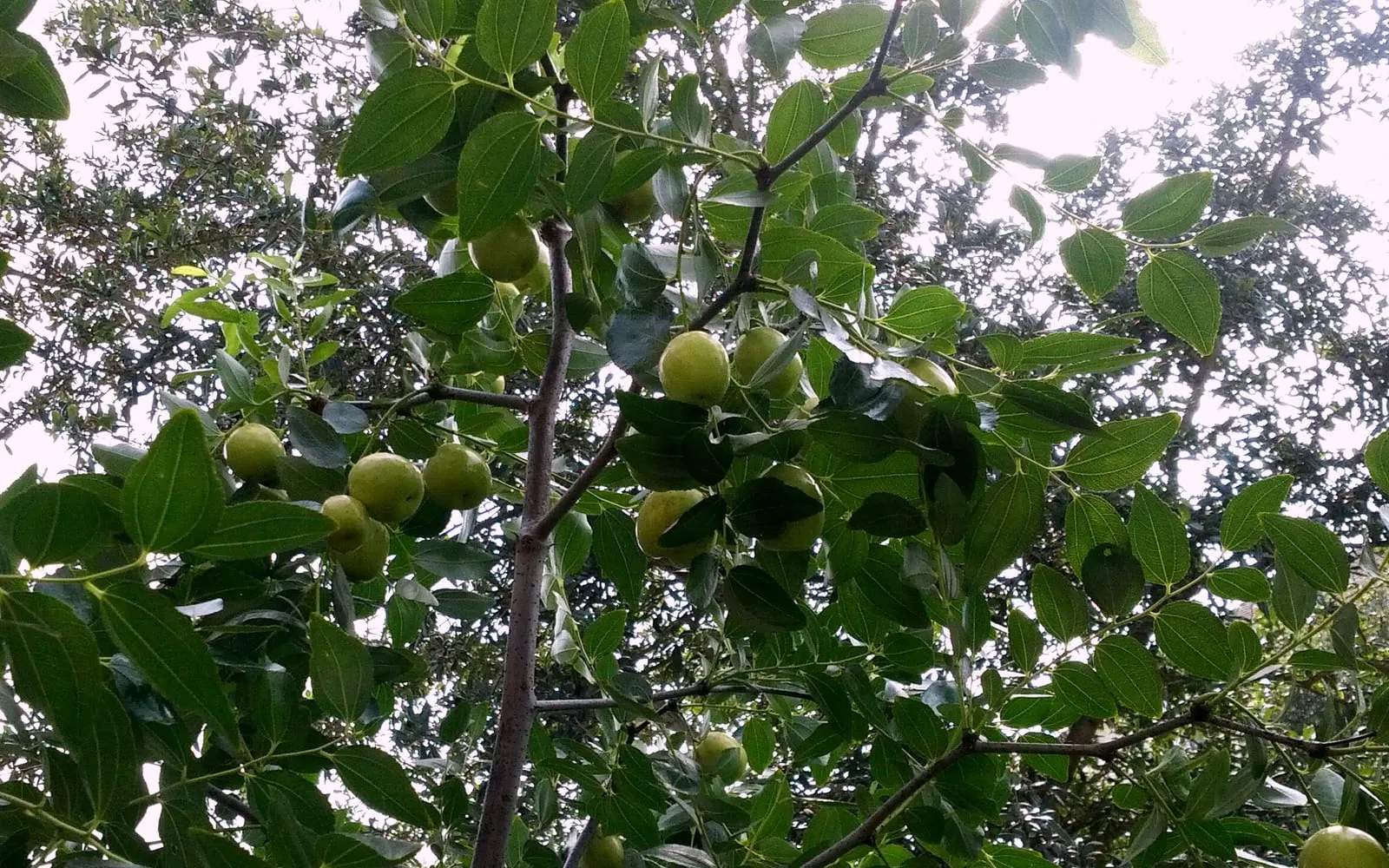
Leaves are small, 2 to 7 cm, oval, glossy bright green, with three prominent veins running from the base and finely toothed edges. They turn clear yellow in autumn.
Flowers are tiny, 5 mm, greenish-yellow and star-shaped, opening from June to August, inconspicuous but strongly scented and much visited by bees.
Fruit is oval, 2 to 4 cm, ripening from green through yellow-brown to mahogany red, with crisp white flesh around a single hard pointed stone.
Where it is from
Ziziphus jujuba is native to China, where it has been cultivated for at least four thousand years and where hundreds of varieties exist.
It spread west along the trade routes into central Asia, Iran, the Middle East and eventually the Mediterranean.
Its wild habitat is dry hillside and semi-desert, which explains the drought tolerance and the appetite for heat.
China grows the overwhelming majority of the world crop, most of it dried, and the fruit is central to both cooking and traditional medicine there.
It reached the United States in the nineteenth century and is grown in the hot dry south-west, where the climate matches its needs closely.
How it grows
Buy a grafted named variety. ‘Li’ and ‘Lang’ are the standards, ‘Li’ producing larger fruit that ripens earlier, which matters in a short season.
Plant in spring against the hottest south-facing wall available, in free-draining soil. Poor and alkaline ground is acceptable.
A large container is the alternative, moved outside for summer and into a cool greenhouse for winter, which extends the growing season at both ends.
Trees are partly self-fertile and crop better with a second variety nearby.
Prune in late winter, keeping an open framework and removing suckers. Fruit forms on the current season’s growth from short permanent spurs.
Expect fruit from the third or fourth year in favourable conditions.
Through the seasons
The tree leafs out very late, often not until late May or June, which is normal and regularly convinces owners that it has died over winter.
Flowering runs from June to August over a long period, scented and heavily worked by bees.
Fruit sets through summer and needs heat to develop. This is the stage a temperate summer usually fails to supply.
Ripening runs from September into October. Fruit is ready for eating fresh when it turns from green to yellow-brown and the flesh is crisp.
Left on the tree it continues to mahogany red and then wrinkles, which is the dried stage used in cooking.
The tree drops its leaves late and goes fully dormant, tolerating hard frost without damage.
Care difficulty
Difficult outside the tropics, and the difficulty is heat rather than hardiness.
The tree survives our winters easily and asks almost nothing in the way of soil, water or feeding.
Ripening is what fails. Without a long hot summer the fruit stays green, and even a good year in a cool climate gives a modest crop compared with what the same tree does in a continental climate.
The late leafing habit causes unnecessary worry every spring.
Thorns make pruning a careful job, and suckers need removing annually.
Watering
Water fortnightly in dry spells through the first two or three summers.
An established tree is exceptionally drought-tolerant and needs almost no watering in a cool summer.
A wall-trained tree in rain shadow is the exception and needs occasional summer watering.
Avoid overwatering, which the plant dislikes more than drought. Wet roots are the main cause of failure.
A container plant needs regular but moderate watering, in a free-draining compost with grit worked through it.
Warning signs, diseases and pests
Fruit staying green and hard into October. Not enough summer heat. This is the usual outcome in a cool summer outdoors, and a hotter wall or a greenhouse is the only fix.
No leaves in May. Normal. Jujube breaks dormancy very late, often in June.
Suckers appearing metres from the trunk. Root suckering, which is vigorous. Cut them out or mow them.
Tree failing on heavy soil with dark roots. Root rot from waterlogging. This plant needs sharp drainage above everything.
Brown bumps along older stems. Scale insects. Scrub off in winter.
Almost no pest damage. Normal, and one of the reasons the tree is grown so widely in difficult climates.
Growing environment
Full sun and as much heat as possible. A south-facing wall in southern England, or a greenhouse.
Free-draining soil of almost any quality. Poor, sandy, stony and alkaline ground all suit it, and rich wet soil does not.
Winter cold is irrelevant, with dormant hardiness to -25 deg C.
Summer heat is the limiting factor, and the difference between a good year and a poor one is entirely about how warm August is.
Allow 3 to 4 m against a wall, and expect suckers within a couple of metres of the trunk.
Feeding
Feeding is rarely needed. The tree evolved on poor dry ground and grows well without it.
A balanced general fertiliser in spring is useful only on very poor sand.
Avoid nitrogen, which produces soft growth and more suckers without improving the crop.
Mulch lightly with compost in spring on thin soil, kept clear of the trunk.
A container plant needs a balanced liquid feed monthly from May to July, then nothing.
Troubleshooting
No leaves until June. Normal for the species rather than winter damage.
Fruit never ripening. Insufficient summer heat. Move to a hotter position or grow under glass.
Flowers but very little fruit. Only one variety, or cool weather during the long flowering period. Plant a second variety.
Suckers spreading widely. Natural habit. Cut them off below ground level each spring.
Tree declining on clay. Waterlogging. Improve drainage or move it into a raised bed or container.
Fruit wrinkled and brown on the tree. The dried stage, which is edible and is how most of the world crop is used.