
Edible
Japanese quince
Chaenomeles speciosa
Also known as Flowering quince, Chaenomeles, Japonica, Ornamental quince
How to grow Japanese quince, Chaenomeles speciosa. Flowers on bare wood in February, hard aromatic fruit in autumn, and the wall training that suits it.
At a glance
- Difficulty
- Easy
- Water
- First summer only, then none in open ground
- Light
- Full sun to part shade, and it flowers on a north wall
- Temperature
- Fully hardy to -20 deg C
- Hardiness
- USDA 5-9, RHS H6, hardy to -20 C
- Type
- Deciduous shrub, long-lived
- Height
- 1-2.5 m free-standing, 3 m trained on a wall
- Native to
- China, Japan
- Best month
- October and November in the Northern Hemisphere, April and May in the Southern Hemisphere
Cold suits it, and the flowers open on bare wood early enough that a hard frost takes some of them without troubling the shrub. Fruit sets readily and ripens slowly through autumn, so a short season gives a smaller and harder crop rather than none at all.
Hardiness zones describe winter cold alone. Summer heat, humidity, rainfall and the length of the growing season decide as much, so treat the range as the outer limit rather than as a recommendation.
Every month named in this guide is for the temperate Northern Hemisphere. If you garden in the Southern Hemisphere, shift each one by six months, so October becomes April. Closer to the equator the wet and dry seasons matter more than the calendar, and the shift stops being a useful guide.
Not known to be toxic
- Safe to eat
- The fruit, cooked
- Do not eat
- The seeds, in large chewed quantity
The flesh is food. The pips contain amygdalin, which releases hydrogen cyanide when the seed coat is broken by chewing, and the same compound occurs in apple and pear seed. Swallowing a few pips whole does nothing, because an intact seed passes through undigested. The quantity needed to cause harm runs to a large cupful of thoroughly chewed seed, so treat this as a reason not to feed cores to a dog rather than as a hazard to the person eating the fruit. Discard the core when juicing in quantity, since a juicer breaks every seed at once. Leaves and wood carry the same compound at low levels and no part of the tree is a grazing risk in a garden.
Sources: RHS potentially harmful garden plants, ASPCA toxic and non-toxic plants
About
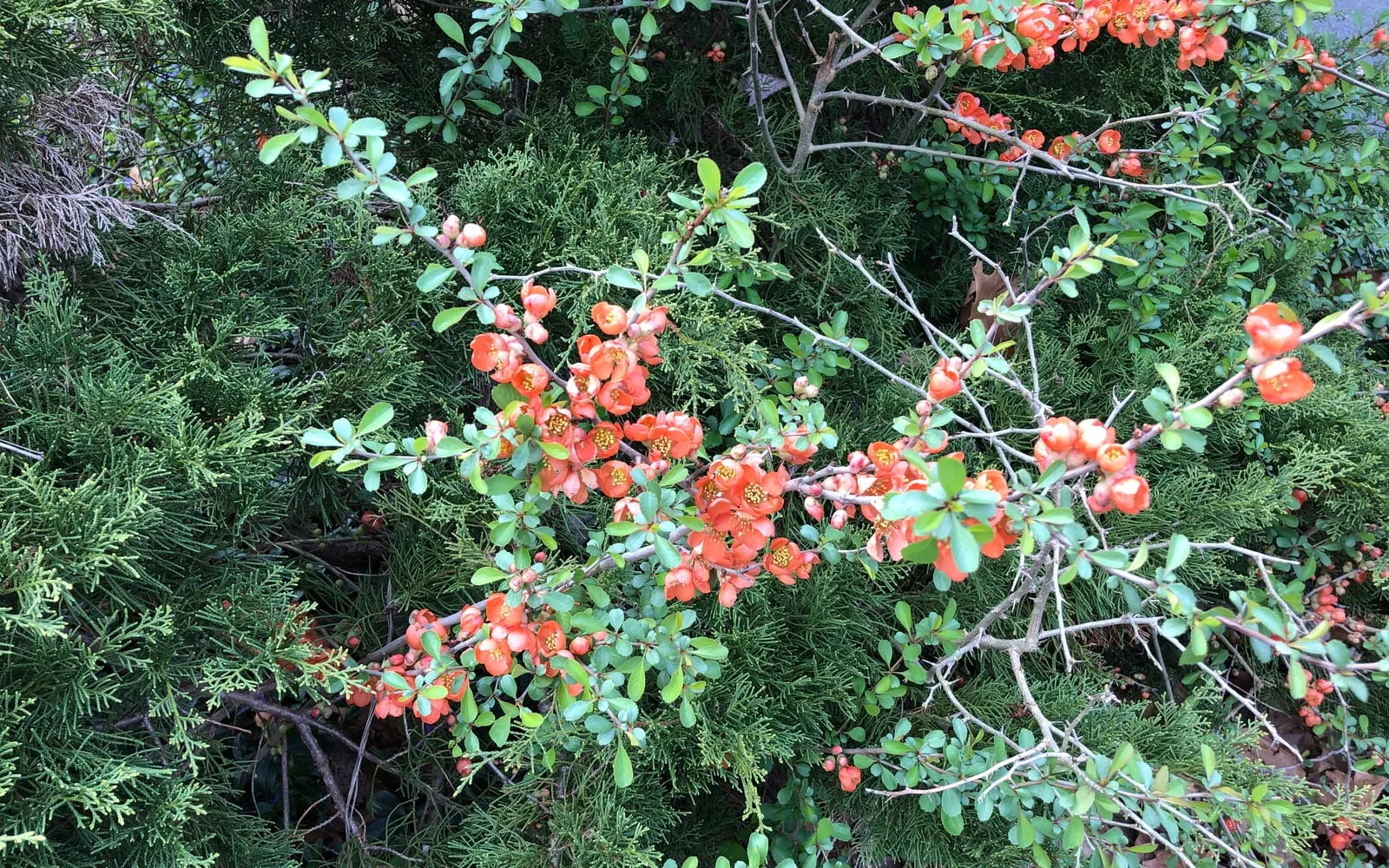
Most people grow this for the flowers and never discover it fruits. Scarlet, coral or white blossom studs the bare twigs from February, months ahead of anything else in the garden, and by October the shrub carries hard green-gold fruit that smells of apple and rose.
The fruit is inedible raw. It is rock hard, astringent and sour, and biting one is a mistake you make once. Cooked with sugar it makes an excellent amber jelly, and it carries enough pectin to set a jam made with low-pectin fruit.
The shrub itself is close to indestructible. It grows on clay, on chalk, in shade, in wind, and it flowers on a north wall where little else will.
Thorns are the drawback. Every branch carries them, which makes the plant a good intruder barrier and an unpleasant one to prune bare-handed.
Appearance and character
A dense twiggy shrub with tangled interlacing branches, spreading slowly outwards by suckers into a wide low thicket.
Stems are armed with sharp spines, and older wood becomes dark grey and gnarled.
Flowers open from February to April on the bare wood, cup-shaped, 3 to 4 cm across, with five rounded petals around a ring of golden stamens. ‘Moerloosei’ is white flushed pink, ‘Nicoline’ deep scarlet, ‘Crimson and Gold’ red with a dark centre.
Leaves follow the flowers, oval and glossy dark green with toothed edges, 4 to 8 cm long.
Fruit is a rounded or slightly pear-shaped pome 4 to 7 cm across, green ripening to yellow with a waxy bloom, and intensely aromatic once brought indoors.
Where it is from
Chaenomeles speciosa is native to China, and it reached Britain in 1796 by way of Japanese gardens, which is how it picked up a misleading common name.
The confusion runs deeper than the name. Early botanists placed it in Pyrus and then in Cydonia, the true quince, and the plant has been sold as japonica for so long that the label persists in nurseries.
Chaenomeles japonica is a separate and smaller species, also grown in gardens, which makes the common names harder still to untangle.
In China the fruit has a long medicinal history and is dried and sold as mu gua. Latvia and Lithuania grow a related species commercially for juice, where the high acidity is used the way lemon is used elsewhere.
Wild plants grow on hillsides and in thickets, which explains the shrub’s tolerance of poor stony ground.
How it grows
Buy a container-grown plant at any time of year and plant in autumn or spring.
Site it in sun for the heaviest flowering and the most fruit, though a north or east wall gives a perfectly good display and is a use few shrubs can fill.
Plant into ordinary soil with no special preparation. It tolerates clay and chalk, and only waterlogging troubles it.
Train it on a wall by tying in a framework of main stems and cutting the side shoots back to two or three buds after flowering. Fruiting spurs build up along those stubs.
Free-standing plants need almost no pruning. Take out a few of the oldest stems at the base every couple of years to keep the thicket from congesting.
Fruit appears from the third year and needs no thinning.
Through the seasons
February to April is the flowering season, starting on bare wood and continuing as the leaves emerge.
Cut a few branches in bud in January and bring them into a cool room. They open indoors within a fortnight and last well in water.
Prune immediately after flowering, which is the only correct moment. Cutting in winter removes the flower buds that formed the previous summer.
Through summer the shrub is a plain green mass and the fruit swells unnoticed behind the leaves.
October and November bring ripening. Pick when the fruit turns from green to yellow and comes away easily. Leaving it slightly longer improves the scent without softening the flesh.
Stored in a bowl indoors the fruit perfumes a room for weeks before it is used.
Care difficulty
Easy. This is one of the toughest shrubs sold, and it survives conditions that kill most fruiting plants.
It tolerates shade, wind, clay, chalk and neglect, and recovers from being cut hard back.
The two things to get right are both simple. Prune after flowering rather than before, and watch for fireblight, which Chaenomeles catches more readily than most garden shrubs.
Thorns make every job slower. Use thick gauntlets and long-handled loppers on an established plant.
No feeding, spraying or winter protection is needed anywhere in its hardiness range.
Watering
Water weekly through the first summer after planting and then leave it alone.
An established plant is thoroughly drought-tolerant and needs no watering in open ground.
A plant against a wall sits in rain shadow and is the exception, so water those through dry spells in the first two or three years.
Mulch in spring with compost, kept off the stems, which does more for the plant than watering.
Waterlogged ground is the one condition it will not accept, and a plant in winter wet will slowly die back.
Warning signs, diseases and pests
Shoot tips blackened, leaves dead and clinging, a shepherd’s crook at the tip. Fireblight. Cut 30 to 60 cm back into clean wood, burn the prunings and disinfect the secateurs between cuts.
Dark spots on leaves, followed by heavy leaf fall in midsummer. Leaf spot, common in a wet year. Rake up the fallen leaves. The plant flowers normally the following spring.
Sticky distorted shoot tips in spring. Aphids. Rub them off or ignore them, since the shrub outgrows the damage.
Brown limpet-like bumps on stems, sooty mould below. Scale insects, most likely on a warm wall. Scrape off small infestations.
Yellow leaves with green veins. Iron shortage on very alkaline soil. Apply chelated iron and mulch with composted bark.
Few or no flowers after a good year. Pruned at the wrong time. Cut back within a few weeks of flowering finishing, never in autumn or winter.
Growing environment
Full sun produces the most flowers and fruit. Part shade reduces both without harming the plant.
A north or east wall is a legitimate position for this shrub, which is unusual among flowering plants, making it useful for a difficult corner.
Soil can be almost anything with drainage, from heavy clay to thin chalk, at any pH from 5.5 to 8.
Wind and cold are tolerated fully, so it suits exposed gardens.
Give a free-standing plant 2 m of width. It spreads by suckers, slowly, and can be kept in bounds by pulling suckers off in spring or by planting it where a widening thicket is welcome.
Feeding
Feeding is rarely needed. The shrub flowers well on poor soil and puts on soft growth if overfed.
Where flowering is shy on rich ground, apply sulphate of potash in late winter and stop any nitrogen feed.
Mulch with compost each spring on thin or sandy soil.
Avoid high-nitrogen lawn fertiliser reaching the roots, which produces long whippy growth, few flowers and greater fireblight risk.
A container plant needs a balanced liquid feed monthly from April to August, and a pot of at least 40 cm.
Troubleshooting
No flowers. Pruned after midsummer, which removes next year’s buds. Prune straight after flowering instead.
Flowers but no fruit. Frost caught the early blossom, or nothing was flying to pollinate it in February. A second plant nearby improves the set.
Fruit small and few. Heavy shade, or a plant crowded by neighbours. Thin the shrubs around it.
Plant becoming a bare tangle at the base. Age and congestion. Remove a third of the oldest stems at ground level after flowering and repeat over three years.
Suckers coming up a metre away. Normal spread. Pull them out with a sharp tug in spring rather than cutting them.
Fruit rock hard in November. That is the fruit behaving correctly. It never softens on the plant and is used cooked.