
Edible
Autumn olive
Elaeagnus umbellata
Also known as Autumnberry, Japanese silverberry, Umbellata oleaster
How to grow autumn olive, Elaeagnus umbellata. A nitrogen-fixing shrub with silver leaves and speckled red fruit, and why it needs planting with thought.
At a glance
- Difficulty
- Easy
- Water
- First summer only, then none
- Light
- Full sun to light shade
- Temperature
- Fully hardy to -25 deg C
- Hardiness
- USDA 3-9, RHS H6, hardy to -30 C
- Type
- Deciduous shrub, living several decades
- Height
- 3-5 m, and as wide
- Native to
- China, Japan, Korea, Himalaya
- Best month
- September and October in the Northern Hemisphere, March and April in the Southern Hemisphere
Hardy, drought-proof and able to fix its own nitrogen on poor ground, which is exactly the combination that made it a problem. It is listed as a noxious or invasive species across much of the eastern and midwestern United States, where birds spread the seed into old fields and it shades out the regrowth. Check the local status before planting.
Hardiness zones describe winter cold alone. Summer heat, humidity, rainfall and the length of the growing season decide as much, so treat the range as the outer limit rather than as a recommendation.
Every month named in this guide is for the temperate Northern Hemisphere. If you garden in the Southern Hemisphere, shift each one by six months, so September becomes March. Closer to the equator the wet and dry seasons matter more than the calendar, and the shift stops being a useful guide.
Not known to be toxic
- Safe to eat
- The ripe fruit, seeds and all
The fruit is food and is eaten fresh, dried and pressed for juice. Neither the RHS nor the ASPCA lists Elaeagnus as harmful, and no toxicity to cats or dogs is recorded. The soft seed inside each berry is eaten with the fruit and presents no problem. Unripe fruit is astringent enough to be unpleasant and will upset a stomach in quantity, which is a tannin effect that disappears as the berries soften. The concern with this plant is ecological rather than medical, and it is covered in the guide above.
Sources: RHS potentially harmful garden plants, ASPCA toxic and non-toxic plants
About
Autumn olive builds its own fertility. Nodules on the roots host Frankia bacteria that fix nitrogen from the air, which is why the shrub thrives on builders’ rubble and poor sand where nothing else will start.
The fruit is small, red and flecked with tiny silver scales, and it carries more lycopene than a tomato by a wide margin. Ripe berries taste sweet-tart and slightly astringent, and they make a good juice and a better fruit leather.
There is a serious caveat, and it belongs at the front rather than buried. In the eastern United States this shrub is one of the worst woody invasives, spread by birds into old fields and roadsides where it forms impenetrable thickets. In Europe it is far better behaved, and it does self-seed where birds carry it.
Plant it in a garden where you can pull up seedlings, and think hard before putting it next to open countryside or a nature reserve.
Appearance and character
A broad spreading shrub, wider than it is tall on an open site, with densely twiggy growth and short stiff spurs that function as thorns.
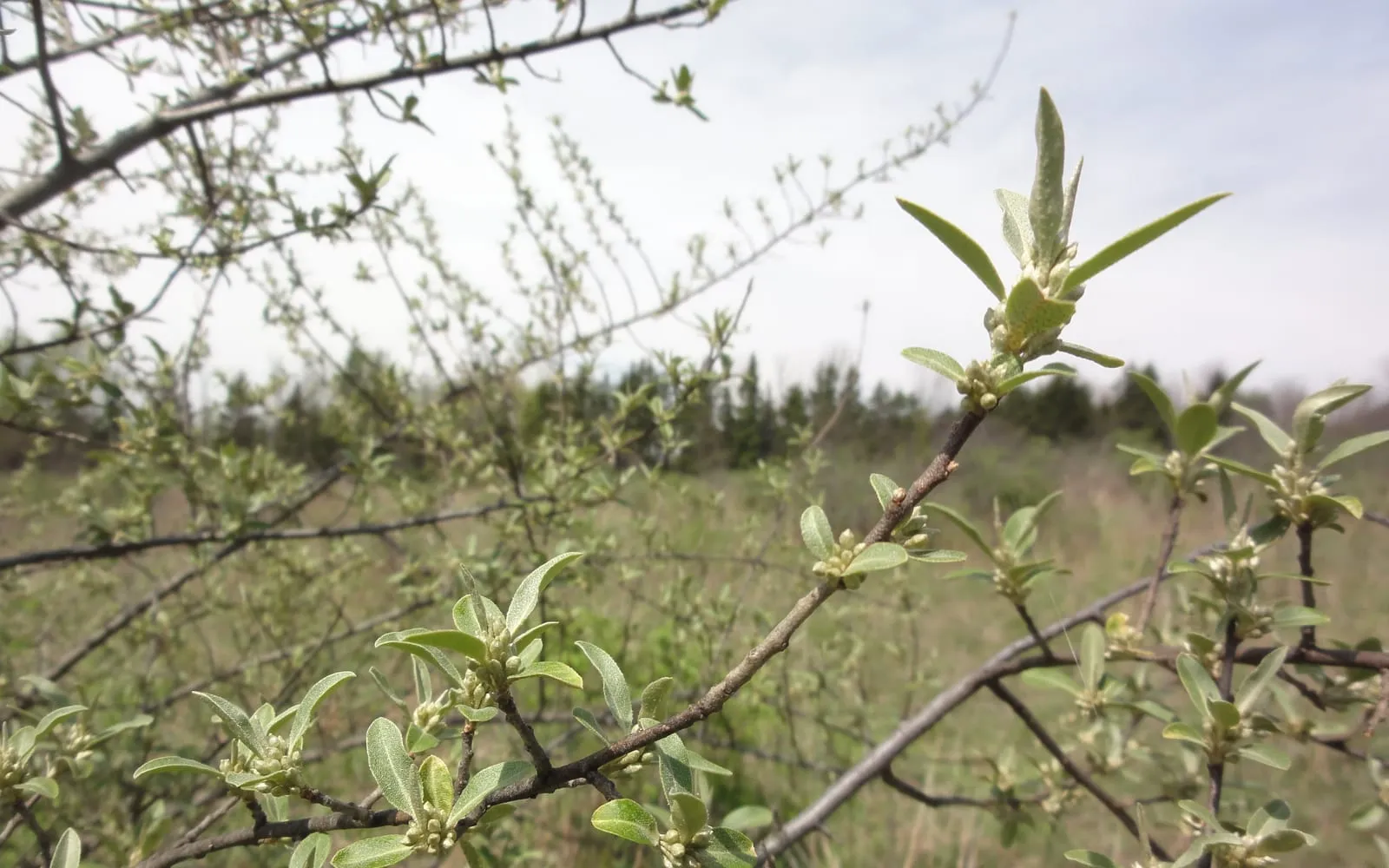
Young stems are covered in silvery-brown scales that catch the light, which is the easiest identifying feature.
Leaves are oval to lance-shaped, 4 to 10 cm, dull green above and brilliant silver beneath from a dense coating of scales. A breeze turns the whole shrub from green to silver.
Flowers open in May and June, small, tubular and pale cream, hanging in clusters along the previous year’s wood. The scent is strong and sweet and carries a long way.
Fruit ripens from September, 6 to 8 mm, round, scarlet and speckled with silver dots, hanging in heavy clusters along the branch.
Where it is from
Elaeagnus umbellata is native to China, Japan, Korea and the Himalaya, where it grows on hillsides, forest edge and disturbed ground.
It reached the West in 1830 and was planted widely in the twentieth century for shelter belts, erosion control and game cover, all of which it does well.
Those plantings are the source of the problem in North America. Soil conservation programmes distributed it across the eastern states from the 1950s, and birds did the rest. It is now listed as invasive in most of that range and its sale is restricted in several states.
It has behaved far better in Europe, where it is grown for shelter and for fruit and naturalises locally rather than aggressively. The mechanism is the same, so it warrants care wherever it goes in.
The fruit has a long history of use in Japan, where it is called akigumi and made into preserves and a fruit wine.
How it grows
Buy a container-grown plant, or a named fruiting selection such as ‘Big Red’ or ‘Sweet and Tart’ if you can find one, since the wild form varies a great deal in fruit quality.
Plant in autumn or spring into any well-drained soil. Poor sandy ground gives a better plant than rich soil, which pushes leafy growth.
Give it 3 to 4 m of space. It spreads wide and resents being cut back into a narrow shape.
It is partly self-fertile and crops much better with a second plant nearby, so put in two where there is room.
Prune in late winter, taking out old and crossing wood. It tolerates hard pruning and regrows readily.
Watch the ground beneath it. Pull up bird-sown seedlings each spring, which is the only maintenance this plant requires.
Through the seasons
Spring brings silvery new growth, and the shrub looks better in May than at any other point.
Flowering follows in May and June, and the scent is noticeable from several metres away on a warm evening.
Through summer the plant is quiet and needs nothing, fixing nitrogen and building the crop.
September and October bring the fruit, ripening over three or four weeks. Pick when the berries are fully red and give slightly, since underripe fruit is unpleasantly astringent.
Harvest is easiest by running a hand down the branch over a tub, or by spreading a sheet and shaking.
Winter shows a dense twiggy outline. This is the season for pruning and for deciding whether the shrub has outgrown its allotted space.
Care difficulty
Easy to the point of being difficult to kill. It grows on poor soil, fixes its own nitrogen, tolerates drought, wind, salt and cold, and shrugs off pests.
No feeding, no spraying, no staking and very little pruning.
The difficulty is entirely about restraint. A plant this vigorous and this well distributed by birds needs a gardener willing to remove seedlings.
Do not plant it adjacent to woodland, heathland, a nature reserve or open countryside where seedlings would go unnoticed.
In a managed garden with a boundary you walk regularly, it is a productive and undemanding shrub.
Watering
Water weekly through the first summer to establish it, and then stop.
An established plant is strongly drought-tolerant. Its deep roots and silvery leaf coating both work against water loss.
Fruit is larger in a summer with reasonable rainfall, and watering in a severe drought improves the crop without being necessary for the plant.
Mulch in the first two springs to help establishment. After that the shrub shades its own root run.
Waterlogged ground is the one thing it will not accept, and a plant in winter wet will fail.
Warning signs, diseases and pests
Seedlings appearing across the garden and beyond it. The trait that makes this plant a problem elsewhere. Pull them each spring while small, and reconsider the planting if they are turning up outside your boundary.
Brown crisp leaf margins on a young plant in high summer. Leaf scorch from drought before the roots are down. Water and mulch.
Dark spots on leaves and early leaf fall. Leaf spot in a wet year, cosmetic.
Curled sticky shoot tips in spring. Aphids on soft growth, which the shrub outgrows without help.
Fruit stripped in early October. Blackbirds and thrushes. Net a small plant, or accept that a large one produces more than you can pick.
Branches dying back with white fungal sheets under the bark. Honey fungus, which is fatal, though this species is more resistant than most.
Growing environment
Full sun gives the heaviest fruit. The plant grows in light shade and crops less.
Poor, dry, sandy or stony ground suits it, and it performs better there than on rich soil.
It tolerates salt spray and coastal wind, which makes it a useful shelter plant near the sea.
Cold is no obstacle. It is hardy well below anything a temperate winter produces.
Space is the real requirement. Allow 3 to 4 m of width, and site it where the spread will not force you into annual hard pruning.
Feeding
Never feed it. The plant fixes its own nitrogen through root nodules, and added fertiliser produces rank leafy growth with less fruit.
This is also why it improves the soil around it, and why it is used in forest gardens as a support plant for hungrier fruit trees nearby.
No mulch is needed beyond the establishment years, though one will suppress weeds around a young plant.
On very poor chalk a plant may show yellowing between the veins, corrected with chelated iron rather than with a general feed.
A container plant needs a low-nitrogen liquid feed monthly at most, and the species is too large for a pot in the long run.
Troubleshooting
Flowers but very little fruit. Only one plant. Autumn olive sets a far heavier crop with a second plant of a different clone nearby.
Fruit harshly astringent. Picked underripe. Wait until the berries are deep red and soft to the touch, which can be three weeks after they first colour.
Shrub taking over its corner. Its natural habit. Prune hard in late winter and expect to repeat, or move it somewhere with more room.
Seedlings in the lawn and the borders. Birds. Hoe them off while small, and review whether the plant belongs where it is.
Leaves silver but growth weak. Waterlogging. This plant needs drainage above everything else.
No fruit at all after three years. Too much shade, or too rich a soil. Both push leaf at the expense of flower.
Autumn olive problem guides
Not sure what is wrong? See the common vegetable pests guide.