
Edible
Thorny Olive
Elaeagnus pungens
Also known as Silverthorn
How to grow thorny olive, Elaeagnus pungens. Why it shares nothing with the true olive beyond a passing resemblance, the autumn flowers that make a mild early winter riskier than a hard freeze, and pruning it hard without losing next year's fruit.
At a glance
- Difficulty
- Easy
- Water
- Regular water while establishing; drought-tolerant once mature
- Light
- Full sun to part shade; flowers and fruits best in full sun
- Temperature
- Fully hardy in a temperate climate; young growth dislikes hard frost
- Hardiness
- USDA 7-9, RHS H5, hardy to -15 C
- Type
- Evergreen shrub
- Height
- 2-5 m
- Native to
- Japan, China
A tough evergreen from coastal and lowland woodland in East Asia, unfussy about soil and unbothered by salt-laden wind, which is why it is planted so often as a windbreak near the sea. It flowers in autumn rather than spring, so a mild spell in early winter, not a late frost, is what threatens that year's fruit set; the plant itself takes a hard freeze in its dormant season without damage.
Hardiness zones describe winter cold alone. Summer heat, humidity, rainfall and the length of the growing season decide as much, so treat the range as the outer limit rather than as a recommendation.
Not known to be toxic
- Safe to eat
- The ripe fruit
Thorny olive produces a real edible fruit, small, tart and astringent until fully ripe, then sweeter and pleasant enough to eat fresh or cook into jam, and neither the RHS harmful plants index nor the ASPCA toxic and non-toxic plants list carries an entry for Elaeagnus. The name is a coincidence of resemblance rather than botany, since this plant is unrelated to the true olive and shares none of its chemistry. The main hazard is physical rather than chemical: mature stems carry stiff, sharp thorns capable of a deep scratch, and a hedge of this species is often planted specifically for the deterrent value of those thorns, so a gardener working close to an established plant should expect to need gloves.
Sources: RHS potentially harmful garden plants, ASPCA toxic and non-toxic plants
About
Thorny olive is a tough, adaptable evergreen shrub grown as much for its usefulness as a hedge and windbreak as for its small, tart, edible fruit. Silvery scales cover the young stems and the underside of every leaf, giving the whole plant a distinctive metallic sheen that catches the light differently from almost anything else in a temperate garden. It flowers in autumn, an unusual season for a shrub of this hardiness, with small, fragrant, easily overlooked blooms that develop into fruit through winter and into spring.
Appearance and character
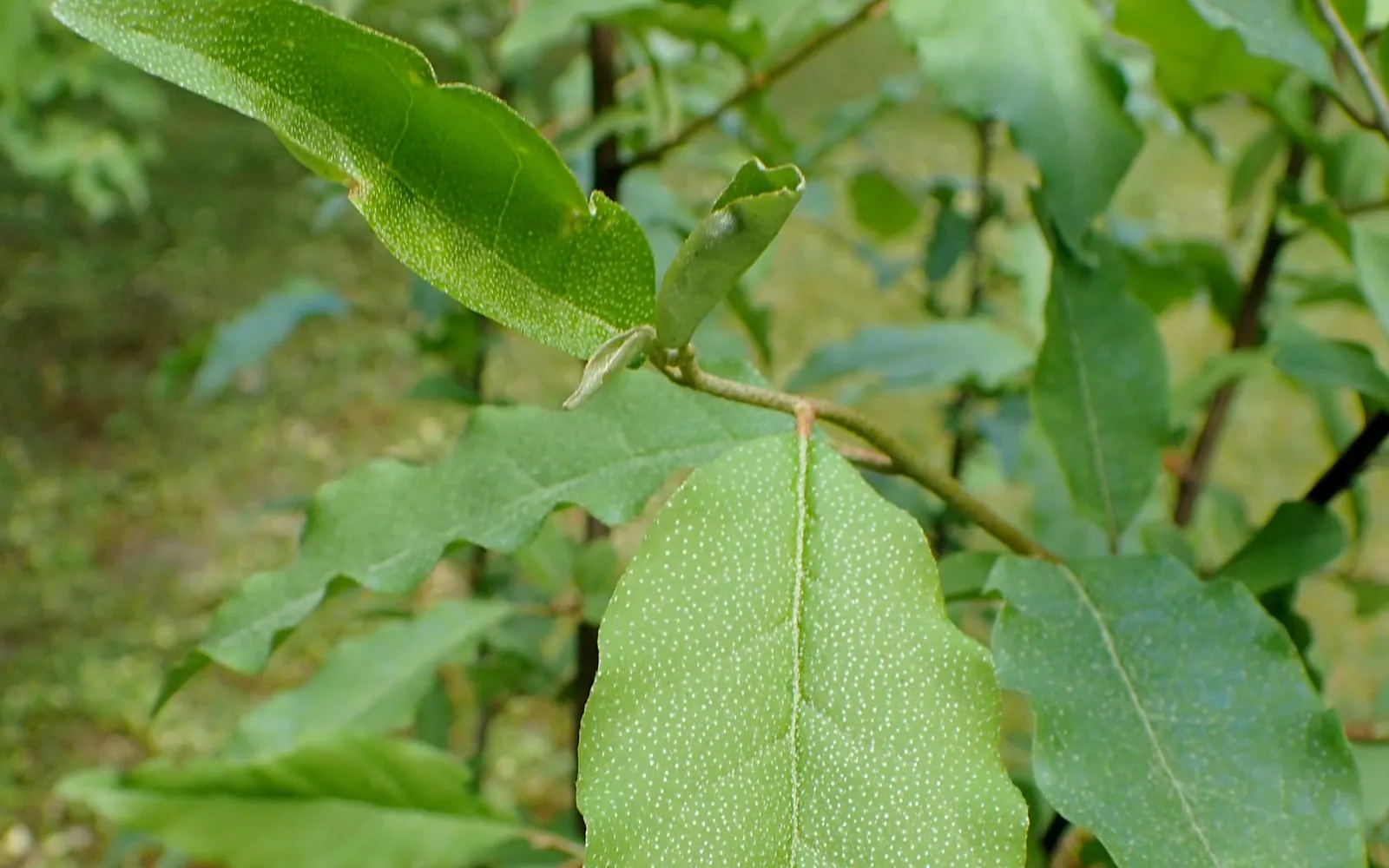
Leaves are leathery, oval and wavy-edged, glossy dark green above and densely covered in silvery to rust-brown scales beneath, a texture unlike almost any other common garden shrub. Stems carry occasional stout thorns, more numerous on older wood, and the plant scales up into a dense, tangled mass of growth if left unpruned. Flowers appear in autumn, small, tubular, creamy white and surprisingly fragrant for how easily they are missed among the foliage. The fruit that follows ripens slowly through winter into spring, oval, roughly one to one and a half centimetres long, red to reddish-brown at maturity and dusted with the same silvery scales as the leaves, sharply tart until fully ripe and then pleasant enough to eat straight off the branch.
Where it is from
Elaeagnus pungens is native to lowland and coastal woodland in Japan and China, where it grows as an understorey and margin shrub tolerant of poor soil, salt spray and exposed, windy sites. That native habitat explains most of its garden behaviour: it copes with sandy or clay soil, coastal conditions and neglect better than almost any other fruiting shrub grown in a temperate climate, and it has been widely planted well beyond its native range for exactly that toughness. It escapes cultivation readily in parts of the warmer United States, where it is considered invasive in some states, so a gardener there should check local guidance before planting it freely, particularly near woodland edges where birds can spread the seed.
How it grows
Plant in any reasonably drained soil in full sun to part shade; it is unfussy about soil type and pH, tolerating poor sandy ground, clay and coastal exposure alike. It responds well to hard pruning and is commonly grown as a formal or informal hedge, trimmed once or twice a year to keep it dense; left unpruned, it sprawls into a wide, loosely mounded shrub considerably larger than its trimmed footprint. Because it flowers and fruits on the current year’s growth in autumn, avoid hard pruning in late summer if fruit is wanted, and instead prune after fruiting has finished in spring. Thorns become more prominent on older wood, so wear gloves for any close work once a plant has matured past its first few years.
Through the seasons
Spring is for pruning once fruit has been harvested, and for the season’s main flush of new growth.
Summer is steady vegetative growth, with the plant building the wood that will flower in autumn.
Autumn brings the unusual flowering season, small fragrant blooms that set the fruit crop.
Winter is fruit development, ripening slowly through the cold months towards a spring harvest.
Care difficulty
Easy. Thorny olive tolerates poor soil, coastal exposure, drought once established and hard pruning, and needs almost no routine attention beyond an annual trim to keep its size and shape in check. The main task most growers face is managing its vigour rather than nursing it through any particular weakness, since a healthy plant left unpruned for several years grows considerably larger and wider than most gardens comfortably accommodate.
Watering
Water regularly through the first growing season while the roots establish, then expect the plant to manage on rainfall alone in most climates. It tolerates drought well once mature, and extra watering beyond an occasional deep soak in a prolonged dry spell offers little additional benefit.
Warning signs, diseases and pests
Scale insects form small, flat bumps along the stems and on the underside of leaves, sapping the plant’s vigour gradually if left unchecked; horticultural oil applied while the insects are active controls most infestations.
Aphids cluster on soft new spring growth, distorting the tips and fouling the leaves below with honeydew that then grows sooty mould; a strong jet of water or an insecticidal soap usually clears a light infestation.
Phytophthora root rot follows soil that stays waterlogged around the roots, showing as a plant that declines and yellows despite otherwise reasonable care. Good drainage from the outset is the only reliable prevention, since this species is markedly less tolerant of wet feet than it is of almost every other stress.
Leaf spot marks the foliage with brown patches during a wet season, rarely serious on an established plant; removing badly affected leaves and improving air movement through congested growth keeps it from spreading.
Growing environment
Full sun gives the heaviest flowering and fruiting, though the plant tolerates part shade with some loss of both. Soil type matters far less than drainage; it grows in sand, clay, chalk and acid soil alike, provided water does not stand around the roots for long. Coastal wind and salt spray, which would scorch many other evergreens, cause it little visible harm, which is why it turns up so often as a windbreak in exposed seaside planting.
Feeding
Little supplementary feeding is needed beyond an annual spring mulch of compost or well-rotted manure. A plant fed heavily with nitrogen produces soft, leafy growth at the expense of the autumn flowering that sets the fruit crop, so restraint suits it better than a generous feeding regime.
Troubleshooting
My established hedge has never produced any fruit. Regular hard pruning is the most likely cause, particularly if it happens in late summer or autumn, since that removes the current season’s growth before it has had a chance to flower. Prune after fruiting finishes in spring instead, and allow some of the current year’s growth to remain unclipped through autumn if fruit is wanted.
The leaves have lost their silvery sheen and look plain green. This can follow a shift to deeper shade, since the scale-covered growth that gives the leaves their sheen develops most strongly in good light. Moving a container-grown plant, or thinning nearby growth that has crowded it into shade, usually restores the effect on new growth over a season or two.
Is this related to the true olive tree? No, the resemblance is only in the name and a loosely similar leaf shape. Thorny olive belongs to an entirely different plant family from the true olive and shares none of its biology, its oil or its culinary uses.
The plant has spread far beyond where I planted it. Birds eat the fruit and disperse the seed widely, and in some warmer regions this species has become invasive as a result. Check local guidance before planting it near woodland or wild areas, and remove unwanted seedlings promptly before they establish a root system of their own.
How hard can I prune it if it has outgrown its space? Very hard. It tolerates being cut back close to old wood and regrows readily from the base, though a severe renovation cut sacrifices flowering and fruiting for a season or two while the plant rebuilds its framework.