
Outdoor plant
Box Elder
Acer negundo
Also known as Ashleaf Maple, Manitoba Maple
Practical guidance for growing box elder, Acer negundo, including its compound leaves, separate male and female trees, weak wood, fast growth, and toxicity to horses.
At a glance
- Difficulty
- Easy
- Water
- Establishes with little help; tolerates both drought and waterlogging once mature
- Light
- Full sun to part shade
- Temperature
- Fully hardy across a wide climate range
- Hardiness
- USDA 2-10, RHS H7, hardy to -40 C
- Type
- Deciduous, fast-growing, short-lived tree
- Height
- 9-15 m
- Native to
- North America
Its native range runs from the Canadian prairies to the Gulf Coast and from floodplain to dry upland, which is why the zone number covers such a wide span; few other trees tolerate such different winters as comfortably as this one does. What the zone leaves out is wood strength rather than cold: fast, weak growth makes it prone to storm damage and limb failure well within any climate it can survive, which shapes how it is sited far more than winter temperature does.
Hardiness zones describe winter cold alone. Summer heat, humidity, rainfall and the length of the growing season decide as much, so treat the range as the outer limit rather than as a recommendation.
Poisonous to horses if eaten
- Do not eat
- The winged seeds and young seedlings
- Harm from
- Eating it
- Affects
- Horses
Box elder is not documented as toxic to cats, dogs or people, and its hazard to horses is a specific, well-studied one rather than the leaf poisoning better known in red maple. Its seeds and seedlings contain hypoglycin A, a toxin that blocks fat metabolism in muscle and heart tissue and is the confirmed cause of seasonal pasture myopathy, a severe and often fatal muscle disease in horses that graze under or near box elder trees, particularly where fallen seeds and volunteer seedlings are abundant on the ground in autumn and spring. The risk is to grazing animals with access to fallen seed and seedlings, not to people or typical house pets, and it is a real reason not to plant this species, or to fence it off carefully, on land used for horses.
Sources: ASPCA toxic and non-toxic plants, RHS potentially harmful garden plants
About
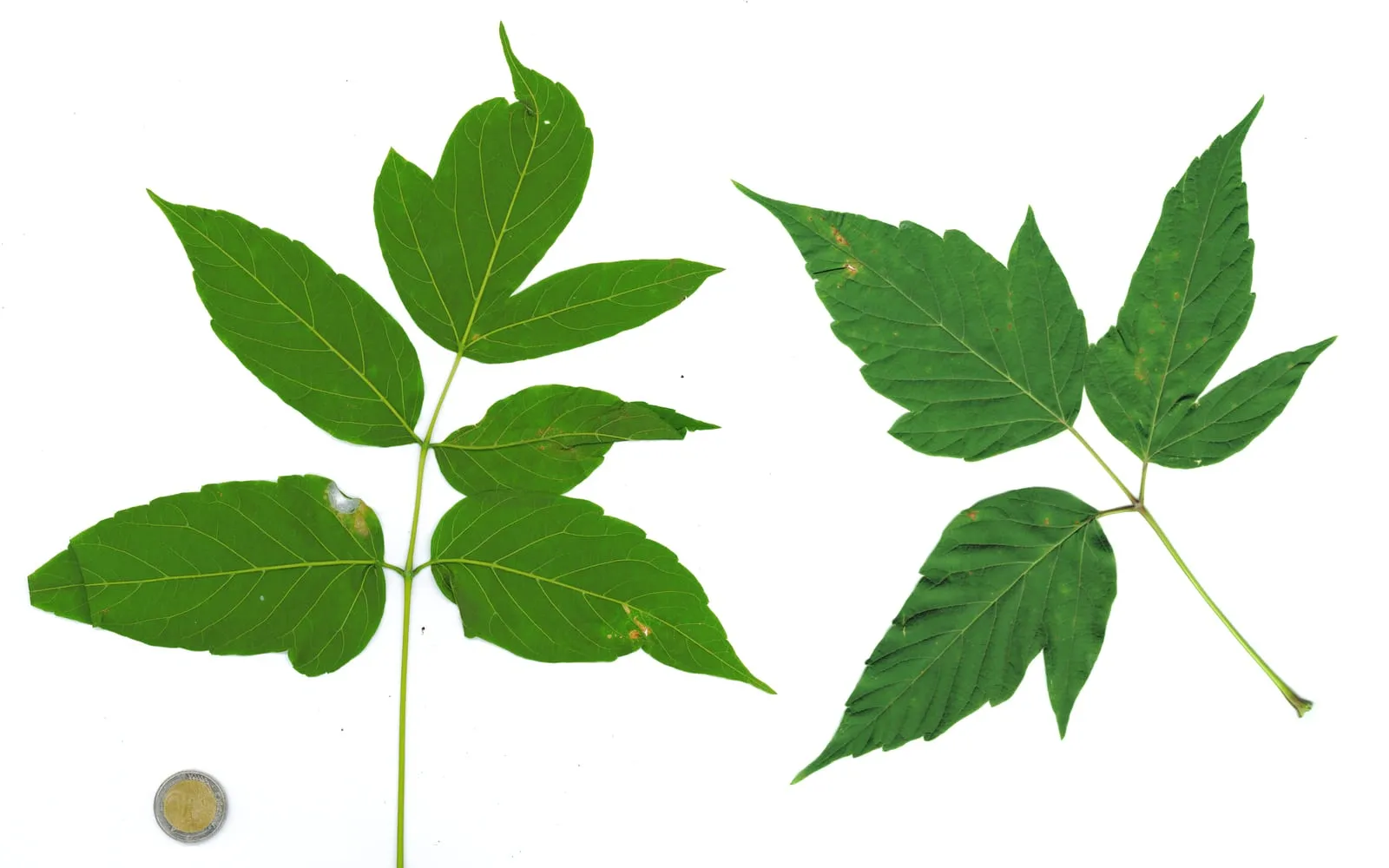
Box elder is the maple that does not look like one. Its leaves are divided into three to seven separate leaflets on a central stalk rather than forming the single lobed blade almost every other maple carries, which means it is regularly mistaken for an ash, or for poison ivy on young seedlings, until the paired winged seeds or the opposite leaf arrangement give it away.
It is also unusual among maples in being reliably dioecious, meaning individual trees are clearly and consistently either male or female rather than carrying flowers of both sexes, a trait most other maples do not share quite so cleanly. Only female trees produce the abundant winged seeds that give the species its reputation for self-seeding into every gap in a garden or a vacant lot nearby.
Appearance and character
Leaves are pinnately compound, typically with three to five leaflets and occasionally as many as seven or nine on vigorous shoots, each leaflet coarsely toothed and pale green, turning an unremarkable yellow in autumn rather than the fiery colour some of its maple relatives produce.
Growth is fast and the wood correspondingly weak, so a mature tree often develops a broad, somewhat untidy, multi-stemmed crown with narrow branch angles that split readily in wind or heavy snow. Bark is pale grey-brown and develops shallow, irregular furrows with age rather than the deep, distinct ridging of longer-lived hardwoods.
Female trees hang heavy with clusters of winged samaras through autumn and often well into winter, persisting on the tree long after the leaves have dropped, which is part of what makes a mature female specimen so conspicuously prolific at seeding into any open ground nearby.
Where it is from
Acer negundo has the widest native range of any North American maple, found from southern Canada down into Mexico and from the Rocky Mountains to the Atlantic coast, most naturally along riverbanks and floodplains where periodic flooding and disturbed, open ground favour a fast-growing pioneer tree over slower, longer-lived species.
Its floodplain origin gives it a tolerance for wet, poorly drained soil that would trouble most other maples. It also explains the weedy, colonising habit: a tree adapted to freshly disturbed river-edge ground does the same thing in a neglected garden bed or an untended fence line. That is why it is often regarded as a nuisance tree in cultivation despite its usefulness in difficult, wet or disturbed sites.
How it grows
Plant in almost any soil; box elder tolerates wet, poorly drained or seasonally flooded ground better than nearly any other maple, alongside dry, poor or compacted sites, which is part of why it has been planted so widely for erosion control and quick shelter on difficult land.
Choose the planting site with its weak wood in mind rather than only its soil tolerance, siting it well clear of buildings, driveways and anywhere falling limbs would be a hazard, since storm damage is a routine part of this tree’s life rather than an occasional risk.
If self-seeding is a concern, plant a known male cultivar rather than a seed-grown tree of unknown sex, since a male tree produces no seed at all and avoids the volunteer seedlings that a female specimen scatters freely into surrounding ground.
Prune to remove weak, crossing or narrow-angled branches while the tree is young, which does more over its lifetime to reduce storm damage than almost any pruning done later on an already mature, weak-wooded crown.
Through the seasons
Spring brings small, inconspicuous flowers, wind-pollinated and easy to miss, followed quickly by the season’s new compound leaves.
Summer is fast, vigorous growth, the season in which this species most visibly outpaces slower, longer-lived maples nearby.
Autumn brings unremarkable yellow leaf colour and, on female trees, a heavy hang of winged seed clusters that will persist through much of winter.
Winter shows the tree’s broad, often multi-stemmed and somewhat untidy branch structure, along with the risk of storm and snow-load damage that weak wood carries through the season’s worst weather.
Care difficulty
Easy in the sense that it establishes and grows with almost no encouragement on nearly any site, which is exactly why it has become a weedy, self-seeding presence in many places it was never deliberately planted. Growing it takes little effort; managing it takes more, siting it away from structures given its weak wood and controlling seedlings if a female tree is nearby.
Watering
Water a newly planted tree occasionally through its first year or two while roots establish, particularly in a dry spell, though this species needs less help than most, given how readily it grows on both wet and dry ground.
Once established, it tolerates both drought and periodic waterlogging with little issue and rarely needs supplemental watering under normal garden conditions.
Warning signs, diseases and pests
Aphids build up heavily on new growth in some years, producing enough honeydew that sooty mould commonly blackens leaves and anything parked or seated beneath the canopy. A strong jet of water and encouraging predatory insects usually keeps numbers manageable without further treatment.
Scale insects appear as small bumps on the bark, more often on a tree already under drought or storm stress. Treat with horticultural soap where numbers are heavy, though a healthy, unstressed tree usually tolerates a light infestation on its own.
Verticillium wilt causes sudden dieback of individual branches, showing as wilted foliage on one limb while the rest of the tree looks unaffected. There is no cure; remove affected wood promptly and keep the tree from further stress where possible.
Sunscald and frost cracks develop on bark newly exposed by storm damage or heavy pruning, since thin bark that has spent its life shaded by dense growth is vulnerable to sudden sun and temperature swings once exposed. Avoid heavy pruning that opens the canopy suddenly, particularly on an older tree.
Growing environment
Full sun to part shade both suit it well, and this species tolerates a wider range of light, soil moisture and soil type than almost any other tree commonly grown. That tolerance is its main appeal and also why it turns up uninvited in so many places.
Wet ground is well tolerated, including soil that floods periodically, which makes it a practical choice for a difficult low-lying site where few ornamental trees would establish reliably.
Wind exposure is a real weakness rather than a strength here, given the weak, brittle wood; a sheltered site, or careful early pruning to remove narrow branch angles, reduces the storm damage this species is otherwise prone to.
Feeding
Established trees rarely need feeding at all, and feeding a fast-growing species like this one risks pushing even softer, weaker growth than it already produces on its own.
A young tree on notably poor soil can be given a balanced fertiliser once in spring to support establishment, but this is the exception rather than the routine for a tree this vigorous by nature.
Troubleshooting
A large branch split and fell during a storm. This is a known characteristic of the species rather than a sign of disease, given how weak and brittle its wood is compared with most other trees. Remove damaged wood cleanly back to sound growth and consider whether the tree’s overall structure needs corrective pruning to reduce the risk of further failures.
Seedlings are coming up everywhere near my tree. A female tree seeds prolifically, and this is one of the most common complaints about the species. Pull seedlings while young, mow regularly in lawn areas, and consider whether a male replacement, or removal, suits the site better if the seeding becomes unmanageable.
The leaves do not look like a typical maple’s. This is normal for the species. Its compound, multi-leaflet leaves are one of the features that sets it apart from almost every other maple, and the paired winged seeds alongside the opposite leaf arrangement confirm the identification.
Can I keep horses or livestock near this tree? Not without real caution. Its seeds and seedlings are a confirmed cause of a severe, often fatal muscle disease in grazing horses, so fence animals away from fallen seed and volunteer seedlings, or avoid planting it on grazed land at all.
Is it worth planting deliberately, or should I remove a volunteer seedling instead? Most gardeners are better served removing an unwanted seedling early, given the weak wood, prolific self-seeding and toxicity risk to horses. It earns a place mainly on difficult wet or disturbed ground where few other trees will establish at all.