
Outdoor plant
Sugar Maple
Acer saccharum
Also known as Rock Maple, Hard Maple
Practical guidance for growing sugar maple, Acer saccharum, including sap tapping, slow shade-tolerant growth, salt sensitivity, and brilliant autumn colour.
At a glance
- Difficulty
- Moderate
- Water
- Regularly while establishing; appreciates even moisture, dislikes both drought and waterlogging
- Light
- Full sun for the best autumn colour; tolerates significant shade, especially when young
- Temperature
- Fully hardy in cold winter climates
- Hardiness
- USDA 3-8, RHS H7, hardy to -35 C
- Type
- Deciduous, slow to moderate growing, long-lived tree
- Height
- 20-35 m
- Native to
- eastern North America
Needs a real winter to perform well, since the sap flow that makes maple syrup depends on a repeated cycle of freezing nights and thawing days in late winter, a pattern that does not occur reliably outside a cold temperate climate. The zone range describes cold tolerance rather than urban tolerance, and this is the more sensitive of the common garden maples once soil is compacted or salted, so a favourable zone number does not guarantee it will thrive in a stressed street or car park planting.
Hardiness zones describe winter cold alone. Summer heat, humidity, rainfall and the length of the growing season decide as much, so treat the range as the outer limit rather than as a recommendation.
Edible, with limits
- Safe to eat
- Sap, tapped in late winter and boiled down into maple syrup
- Do not eat
- Wilted leaves, occasionally implicated
- Harm from
- Eating it
- Affects
- Horses
Sugar maple is best known for a properly edible product: its sap, collected by tapping the trunk in late winter and boiled down at roughly forty parts sap to one part syrup, is the source of true maple syrup and carries no toxicity concern of any kind for people. The plant's toxicity risk sits with horses rather than with people, cats or dogs, and it is considerably less consistent than red maple's, the species that carries almost all of the confirmed, severe cases of wilted-leaf poisoning. Sugar maple has occasionally been implicated when horses have eaten large quantities of wilted leaves, but nowhere near as reliably as its close relative, and its role in confirmed poisonings is much smaller. Grazing animals are still best kept away from any large amount of fallen or wind-blown maple leaves as a precaution, whichever species is planted.
Sources: ASPCA toxic and non-toxic plants, RHS potentially harmful garden plants
About
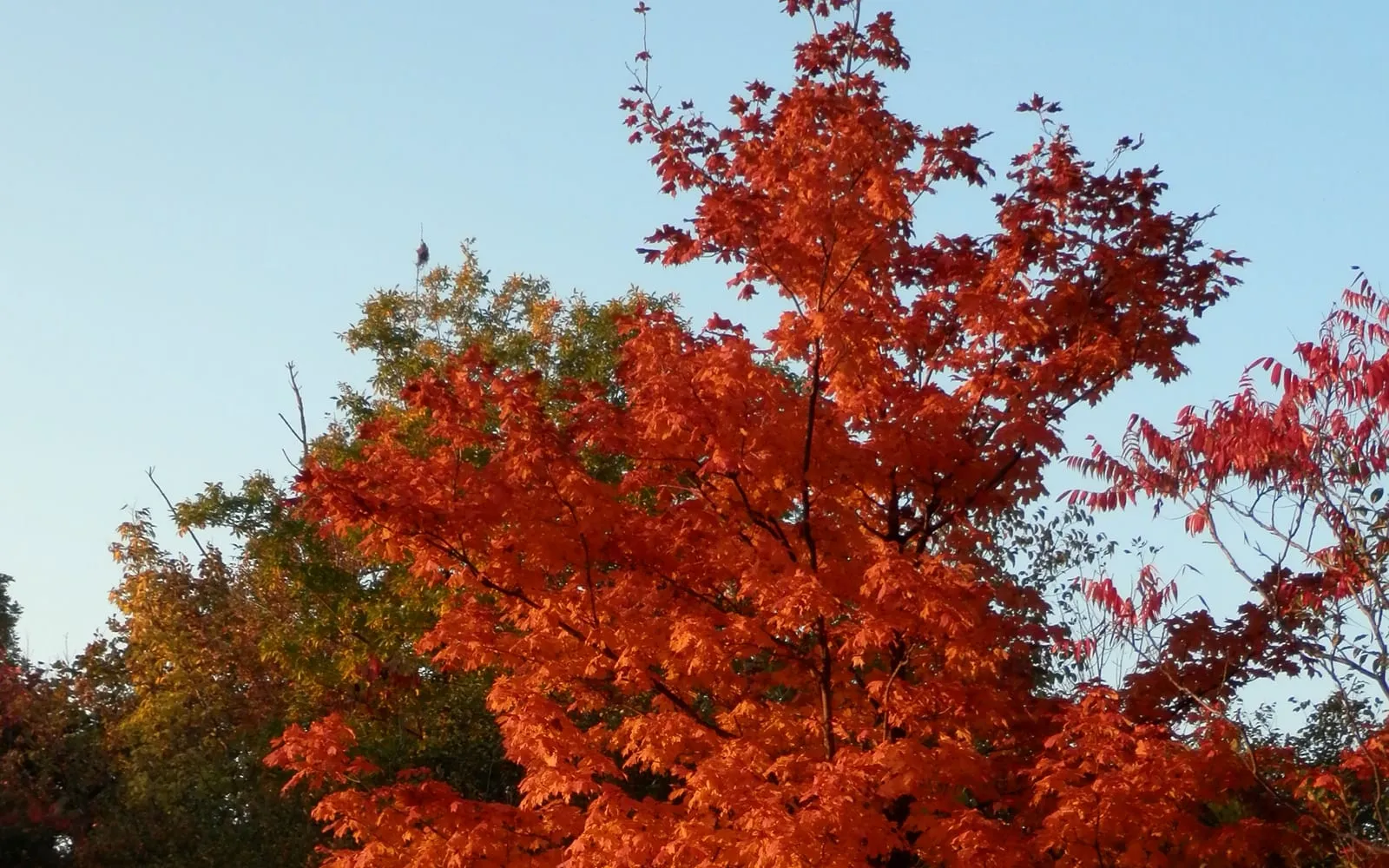
Sugar maple is the tree behind true maple syrup, tapped every late winter across its native range for a sap that flows only during the narrow window when nights freeze and days thaw. It is also one of the most reliably brilliant autumn trees grown anywhere in cultivation, turning a range of orange, gold and red across a single crown that has made it the emblematic tree of the North American fall.
Unlike red maple or box elder, it grows slowly and needs better conditions to thrive. A young tree tolerates shade well, but an older tree suffers in compacted soil, road salt or drought. In a suitable site, it becomes one of the longest-lived and most useful shade trees a garden can hold.
Appearance and character
Leaves are the classic five-lobed maple shape with pointed lobe tips and smoothly rounded, U-shaped sinuses between them, dark green through summer and turning through a wide, often multi-coloured range of yellow, orange and red in autumn, sometimes all three shades appearing across the same tree at once.
Growth is slower and the wood considerably harder and denser than red maple or box elder, which is where the alternative name hard maple comes from and part of why the timber is prized for flooring and furniture. The crown develops a dense, rounded, cathedral-like form with age, casting enough shade that little grows well directly beneath a mature specimen.
Bark on a young tree is smooth and grey, developing long, plated, flaking ridges with age that give an old trunk a distinctive, furrowed texture. Sap runs clear and, among common garden trees, has enough sugar to collect when tapped at the right time of year.
Where it is from
Acer saccharum is native to the hardwood forests of eastern North America, from the Great Lakes and southeastern Canada down into the Appalachian uplands, typically on deep, well-drained, moderately fertile soil in mixed forest alongside beech and birch. It grows as a shade-tolerant understorey tree when young, waiting years or decades in the shade of taller trees before a gap in the canopy lets it grow on into full sun.
Its forest origin explains its shade tolerance early in life. It also explains why compacted soil, road salt and reflected urban heat weaken it. Those stresses are absent from the undisturbed woodland where the species evolved.
How it grows
Plant in deep, well-drained, moderately fertile soil, avoiding compacted or heavily disturbed ground where possible, since this is a considerably less tolerant species of poor soil conditions than red maple or box elder.
Choose a site well away from roads or paths that are salted in winter, and away from reflected heat off paving or a south-facing wall, both of which stress this species more than most other common garden trees.
Young trees tolerate significant shade and often establish well beneath the light shade of a taller, more mature tree nearby, though they need increasing light as they grow to develop a full, well-shaped crown and to colour well in autumn.
Prune while young to establish a single leading stem and a well-spaced branch structure, since this slow-growing species does not recover from structural mistakes as quickly as a faster-growing tree would.
Through the seasons
Late winter is the traditional sap-tapping season in its native range, when repeated freezing nights and thawing days push sap up through the trunk and make tapping worthwhile; this window closes once growth resumes in earnest.
Spring brings small, inconspicuous yellow-green flowers alongside the new leaves, followed by the paired winged seeds.
Summer is steady but unhurried growth, best supported with even soil moisture rather than either drought or waterlogging.
Autumn brings the tree’s best-known display, a range of yellow, orange and red that is among the most reliably brilliant of any commonly grown tree.
Care difficulty
Moderate, largely because the site matters more here than for most other maples. Given deep, well-drained soil away from salt and compaction, it is a resilient, long-lived tree that needs little routine attention beyond establishment care. In a stressed urban site with road salt or compacted soil, it declines steadily in a way red maple or box elder usually would not.
Watering
Water regularly through the first two to three growing seasons while the tree establishes its root system, giving it a deep soak rather than frequent light watering.
Once established, it appreciates even soil moisture and tolerates neither prolonged drought nor waterlogged ground well, so a site with reliably good drainage suits it better than one at either extreme.
Warning signs, diseases and pests
Verticillium wilt causes sudden dieback of individual branches, usually following drought or root disturbance. There is no cure once established; remove affected wood promptly and reduce further stress on the tree where possible.
Leaf spot, including fungal tar spot that leaves raised black blotches across the leaf surface, is common in wet years and mostly cosmetic. Clearing fallen leaves in autumn reduces how much fungus overwinters nearby.
Asian longhorned beetle is a serious quarantine pest that particularly targets maples, including this species, boring into the trunk and major branches and eventually killing the tree. Report a suspected sighting, sawdust-like frass at the base of the trunk or perfectly round exit holes in the bark, to the relevant plant health authority rather than attempting treatment, since this pest is subject to statutory control in many regions.
Sunscald and frost cracks develop on young or newly exposed bark, particularly on the south or west side of a young trunk in winter. Wrapping a young trunk for its first few winters, or planting where nearby structures provide some shelter, reduces the risk.
Growing environment
Full sun brings out the strongest, most even autumn colour on a mature tree, though young trees tolerate considerable shade and often grow well for years beneath the light shade of a taller neighbour.
Deep, well-drained, moderately fertile soil suits it best. This species is considerably less tolerant of poor, compacted or waterlogged ground than red maple or box elder, so check soil quality before planting rather than assuming any maple performs the same way.
Road salt and soil compaction are genuine weaknesses, and this is the maple most likely to decline visibly, with early leaf scorch and dieback, where either is a factor, which makes it a poor choice for planting close to a heavily gritted road.
Feeding
Established trees on good soil generally need little feeding.
A young tree can be given a balanced, slow-release fertiliser once in spring for its first few seasons to support establishment, tapering off as the tree matures and its roots spread into a wider volume of soil.
Troubleshooting
Can I tap my own tree for syrup? Yes, provided the tree is at least about 25 to 30 cm in trunk diameter, tapped in late winter during the freeze-thaw window, with sap collected and boiled down at roughly forty parts sap to one part finished syrup. A young or small tree should not be tapped, since it needs its full sap flow for its own growth.
The leaves are scorching brown at the edges in summer. Drought stress or, on a tree near a road, salt exposure are both common causes, since this species tolerates neither well. Check soil moisture first, and consider whether winter salting nearby could be reaching the root zone.
I found round exit holes and sawdust-like material at the base of the trunk. This can be a sign of Asian longhorned beetle, a serious quarantine pest. Report it to the relevant plant health or agriculture authority promptly rather than attempting to treat it yourself, since early reporting is central to controlling this pest.
Why is my tree growing so slowly compared with a red maple planted at the same time? This is normal. Sugar maple grows considerably more slowly than red maple or box elder, trading speed for greater longevity, denser wood and typically more reliable autumn colour over the long term.
Is it a good choice for a street tree? Only where soil is good and road salt is not heavily used, since this species is markedly more sensitive to compaction and salt than most other common street maples. A sheltered garden or park setting suits it considerably better than a heavily salted urban roadside.