
Outdoor plant
Red Maple
Acer rubrum
Also known as Swamp Maple, Scarlet Maple
Practical guidance for growing red maple, Acer rubrum, including early red flowers, wet-soil tolerance, brilliant autumn colour, and toxicity to horses.
At a glance
- Difficulty
- Easy
- Water
- Regularly while establishing; appreciates consistent moisture once mature
- Light
- Full sun to part shade
- Temperature
- Fully hardy across most temperate climates
- Hardiness
- USDA 3-9, RHS H7, hardy to -35 C
- Type
- Deciduous tree
- Height
- 18-27 m
- Native to
- eastern North America
Native across a huge span of eastern North America, from the cold edge of the boreal forest to the humid subtropical Gulf Coast, and that range of origin populations means individual trees and cultivars vary considerably in how they perform outside a cold winter. A tree grown from northern stock can struggle in a long, hot, humid summer, while one from southern stock may colour later and less vividly in a shorter, colder season, so a cultivar bred for the local climate colours far more reliably than one of unknown origin.
Hardiness zones describe winter cold alone. Summer heat, humidity, rainfall and the length of the growing season decide as much, so treat the range as the outer limit rather than as a recommendation.
Poisonous to horses if eaten
- Do not eat
- Wilted or dried leaves, most dangerous in autumn or after storm damage
- Harm from
- Eating it
- Affects
- Horses
Red maple is not documented as toxic to cats, dogs or people, but it carries one of the best-documented plant poisonings known in horses. Wilted, dried or damaged leaves, whether fallen naturally in autumn, blown down in a storm, or trimmed from an overhanging branch, contain compounds that destroy red blood cells when eaten in enough quantity, causing a severe and sometimes fatal anaemia. Fresh, growing leaves on the tree carry far less risk, which is why the danger spikes sharply after storms and through autumn leaf drop rather than being constant year round. Any horse pasture with red maple nearby should be checked and cleared of fallen or wind-blown leaves and branches, particularly following bad weather, and grazing animals should not have access to prunings from this tree.
Sources: ASPCA toxic and non-toxic plants, RHS potentially harmful garden plants
About
Red maple earns its name several times over across a single year. Red flowers open on bare branches before almost any other tree comes into leaf, red-tinged new leaves and leaf stalks follow in spring, red-winged seeds hang through early summer, and the autumn display is among the most consistently brilliant scarlet of any tree grown in a temperate garden. Few species commit to one colour across so many separate moments of the growing year.
It is also one of the most widely adaptable trees native to eastern North America, equally at home rooted in a permanently damp swamp margin or established on an ordinary garden lawn, which has made it both an enormously common wild tree across its native range and a dependable garden choice wherever the climate suits it.
Appearance and character
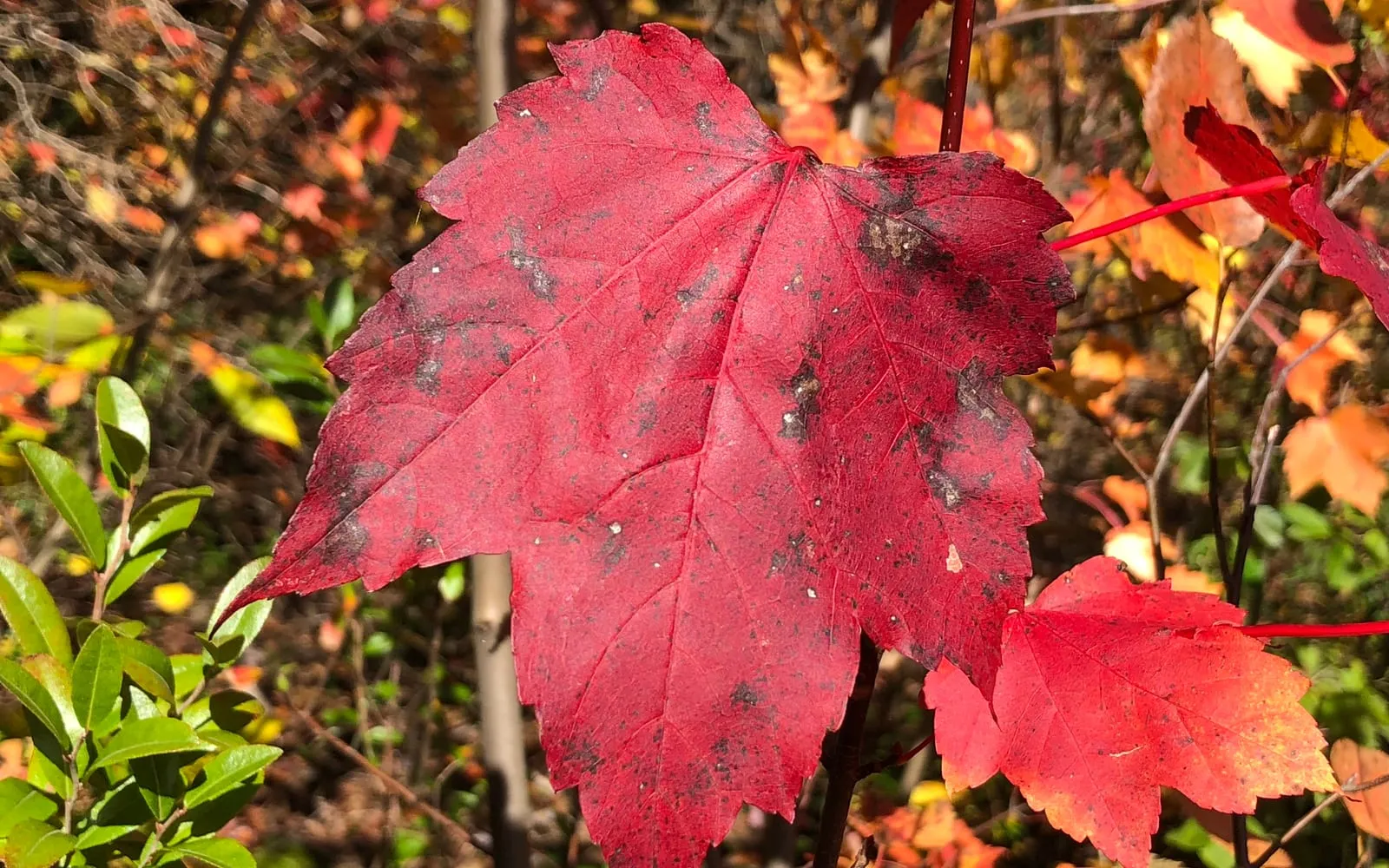
Leaves are three to five lobed, with the classic maple silhouette most people picture when they hear the word, medium green through summer and turning a strong scarlet to orange-red in autumn, a colour change that tends to arrive earlier in the season than on many other trees.
Flowers are small, red or reddish, and open in late winter to early spring before the leaves unfurl, giving a mature tree a subtle red haze against bare branches at a time of year when little else in a temperate garden is flowering at all. The paired winged seeds that follow carry the same reddish tone before ripening and browning.
Bark on a young tree is smooth and pale grey, developing shallow, flaking ridges with age. Growth habit is generally upright and rounded, denser than box elder’s sprawling form but less broad-crowned than a mature sugar maple.
Where it is from
Acer rubrum grows natively across almost the entire eastern half of North America, from the cold forests of eastern Canada down through the humid subtropical Southeast, and from wet, poorly drained swamp margins to drier upland woods, a breadth of habitat that few other single tree species match. It is one of the most abundant native trees across that entire range.
The swamp populations are where its wet-soil tolerance comes from, rooting happily in ground that would drown most other large trees, while upland populations show it also copes perfectly well with ordinary, better-drained garden soil, which is why it performs reliably across such a wide range of planting sites.
How it grows
Plant in most reasonably fertile soil; red maple tolerates both wet, poorly drained ground and drier upland conditions, though it grows fastest and colours most reliably with consistent moisture through the growing season rather than repeated drought stress.
Choose a cultivar suited to the local climate where possible, since the species’ huge native range means seed-grown trees vary in cold hardiness and in how well they colour in a hot, humid summer. A named cultivar selected for the local region gives a more predictable result than an unknown seedling.
Give it room for a moderately wide, rounded crown at maturity, and avoid planting directly over paving or a patio, since the surface roots this species can develop in compacted or shallow soil are prone to lifting hard surfaces over time.
Prune while young to establish a strong branch structure, removing crossing or narrow-angled branches, since correcting structure later on an older tree is harder and creates larger wounds.
Through the seasons
Late winter to early spring brings the season’s first colour, small red flowers opening on bare branches well before the leaves.
Spring follows with red-tinged new leaves and the winged seed clusters developing quickly behind the flowers.
Summer is steady growth, best supported with consistent moisture rather than left to dry out repeatedly, particularly on a young tree still establishing its root system.
Autumn brings the tree’s best-known display, reliably vivid scarlet to orange-red colour, often arriving earlier in the season than many other trees manage.
Care difficulty
Easy, and one of the more forgiving large trees available for a garden with variable soil moisture. Its main requirement beyond ordinary establishment care is consistent water; a tree left to dry out repeatedly in summer grows more slowly and colours less brilliantly than one given steady moisture, though it rarely dies from drought outright the way some less adaptable trees can.
Watering
Water regularly through the first two to three growing seasons while the tree establishes, and continue giving it a deep soak during any extended dry spell afterward, since this species appreciates more consistent moisture than many other maples.
Established trees on reasonable soil tolerate short dry spells without serious harm, but colour and vigour both suffer under prolonged summer drought more than they would on a more drought-adapted species.
Warning signs, diseases and pests
Verticillium wilt causes sudden wilting and dieback on individual branches, usually on a tree already under stress from drought or root disturbance. There is no cure once established; remove affected wood promptly and reduce further stress where possible.
Leaf spot, including a fungal tar spot that leaves raised black blotches on the leaf surface, is common in wet, humid weather and is mostly cosmetic rather than seriously damaging. Clearing fallen leaves in autumn reduces the fungus overwintering nearby for the following year.
Gall mites raise small bumps scattered across the leaf surface, alarming to look at but rarely harmful to the tree’s overall health. No treatment is usually needed beyond removing the worst affected leaves if appearance is a concern.
Aphids cluster on new growth in some years, often leaving a sticky honeydew that sooty mould then blackens. A strong jet of water and encouraging predatory insects usually keeps numbers manageable.
Growing environment
Full sun to part shade both suit it, though full sun brings out the strongest, most even autumn colour on most cultivars.
Wet, poorly drained ground is well tolerated, a trait inherited from its native swamp-margin populations, which makes it a practical choice for a low-lying garden site that would trouble many other ornamental trees.
Consistent soil moisture through summer matters more to this species than it does to some other maples, and a site prone to repeated summer drought suits a more drought-tolerant tree better.
Feeding
Established trees on reasonable soil generally need little to no feeding.
A young tree can be given a balanced, slow-release fertiliser once in spring for its first few seasons to support establishment and vigorous early growth, tapering off as the tree matures and its root system expands into a wider area of soil.
Troubleshooting
The autumn colour was disappointing this year. A hot, prolonged summer drought is the likeliest cause, since this species colours best with consistent moisture through the growing season. Watering deeply during any dry spell the following summer, and choosing a cultivar suited to the local climate, both improve the odds of a stronger display.
A branch wilted and died while the rest of the tree looks healthy. Likely verticillium wilt, particularly following a period of drought or root stress. Cut the affected branch back to healthy wood and keep the remaining tree well watered.
The tree is lifting my patio or driveway. Surface roots are more common on this species in compacted or shallow soil than on some other trees. Avoid planting a new tree within several metres of paving, and for an existing tree, consult a professional before cutting roots, since removing the wrong ones can seriously destabilise a mature specimen.
Can I plant it in a consistently wet corner of the garden? Yes, this is one of its genuine strengths. It tolerates wet, poorly drained soil better than most large ornamental trees, inherited from its native swamp-margin populations.
Is it safe to have horses graze near this tree? Only with real caution. Wilted or fallen leaves are a well-documented cause of severe, sometimes fatal anaemia in horses, so keep grazing animals away from fallen leaves and storm debris, and never let animals access prunings from this species.