
Pest
Asian longhorned beetle
Anoplophora glabripennis
Also called ALB, Starry sky beetle
A maple, birch or willow riddled with round exit holes big enough to take a pencil, cut by a large black-and-white beetle with antennae longer than its own body. Native to China, it has broken out repeatedly in North America and Europe since the 1990s, and every outbreak so far has triggered full eradication rather than being managed as an established pest.
At a glance
- Type
- Pest
- Cause
- Insect
- Severity
- Can kill the plant
- Affects
- Garden plants
- Active
- June to September
- Established in
- Asia
What you are seeing
- Perfectly round exit holes, roughly the diameter of a pencil, scattered across the trunk and major branches
- Shallow, oval to round egg-laying pits chewed into the bark, often weeping sap
- Coarse, pale sawdust-like frass accumulating at the base of the tree or in branch forks
- Dieback of individual branches in the upper canopy, progressing over several years to whole-tree decline
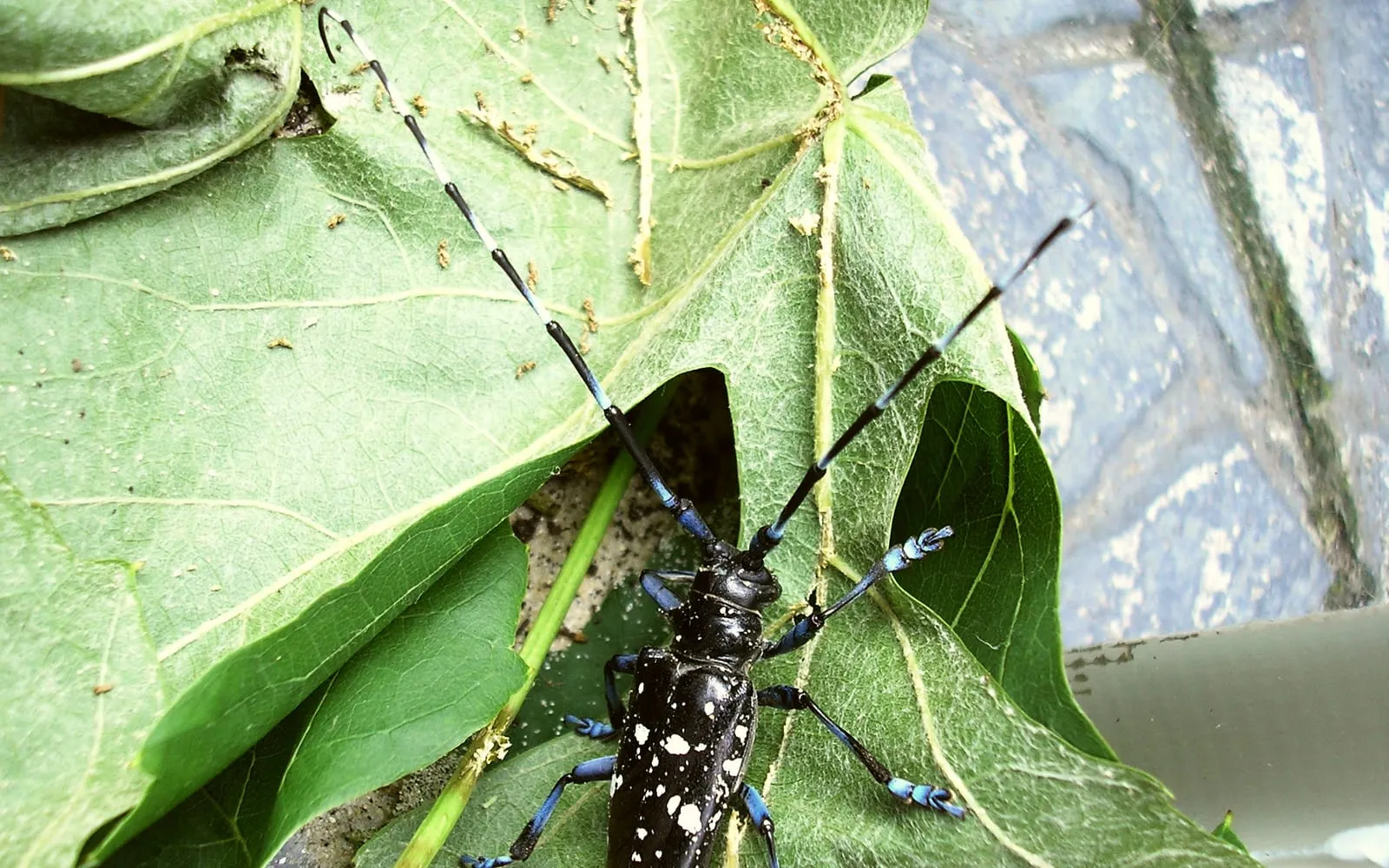
- Large black beetles, 2 to 4 cm long, glossy with irregular white spots, and antennae banded black and white that are longer than the beetle's own body
- Damage concentrated on maples where present, but capable of developing in birch, willow, poplar and several other broadleaf genera
Before you treat anything
None beyond the physical hazard of a structurally weakened, dying tree, which should be assessed and removed by a professional.
What you are looking at
Perfectly round exit holes, about the width of a pencil, scattered across the trunk and major branches of an affected tree, alongside shallow, sap-weeping pits chewed into the bark where eggs were laid. Coarse, pale sawdust-like frass often collects at the base of the tree or where branches fork. Individual branches in the upper canopy die back first, and the decline spreads through the whole tree over several years as more larvae mature inside it.
The adult beetle is unmistakable once seen: large, glossy black, 2 to 4 cm long, marked with irregular white spots, and carrying antennae banded black and white that are longer than its own body. Maples take the worst of it where the beetle occurs, though birch, willow, poplar and several other broadleaf genera can all host developing larvae.
Every outbreak so far has ended in eradication, not establishment
Native to China and the Korean peninsula, this beetle first turned up outside Asia in the New York City area in 1996, almost certainly carried in solid wood packaging material, and has since broken out independently across North America and in Austria, Belgium, Finland, France, Germany, Italy, Montenegro, the Netherlands, Turkey and the United Kingdom. What sets this pest apart from many others on this site is the response each time: rather than being managed as a new but permanent local threat, nearly every outbreak has triggered an aggressive eradication campaign, and several, including a large one in northeastern Italy, have succeeded. The beetle is not considered established anywhere outside Asia today, though the pattern of repeated, independent introductions shows the underlying risk from wood-packaged global trade has not gone away.
What to do about it
Never move firewood, and check solid wood packaging from overseas shipments for round exit holes or sap-weeping pits before it leaves a port or warehouse.
Report a suspected sighting, whether the beetle itself, exit holes or egg-laying pits, to the national plant health authority immediately rather than treating it as a garden problem.
Cooperate fully with official surveying and, where an outbreak is confirmed, host tree removal within the designated zone; this approach has succeeded in eradicating multiple outbreaks so far.
What it gets mistaken for
Galls are raised growths with no exit holes and no frass, quite different from the round pencil-width holes this beetle cuts into solid wood.
Coral spot produces small orange-pink pustules on wood that is already dead or damaged, rather than the sap-weeping pits and exit holes this beetle leaves in otherwise healthy bark.
Not established in North America, Europe, Australia and New Zealand
Do not prune, spray or otherwise treat a suspected case. Doing so risks spreading an organism the country has kept out, and it disturbs the evidence needed to identify it. Photograph what you can see, leave the plant alone, and contact your national or state plant health authority. The control advice further down this page is written for regions where this problem is already established.
Native to China and the Korean peninsula. Since the beetle was first found in the New York City area in 1996, almost certainly having arrived in solid wood packaging material, it has broken out repeatedly in North America, and separately in Austria, Belgium, Finland, France, Germany, Italy, Montenegro, the Netherlands, Turkey and the United Kingdom. Nearly every one of these outbreaks has been met with an aggressive eradication response, host tree removal and all, rather than being managed as an established local pest, and several, including a large outbreak in northeastern Italy, have been declared successfully eradicated. None of this adds up to the beetle being established anywhere outside Asia at present, but the repeated, independent introductions make clear that the risk of a new outbreak starting again almost anywhere with wood-packaged trade is real and ongoing.
What to do, in order
The steps below apply where this problem is already established.
Start here
Prevention, and the changes that stop the problem returning. Most of these pages should end at this tier.
- Never move firewood, and inspect solid wood packaging from overseas shipments
- Every confirmed introduction of this beetle has been traced to wood packaging material or, within an already-affected area, to moved firewood and green waste. Not moving these, and checking imported wood packaging for the round exit holes and pits described here, remains the primary way new outbreaks are prevented from starting at all.
- Report a suspected sighting immediately rather than treating it locally
- Every jurisdiction that has found this beetle has responded with eradication rather than routine management, because established populations do enormous, irreversible damage to urban and forest trees. A suspected sighting, including the beetle itself, exit holes or egg-laying pits, should go to the national plant health authority straight away rather than being treated as a garden pest to deal with independently.
Then reach for a barrier
Netting, hand removal and water. Nothing here harms anything except the target.
- Support official surveying and, where required, host tree removal
- Eradication programmes work by finding and removing every infested tree within a defined radius before larvae inside can mature and emerge, which is laborious, visible and often unpopular locally but has succeeded in multiple outbreaks, including a large one in northeastern Italy. Cooperating with official surveys and removal orders in an affected area is what has made those successes possible.
Then bring in the predators
Encourage what already lives in the garden, and buy predators in where the problem is under glass and nothing will arrive on its own.
- Support research into entomopathogenic fungi and parasitoids
- Fungal biocontrol agents and specialist parasitoids are being studied as potential tools against this beetle, but none is yet a practical field option, and eradication of trees within an outbreak zone remains the response in use.Under active research rather than commercially available; not something to buy or apply independently.
Biological controls are live organisms and their sale and release are regulated country by country. An agent sold freely in one place may be unapproved in another, so buy from a licensed supplier where you live and never import or move one yourself.
Plants affected
Guides that name it among the problems to watch for. The list is the plants it is characteristic of rather than everything it will feed on.