
Edible
African Yam Bean
Sphenostylis stenocarpa
Also known as Girigiri, Sese, Azama, Nsama
How to grow African yam bean, Sphenostylis stenocarpa. A West African climbing legume grown for edible seeds and tubers, with notes on heat, support and long boiling.
At a glance
- Difficulty
- Difficult
- Water
- Moderate through the growing season
- Light
- Full sun
- Temperature
- 22-30 deg C, and frost kills it
- Humidity
- Moderate to high
- Hardiness
- USDA 10-11, RHS H1b, hardy to 5 C
- Type
- Perennial climber, grown as a tender annual
- Height
- 150-300 cm
- Native to
- west and central Africa, Nigeria and Cameroon
It gives two crops from one plant, pods above ground and tubers below, and the tubers need a long season of 180 to 240 days to form at all. Short days trigger both flowering and tuberisation. Frost ends it, so the crop belongs to the humid tropics and nowhere else.
Hardiness zones describe winter cold alone. Summer heat, humidity, rainfall and the length of the growing season decide as much, so treat the range as the outer limit rather than as a recommendation.
Toxic if eaten
- Safe to eat
- The seed after prolonged soaking and boiling, and the tubers cooked
- Do not eat
- Raw and undercooked seed
- Harm from
- Eating it
- Affects
- People
African yam bean is a staple in parts of west Africa and its seed needs serious preparation. The raw seed carries trypsin inhibitors, lectins, tannins and phytate at levels high enough to cause digestive upset and to reduce the nutritional value of the meal, and the hard seed coat means it cooks slowly. Traditional practice is to soak the seed for a day or more with changes of water, sometimes with wood ash, and then boil it for two to four hours, or to ferment it. Cooked properly it is a good protein source. The tubers are cooked in the same way a yam is and present no comparable problem. It is not one of the 14 named allergens in Britain, though legume allergy exists and cross-reactivity between pulses is documented. Keep raw seed away from children.
Sources: Food Standards Agency on the 14 named allergens, Food Standards Agency on food allergy and intolerance
About
African yam bean produces two crops from one plant. Above ground it sets long slender pods full of hard seeds used as a pulse. Below ground it forms sweet starchy tubers eaten like a yam, which is where the name comes from and which no other common legume does on the same scale.
It is grown across the forest and savanna belt of west and central Africa, particularly in Nigeria, Ghana, Cameroon, Togo and the Democratic Republic of the Congo, and it has been repeatedly named in surveys of neglected crops with real potential. Outside that region it is close to unknown.
What has held it back is the seed. The coat is hard, the antinutrient load is high, and cooking takes two to four hours after a long soak, which is a serious demand on fuel. Breeding programmes in Nigeria have worked on the cooking time, and it remains the crop’s central obstacle.
Appearance and character
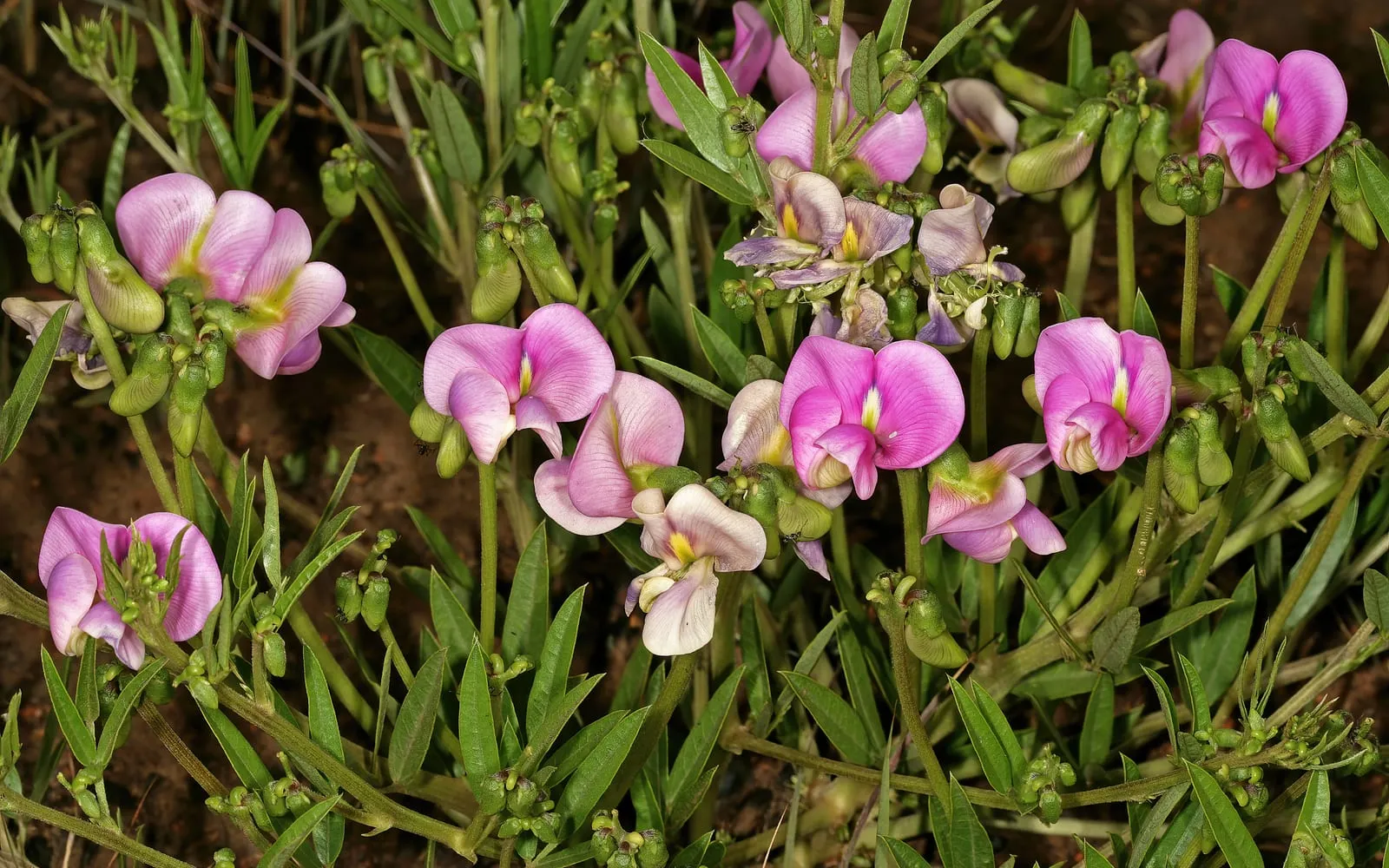
The photograph at the top of this page is Sphenostylis angustifolia, a South African relative, because no picture of this species exists on Wikimedia Commons at a usable size. It shows the genus well and it is the wrong plant for the crop, which climbs where that one sprawls and carries much longer pods.
The vine twines vigorously, reaching two to three metres on a support, with trifoliate leaves whose leaflets are narrow and lance-shaped, quite unlike the broad leaflets of most beans.
The flowers are large and showy for a pulse, 2 to 3 cm across, usually pink, purple or greenish-white, carried in pairs on long stalks. They are attractive enough that the plant is occasionally grown ornamentally in Africa.
The pods are long, slender and cylindrical, 20 to 30 cm, carrying up to twenty small hard seeds in cream, brown, grey, red or mottled patterns. The tubers form on the roots, spindle-shaped, 5 to 8 cm long, pale-fleshed and sweeter than a potato.
Where it is from
African yam bean was domesticated in west and central Africa, and wild relatives grow across the region from Guinea to Ethiopia and south into Zimbabwe. The archaeology is thin, as it is for most African crops that were never traded far.
Cultivation is concentrated in Nigeria, where it is grown in the south east among yams and cassava, and across the forest margin from Ghana to central Africa. Distinct traditions favour the seed in some areas and the tuber in others.
Interest from outside has been intermittent. The crop appeared in the United States National Academy of Sciences series on lost crops of Africa, and Nigerian research institutes maintain collections and breeding programmes, though no large scale production has developed anywhere.
How it grows
The seed has a hard coat and germinates slowly, so soaking overnight or nicking the coat improves establishment considerably.
The vine grows steadily once warm, twining up any support and branching. It nodulates and fixes nitrogen, and it will establish on poor ground where other legumes will not.
Flowering depends on day length in most accessions, which is the problem for anyone growing it outside the tropics. Flowers appear as nights lengthen, which at high latitude comes too late for pods to fill.
Tubers form slowly, over six months or more, and they are harvested well after the pods. That timescale is longer than a short season allows even under glass.
Through the seasons
Sow indoors in March or April at 22 to 25 deg C, after soaking the seed overnight, into deep pots.
Plant out into a polytunnel bed or a large container at the end of May, with a support in place, 45 cm apart. The vine grows through the summer and needs tying in as it goes.
Flowering, if it comes, is in September. Frost ends the plant, and a cool-climate grower will usually be looking at a vine and some flowers rather than at a harvest. Treat pods as the realistic aim and tubers as unlikely.
Care difficulty
This is one of the two hardest crops in the wave to bring to anything outside the tropics, alongside winged bean, and the reasons are the same. It wants sustained tropical warmth, it is a short-day plant in most accessions, and its tuber crop takes longer than a short season allows.
The vine itself is easy. It establishes readily, climbs enthusiastically, fixes its own nitrogen and resists most problems.
Grow it under glass, choose the largest container you can, and treat it as an interesting plant rather than a harvest. If pods do form, the seed still needs soaking and hours of boiling before it becomes food.
Watering
Water regularly through the growing season. The plant is not as drought tolerant as the dryland pulses are, and it comes from a wetter part of Africa.
Under glass, a thorough soak two or three times a week in summer suits it, more in a heatwave. Keep the humidity reasonable to hold off red spider mite.
Standing water still rots the roots and destroys any tubers that have begun to form.
Warning signs, diseases and pests
Red spider mite is the main pest under glass, thriving in dry warm air. The first sign is fine pale speckling on the upper leaf surface, followed by webbing at the growing tips.
Aphids gather on the growing tips and in the flower stalks. Powdery mildew appears in still air as a white coating on the leaves.
Root rot follows waterlogging and is the commonest way to lose a container plant.
Failure to flower is the usual disappointment, and it is a day length problem rather than a disease. Nothing can be done about it within a season.
Growing environment
Full sun, 22 to 30 deg C, and moderate to high humidity. This is a plant of the west African forest margin and it wants warmth without the dry heat that suits a desert legume.
Soil should be free-draining and slightly acid, from pH 5 to 6.5, and can be poor. The plant is grown on ground that has already carried yams and cassava.
A heated greenhouse or a polytunnel is the practical setting outside the tropics. Frost ends the plant, and outdoor cultivation in a cool climate produces a vine and nothing else.
Feeding
Feed nothing in the ground. The plant fixes its own nitrogen, and fertiliser produces leaf at the expense of flower on a vine already inclined to grow.
In a container a high-potash feed every fortnight once flowering begins is sensible, since a pot restricts what the roots can find.
Phosphate supports both nodulation and tuber formation, so a container mix with reasonable phosphate is worth more than a nitrogen feed.
Troubleshooting
Does it produce tubers as well as seed? Yes, spindle-shaped starchy ones on the roots, eaten like a yam and sweeter than a potato. They take six months or more to form, which is beyond a short season.
Why did my plant not flower? Day length. Most accessions are short-day plants that flower as nights lengthen, and at high latitude that point comes too late in the year for pods to fill.
Why does the seed take so long to cook? A hard seed coat and a high load of tannins, phytate and protease inhibitors. Traditional preparation is a long soak with changes of water, sometimes with wood ash, then two to four hours of boiling.
Can I grow it outdoors in a cool climate? The vine will grow in a hot summer against a sheltered wall and will not crop. A polytunnel or heated greenhouse is the only realistic setting.
Where do I get seed? Specialist suppliers of African vegetables, and African food shops sometimes sell dried seed that will germinate. Soak it overnight before sowing.
Is it related to the yam? No. Yams are Dioscorea, monocots in their own family. This is a legume, and the name records that its tubers are used in the same way.
Why is it not grown more widely? Cooking time, chiefly. Two to four hours of boiling after a long soak is a heavy fuel demand, and breeding programmes in Nigeria have been working on exactly that.
African Yam Bean problem guides
Not sure what is wrong? See the common vegetable pests guide.