
Edible
Corn Salad
Valerianella locusta
Also known as Lamb's lettuce, Mache, Feldsalat
How to grow corn salad, Valerianella locusta. The hardiest winter salad there is, sowing in September, and picking whole rosettes through the frost.
At a glance
- Difficulty
- Easy
- Water
- Every few days until established, rarely afterwards
- Light
- Full sun through autumn and winter
- Temperature
- 5-15 deg C, and hardy to about -15 deg C
- Hardiness
- USDA 4-8, RHS H6, hardy to -15 C
- Type
- Annual
- Height
- 10-15 cm
- Native to
- Europe, including Britain, and western Asia
- Best month
- September in the Northern Hemisphere, March in the Southern Hemisphere
Among the hardiest salads there is, cropping under snow and standing -15 deg C without cover, which makes it the winter salad in a cold garden. Spring warmth sends it straight to flower. Sow from late summer onwards and treat spring sowings as a bonus.
Hardiness zones describe winter cold alone. Summer heat, humidity, rainfall and the length of the growing season decide as much, so treat the range as the outer limit rather than as a recommendation.
Every month named in this guide is for the temperate Northern Hemisphere. If you garden in the Southern Hemisphere, shift each one by six months, so September becomes March. Closer to the equator the wet and dry seasons matter more than the calendar, and the shift stops being a useful guide.
Not known to be toxic
- Safe to eat
- The whole rosette, raw
Corn salad is a food crop and carries no toxicity concern. The RHS does not list Valerianella locusta as a potentially harmful garden plant and the ASPCA does not list it as toxic to cats and dogs. It is a British native that has been gathered from arable fields for centuries, which is where the name comes from, since corn meant any cereal and the plant grew among it. It belongs to the valerian family, and it carries none of the sedative compounds that garden valerian is known for. The leaves are eaten raw and whole and need no preparation beyond washing, which does need doing carefully because the low rosette collects grit. Corn salad is a moderate nitrate accumulator, like most fast-growing leafy salads grown in low light, which is a consideration for commercial winter production rather than a hazard in a garden.
Sources: RHS potentially harmful garden plants, ASPCA toxic and non-toxic plants
About
Corn salad is the hardiest salad plant a cool temperate garden can grow. It stands -15 deg C without protection, keeps its leaves green and edible through a hard frost, and asks for nothing between sowing and picking.
The flavour is the opposite of the toughness. Soft, mild, faintly nutty leaves with no bitterness and no pepper, which makes it the one winter salad that can carry a bowl on its own rather than accenting one.
It is a British native, growing wild in arable fields and on dunes and walls, and it has been picked here for centuries. The name records where it was found rather than what it is, since corn meant any cereal crop and this grew between the rows.
Appearance and character
A small, low rosette 8 to 15 cm across, sitting almost flat on the soil.
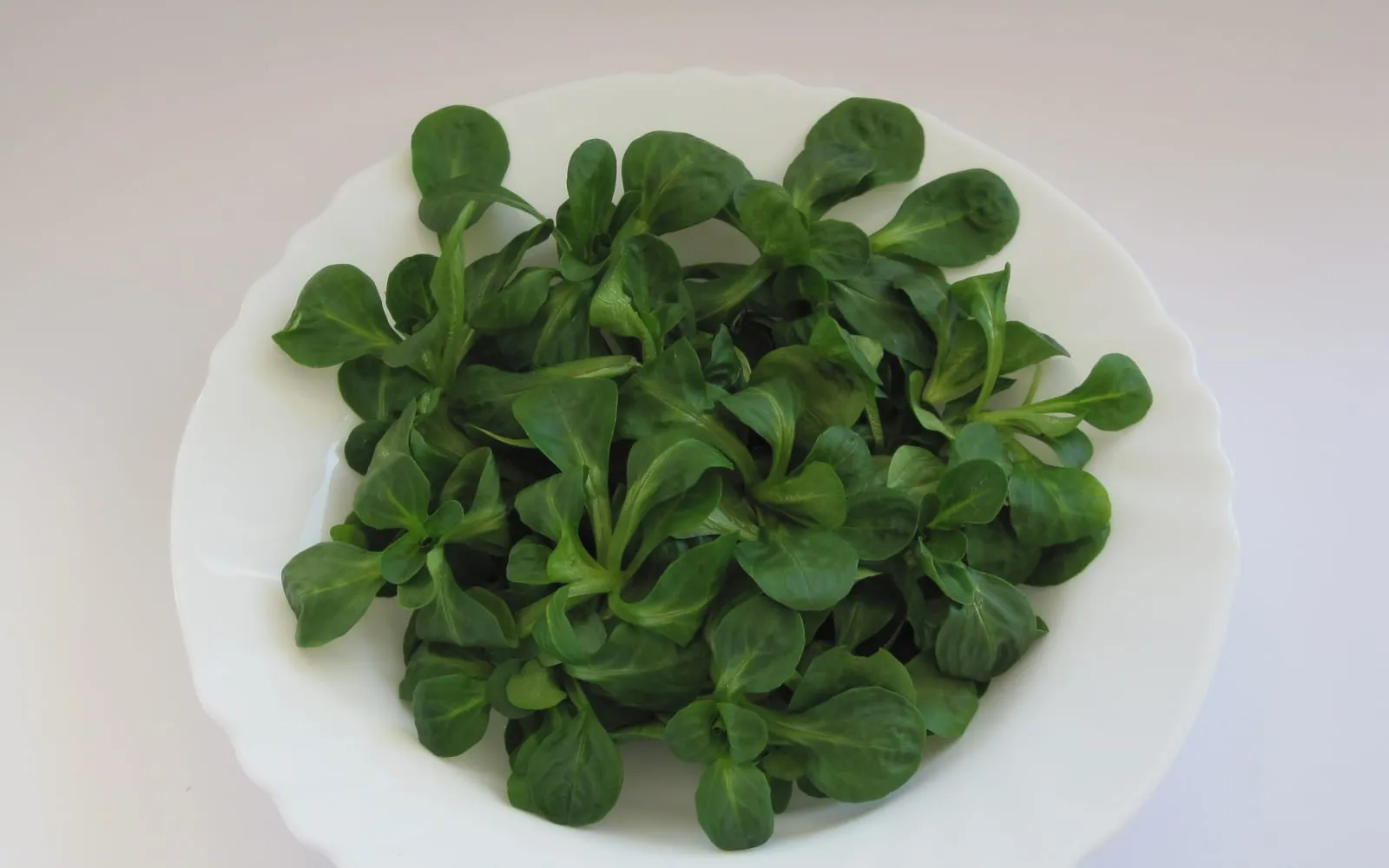
Leaves are small, rounded to spoon-shaped, smooth-edged, slightly succulent and a soft mid-green, held in opposite pairs on very short stalks.
The whole plant is picked at once rather than leaf by leaf, and a rosette makes one generous handful.
Texture is soft and velvety, quite unlike the crispness of a lettuce, and it wilts fast once dressed.
In spring the plant bolts, throwing up a branched stem to 30 cm with tiny pale blue flowers, and the leaves become thin and unappealing.
Large-leaved varieties such as ‘Verte de Cambrai’ and ‘Vit’ give a bigger rosette, and the small-leaved wild types are hardier.
Where it is from
Corn salad is native across Europe, including Britain, and into western Asia and North Africa, growing on dunes, walls, arable margins and disturbed ground.
Gathering it as a wild salad goes back a long way, and it was a standard winter green in France and Germany long before anybody sowed it deliberately.
France made it a market crop from the seventeenth century, and mache remains a supermarket staple there. Germany grows Feldsalat on the same scale.
Britain named it lamb’s lettuce, probably because it appears at lambing time in early spring, and never took to it in the way its neighbours did.
The plant is in the Valerianaceae with valerian and red valerian, which is unexpected for something that looks and tastes so unlike either.
How it grows
Sow direct. Corn salad is small and quick and transplanting is not worth the effort.
Sow from August to October at 1 cm deep in rows 15 cm apart. Thin to 10 cm, or broadcast thinly and do not thin at all, which is how most people grow it.
Germination is slow and unreliable in warm soil above 20 deg C, so an August sowing needs shading and watering while a September one does not.
Germination takes ten to fourteen days.
Plants are ready in eight to twelve weeks from an autumn sowing, and much longer through midwinter when growth all but stops.
Pick whole rosettes with a knife just above the root, or lift the plant entirely. Leaves picked individually are fiddly and the plant does not regrow usefully.
Firm the soil before sowing. Corn salad prefers a firm seedbed and germinates poorly in fluffy ground.
Through the seasons
Late summer starts the sowing window in August, and this sowing needs watering and shading because the soil is still warm.
Early autumn is the best time to sow, in September. Cooling soil gives reliable germination and the plants establish before the light fails.
Autumn grows the rosettes on. Weed carefully, since the plants are small and easily smothered.
Winter is the harvest. Pick from November through to March. Growth stops in December and January and the standing plants stay in perfect condition, which is what makes this crop so useful.
Spring brings a last picking in March, then bolting in April. Let a patch flower and seed and it will come up on its own next autumn.
Care difficulty
Among the easiest crops in this collection, and the least demanding of anything that crops in midwinter.
Germination is the one hurdle. Warm soil suppresses it, so sow in September rather than August where you can, firm the bed, and keep the surface damp for a fortnight.
Weeding needs care while the plants are small, because a corn salad seedling is easily hoed off with the chickweed it resembles.
Slugs graze the low rosettes and are the main pest, though the damage in cold weather is limited.
Washing is the practical chore. A rosette sitting on soil collects grit in every crevice, and a coarse mulch of grit or straw under the plants saves a good deal of rinsing.
Watering
Water every few days from sowing until the plants are established, which is the only period this crop needs attention.
Keep the surface damp through the fortnight of germination.
After establishment, autumn and winter rainfall covers it entirely in a maritime climate and watering is rarely needed.
Avoid overhead watering in a mild wet autumn, which brings downy mildew and grey mould on plants pressed against the soil.
A gritty surface mulch keeps the leaves clean and off wet soil.
Container growing suits it well. A shallow wide pot or a windowbox gives winter salad and drains better than open ground.
Warning signs, diseases and pests
Slugs graze the rosettes and shelter beneath them. Clear the surrounding ground, use a gritty mulch, and patrol on damp evenings, though slug activity falls away in genuine cold.
Downy mildew shows as pale patches above and grey growth beneath in a mild wet autumn. Space the plants, avoid overhead watering, and remove affected leaves.
Grey mould rots leaves lying on wet soil. A gritty or strawy mulch under the rosettes prevents most of it.
Poor germination in August sowings is the commonest complaint and is caused by warm soil. Sow in September.
Bolting in April ends the crop and is normal rather than a fault.
Nothing else troubles it. Corn salad is largely ignored by the pests that attack brassicas and lettuces.
Growing environment
Full sun through autumn and winter. Every hour of low winter light counts, so give it the most open position available.
Fertile, firm, moisture-retentive soil. Corn salad germinates and establishes better on a firm bed than a freshly dug one, so sow into ground that has settled after an earlier crop.
Neutral soil, pH 6.5 to 7.
A gritty surface mulch keeps the leaves clean and off wet soil, and it is the best way to keep this crop clean.
A cloche keeps the plants clean and picks up growth in February, though the crop is hardy enough not to need it.
Rotate on three years, though it shares few problems with anything else.
Feeding
Corn salad needs no feeding. Sow it into ground that grew a fed crop earlier in the year and it will be perfectly happy.
Avoid nitrogen, which gives soft leaves that rot in winter wet and raises the nitrate content of a crop grown in low light.
Never use fresh manure.
A container of fresh compost needs nothing added for the life of the crop.
Troubleshooting
Nothing germinated from an August sowing. Warm soil suppresses germination above about 20 deg C. Sow in September, or shade and water the row.
The plants are full of grit. The rosettes sit on the soil. Spread a gritty or strawy mulch under them, and wash the picked rosettes in several changes of water.
Leaves rotting where they touch the ground. Grey mould in a wet autumn. Use a mulch to lift the leaves clear and pick off affected foliage.
I hoed my seedlings off. They look much like chickweed at that size. Mark the row when sowing.
It bolted in April. Normal. The crop finishes in spring. Let a patch seed and it will return in autumn.
Pale patches with grey growth underneath. Downy mildew. Space the plants and stop watering overhead.
Do I pick leaves or whole plants? Whole rosettes, cut just above the root. Picking individual leaves is fiddly and the plant does not regrow usefully.
How cold can it take? About -15 deg C unprotected, which makes it the hardiest salad in the garden by a considerable margin.
Corn Salad problem guides
Not sure what is wrong? See the common vegetable pests guide.