
Edible
Sea buckthorn
Hippophae rhamnoides
Also known as Sallow thorn, Seaberry, Sandthorn
How to grow sea buckthorn, Hippophae rhamnoides. Male and female plants, ferociously acidic orange berries, and the thorns that make picking a considered job.
At a glance
- Difficulty
- Moderate
- Water
- First summer only, then none
- Light
- Full sun, and it will not fruit properly without it
- Temperature
- Fully hardy to -40 deg C
- Hardiness
- USDA 3-8, RHS H7, hardy to -40 C
- Type
- Deciduous shrub or small tree, long-lived
- Height
- 3-6 m, occasionally 10 m
- Native to
- Britain, Europe, Central Asia
- Best month
- September and October in the Northern Hemisphere, March and April in the Southern Hemisphere
Salt, wind, drought and Arctic cold all leave it unbothered, and it fixes nitrogen on pure sand. The catch is that plants are male or female, so a berry crop needs one male within pollen range of every six or eight females. It suckers hard, and on light soil it will colonise ground you did not intend to give it.
Hardiness zones describe winter cold alone. Summer heat, humidity, rainfall and the length of the growing season decide as much, so treat the range as the outer limit rather than as a recommendation.
Every month named in this guide is for the temperate Northern Hemisphere. If you garden in the Southern Hemisphere, shift each one by six months, so September becomes March. Closer to the equator the wet and dry seasons matter more than the calendar, and the shift stops being a useful guide.
Not known to be toxic
- Safe to eat
- The berries
The berries are food and are pressed commercially for juice and oil across northern Europe and China. Neither the RHS nor the ASPCA lists Hippophae as harmful, and no toxicity to cats or dogs is recorded. The fruit is extremely acidic and a large quantity taken raw will upset a stomach for that reason rather than through any toxin. The thorns are the real hazard on this plant. They are long, stiff and sharp enough to go through a glove, and puncture wounds from them are slow to heal, so wear gauntlets and eye protection when pruning.
Sources: RHS potentially harmful garden plants, ASPCA toxic and non-toxic plants
About
Sea buckthorn grows on shifting sand dunes in salt wind, fixes its own nitrogen, and produces berries with more vitamin C than a blackcurrant. It is one of the toughest fruiting plants in cultivation.
Two things make it a considered choice rather than an obvious one. The plant is dioecious, so you need a male and a female and only the female fruits. And it is armed with long hard thorns that make every interaction with it a careful one.
The berries cling so tightly that pulling them off bursts them. Growers in Siberia and Scandinavia cut whole fruiting branches, freeze them, and knock the frozen berries off, which is the method worth copying at home.
The flavour is sharp and oily, somewhere between passion fruit and a very sour orange. It is used as a juice, diluted and sweetened, rather than eaten by the handful.
Appearance and character
An upright thorny shrub or small tree with stiff branches, suckering from the roots into a dense thicket over time.
Thorns are formed from shortened side shoots, long and rigid, and they occur all along the branches rather than only at the tips.
Leaves are narrow and willow-like, 3 to 8 cm, grey-green above and covered underneath with silvery scales that make the whole plant shimmer.
Flowers are small, greenish and wind-pollinated, opening in March and April before the leaves. Male flowers sit in short cones on the stem, female ones are smaller and sparser, and telling the sexes apart before flowering is close to impossible.
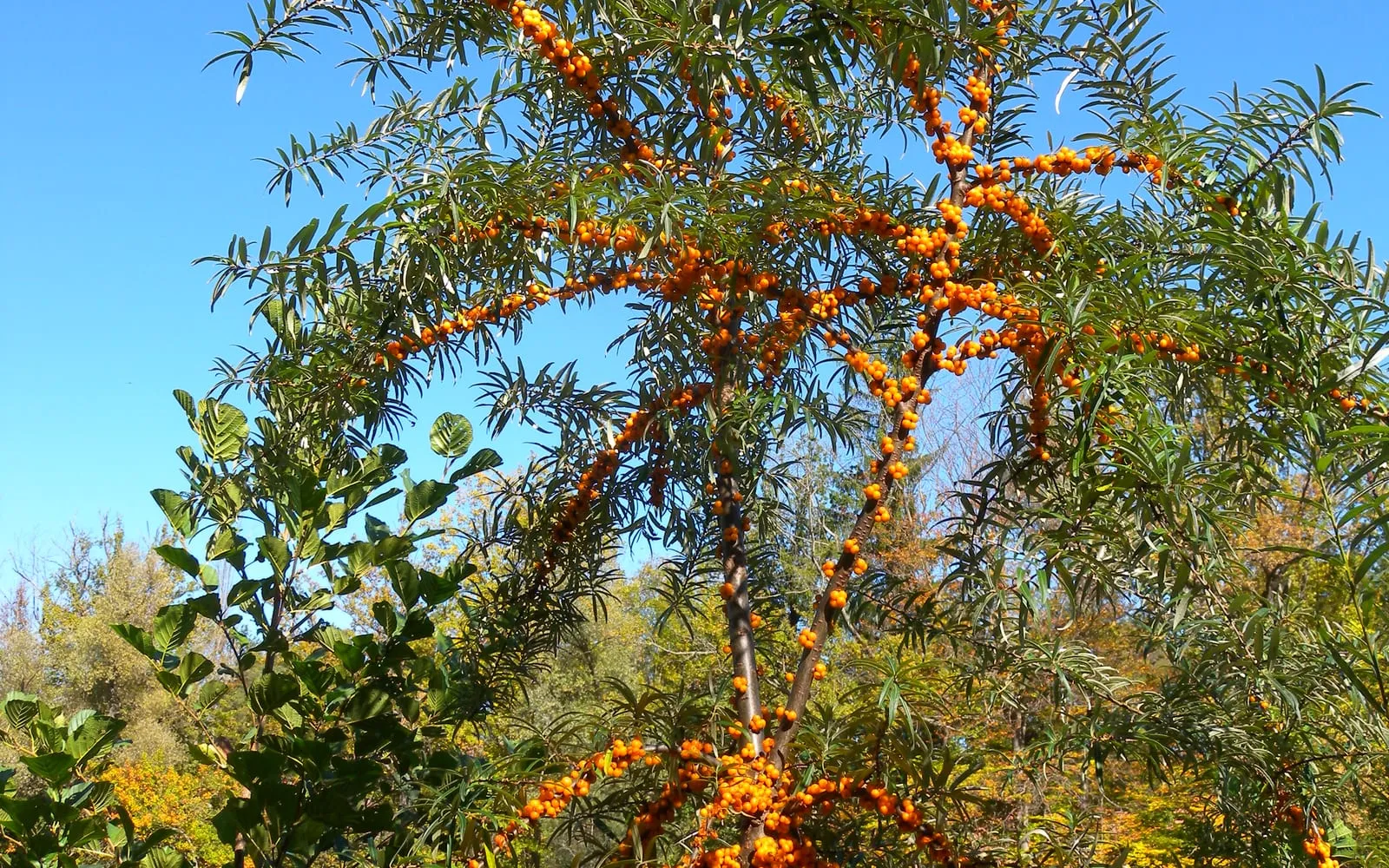
Fruit is a bright orange oval berry 6 to 9 mm long, packed so densely along the stem that the branch looks sleeved in orange.
Where it is from
Hippophae rhamnoides is native across Europe and temperate Asia. In Britain it grows on coastal sand dunes, mainly along the east coast from Kent to Scotland.
Its wider range runs across Europe and deep into central Asia, including the Himalaya and the Mongolian steppe, where it grows at high altitude in extreme cold.
The plant stabilises dunes by suckering, which is why it was widely planted on the British coast in the twentieth century.
That planting created a conservation problem. On several dune systems it spread into rare open sand habitat and is now being controlled or removed. A shelter plant chosen for its vigour will spread with that same vigour once it has settled in.
Russia and China grow it on an industrial scale for juice and for seed oil, and Soviet-era breeding produced the large-fruited, less thorny varieties sold to gardeners today.
How it grows
Buy named plants of known sex. Seedlings cannot be sexed until they flower, which takes three or four years, and buying unsexed seedlings is how people end up with no fruit.
Plant one male to every six to eight females, positioned upwind since pollination is by wind rather than insects.
Choose a sunny open site with free-draining soil. Sand, gravel and poor stony ground all suit it, and it tolerates salt spray.
Plant in autumn or spring, 2 to 3 m apart. Expect suckers, and site the plant where a spreading thicket is acceptable or where a mower will keep it in check.
Prune in winter with gauntlets, long sleeves and eye protection. Take out old wood and keep the plant open enough to pick from.
Fruit appears in the third or fourth year and builds steadily.
Through the seasons
March and April bring flowering, which is inconspicuous and wind-driven. A still spring can reduce the crop, which is why the male goes upwind.
Leaves follow, and through summer the shrub is a silver-grey mass that looks handsome and needs nothing.
Berries colour from August and are ripe from September, though they hang on the plant for months without spoiling.
Harvest is the season’s real work. Cut whole fruiting branches, bag them and freeze them, then knock the berries off while frozen.
Taking whole branches removes next year’s fruiting wood on those stems, so cut selectively and rotate around the plant.
After leaf fall the orange berries stand out against bare thorny stems, and birds will eventually take what remains.
Care difficulty
Moderate, and the rating is about handling and layout rather than horticulture.
The plant itself is close to indestructible. It survives -40 deg C, salt wind, drought and soil with almost no nutrients.
The complications are the sexes, the thorns and the suckering. Get the male and female balance right at planting and two of those three are solved.
Suckers travel. A plant put in a border will send shoots up two metres away through a lawn, and that continues for the life of the plant.
Verticillium wilt is the one disease that kills it, and there is no treatment.
Watering
Water weekly through the first summer only.
After that the plant needs nothing. It grows on dune sand where the water table is metres down and its roots go looking.
Fruit yield improves slightly with summer moisture, though watering an established plant is rarely worth the effort.
Do not mulch heavily against the stems, which encourages rot at the base on a plant adapted to dry sharp drainage.
Waterlogging kills it. Heavy clay that sits wet in winter is the one soil to avoid entirely.
Warning signs, diseases and pests
Whole branches wilting and dying in midsummer while the rest looks well. Verticillium wilt, the main killer of this species. Cut out affected branches well below the damage, and do not replant Hippophae in the same ground.
Plant declining on heavy soil, roots dark and soft. Root rot from waterlogging. Improve drainage or move it, since the plant will not recover in wet ground.
Curled shoot tips with clustered insects. Aphids, which the plant outgrows.
Brown scorched leaf edges on a young plant. Drought before establishment. Water through the first summer.
No fruit on a mature plant. Either it is male, or no male is within pollinating range upwind. Neither can be fixed by feeding or pruning.
Suckers appearing across the lawn. Normal behaviour. Mow them, or slice through them with a spade and pull them out.
Growing environment
Full sun is not negotiable. Sea buckthorn in shade grows leggy and fruits poorly.
Soil should be sandy, gravelly or otherwise sharply drained. Poor ground is an advantage rather than a compromise.
Salt tolerance is high, which makes it one of the few fruiting plants for a windy coastal garden.
Cold is irrelevant to it. Hardiness runs to -40 deg C.
Allow real space and expect spread. A hedge or a boundary thicket suits it far better than a mixed border, and a lawn on one side gives you a mower to control the suckers.
Feeding
Do not feed it. Root nodules host Frankia bacteria that fix atmospheric nitrogen, and the plant makes its own supply.
Added fertiliser produces soft growth, more thorns to fight through and no extra fruit.
The shrub improves the nitrogen status of soil around it, which is why it is planted in shelter belts alongside more demanding species.
No mulch is needed. Bare sandy ground around the base suits it.
A container plant is impractical given the suckering and the eventual size.
Troubleshooting
Plenty of flowers, no berries at all. The plant is male. Male and female flowers look different but only under close inspection, so buy named sexed plants rather than seedlings.
Female plant flowering but setting little. No male upwind, or a still calm spring that limited wind pollination.
Berries bursting as you pick them. Normal. They are attached too firmly to pull off cleanly. Cut branches and freeze them, then knock the fruit off.
Juice unbearably sour. Correct for the species. It is diluted and sweetened rather than drunk neat.
Plant spreading through a border. Suckering. Contain it with a mown strip, or accept the thicket.
Sudden death of a mature plant. Verticillium wilt or waterlogging. Check drainage before replanting anything in the spot.
Sea buckthorn problem guides
Not sure what is wrong? See the common vegetable pests guide.