
Outdoor plant
Spindle
Euonymus europaeus
Also known as European spindle, Spindle tree, Prickwood
How to grow spindle, Euonymus europaeus. The pink capsules and orange seeds that make it the brightest native shrub in autumn, its value to wildlife, and why the fruit must not be eaten.
At a glance
- Difficulty
- Easy
- Water
- Rarely once established
- Light
- Full sun to partial shade, and best fruit colour in sun
- Temperature
- Fully hardy, to about -30 deg C
- Hardiness
- USDA 4-8, RHS H6, hardy to -30 C
- Type
- Deciduous shrub or small tree, long lived
- Height
- 3-6 m
- Native to
- Europe and western Asia, and native to Britain, mostly on chalk and lime
- Best month
- October in the Northern Hemisphere, April in the Southern Hemisphere
Chalk and limestone suit it best and it takes cold without difficulty. It is the winter host of the black bean aphid, so it is a poor neighbour for a vegetable garden growing broad beans. Related Euonymus are a different matter in North America, where burning bush, Euonymus alatus, is banned from sale in Massachusetts and New Hampshire and winter creeper, Euonymus fortunei, smothers woodland floors across the midwest.
Hardiness zones describe winter cold alone. Summer heat, humidity, rainfall and the length of the growing season decide as much, so treat the range as the outer limit rather than as a recommendation.
Every month named in this guide is for the temperate Northern Hemisphere. If you garden in the Southern Hemisphere, shift each one by six months, so October becomes April. Closer to the equator the wet and dry seasons matter more than the calendar, and the shift stops being a useful guide.
Toxic if eaten
- Do not eat
- All parts, and the fruit and seeds most of all
- Harm from
- Eating it
- Affects
- People, cats, dogs and horses
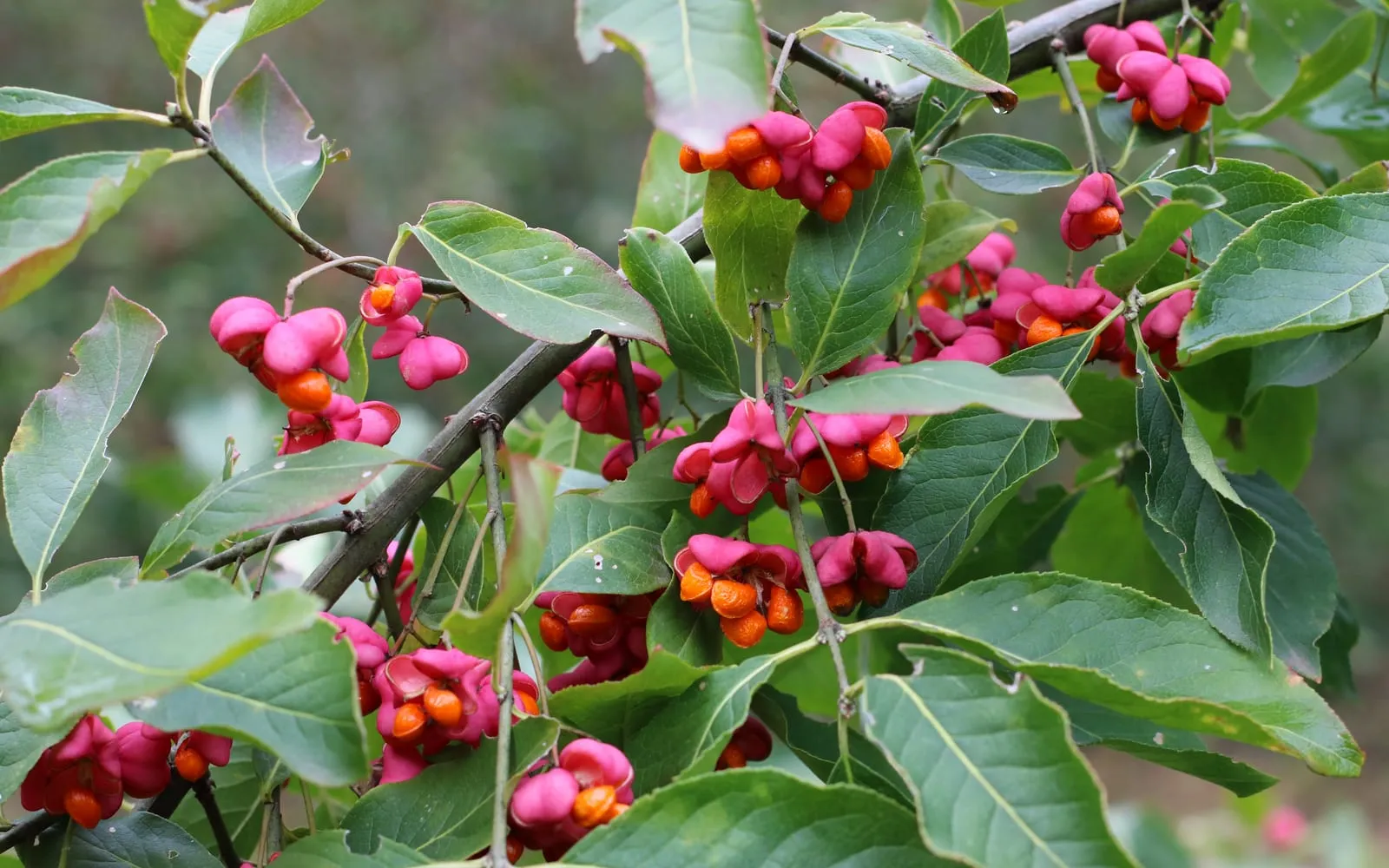
Spindle is listed by the RHS as harmful if eaten, and every part contains cardiac glycosides and alkaloids. The fruit is the practical hazard because it is the brightest thing in a temperate hedgerow in October, shocking pink capsules splitting open to show orange seeds, and it looks entirely edible. Eating the fruit causes vomiting, severe diarrhoea and stomach cramps, typically beginning some hours after ingestion rather than immediately, and larger quantities can disturb heart rhythm and cause drowsiness and convulsions. The delayed onset is important, since an absence of symptoms in the first hour is not reassurance. Historically the fruit was also dried and powdered to treat head lice and mange, which gives some sense of its potency. Get medical advice if a child has eaten any, and treat a large quantity swallowed as an emergency. Bark and leaves are toxic too, and horses have been poisoned by browsing hedges containing it. Birds eat the fruit in quantity without harm and are the plant's main dispersers.
Sources: RHS potentially harmful garden plants, ASPCA toxic and non-toxic plants
About
Nothing else in a European hedgerow is as loud in October as a spindle in fruit. The capsules are a hot shocking pink that looks synthetic, and they split into four lobes to show seeds coated in bright orange.
For eleven months of the year it is an unremarkable green shrub that nobody notices, which is precisely why it is worth planting. It occupies a position quietly and then does something extraordinary in autumn.
The colour is doing a job. The pink and orange combination is a signal to birds, which take the seeds and disperse them, and the same brightness is what makes the fruit dangerous to children.
It is a good wildlife plant beyond the birds. Spindle is a host for blackfly over winter, which sounds like a drawback and means the shrub supports ladybirds and hoverflies early in the year, and it feeds a range of moth caterpillars.
The name comes from the wood, which is hard, fine-grained and was turned into spindles for spinning wool, along with skewers, pegs and knitting needles.
Appearance and character
A deciduous shrub or small tree reaching 3 to 6 m, upright when young and spreading and suckering with age.
Young stems are distinctly green and four-angled, almost square in cross-section, which is a reliable winter identification. Older bark is grey and smooth.
Leaves are opposite, narrowly oval, pointed, finely toothed, 3 to 8 cm long, and a plain mid-green through summer.
Autumn colour is the second reason to grow it. The leaves turn through yellow to crimson and deep purple-red, often at the same time as the fruit is at its brightest.
Flowers open in May and June and are almost invisible, tiny, four-petalled and a pale greenish-white, borne in small clusters. Insects find them regardless.
Fruits ripen through September and October into deep pink four-lobed capsules about 1.5 cm across, which split to reveal each seed wrapped in a bright orange aril. They hang on well into November.
The whole plant has a slightly rank smell when the leaves are crushed.
Where it is from
Europe and western Asia, and native throughout most of Britain, commonest in England and Wales and scarce in Scotland.
It is a plant of hedgerows, woodland edges, scrub and chalk downland, and it is particularly associated with lime-rich soils. A spindle in a hedge is often taken as an indicator of an old hedgerow.
It grows on most soils and is at its best on chalk and limestone, which is where the autumn colour tends to be strongest.
The wood’s density and fine grain made it valuable historically. Beyond spindles it was used for skewers, toothpicks, pegs and artists’ charcoal, and the charcoal is still preferred by some for drawing.
Its relationship with blackfly is well established. Spindle is the winter host of the black bean aphid, which moves to beans and other crops in spring, and this is occasionally given as a reason not to plant it near a vegetable garden.
How it grows
Plant bare-root between November and March, or container-grown at any time the ground is workable.
Choose sun or partial shade. It fruits and colours far better with sun on it.
Any reasonable soil suits it, and chalk suits it best. It tolerates clay and dry ground once established.
Plant more than one if you want a heavy fruit set. Spindle flowers vary in whether they function as male or female, and a solitary plant often fruits poorly.
Prune as little as possible. The shrub makes a good natural shape and every cut removes potential fruit, since the capsules form on wood at least a year old.
Where a cut is needed, take whole branches out at a fork in late winter rather than shortening everything.
Remove suckers from the base if you want a single-stemmed small tree rather than a thicket.
For a hedge, spindle mixes well with hawthorn, hazel and field maple in a native mix, and it is best not used alone.
Propagate from semi-ripe cuttings in summer, or from seed sown fresh in autumn and left outside over winter to break dormancy.
Through the seasons
Winter shows the distinctive green four-angled young stems, which are the easiest way to identify a leafless spindle. This is the time for any structural pruning.
Spring brings leaves in April and blackfly colonies on the new shoots, which draw in early ladybirds.
Summer is the inconspicuous flowering in May and June, followed by quiet green growth.
Autumn is the point of the plant. Capsules colour from September, split through October, and the foliage turns crimson around them.
Care difficulty
Easy. It is fully hardy, tolerant of most soils and exposure, and needs no routine attention.
The two things that disappoint are both avoidable. Poor fruiting is usually a matter of a single plant with no partner, or too much shade. Over-pruning removes the fruit.
Ermine moth webbing looks alarming and is not a health problem for the shrub.
Its toxicity is the reason to think about placement rather than a reason to avoid it.
Watering
Water through the first summer after planting.
An established spindle needs no watering in a temperate climate.
It tolerates dry chalky ground well and dislikes waterlogging.
Warning signs, diseases and pests
Blackfly colonise the shoot tips in spring, sometimes heavily. Spindle is their winter host, so this is expected rather than a failure. Ladybirds and hoverflies follow them, and the shrub is unharmed. Leave it alone.
Spindle ermine moth caterpillars can cover an entire bush in dense white silk webbing in early summer and strip every leaf inside it. It looks like a disaster and it is not. The shrub refoliates later in the season and is rarely killed. Cut out and bin webbed branches if the sight is unbearable.
Powdery mildew whitens the leaves in dry summers and does little harm.
Honey fungus attacks spindle and is fatal, showing as white fungal sheets under the bark at the base and sudden collapse.
Sparse fruit is the common complaint. Plant two or three shrubs rather than one, give it more sun, and stop pruning it.
The fruit itself is the warning to pass on to anyone using the garden. It is brilliantly coloured, at picking height, and toxic.
Growing environment
Full sun to partial shade. Sun gives better fruit set, brighter capsules and stronger autumn leaf colour.
Any reasonable soil, best on chalk and limestone, tolerant of clay and dry ground. Avoid waterlogged positions.
Fully hardy to about -30 deg C, and tolerant of exposure, including moderate coastal wind.
Allow 3 to 4 m of space. It suckers, so a spindle in a border will widen over time.
It suits a native hedge, a wild corner, a woodland edge planting or a mixed shrub border where something is needed for October.
Site it away from paths used by small children if the bright fruit is a concern, or grow it where the fruit is above head height.
Avoid planting it immediately beside a bean patch if blackfly is a recurring problem in your vegetable garden, though the connection is often overstated.
Feeding
None needed on ordinary soil.
Mulch with compost in the spring after planting, which does more by conserving moisture than by feeding.
Avoid nitrogen-rich feeds, which produce leafy growth and less fruit.
Poor fruiting is a pollination or a light problem rather than a feeding one.
Troubleshooting
Are the pink and orange berries poisonous? Yes. Every part of the plant is toxic and the fruit most of all. Eating it causes vomiting, severe diarrhoea and cramps, often starting some hours later. Get medical advice, and treat a large quantity eaten as an emergency.
Hardly any fruit. Usually a single plant with no pollination partner, or too much shade, or too much pruning. Plant two or three, give it sun, and leave it alone.
The whole bush is covered in white webbing and stripped bare. Spindle ermine moth. It looks catastrophic and the shrub refoliates. Cut out the webbed branches if you want to, or leave it.
The shoots are covered in blackfly. Spindle is the winter host of the black bean aphid, so this is normal. Ladybirds and hoverflies arrive to feed on them.
How do I identify it in winter? The young stems are green and four-angled, almost square in section. Very little else in a temperate hedge looks like that.
Can I prune it into shape? Sparingly. Fruit forms on wood at least a year old, so regular clipping removes the display. Take whole branches at a fork in late winter if you must.
Is it safe for horses? No. Spindle in a hedge is a risk to browsing horses, and poisonings are recorded. Keep it out of reach of a grazed paddock.
Is it worth planting for wildlife? Yes. Birds take the seeds, moth caterpillars feed on the leaves, and the early aphid colonies support ladybirds and hoverflies before anything else is available.