
Edible
Elephant Apple
Dillenia indica
Also known as Chalta, Ma-tad
How to grow elephant apple, Dillenia indica. Why the fruit sold in markets is a swollen sepal around a small true fruit, the single flower that opens 20 cm across for a day, and the sourness that means it is cooked rather than eaten raw.
At a glance
- Difficulty
- Difficult
- Water
- Frequent and generous, all year round
- Light
- Full sun to light shade
- Temperature
- Frost-tender; needs year-round warmth
- Humidity
- High
- Hardiness
- USDA 10-12, RHS H1c, hardy to 5 C
- Type
- Evergreen tropical tree
- Height
- 15-20 m
- Native to
- South Asia, Southeast Asia
A riverside and swamp-forest tree from the wet tropics of South and Southeast Asia, growing naturally along streams and in seasonally flooded ground rather than on a dry hillside. It needs constant warmth and reliable moisture at the root all year, tolerates no frost at all, and struggles anywhere a true dry season lasts more than a few weeks.
Hardiness zones describe winter cold alone. Summer heat, humidity, rainfall and the length of the growing season decide as much, so treat the range as the outer limit rather than as a recommendation.
Not known to be toxic
- Safe to eat
- The thickened, fleshy sepals surrounding the fruit, usually cooked
Elephant apple is not listed as harmful on the RHS potentially harmful garden plants index or the ASPCA toxic plant index. What most people call the fruit is botanically the enlarged, hardened sepals that swell around the true fruit inside, strongly sour with a high malic acid content that makes it unpalatable raw in any quantity. Across its native range it is cooked into curries, chutneys, pickles and jellies rather than eaten out of hand, and that sourness, not any toxin, is why it is treated as a cooking ingredient rather than a dessert fruit.
Sources: RHS potentially harmful garden plants, ASPCA toxic and non-toxic plants
About
Elephant apple grows as a substantial evergreen tree along rivers and wetlands across South and Southeast Asia, named for the size of its fruit rather than for any association with elephants eating it, though wild elephants do take the fallen fruit readily. It carries one of the largest single flowers of any tree in the region and a fruit sour enough to need cooking before it becomes food.
It is grown both as an ornamental shade tree, for the striking flower and the handsome ribbed foliage, and as a fruiting tree in home gardens and smallholdings across its native range, where the sour pulp goes into curries and preserves rather than being eaten fresh.
Appearance and character
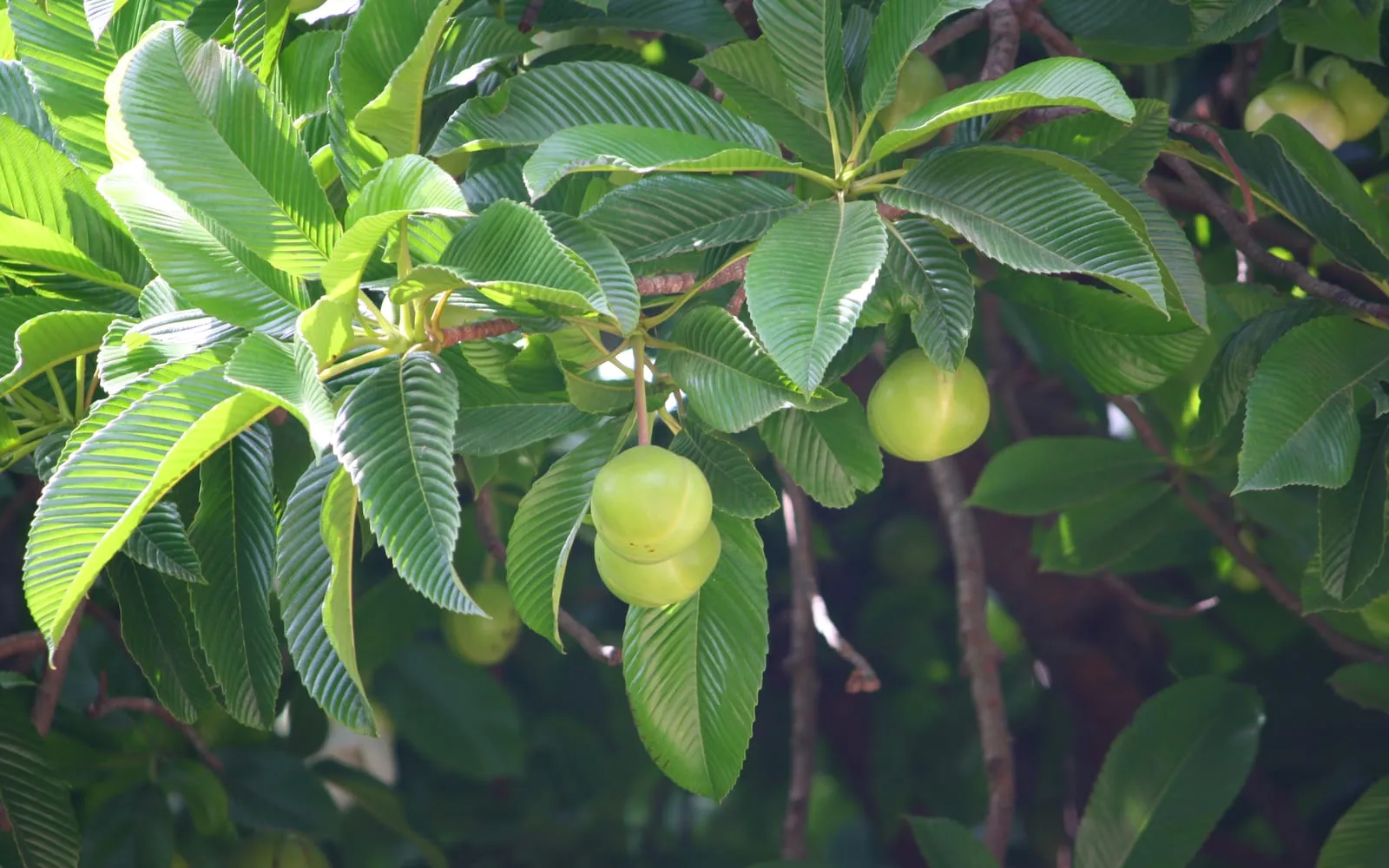
Leaves are the tree’s most distinctive feature outside flowering season, large, glossy, elliptic and deeply ribbed with prominent parallel veins running from the midrib to a sharply toothed margin, giving each leaf a pleated, almost corrugated look.
Flowers open singly, up to 20 cm across, among the largest borne by any tree in the region, with five broad white petals surrounding a dense central boss of bright yellow stamens. Each flower lasts only a day or two, but a mature tree in season produces a long, scattered succession of them rather than a single synchronised flush.
What follows is unusual botanically. The true fruit is a small cluster of seed-bearing carpels at the centre, but the fleshy, overlapping sepals that originally protected the flower swell dramatically around it as it develops, forming the large, hard, round green structure that is harvested, sold and cooked as the fruit.
Where it is from
Dillenia indica grows wild across the Indian subcontinent, Sri Lanka, Myanmar and into Southeast Asia and southern China, typically along riverbanks, in swamp forest and in other permanently or seasonally wet ground rather than on drier upland sites.
That riverside origin explains why the tree tolerates, and in cultivation often needs, far wetter soil than most fruiting trees, including occasional flooding around the root zone that would kill a species from a drier habitat. It also explains its intolerance of any real dry period, since a tree built around a permanent water source has little capacity to store reserves against drought the way species from more seasonal climates do.
How it grows
Plant in moist, fertile soil in full sun to light shade, ideally near a reliable water source or somewhere the ground stays naturally damp, since this is not a tree suited to an ordinary free-draining border.
Give it plenty of space from the outset. A mature tree develops a broad canopy and a substantial root system, and it is not a species that tolerates being confined to a small container or a restricted planting pit for long.
Propagate from seed, sown fresh since viability drops quickly once seed has dried out, or from air-layering an established tree, which produces a flowering and fruiting specimen faster than seed does. Growth is moderately fast in warm, wet conditions and considerably slower wherever either warmth or moisture falls short.
Water generously from planting onward, and expect a young tree to need close attention to soil moisture through its first several years while its root system develops enough reach to buffer against any dry spell.
Through the seasons
The main growing season, through the warmest and wettest months of a tropical or monsoon climate, brings the strongest vegetative growth and the start of flowering.
Flowering continues over an extended period rather than in one flush, with individual blooms opening and fading within a day or two while the tree as a whole stays in flower for weeks or months.
Fruit development follows flowering by several months, with the thickened sepals slowly hardening and enlarging around the fruit until it reaches full size and is harvested.
Any cooler or drier period, where the local climate provides one, slows growth noticeably and can trigger some leaf drop, though the tree does not lose its leaves completely the way a fully deciduous species does.
Care difficulty
Difficult outside a tropical or warm, consistently humid climate. The tree itself needs little where its basic needs are met, and those needs, constant warmth, high humidity and reliably wet soil, rule it out for most gardens and make it a specialist glasshouse subject anywhere with a real winter.
Even within a suitable climate, its eventual size and its appetite for water mean it needs deliberate siting near a dependable water source rather than being planted and left to fend for itself.
Watering
Water frequently and generously all year round, since this species grows naturally along rivers and in wet ground and has little tolerance for soil that dries out between waterings.
It tolerates occasional flooding around the roots far better than most fruiting trees, which makes a naturally damp or low-lying site, or a position near a pond or stream, closer to its native conditions than an ordinary well-drained bed.
Reduce watering only slightly during any cooler period, and never let the root zone dry out completely at any point in the year.
Warning signs, diseases and pests
Leaf spot appears as small brown or black lesions on the foliage in humid, still air with poor circulation, common in a crowded or sheltered planting. Improve airflow around the canopy and remove badly affected leaves.
Scale insects colonise the stems and the undersides of the leaves, appearing as small, immobile brown or grey bumps that weaken the plant gradually. Horticultural oil applied to the affected areas is the standard treatment.
Mealybug shows as small white, cottony tufts in leaf axils and among new growth. Wipe them away with a damp cloth or treat with horticultural soap.
Sooty mould follows an infestation of scale or mealybug, growing as a black, powdery coating on the honeydew they excrete. Treating the underlying insect clears the mould as a result.
Growing environment
Full sun to light shade both suit it, though flowering and fruiting are generally better in more open positions with good direct light for at least part of the day.
High humidity is important. A tree grown in dry air, whether outdoors in an arid climate or indoors under glass with poor ventilation, performs noticeably worse than one grown where the air itself stays moist.
Moist to wet, fertile soil near a reliable water source reproduces the riverside conditions this species grows in naturally. Ordinary free-draining garden soil, kept only lightly watered, does not suit it well.
Warmth year round is essential. Growth slows sharply below around 15 deg C, and any real frost is likely to be fatal, particularly to a young tree without the size and reserves of an established one.
Feeding
Feed with a balanced fertiliser or well-rotted manure roughly every two months through the growing season, supporting the vigorous growth this species produces where warmth and moisture are both adequate.
Reduce feeding during any cooler or slower period, since a tree that is not actively growing makes poor use of applied fertiliser and unused nutrients accumulate in soil that is already kept consistently wet.
A generous organic mulch around the root zone, kept away from direct contact with the trunk, supplies additional fertility over time and helps retain the soil moisture this tree constantly needs.
Troubleshooting
The fruit is rock hard and unpleasantly sour even when it looks ripe. That is normal. Elephant apple is not a fruit eaten raw like an apple or a mango; the thickened sepals stay firm and acidic even at full ripeness and are meant to be cooked into a curry, chutney or preserve rather than eaten out of hand.
My tree has not flowered after several years. This species can take some years to reach flowering size from seed, and a tree grown in marginal conditions, whether too dry, too cool or too shaded, takes longer still. Consistent warmth, humidity and moisture all speed the process.
Leaves are yellowing and dropping even though the soil is wet. Check that the wetness is not stagnant, airless waterlogging rather than the moving or well-aerated wet ground this species tolerates naturally. Poor drainage combined with permanently saturated soil can still cause root problems despite the tree’s general tolerance for wet conditions.
Can I grow this in a large container? Only with real commitment to watering and eventual root restriction, and even then it will stay considerably smaller than a tree in open, wet ground. It is better suited to being planted out where a reliable water source already exists.
Is the fruit the same thing sold as chalta in South Asian markets? Yes. Chalta is one of the common names this fruit is sold under across parts of South Asia, along with several regional names elsewhere in its range, and it is the same thickened, sour, calyx-derived structure described here.