
Edible
Grapefruit
Citrus paradisi
Also known as Pomelo hybrid, Shaddock hybrid, Pink grapefruit, Ruby red
How to grow grapefruit, Citrus paradisi. The citrus that needs the most heat and the longest season, and the one with a genuine medical caution attached.
At a glance
- Difficulty
- Difficult
- Water
- When the top few centimetres dry, so twice weekly in summer and monthly in winter
- Light
- Full sun, and as much heat as can be supplied
- Temperature
- Minimum 7-10 deg C, with high summer heat needed to ripen
- Humidity
- Moderate
- Hardiness
- USDA 9-11, RHS H1c, hardy to -3 C
- Type
- Evergreen tree, long-lived
- Height
- 2-3 m in a container, 12 m in the ground in the tropics
- Native to
- Barbados
- Best month
- January, February, March and April in the Northern Hemisphere, July, August, September and October in the Southern Hemisphere
A Barbadian hybrid of pomelo and sweet orange rather than a wild species. It needs more accumulated summer heat than any other common citrus to sweeten, so fruit from a marginal climate stays sharp however long it hangs.
Hardiness zones describe winter cold alone. Summer heat, humidity, rainfall and the length of the growing season decide as much, so treat the range as the outer limit rather than as a recommendation.
Every month named in this guide is for the temperate Northern Hemisphere. If you garden in the Southern Hemisphere, shift each one by six months, so January becomes July. Closer to the equator the wet and dry seasons matter more than the calendar, and the shift stops being a useful guide.
Toxic if eaten
- Safe to eat
- The flesh and the juice
- Do not eat
- Peel oils and leaves for pets, and the flesh where medication is involved
- Harm from
- Eating it and handling it
- Affects
- People, cats, dogs and horses
The fruit is food, and it carries a caution that no other citrus does. Grapefruit contains furanocoumarins that block an intestinal enzyme responsible for breaking down a long list of medicines, which raises blood levels of those drugs unpredictably. Statins, some blood pressure medicines, ciclosporin and several others carry explicit warnings, and the effect lasts many hours so separating the fruit from the dose does not avoid it. Anyone on regular medication should check with a pharmacist before eating grapefruit or drinking the juice. The ASPCA separately lists citrus as toxic to cats, dogs and horses because of the essential oils and psoralens in peel and foliage rather than the flesh.
Sources: RHS potentially harmful garden plants, ASPCA toxic and non-toxic plants
About
Grapefruit is the hardest citrus to fruit outside the subtropics. It needs more accumulated heat than any of the others and takes twelve to eighteen months from flower to ripe fruit, which is a long time to keep a large tree in good condition under glass.
The plant itself grows readily. Big glossy leaves, vigorous growth and scented flowers make it a handsome conservatory specimen whether or not it fruits.
It carries a caution the others do not. Furanocoumarins in the flesh interfere with an enzyme that breaks down a long list of medicines, and the interaction is significant enough that many drug packets name grapefruit specifically.
The species arose in Barbados in the eighteenth century as a cross between pomelo and sweet orange, which makes it the youngest citrus in common cultivation.
Appearance and character
A vigorous evergreen tree with a large rounded crown, bigger in every part than an orange.
Leaves are large, 10 to 15 cm, glossy dark green, with a broadly winged leaf stalk that is close to a second small leaf.
Flowers are the largest of the common citrus, 4 to 5 cm across, white and heavily scented, opening mainly in spring.
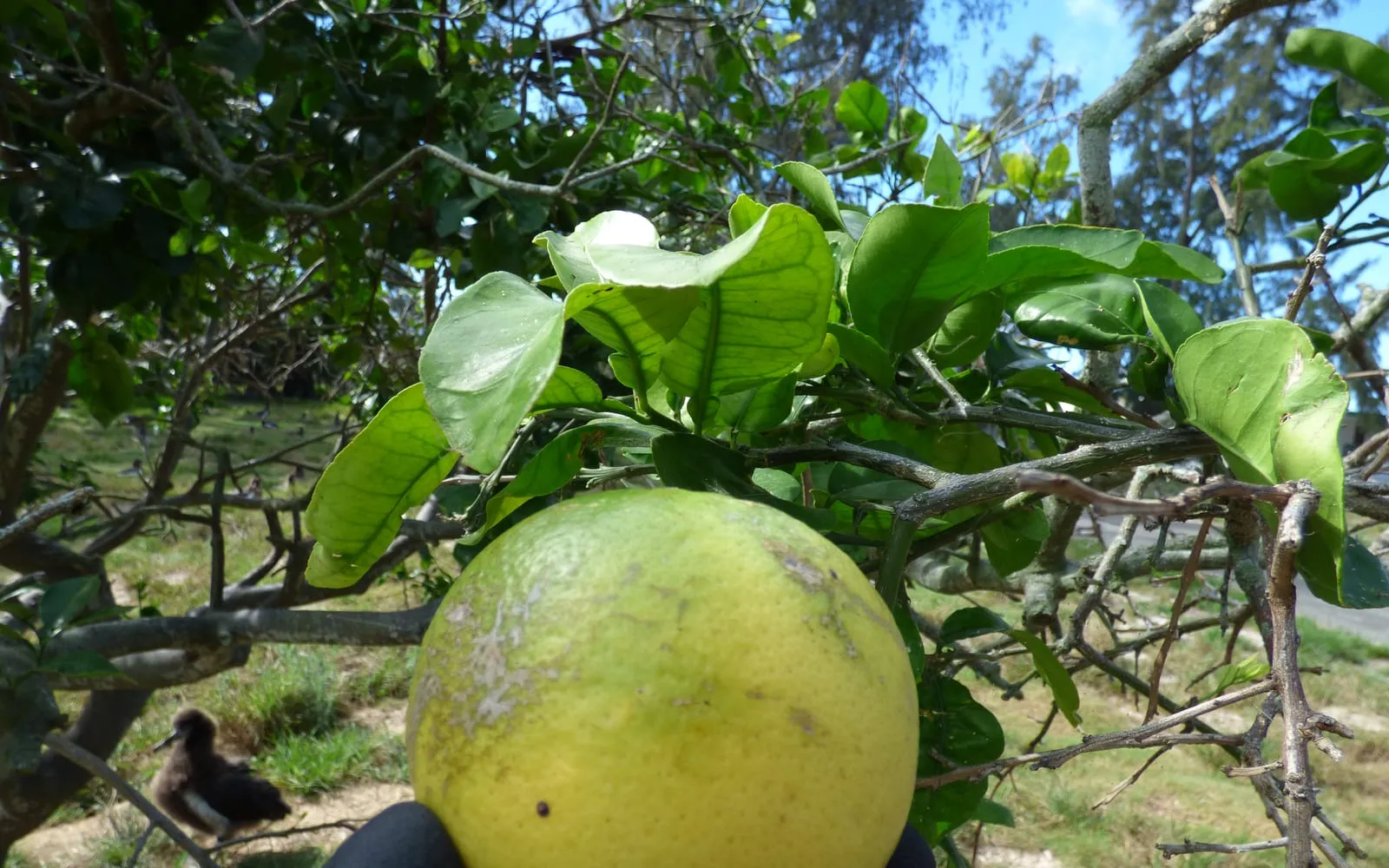
Fruit is round and large, 10 to 15 cm across, pale yellow or flushed pink, with a thick pith and flesh that varies from white through pink to deep ruby depending on variety.
Fruit hangs in clusters, which is where the name comes from, since the bunches were thought to resemble grapes.
Where it is from
Citrus paradisi arose in Barbados in the eighteenth century as a spontaneous cross between pomelo, introduced from Asia, and sweet orange.
It was first described as the forbidden fruit and reached Florida in the 1820s, where it became a major commercial crop.
Pink and red-fleshed forms appeared as bud mutations, the first in Texas in 1929, and the deeper-coloured varieties now dominate the market.
The medical interaction was discovered by accident in 1989, during a study that used grapefruit juice to mask the taste of alcohol and produced unexpected drug levels.
Its parentage explains its needs. Both parents are subtropical, and the hybrid inherited a long ripening period from the pomelo side.
How it grows
Grow it under glass outside the tropics. A large conservatory or heated greenhouse gives the best chance of fruit.
Buy a grafted plant. ‘Star Ruby’ and ‘Rio Red’ are good red-fleshed varieties, and ‘Marsh’ is the standard white.
Pot into free-draining citrus compost in a large container, since the plant is vigorous and roots strongly.
Keep the winter minimum at 7 to 10 deg C in the brightest position available.
Stand it outside in high summer only, from June to early September, in full sun.
Water thoroughly and allow the compost to dry down. Feed fortnightly through the growing season.
Through the seasons
Flowering is mainly in spring, with large heavily scented flowers.
Fruit set follows, and from that point the crop needs twelve to eighteen months on the tree, so the plant carries two years of fruit at once.
Move outside in June for as much summer heat as possible, returning it under cover in early September.
Feed fortnightly with summer citrus feed from March to October and monthly with winter feed thereafter.
Fruit colours slowly and ripens from January to April, and it improves the longer it hangs.
Pick when fully coloured and heavy in the hand. Grapefruit holds well on the tree once ripe.
Care difficulty
Difficult. The plant grows easily and the fruit is what defeats a cool temperate climate.
Twelve to eighteen months of ripening means the tree must be kept in good health through two winters for a single crop.
Size is the other problem. Grapefruit is vigorous and makes a large plant, which needs a big container and a lot of conservatory space.
Winter warmth at 7 to 10 deg C with good light is needed, and low winter light outside the subtropics is a limitation nothing else compensates for.
Grown as a foliage plant it is easy and handsome, and the fruit should be treated as a bonus.
Watering
Water thoroughly until it drains, then allow the top few centimetres to dry.
The large leaves transpire heavily, so a grapefruit needs more water in summer than a mandarin of the same size.
Reduce water considerably in winter, when growth slows and the compost stays wet far longer.
Never leave the pot standing in a full saucer.
Use rainwater where possible, since the plant is prone to yellowing between the veins on hard water.
Warning signs, diseases and pests
Fruit failing to ripen after a year. Insufficient heat and light. This is the normal limitation in a cool summer.
Leaves yellowing between green veins. Iron shortage from hard water or high pH. Use sequestered iron and rainwater.
Leaf drop in winter. Overwatering, cold, or dry heated air. Check the compost first.
Brown limpet bumps on stems and leaf ribs. Scale insects. Scrub off with soapy water.
White fluff in leaf joints. Mealybug. Treat with horticultural soap.
Fine speckling and webbing. Red spider mite. Raise humidity and improve ventilation.
Blotchy yellow leaves with small, lopsided, bitter fruit that stays green at the base. Citrus greening, the world’s most destructive citrus disease and incurable once a tree is infected. Not established in Europe, Australia or New Zealand, where a sighting is reportable. Buy trees only from a certified, disease-free nursery.
A pinprick sting mark on ripening fruit that develops into a soft rotting patch, with small maggots inside when the fruit is cut open. Mediterranean fruit fly, established across the Mediterranean, the Middle East and much of Central and South America. Pick up and destroy fallen fruit, and net or bag fruit as it ripens where the pest is present locally.
Growing environment
Full sun with as much heat as possible, which outside the subtropics means glass.
A winter minimum of 7 to 10 deg C with the brightest available light.
Free-draining citrus compost at pH 6 to 6.5.
Space is a real consideration. This is the largest of the common citrus and needs a pot of 50 cm or more and headroom to match.
Ventilation in summer prevents the temperature spikes that scorch leaves under glass.
Feeding
Feed fortnightly with summer citrus feed from March to October.
Switch to winter citrus feed monthly from October to February.
The long fruiting cycle means a consistent feeding regime matters more here than for a citrus that ripens in six months.
Sequestered iron corrects hard-water yellowing.
Repot every two or three years in spring and top-dress in the intervening years.
Troubleshooting
Fruit still green after eighteen months. Not enough heat. A warmer conservatory is the only answer.
Tree growing vigorously but never flowering. Too young, or too much nitrogen. Grafted trees flower within a few years.
Fruit dropping in summer. Water stress or a heavy natural drop. Water steadily.
Leaves large and pale. Overfeeding with nitrogen, or low light.
Plant outgrowing the conservatory. Prune in spring, and accept that this species makes a large plant.
Wondering whether to eat the fruit while on medication. Check with a pharmacist first, since the interaction is real and applies to a long list of drugs.
Grapefruit problem guides
Not sure what is wrong? See the common vegetable pests guide.
- Scale insects on stems and leaf ribs
- Mealybug in the leaf joints
- Red spider mite in dry winter air
- Sooty mould growing on the honeydew those pests leave
- Leaf drop from cold draughts, overwatering or a sudden move
- Root rot from standing in water, which kills more citrus than cold
- Citrus greening, absent from Europe, Australia and New Zealand but present across much of the Americas and Asia
- Mediterranean fruit fly, established across the Mediterranean, the Middle East and parts of the Americas