
Edible
Seville orange
Citrus aurantium
Also known as Bitter orange, Sour orange, Bigarade, Marmalade orange
How to grow Seville orange, Citrus aurantium. The bitter orange behind marmalade, hardier than a sweet orange, and the source of neroli oil.
At a glance
- Difficulty
- Moderate
- Water
- When the top few centimetres dry, so twice weekly in summer and monthly in winter
- Light
- Full sun outdoors in summer, bright light in winter
- Temperature
- Minimum 4-5 deg C, and hardier than a sweet orange
- Humidity
- Moderate
- Hardiness
- USDA 9-11, RHS H2, hardy to -5 C
- Type
- Evergreen tree, very long-lived
- Height
- 2-3 m in a container
- Native to
- South-east Asia
- Best month
- January and February in the Northern Hemisphere, July and August in the Southern Hemisphere
A pomelo and mandarin hybrid, hardier and tougher than the sweet orange, which is why it is the standard rootstock as much as a crop. The fruit is too sour to eat raw and its high pectin is what makes it the marmalade orange.
Hardiness zones describe winter cold alone. Summer heat, humidity, rainfall and the length of the growing season decide as much, so treat the range as the outer limit rather than as a recommendation.
Every month named in this guide is for the temperate Northern Hemisphere. If you garden in the Southern Hemisphere, shift each one by six months, so January becomes July. Closer to the equator the wet and dry seasons matter more than the calendar, and the shift stops being a useful guide.
Skin irritant
- Safe to eat
- The fruit, cooked, and the zest
- Do not eat
- Peel oils, pith and leaves, for pets
- Harm from
- Eating it and handling it
- Affects
- Cats, dogs and horses
The fruit is food. The entry that matters is the veterinary one. The ASPCA lists citrus as toxic to cats, dogs and horses, on the strength of the essential oils and psoralens concentrated in the peel, the pith and the leaves rather than anything in the flesh. A pet that chews peel or foliage may vomit or develop a skin reaction, and citrus oil products marketed as pet deterrents have caused poisoning at concentrated doses. Sap and leaves can also irritate human skin, and the psoralens they carry are phototoxic, so a scratch from a thorn followed by strong sunlight sometimes produces a burn out of proportion to the wound. Wear sleeves when pruning a thorny plant on a bright day.
Sources: RHS potentially harmful garden plants, ASPCA toxic and non-toxic plants
About
Seville oranges arrive in European shops for about six weeks in January and February and are bought almost entirely to be turned into marmalade. Raw they are harsh and bitter, and the high pectin in the pith and pips is what makes marmalade set without help.
The tree reached Europe several centuries before the sweet orange, carried by Arab traders, so it was the orange of medieval Europe.
It is hardier than a sweet orange, tolerating a winter minimum of about 4 deg C, which makes it a slightly easier container plant.
The flowers are worth as much as the fruit. Neroli oil is distilled from them and orange flower water is the by-product, both central to perfumery and to Middle Eastern cooking.
Appearance and character
An evergreen tree with a dense rounded crown and long flexible thorns, more pronounced than on a sweet orange.
Leaves are oval, 7 to 10 cm, glossy dark green, with a broadly winged leaf stalk that is noticeably wider than a sweet orange’s.
Flowers are white, 3 cm, very heavily scented, and produced in great quantity in spring.
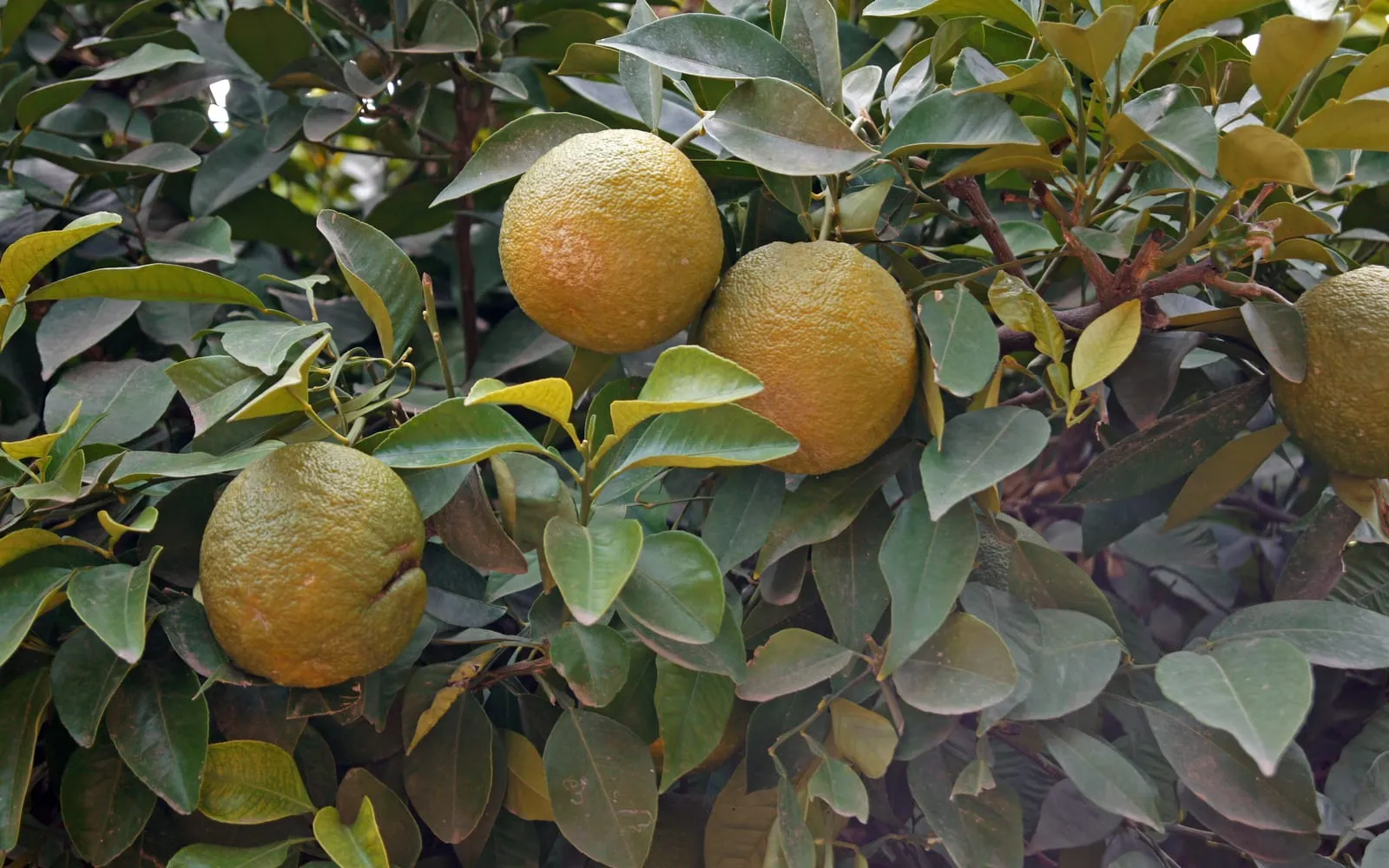
Fruit is round, 7 to 8 cm, with a rough deeply pitted rind ripening to a deep orange-red, and sour acidic flesh full of seeds.
The rough pitted skin distinguishes it from a sweet orange at a glance.
Where it is from
Citrus aurantium is a hybrid of pomelo and mandarin, arising in south-east Asia, and it is a sibling of the sweet orange rather than an ancestor of it.
Arab traders carried it west along the Mediterranean from the tenth century, and it was established in Spain, Sicily and North Africa long before the sweet orange arrived.
Seville became the centre of the trade, and Spanish groves still supply most of the fruit that reaches Europe each January.
Scottish marmalade tradition grew from that trade, and the Dundee story of a merchant buying a cargo of unsaleable bitter oranges is repeated more often than it is verified.
The species is also the standard rootstock for other citrus in many countries, valued for disease resistance and cold tolerance.
How it grows
Buy a grafted plant, and expect it to be sold as bitter orange or bigarade as often as Seville.
Pot into free-draining citrus compost in a container of 40 to 50 cm.
Stand it outside from late May in full sun, moving it out in stages, and bring it in during October.
A winter minimum of 4 to 5 deg C is enough, which allows a cool porch or an unheated but frost-free conservatory.
Water thoroughly and let the compost dry down, reducing water sharply in winter.
Prune in spring to keep the crown open, wearing gloves for the thorns.
Through the seasons
Spring brings a heavy flush of intensely scented flowers, usually in April and May.
Move the tree outside in late May and start fortnightly summer citrus feed.
Fruit sets in spring and swells through summer, with a natural drop in June.
Bring the tree under cover in October and switch to winter feed and much less water.
Fruit colours through late autumn and ripens in January and February, which is exactly when marmalade is made.
Pick when fully coloured. The fruit holds on the tree for several weeks once ripe.
Care difficulty
Moderate, and slightly easier than a sweet orange because of the greater cold tolerance.
The plant is vigorous and long-lived, and it is the rootstock other citrus are grafted onto for good reason.
The usual watering discipline applies, with overwatering the main risk.
Thorns are longer than on most citrus and make pruning a job for gloves.
Fruit is reliably produced under glass, and unlike a grapefruit it ripens within a single season.
Watering
Water thoroughly until it drains, then let the top few centimetres dry.
Twice weekly outdoors in summer, and monthly or less in a cool winter position.
Reduce water sharply when the tree comes indoors.
Never leave the pot standing in water.
Use rainwater where possible, since hard water causes yellowing between the veins.
Warning signs, diseases and pests
Leaf drop in winter. Overwatering or a warm dry room. Check the compost before watering again.
Yellow leaves with green veins. Iron shortage from hard water. Use sequestered iron.
Brown limpet bumps on stems. Scale insects. Scrub off with soapy water.
White fluff in leaf joints. Mealybug. Treat with horticultural soap.
Fine speckling with webbing. Red spider mite in dry indoor air. Mist and raise humidity.
Sticky leaves and black film. Sooty mould on honeydew. Treat the pest and wipe the leaves.
Blotchy yellow leaves with small, lopsided, bitter fruit that stays green at the base. Citrus greening, the world’s most destructive citrus disease and incurable once a tree is infected. Not established in Europe, Australia or New Zealand, where a sighting is reportable. Buy trees only from a certified, disease-free nursery.
Growing environment
Full sun outdoors from late May to October.
A cool bright winter position at 4 to 10 deg C, which is more forgiving than a sweet orange needs.
Free-draining citrus compost at pH 6 to 6.5.
Shelter from wind outdoors, since the tree carries heavy fruit.
A pot of 40 to 50 cm suits a mature tree, with grit worked into the compost and a saucer that is emptied after watering.
Feeding
Feed fortnightly with summer citrus feed from March to October.
Switch to winter citrus feed monthly from October to February.
Avoid overfeeding with nitrogen, which produces soft growth and long thorny shoots.
Sequestered iron corrects hard-water yellowing.
Repot every two or three years in spring, top-dressing in the intervening years.
Troubleshooting
Fruit inedibly bitter. Correct for the species. It is a cooking fruit rather than a dessert one.
Heavy flowering, little fruit. Poor pollination indoors. Brush between flowers or put the tree outside while flowering.
Fruit dropping small in June. Natural thinning.
Long whippy thorny growth. Too much nitrogen. Cut back in spring and reduce feeding.
Leaves dropping after coming indoors. Sudden change in light and temperature. Move it in before the heating goes on.
Marmalade failing to set. Not the tree’s fault. Include the pips and pith in a muslin bag, since that is where the pectin sits.
Seville orange problem guides
Not sure what is wrong? See the common vegetable pests guide.
- Scale insects on stems and leaf ribs
- Mealybug in the leaf joints
- Red spider mite in dry winter air
- Sooty mould growing on the honeydew those pests leave
- Leaf drop from cold draughts, overwatering or a sudden move
- Root rot from standing in water, which kills more citrus than cold
- Citrus greening, absent from Europe, Australia and New Zealand but present across much of the Americas and Asia