
Edible
Black Cumin
Nigella sativa
Also known as Nigella, Kalonji, Black seed, Black caraway
How to grow nigella, Nigella sativa. The black seed of kalonji, sowing it direct in spring, and how it differs from the love-in-a-mist in a flower border.
At a glance
- Difficulty
- Easy
- Water
- Rarely once established
- Light
- Full sun
- Temperature
- Hardy as a seedling. Autumn sowings overwinter in the south
- Hardiness
- USDA 3-10, RHS H4, hardy to -8 C
- Type
- Hardy annual
- Height
- 20-40 cm
- Native to
- western Asia
- Best month
- April and August in the Northern Hemisphere, October and February in the Southern Hemisphere
Hardy enough as a seedling that an autumn sowing overwinters where frosts stay light, and that earlier start is what ripens a full seed crop. It resents root disturbance, so sow direct. Seed needs a dry warm period to fill, and a wet August gives light chaffy seed.
Hardiness zones describe winter cold alone. Summer heat, humidity, rainfall and the length of the growing season decide as much, so treat the range as the outer limit rather than as a recommendation.
Every month named in this guide is for the temperate Northern Hemisphere. If you garden in the Southern Hemisphere, shift each one by six months, so April becomes October. Closer to the equator the wet and dry seasons matter more than the calendar, and the shift stops being a useful guide.
Edible, with limits
- Safe to eat
- The seeds
- Do not eat
- The seed oil in medicinal quantities
- Harm from
- Eating it
- Affects
- People
Nigella seed is a culinary spice eaten across the Middle East and south Asia and it is safe in food use. It appears on neither the RHS list of potentially harmful garden plants nor the ASPCA list. The caution attaches to black seed oil, which is sold as a supplement and taken in far larger quantities than anyone eats as a spice. Case reports describe contact dermatitis from the oil applied to skin, and there are documented cases of liver injury following high-dose supplementation. Standard references also advise against medicinal doses in pregnancy. Seed sprinkled on naan is a different proposition from a daily spoonful of concentrated oil. Note also that Nigella damascena, the ornamental love-in-a-mist, is a different species and is not a food plant.
Sources: RHS potentially harmful garden plants, ASPCA toxic and non-toxic plants
About
Nigella is the small angular black seed on Turkish bread and Indian naan, with a flavour somewhere between onion, oregano and black pepper. It has a confusing list of English names. Black cumin, black caraway and black onion seed all refer to it and none of them is accurate, since it is unrelated to cumin, caraway or onion.
The plant is a small feathery annual with pale blue flowers, closely related to the love-in-a-mist grown in flower borders. That relative, Nigella damascena, is a different species and is not a food plant, though the two look similar enough to be confused in a garden.
It is the easiest of the tropical-sounding spices in this wave to grow, because it is not tropical at all. Sown direct in spring on ordinary ground in full sun, it ripens seed reliably in a cool summer.
Appearance and character
An upright branching annual, 20 to 40 cm, feathery throughout.
Leaves are finely divided into narrow segments, mid green, giving the plant an airy look.
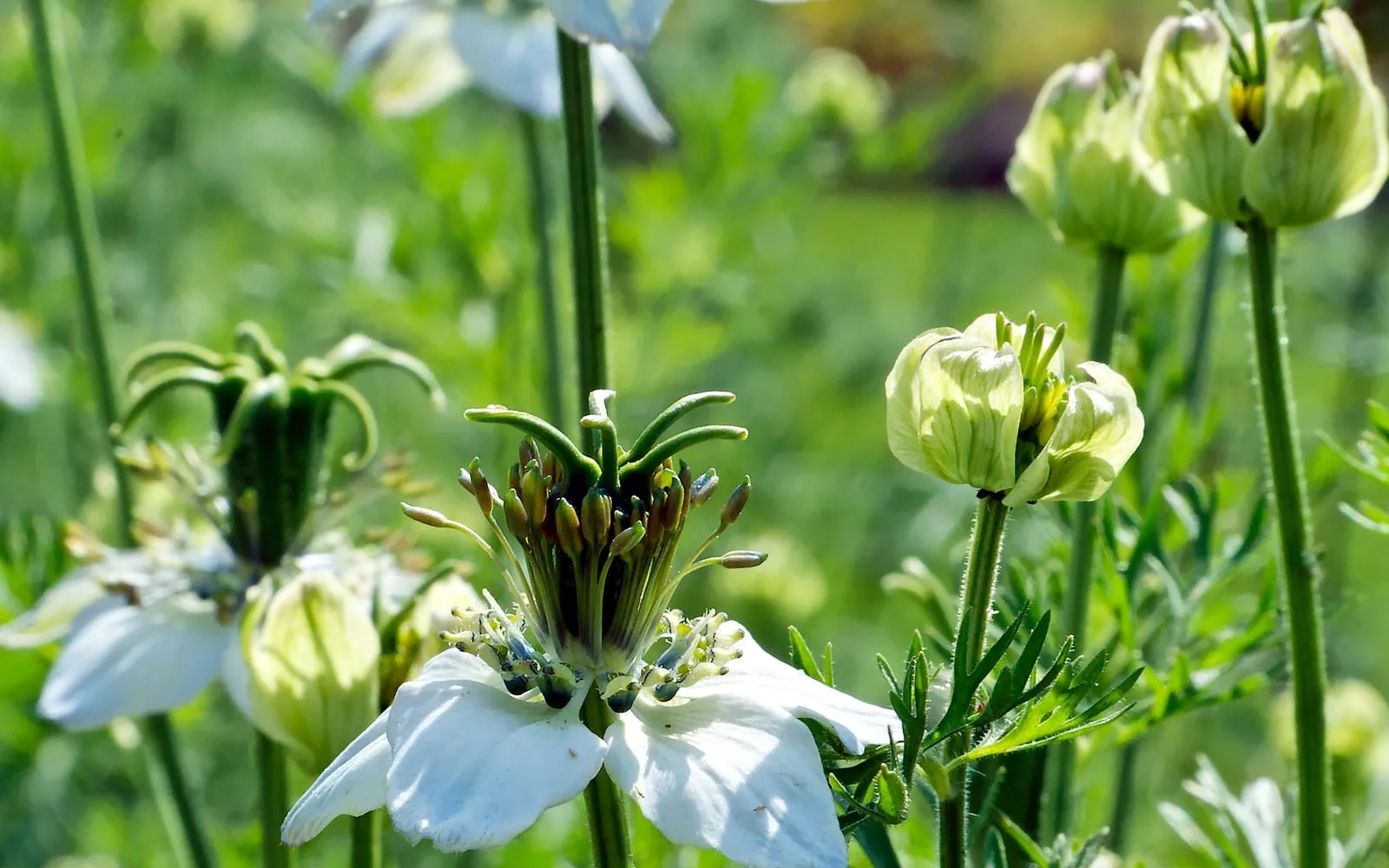
Flowers are 2 to 3 cm across, pale blue to white with greenish veining, with five petal-like sepals. They lack the ruff of thread-like bracts that surrounds the flowers of love-in-a-mist, which is the quickest way to tell the two apart.
Seed pods are inflated and rounded, with five to seven horn-like projections at the top, ripening from green to papery brown.
Seeds are small, angular, matt black and sharply three-sided, and they rattle in the ripe pod.
The scent is released when the seed is crushed or toasted, sharp and slightly peppery.
Where it is from
Nigella is native to western Asia, from the eastern Mediterranean through to Iraq and Iran, and it has been cultivated across the region for thousands of years.
Seeds were found in Tutankhamun’s tomb, which places its use in Egypt by the fourteenth century BC.
Its culinary range runs from Turkey and the Levant through Iran to India and Bangladesh. It goes on breads, into panch phoron, the Bengali five-spice mix, into pickles and into vegetable dishes.
Its medicinal reputation in the Islamic world is substantial and long-standing, based on a hadith describing the black seed as a remedy for every illness except death, and black seed oil is sold widely on that basis.
India and Egypt are among the main producers now, and the crop is grown across the Middle East and central Asia.
How it grows
Sow direct where it is to grow, from March to May. Nigella has a taproot and resents transplanting.
Sow thinly at 1 cm deep and thin to 20 cm. Germination takes two to three weeks in cool soil.
An autumn sowing in September works in the south of England, producing stronger earlier plants that flower in May.
Choose an open sunny position on free-draining ground. Rich soil gives you leafy plants with fewer seeds.
Water until established, then leave it.
Sow successionally at three-week intervals if you want a long flowering season.
Let the pods ripen fully on the plant. They go from green to papery brown and the seed rattles inside.
Cut whole plants when the pods are brown and dry them head-down in paper bags, then shake out the seed.
Let a few pods shed if you want it to return, which it does readily.
Through the seasons
Winter shows small seedlings from an autumn sowing in the south, and nothing from a spring one.
Spring is sowing, from March, and rapid growth from overwintered plants.
Early summer is flowering, from June, in pale blue.
Midsummer is when the pods inflate and fill.
Late summer is harvest, cutting whole plants once the pods are brown and papery.
Autumn is the second sowing window in the south, and the point at which self-sown seedlings appear.
Care difficulty
Easy, and it is the most straightforward spice crop in this wave.
Direct sowing is the only requirement worth stressing. The taproot resents disturbance and transplanted plants sulk.
Poor ground suits it. A rich bed gives you a taller leafier plant with fewer pods.
Heavy wet soil is the one condition it dislikes, since the roots rot.
Harvest timing is straightforward, since the pods hold their seed rather than shattering like caraway, so there is no rush once they brown.
It self-seeds moderately and returns without effort in a garden where it is happy.
Nothing else needs doing. No feeding, no staking, no watering once established.
Watering
Water the seedbed before sowing and keep it damp until germination.
Water seedlings in a dry spring until they are established.
After that, leave it. Nigella is drought tolerant and copes with a cool summer.
Water in a genuine drought if the plants wilt by mid-morning.
Stop watering once the pods start to brown, since dry conditions at ripening give better seed.
Water at the base rather than over the plants.
Warning signs, diseases and pests
Slugs take seedlings in a wet spring. Protect a new sowing.
Aphids gather on flowering stems and rarely need action.
Root rot in cold heavy ground kills plants outright. Improve drainage or grow it somewhere sharper.
Powdery mildew whitens the foliage in late summer, usually as the plants are finishing.
Tall leafy plants with few pods mean the ground was too rich.
Plants that stay small were sown too deep or transplanted.
Pods that never fill mean a poor season or crowded plants. Thin to 20 cm.
Growing environment
Full sun. Nigella in shade is thin and flowers poorly.
Free-draining soil of moderate fertility. It grows on dry stony ground in the wild.
Neutral to alkaline, around pH 6.5 to 7.5.
An open position, a vegetable bed edge or a gravel garden all suit it.
It is hardy enough to sow in March outdoors and it dies at the end of the season like any annual.
For pollinators the flowers are useful, and the inflated seed pods are worth leaving for their appearance into autumn.
Feeding
Nothing is needed in reasonable soil.
Avoid nitrogen, which produces leafy plants with fewer pods.
Compost dug in the previous autumn is adequate preparation.
A container plant takes a weak balanced feed every three weeks.
Lean growing gives better seed, which is true of every spice crop in this wave.
Troubleshooting
Is it the same as love-in-a-mist? No. Love-in-a-mist is Nigella damascena, an ornamental with a ruff of thread-like bracts around each flower, and it is not a food plant. Nigella sativa has no such ruff and its seed is the spice. They look similar enough to be confused in a garden.
Why is it called black cumin? A misleading name. It is unrelated to cumin, caraway or onion despite being called black cumin, black caraway and black onion seed. It is a buttercup relative.
Nothing came up. Sown too deep, or into cold wet ground. Sow at 1 cm from March, direct.
Lots of leaf and few pods. The ground was too rich. Grow it harder next time.
When do I harvest? Once the pods have gone papery brown and the seed rattles. The pods hold their seed rather than shattering, so there is no rush.
Can I transplant seedlings? Poorly. The taproot resents disturbance. Sow direct.
Is black seed oil safe? It is sold as a supplement and taken in far larger quantities than the spice. Cases of liver injury after high-dose supplementation are documented, and it is advised against in pregnancy. Seed on bread is a different matter.