
Outdoor plant
Flowering Currant
Ribes sanguineum
Also known as Red-Flowering Currant
How to grow flowering currant, Ribes sanguineum. Why the berries taste nothing like blackcurrants, pruning straight after flowering rather than in winter, and reviving a leggy shrub with renovation pruning.
At a glance
- Difficulty
- Easy
- Water
- Regularly while establishing, then rarely once mature
- Light
- Full sun to part shade
- Temperature
- Fully hardy
- Hardiness
- USDA 6-8, RHS H6, hardy to -20 C
- Type
- Deciduous shrub, living several decades
- Height
- 2-3.5 m
- Native to
- western North America
Fully hardy through a real winter, and untroubled by the early flowering season that catches out so many other spring shrubs, since the blooms are more cold-tolerant than most and tolerate all but the hardest late frost. It performs best where summers stay on the cool, mild side, and can look tired and prone to mildew by late summer in a hot, dry climate.
Hardiness zones describe winter cold alone. Summer heat, humidity, rainfall and the length of the growing season decide as much, so treat the range as the outer limit rather than as a recommendation.
Not known to be toxic
Flowering currant does not appear on the RHS or ASPCA lists of plants harmful to people or pets, and no toxic compound is documented in the species. The blue-black berries that follow flowering are not the crop currants of the kitchen, which come from related but distinct Ribes species bred for the purpose, and while they are not reported as poisonous, they are also thin-fleshed, bland and generally considered unpalatable rather than worth eating, so birds take most of them and gardeners rarely bother. A pet or child that eats a handful gets nothing worse than an unimpressive snack.
Sources: RHS potentially harmful garden plants, ASPCA toxic and non-toxic plants
About
Flowering currant is an ornamental Ribes grown for early spring flowers, not for edible fruit. It is related to fruiting currants, but the berries are small, dull and usually left for birds.
Its main value is the early display of pink to red flower clusters on bare or barely leafing stems. Those flowers also provide nectar for early bumblebees. The shrub is hardy, easy to grow in ordinary soil, and pruned after flowering.
Appearance and character
Leaves are palmately lobed with three to five lobes, toothed edges and a somewhat rough texture, 5 to 10 cm across, with the musky scent characteristic of the species when crushed or bruised.
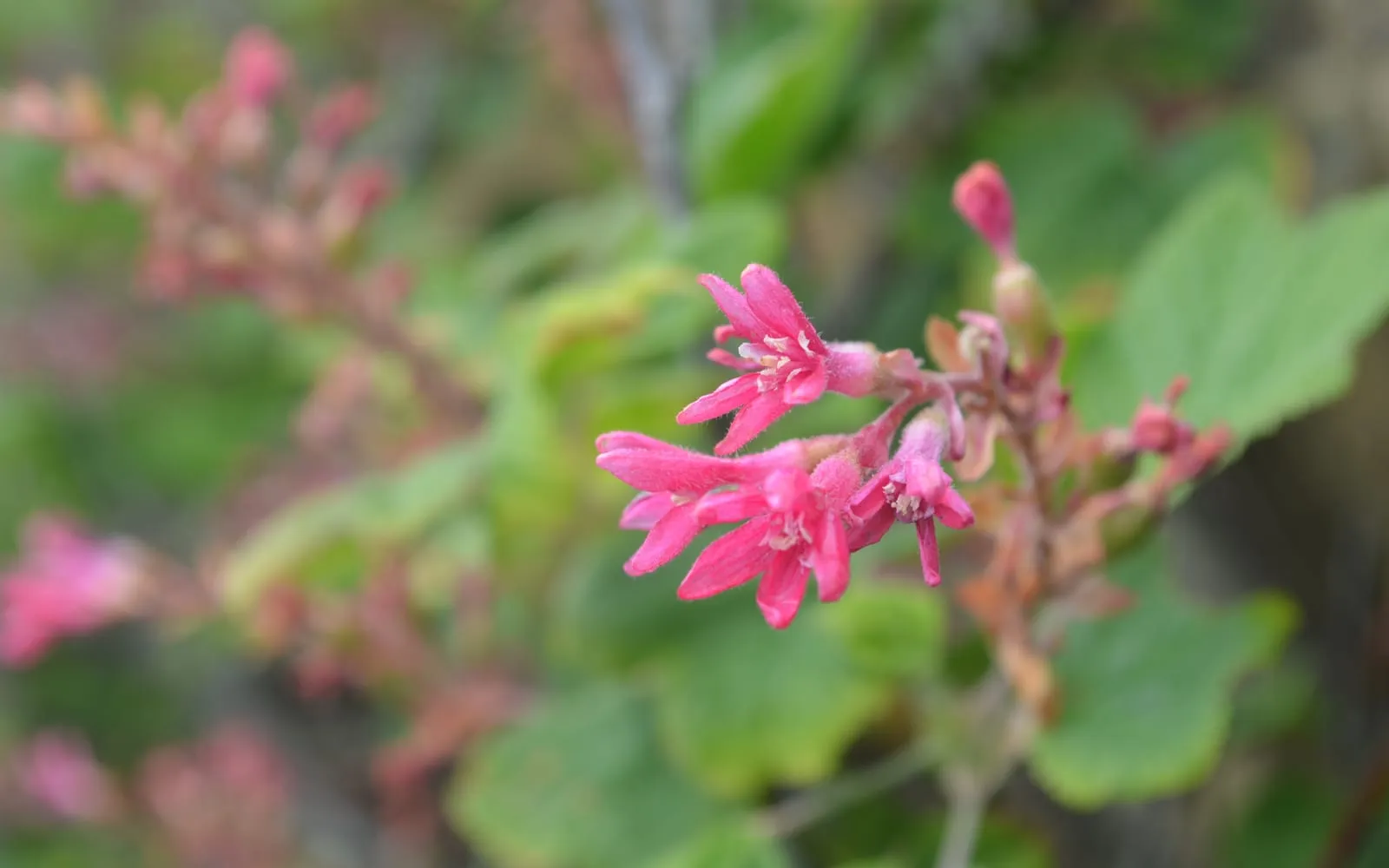
Flowers open in dense, drooping racemes of twenty to thirty tubular blooms, deep rose-pink to crimson in most garden forms, appearing on bare or barely leafing stems in early spring, well before many other shrubs have started into growth.
Berries follow in summer, small, round and blue-black with a whitish bloom, sparsely produced and mostly left for birds rather than gathered, in clear contrast to a fruiting currant bush grown deliberately for a heavy crop.
Growth is upright and deciduous, forming a rounded to slightly leggy shrub 2 to 3.5 m tall over time, and it responds well to renovation pruning if it becomes bare and woody at the base with age.
Where it is from
Ribes sanguineum is native to western North America, from British Columbia south through the Pacific coastal states, growing on woodland edges and open slopes in a climate defined by cool, wet winters and mild, often dry summers.
That coastal, maritime origin explains both its exceptional hardiness in winter and its preference for cooler summer conditions, since the species has never needed to cope with prolonged summer heat in the way plants from a more continental climate have.
How it grows
Plant in ordinary, well-drained garden soil in full sun to part shade; it is not fussy about soil type and tolerates a wide range without difficulty.
Prune immediately after flowering finishes in spring rather than in winter, removing a proportion of the oldest stems at the base each year to keep the shrub renewing itself, since flowers form on the previous year’s growth and pruning too late in the season removes next spring’s display before it forms.
Renovate an old, leggy plant by cutting a third of the oldest stems back hard to near ground level each year for three years running, which gradually replaces the whole framework with vigorous younger growth without sacrificing an entire season’s flowers at once.
Water well through the first two seasons while the root system establishes, after which it generally needs no supplementary watering beyond an extended dry spell.
Through the seasons
Late winter to early spring brings the main flowering display, opening on bare or barely leafing stems ahead of most other shrubs.
Spring is also the time to prune, immediately after flowering finishes, removing a portion of the oldest stems to encourage fresh growth from the base.
Summer brings full leaf and the sparse berry crop, along with the main risk period for powdery mildew in hot, dry conditions.
Autumn brings unremarkable leaf colour before the leaves fall, leaving the bare framework that will flower again the following spring.
Care difficulty
Easy, and one of the more reliable early-flowering shrubs for a temperate garden. It tolerates a wide range of soils, needs no special feeding on reasonable ground, and recovers well from hard pruning if it becomes overgrown. The main skill is pruning at the right time, straight after flowering rather than in winter, to avoid cutting off the following year’s display.
Watering
Water regularly through the first two growing seasons while the root system establishes, a deep soak rather than frequent light watering.
Once established, it generally needs no supplementary watering on reasonable soil except during an extended dry spell, when a deep soak helps reduce stress and lowers the risk of powdery mildew developing on drought-stressed foliage later in summer.
Warning signs, diseases and pests
Aphids cluster on soft new growth in spring, curling and distorting young leaves. A strong jet of water or an insecticidal soap controls light infestations, and natural predators usually bring heavier ones under control within a few weeks.
Powdery mildew shows as a white, dusty coating on the leaves, most common by late summer, particularly after a hot, dry spell that has stressed the plant. Improve air circulation by thinning crowded growth and ensure the plant is not short of water during dry periods.
Currant sawfly larvae, small green caterpillar-like larvae, can strip leaves rapidly, though they are a more significant risk to fruiting currant bushes grown for their crop than to this ornamental species, which tolerates some leaf loss without lasting harm.
Growing environment
Full sun to part shade suits it well; full sun generally produces the best flowering, though it tolerates a good amount of shade, particularly useful under the light canopy of deciduous trees where its early flowering happens before the canopy above has leafed out.
Ordinary, well-drained garden soil is fine, and it is not particular about pH or fertility.
Cool to moderate summer conditions suit it best. In a hot, dry summer climate, it can look tired by late summer and is more prone to powdery mildew than in a milder one.
Give it room to develop its natural upright, slightly arching form, since it does not respond well to tight, formal clipping, which removes much of the following year’s flowering wood.
Feeding
A balanced, general-purpose fertiliser applied once in spring is enough where soil is poor, but on reasonable garden soil this species generally needs no supplementary feeding at all.
A mulch of well-rotted compost applied in spring supplies adequate general fertility for most soils without the need for additional fertiliser.
Avoid heavy feeding, particularly with high nitrogen, which produces soft growth more prone to aphid attack and mildew later in the season.
Troubleshooting
It has flowered less each year and looks leggy and bare at the base. Renovation pruning is the fix. Cut a third of the oldest stems back hard to near ground level each spring for three years running, which gradually rebuilds the shrub with vigorous younger growth.
The leaves have a white, dusty coating by late summer. Powdery mildew, more likely after a hot, dry spell. Improve air circulation by thinning crowded stems and make sure the plant has not been short of water through summer.
Why don’t the berries taste like blackcurrants? They are a different, closely related species from the fruiting currants grown in the kitchen garden. Ribes sanguineum berries are thin-fleshed and generally considered not worth eating, grown for the flowers rather than for any crop.
When exactly should I prune it? Immediately after flowering finishes in spring, not in winter. Pruning in winter removes the wood that would otherwise flower that same spring, since flower buds form on the previous year’s growth.
Does it need a pollination partner to fruit? No, though as noted the berries are of little value regardless. If you want a genuine currant crop, plant a fruiting Ribes cultivar bred for that purpose alongside it rather than relying on this ornamental species.