
Outdoor plant
Giant Allium
Allium giganteum
Practical guidance for growing giant allium, Allium giganteum, including its tall stems, dense round flower heads, deep planting, dry summer dormancy, and toxicity to pets.
At a glance
- Difficulty
- Easy
- Water
- Water while it is actively growing in spring, then stop completely once flowering finishes
- Light
- Full sun
- Temperature
- Fully hardy once established
- Hardiness
- USDA 4-8, RHS H6, hardy to -20 C
- Type
- Hardy bulbous perennial, dormant through summer
- Height
- 90-150 cm in flower
- Native to
- central Asia, southwestern Asia
This mountain steppe bulb is adapted to a short, cold winter and a long, hot, dry summer, and its zone range describes only the cold half of that. A large bulb like this one stores enough reserve to flower reliably for years where summers dry out properly, but the same bulb sitting in damp ground through summer, common in a temperate garden with regular rain, can rot regardless of how mild or cold the preceding winter was.
Hardiness zones describe winter cold alone. Summer heat, humidity, rainfall and the length of the growing season decide as much, so treat the range as the outer limit rather than as a recommendation.
Toxic to pets if eaten
- Do not eat
- The bulb most of all, and the leaves to a lesser degree
- Harm from
- Eating it
- Affects
- Cats, dogs and horses
The ASPCA lists this species by name as ornamental onion, describing the same organosulfoxide toxic principle found in culinary onion and garlic, which damages red blood cells and can cause a form of anaemia in cats, dogs and horses that eat a significant quantity. Signs include vomiting, lethargy and pale gums, and they can take a day or two to appear after the plant is eaten, which sometimes delays an owner connecting the two. The bulb is large, up to 8 to 10 cm across, and carries the highest concentration of the toxic compound, while the strappy leaves above ground are comparatively unappealing to most animals and rarely eaten in quantity. There is no reported risk to people from ordinary garden contact; this is an ornamental bulb rather than a food crop.
Sources: ASPCA (Onion, Ornamental), RHS potentially harmful garden plants
About
Giant allium is the tallest of the ornamental onions commonly grown, sending up a single bare stem well over a metre high and topping it with a dense, perfectly round flower head the size of a grapefruit. It is a plant built for height and structure rather than for the huge, spidery flower heads of some of its relatives, and it earns its place at the back of a border on that alone.
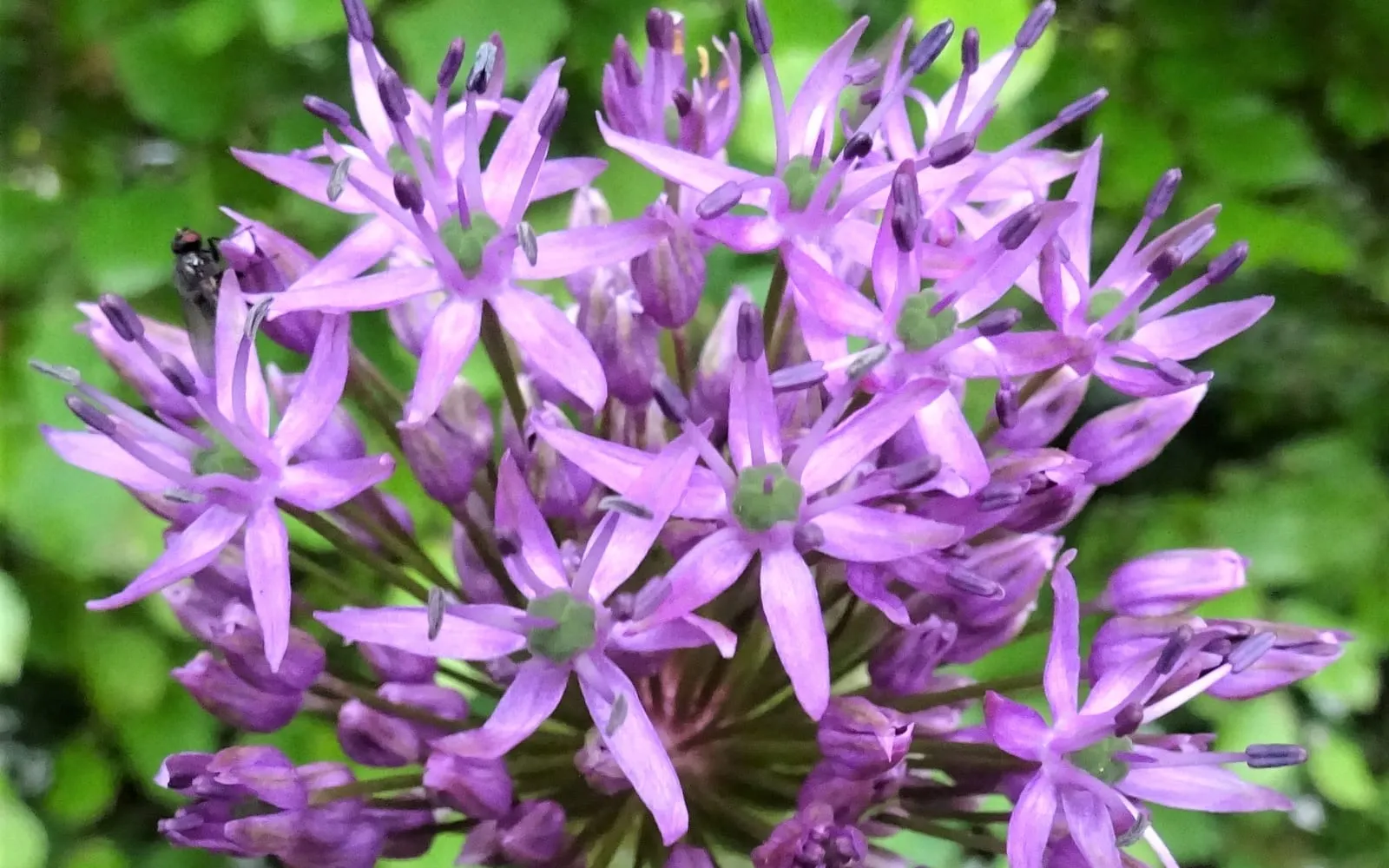
The flower head is made up of hundreds of small, tightly packed star-shaped florets rather than the fewer, larger florets of some other ornamental onions, which gives it a dense, almost solid look from a distance and a fine, textured one close up. Bees find it hard to resist, and a bed of giant allium in flower hums audibly on a warm day.
Appearance and character
The stem rises bare and leafless above a low rosette of strap-shaped, blue- green foliage that is already fading by the time the flower opens, a trait shared with most large ornamental onions and one worth planning for with underplanting.
The flower head itself is a tight, dense sphere, 10 to 15 cm across, packed with small purple-violet florets that open gradually from the bottom of the head upward, extending the display over several weeks rather than all opening at once. Individual florets are far smaller than those of the looser-headed ornamental onions, which is what gives this species its solid, rounded look rather than a starry, open one.
Once flowering finishes, the seed heads keep their round shape and turn a pale straw colour, standing through much of summer if left uncut and adding structure to a border long after the colour has gone.
Where it is from
Allium giganteum is native to the mountains of central and southwestern Asia, growing on dry, stony slopes at altitude where winters are cold and summers are long, hot and dry. The bulb’s large size is itself an adaptation to that climate, storing enough reserve to survive a long dry dormancy and still push up a tall flowering stem the following spring without any external feeding.
It reached European gardens in the mid-nineteenth century and has been grown as a specimen and cut flower ever since, prized for its height and for how well the dried seed head holds its shape, which made it a long-standing favourite for dried flower arrangements as well as for borders.
How it grows
Plant bulbs in autumn, setting them deep, around 15 to 20 cm, since a bulb this large needs real depth to anchor the eventual weight of a tall flowering stem and to stay properly insulated from summer heat. Space bulbs generously, at least 25 to 30 cm apart, since a mature clump spreads considerably wider than the bulb itself suggests.
Full sun and free-draining soil matter more for this species than for almost anything else in the border, given how large the bulb is and how much rot can spread through it once wet ground takes hold. A raised bed, a gravel garden, or soil improved with coarse grit before planting all help where drainage is naturally poor.
Leave the foliage to die back completely and naturally rather than tidying it away early, since it feeds the bulb for the following year’s display, and interplant with something bushy that fills in as the rosette fades and yellows.
Unlike some other ornamental onions, giant allium self-seeds only sparsely in most gardens, so an established planting tends to stay roughly the size it was planted rather than spreading rapidly on its own, and topping up numbers with fresh bulbs every few years keeps a display at full strength.
Through the seasons
Winter is quiet below ground, with the first leaf tips sometimes showing through in a mild spell.
Spring brings rapid growth: the leaf rosette first, then the stem extending quickly and the flower head opening in late spring or early summer.
Summer is dormancy once flowering finishes. The bulb rests underground through the hottest, driest months and needs no water at all during this period.
Autumn is planting time for new bulbs, set deep before the ground turns cold.
Care difficulty
Easy for the display it gives, provided the site is right. The bulb needs for full sun, free-draining soil and to be left alone once planted; beyond that, it needs no staking despite its height, since the stem is surprisingly rigid for its length, and no regular feeding. The one common mistake is planting it too shallow or in ground that holds water over summer, both of which shorten the life of a bulb that would otherwise return reliably for many years.
Watering
Water while the plant is actively growing in spring if rainfall is light, which supports the bulb in building the reserves for a strong flower head. Stop watering once flowering finishes and the foliage begins to yellow.
Summer needs to stay dry. A large bulb sitting in consistently damp soil through summer dormancy is more prone to rot than a smaller one, because there is more tissue for rot to spread through once it starts.
Warning signs, diseases and pests
Allium white rot causes yellowing, wilting foliage and a white fungal growth around the base of the bulb, which softens and rots away entirely. There is no cure once established, and affected bulbs and the surrounding soil should be removed rather than replanted with any allium for several years afterwards.
Rust shows as small orange pustules on the leaves, usually after a wet spring. It rarely threatens the bulb itself and mostly affects the look of the foliage, which is already fading by flowering time in any case.
Squirrels and mice dig up and eat the bulbs, drawn by their large size, and are the most likely cause of newly planted bulbs disappearing before they ever come up. A layer of chicken wire pegged over a fresh planting, removed once shoots appear, protects them through the vulnerable weeks.
Waterlogging over summer dormancy is the leading cause of an established clump failing to return, softening and rotting the bulb underground where the damage stays invisible until nothing appears the following spring.
Growing environment
Full sun and free-draining soil are essential for a bulb this large to thrive for more than a season or two. A raised bed, a sloped border, or ground improved with coarse grit all suit it far better than a flat, moisture-retentive one.
Give it space at the back or middle of a border where its bare stem and round flower head can be appreciated above lower planting, since the fading rosette at its base is rarely attractive by the time the flower is at its best.
It tolerates fairly poor soil and often performs better in lean ground than in a rich, regularly irrigated border, where the risk of summer rot rises considerably.
Feeding
A light application of bonemeal or a general bulb fertiliser in early spring, as growth resumes, is enough to support a strong flower head. Rich or frequent feeding is unnecessary and offers no real benefit to a bulb already storing most of what it needs.
No feeding is needed once the plant enters summer dormancy, since a resting bulb has no active roots to take anything up.
Troubleshooting
The flower head is smaller than in previous years. Overcrowding or a bulb running out of stored reserve are the two likeliest causes. Lift and divide a congested clump in autumn, replanting with more space between bulbs, and consider topping up an old planting with fresh bulbs.
My bulbs rotted over summer and never came back. Wet soil during dormancy is almost always responsible. Choose a sunnier, better-drained spot for replacement bulbs rather than the same position, or raise the bed with grit worked through it.
Do I need to stake the stems? No. The stem is rigid and holds the flower head upright without support in all but the most exposed, windy sites, where a discreet cane is a reasonable precaution rather than a routine necessity.
Why has it not spread the way my neighbour’s has? Giant allium self-seeds only sparingly compared with some other ornamental onions, so a planting tends to stay close to the number of bulbs originally put in. Add fresh bulbs every few years to build up numbers rather than relying on self-seeding.
Is it safe to grow where pets dig? Treat it with the same caution as any onion relative. The large bulb is the most toxic part and the part most likely to attract a digging dog, so keep new plantings fenced off until the bulbs are established and covered by growth.