
Edible
Sapodilla
Manilkara zapota
Also known as Chikoo, Sapota, Naseberry, Chicle tree
How to grow sapodilla, Manilkara zapota. The fruit that tastes of brown sugar and malt, the latex that made chewing gum, and why an unripe one turns your mouth to felt.
At a glance
- Difficulty
- Moderate
- Water
- Weekly in growth, sparingly in winter
- Light
- Full sun
- Temperature
- Minimum 5 deg C. A mature tree takes a light frost
- Humidity
- Moderate
- Hardiness
- USDA 10-11, RHS H1b, hardy to 5 C
- Type
- Tender evergreen tree
- Height
- 8-30 m in the open, 1.5-2 m in a pot
- Native to
- southern Mexico, Central America
- Best month
- May and June in the Northern Hemisphere, November and December in the Southern Hemisphere
Seasonally dry Central America. It is unusually tolerant of salt spray, wind and drought, which makes it a coastal tree in the tropics. The latex was the original base of chewing gum.
Hardiness zones describe winter cold alone. Summer heat, humidity, rainfall and the length of the growing season decide as much, so treat the range as the outer limit rather than as a recommendation.
Every month named in this guide is for the temperate Northern Hemisphere. If you garden in the Southern Hemisphere, shift each one by six months, so May becomes November. Closer to the equator the wet and dry seasons matter more than the calendar, and the shift stops being a useful guide.
Edible, with limits
- Safe to eat
- The ripe flesh
- Do not eat
- Unripe fruit and the latex in it, and the seeds
- Harm from
- Eating it
- Affects
- People
Ripe sapodilla is food and no reputable source treats it as harmful. An unripe one is a different experience. Green fruit is loaded with tannins and a sticky white latex, and eating it turns the mouth dry and rough for an hour or more; it is unpleasant rather than dangerous, though a large quantity is constipating. The seeds carry a hooked projection at one end, and swallowing one can catch in the throat or gut, so the seeds should always be removed before the fruit is given to a child. Sapotinine and saponins in the seed make them mildly toxic if chewed in quantity, which nobody does by accident. The latex is chicle, the original base of chewing gum, and it is inert.
Sources: RHS potentially harmful garden plants, ASPCA toxic and non-toxic plants
About
Sapodilla tastes of brown sugar. A ripe one is soft, grainy and sweet, with malt and pear behind it, and it is eaten with a spoon out of the halved fruit like a small kiwi.
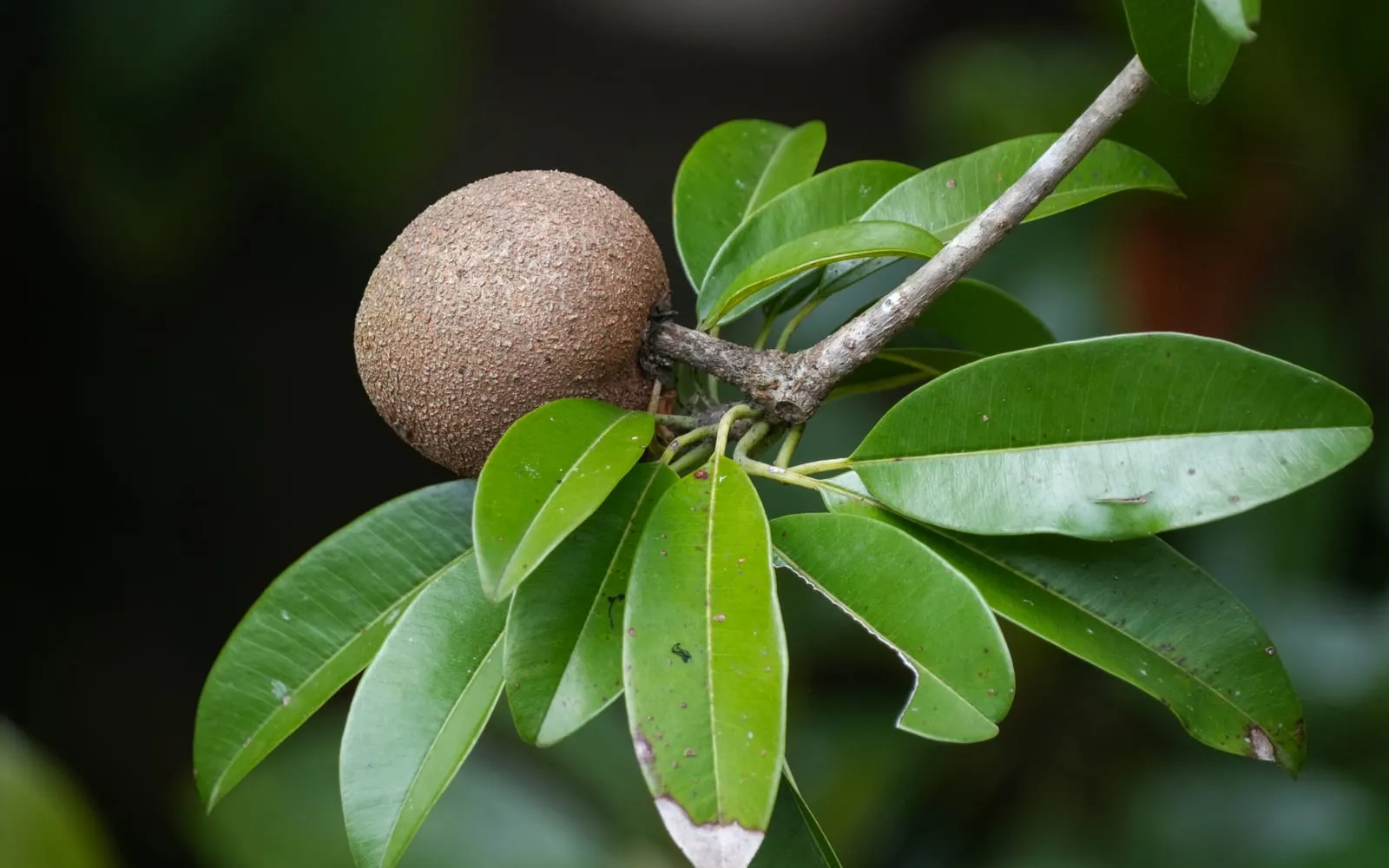
Judging ripeness is where people go wrong. Under the dull brown skin an unripe sapodilla is packed with tannin and sticky latex, and one mouthful of a green one leaves the mouth feeling like felt.
The tree gave the world chewing gum. Chicle, the latex tapped from the trunk, was the base of every commercial chewing gum until synthetic substitutes took over in the mid twentieth century, and Mexican chicleros still tap wild trees on a small scale.
Appearance and character
A dense upright evergreen tree, slow growing, 8 to 30 m in the open, with branches arranged in rough tiers.
Bark is dark grey-brown and rough, and all parts bleed a sticky white latex when cut.
Leaves are alternate but crowded at the shoot tips into apparent whorls, elliptic, 7 to 15 cm, glossy dark green, leathery, with a smooth margin.
Flowers are small, about 1 cm, bell-shaped, pale greenish white, and hang singly on short stalks in the leaf axils.
Fruit is round to oval, 4 to 10 cm, with a rough matt brown skin that looks like a potato and often carries a fine scurf.
Flesh is pale yellow-brown to russet, soft when ripe, with a faintly granular texture from stone cells, and it is very sweet.
Seeds are three to twelve, black, flat and glossy, each with a small hook at one end.
Ripeness is judged by a slight give and by scratching the skin, which shows brown rather than green underneath on a ready fruit.
Where it is from
Sapodilla is native to southern Mexico, Belize and Guatemala, where it grows in the lowland forest of the Yucatan and the Peten.
The Maya used it for both fruit and timber, and sapodilla beams cut two thousand years ago survive in Mayan buildings because the wood is exceptionally hard and durable.
Chicle made the tree internationally significant. Latex tapped from wild trees was chewed locally, reached the United States in the nineteenth century, and became the base of the chewing gum industry until synthetic gum bases replaced it.
The Spanish carried it to the Philippines and from there it spread through South and South East Asia, where India adopted it thoroughly under the name chikoo.
India is now the largest producer, followed by Mexico, Guatemala and Venezuela.
Temperate markets see sapodilla in South Asian and Caribbean groceries under the names chikoo and naseberry.
How it grows
Sow seed from a ripe fruit. Sapodilla seed keeps for months and germinates at 22 to 28 deg C in three to six weeks.
Buy a grafted plant if fruit is the aim. Seedlings take five to eight years and give variable fruit.
Grow in free-draining compost. This species tolerates poor, sandy and limy ground better than most tropical fruit.
Give full sun and a minimum of 5 deg C, with 20 to 30 deg C for growth.
Water weekly in growth and sparingly in winter.
Feed monthly from April to September.
Expect very slow growth. Sapodilla is among the slowest trees in this collection and a few centimetres a year in a pot is normal.
Prune lightly to shape, since the tree is naturally dense and tidy.
Expect fruit on a grafted plant in three to four years under warm glass, taking four to eight months from flower to ripe fruit.
Through the seasons
Winter is a cool rest above 5 deg C, watered sparingly and unfed.
Spring brings a growth flush and the first flowers. Repot and start feeding.
Early summer is flowering and setting, and the tree flowers over a long period.
Midsummer is fruit swell, which is slow.
Autumn is harvest for spring-set fruit, and the point to reduce feeding.
Late autumn is when to cut watering back for the winter rest.
Care difficulty
Moderate, and easier than most tropical fruit trees in every respect but speed.
Cold tolerance is good. A minimum of 5 deg C suffices and a mature tree takes a light frost.
Soil is undemanding, and it grows on limy ground where many tropical fruits will not.
Drought tolerance is good once established.
Slowness is the real obstacle. This is one of the slowest trees here, and a seedling takes five to eight years to fruit.
Fruit ripening off the tree is a help, since sapodilla is picked mature and ripened indoors.
A grafted plant under warm glass is a realistic prospect for a crop, which cannot be said of most of these plants.
Watering
Water weekly in growth, giving a thorough soak and letting the surface dry.
Reduce sharply in winter, keeping the compost barely damp.
Drain fully.
Water steadily through fruit swell to avoid drop.
Tap water is fine, including hard water, since this species tolerates alkalinity.
Keep humidity moderate.
Established plants tolerate a dry spell without complaint.
Warning signs, diseases and pests
A mouth-puckering fruit means it was picked or eaten unripe. Scratch the skin, and if it shows green underneath the fruit is not ready.
Sticky white latex on a cut surface is normal for the species.
Brown limpets on the stems are scale.
White fluff in the leaf axils and around the fruit stalk is mealybug.
Fine webbing on the leaves is spider mite in dry heated air.
Wilting in damp compost is root rot.
Very slow growth is the species rather than a problem.
Leaf drop after a cold spell is chill damage. Cut back to live wood in spring.
Fruit dropping small usually means irregular watering or too heavy a set.
Growing environment
A frost-free greenhouse or conservatory, standing outdoors in a warm summer.
Minimum 5 deg C, with 20 to 30 deg C for growth and fruit.
Full sun.
Moderate humidity.
Free-draining compost of moderate fertility, tolerant of lime.
pH from 6.0 to 8.0.
A pot of 40 cm or more for a fruiting plant.
Shelter from cold wind.
Feeding
Feed monthly from April to September with a balanced liquid feed.
Switch to a high-potash feed as fruit swells.
Stop feeding at the end of September.
Give nothing through winter.
Top-dress or repot every second spring, since growth is slow and a pot lasts.
Add magnesium if older leaves yellow between the veins.
Keep feeding moderate, since heavy feeding does not speed a slow tree.
Troubleshooting
How do I tell when one is ripe? Scratch the skin with a fingernail. Brown underneath means ready, green means wait. A ripe one also gives slightly under a thumb.
I ate one and my mouth went dry and rough. It was unripe. Green sapodilla is loaded with tannin and latex, and the effect lasts an hour or so. It is unpleasant rather than harmful.
Is this where chewing gum came from? Yes. Chicle, the latex tapped from the trunk, was the base of every commercial chewing gum until synthetic bases replaced it in the mid twentieth century.
Should I eat the seeds? No. Remove them. Each has a small hook at one end that can catch in the throat, and they are mildly toxic if chewed.
It has hardly grown. Sapodilla is among the slowest trees in cultivation. A few centimetres a year in a pot is normal.
Will it fruit in a pot? A grafted plant under warm glass will fruit in three or four years. A seedling takes five to eight and gives variable fruit.
What is chikoo? The Indian name for this fruit. Naseberry is the Jamaican one. All three names are the same species.
Can I grow it in chalky soil? Yes. Sapodilla tolerates limy and sandy ground better than almost any other fruit in this collection.
Sapodilla problem guides
Not sure what is wrong? See the common vegetable pests guide.