
Outdoor plant
Star of Persia
Allium christophii
Practical guidance for growing star of Persia, Allium christophii, including its huge starry flower head, short sturdy stems, dry summer dormancy, self-seeding, and toxicity to pets.
At a glance
- Difficulty
- Easy
- Water
- Water while it is in leaf during spring, then stop completely once the foliage yellows
- Light
- Full sun
- Temperature
- Fully hardy once established
- Hardiness
- USDA 4-8, RHS H6, hardy to -20 C
- Type
- Hardy bulbous perennial, dormant through summer
- Height
- 30-45 cm in flower
- Native to
- central Asia, Iran
Winter cold is never the limiting factor for star of Persia. It comes from mountain steppe with a short, cold winter and a long, hot, dry summer, and the bulb needs that dry season during dormancy. Gardens with reliably dry summers see the bulb multiply and flower for years; gardens with warm, wet summers, common in oceanic climates, risk losing bulbs to rot even where winters stay well within its hardiness range.
Hardiness zones describe winter cold alone. Summer heat, humidity, rainfall and the length of the growing season decide as much, so treat the range as the outer limit rather than as a recommendation.
Toxic to pets if eaten
- Do not eat
- The bulb most of all, and the leaves to a lesser degree
- Harm from
- Eating it
- Affects
- Cats, dogs and horses
The ASPCA's specific entry for ornamental onion names Allium giganteum, but the toxic principle, an organosulfoxide compound that damages red blood cells, runs through the ornamental onions as a group, star of Persia included. Cats, dogs and horses that eat a significant quantity can develop a form of anaemia, with signs including vomiting, lethargy and pale gums that may not appear for a day or two after eating. The bulb carries the highest concentration and is the part most likely to be dug up and chewed, since the strappy foliage above ground is far less appealing to most pets. Ornamental onions are grown for their flowers rather than eaten by people, so there is no comparable culinary exposure the way there is with garden chives or spring onions.
Sources: ASPCA (Onion, Ornamental), RHS potentially harmful garden plants
About
Star of Persia carries one of the largest flower heads of any bulb grown in gardens, a loose, spiky sphere that can reach 20 cm or more across on a stem barely half that tall. The scale is what people remember. A single head looks disproportionate to the plant beneath it, and a clump of several makes a strong metallic burst of colour against almost anything planted around it.
Unlike the taller ornamental onions bred for height at the back of a border, star of Persia sits low and sturdy, its short stem more than able to carry the weight of its own flower head without staking. It self-seeds readily where it is happy, so a modest planting can turn into a naturalised drift over several years without any bulbs being added.
Appearance and character
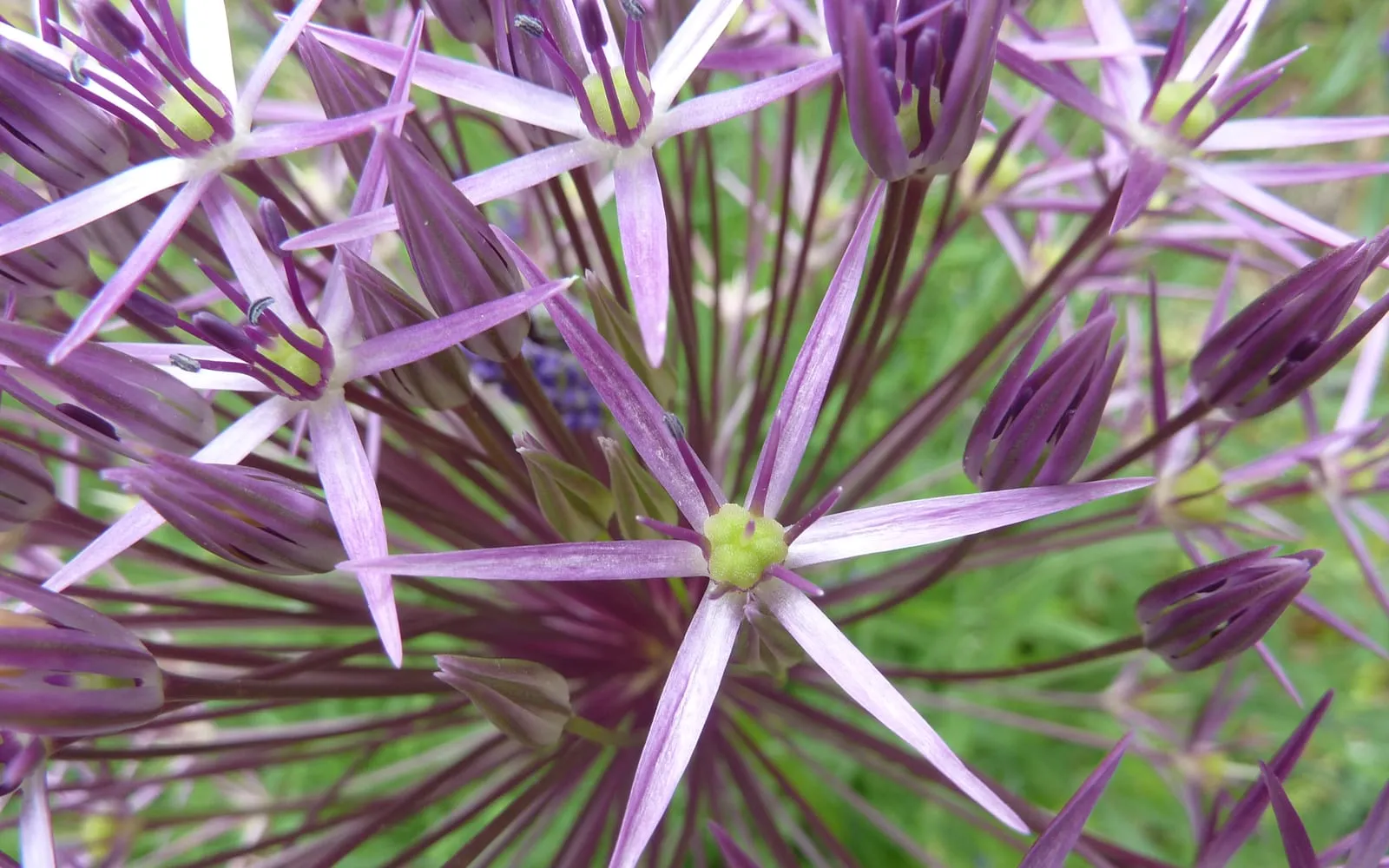
The flower head is a loose umbel rather than the tight, dense ball of many other ornamental onions, made up of thirty to eighty individual star-shaped florets, each one large enough, at 3 to 4 cm across, to be appreciated on its own rather than blurring into the mass. The colour is a metallic amethyst-pink with a faint silvery sheen, particularly striking in low, angled light.
Below the flower, the leaves form a low rosette that is often fading or already going papery and brown by the time the flower head is at its best, which is worth planning for: this is a plant better underplanted with something to hide its own foliage than grown as a bare specimen.
Once the flowers fade, the seed heads keep their shape and colour for weeks, turning a soft parchment tone, and are commonly left standing or cut and dried for arrangements, which hold their star pattern indefinitely once dry.
Where it is from
Allium christophii is native to the mountains of central Asia and Iran, growing on dry, stony slopes and steppe grassland at moderate to high altitude. Its natural range experiences a cold winter followed by an intensely hot, dry summer, and the bulb’s growth cycle, up in late winter, flowering in early summer, then dormant through the hottest months, follows that rhythm closely.
It was introduced to European gardens in the nineteenth century, named for the German plant collector who first sent seed back, and has since become one of the most widely grown ornamental onions for its combination of enormous flower head and comparatively compact stature.
How it grows
Plant bulbs in autumn, about 10 to 15 cm deep, in full sun and free-draining soil. Ordinary or even fairly poor soil suits it better than a rich, moisture-retentive border, since the bulb’s real requirement is dry ground over summer rather than fertility.
A gravel garden, a raised bed, or a border on a slope all suit it well, anywhere the water drains away quickly rather than sitting around the bulb. In heavier soil, dig in coarse grit before planting or plant slightly proud of the surrounding ground so excess water sheds away from the bulb.
Leave the foliage to die back naturally after flowering rather than tidying it away, since the leaves feed the bulb for the following year’s display during that period even as they turn increasingly unattractive.
It self-seeds freely in a spot it likes, and seedling bulbs take several years to reach flowering size, so an established clump gradually thickens with plants at different stages rather than flowering uniformly every year.
Through the seasons
Winter is mostly quiet below ground, though mild spells can bring the first leaf tips through in a sheltered spot.
Spring brings the leaf rosette fully into growth, followed by the flower stem extending rapidly and the huge flower head opening in late spring to early summer.
Summer is dormancy. The foliage dies back completely and the bulb rests underground through the hottest, driest part of the year, needing no water at all.
Autumn is the planting season for new bulbs, and a reasonable time to lift and divide an established clump that has become congested.
Care difficulty
Easy, provided the site suits it. Full sun and free-draining soil are close to non-negotiable, since a bulb planted in heavy, moisture- retentive ground is fighting its own dormancy every summer and rarely lasts more than a season or two. Given the right spot, it needs almost no attention. It needs no staking despite the size of the flower head, no regular feeding, and no watering once established beyond the odd dry spring.
Watering
Water while the leaves are actively growing in spring if the season is dry, since this is the period when the bulb is building the reserves for flowering. Once the flower has finished and the foliage begins to yellow, stop watering entirely.
Summer dormancy needs to stay dry. A bulb watered through summer, whether directly or by nearby irrigation intended for other planting, is far more likely to rot than one left alone in dry ground until autumn.
Warning signs, diseases and pests
Allium white rot causes yellowing, wilting foliage and a white fungal growth around the base of the bulb, which softens and rots. There is no cure once it takes hold, and infected bulbs and the soil immediately around them should be removed rather than replanted with alliums for several years.
Rust shows as small orange pustules on the leaves, usually in a wet spring. It rarely threatens the bulb itself and is more a cosmetic problem, cleared by removing badly affected leaves.
Slugs and snails graze the earliest young leaves in a wet spring, though established clumps generally outgrow the damage quickly.
Waterlogging over summer dormancy is the most common way this bulb is lost, softening and rotting it below ground where the damage goes unnoticed until nothing comes up the following spring. Improve drainage rather than replanting into the same wet spot.
Growing environment
Full sun and free-draining soil are the two conditions that matter most. A gravel garden, a raised bed, or any border that dries out properly over summer all suit this bulb far better than a rich, well-irrigated one.
It tolerates poor and even fairly infertile soil, and in fact often performs better in it than in a heavily improved border, since lean ground rarely stays wet for long after rain.
Underplant it with something low that fills in as its own leaves fade, since the rosette below the flower head is rarely attractive by the time the bloom is at its best.
Feeding
A light application of bonemeal or a general bulb fertiliser in early spring, as the leaves emerge, is enough to support strong flowering. Rich feeding is unnecessary and can push soft growth that copes worse with the dry summer ahead.
No feeding is needed once the plant enters dormancy, and none should be applied then, since a resting bulb has no active roots to take it up.
Troubleshooting
The flower head opened much smaller than I expected. A young, immature bulb, most likely a self-sown seedling not yet at full flowering size. Established bulbs planted at the right depth in a sunny, free-draining spot produce the largest heads, and size increases over several seasons.
My bulbs rotted over the summer. Wet soil during dormancy is almost always the cause, whether from rainfall, nearby irrigation, or naturally heavy ground. Move new bulbs to a drier, sunnier spot with better drainage rather than replanting into the same conditions.
Can I leave the seed heads on the plant? Yes, and many gardeners do, since the dried seed heads hold their star shape and colour for weeks and add structure to a border into autumn. Remove them before seed drops if self-seeding is not wanted.
Does it need staking? No. The stem is short and sturdy relative to the size of the flower head, unlike some of the taller ornamental onions, and stands without support in all but the most exposed sites.
Is it safe to grow where dogs dig in the border? Treat it with the same caution as any onion relative. The bulb is the most toxic part and the part most likely to be dug up, so a dog with a habit of excavating bulbs is worth keeping away from a planting area until it is well established and covered by growth.