
Edible
Durian
Durio zibethinus
Also known as King of fruits, Dulian, Thurian
How to grow durian, Durio zibethinus. The smell that gets it banned from hotels, why a falling one can kill, the alcohol interaction that is real, and what it tastes like once you get past the door.
At a glance
- Difficulty
- Difficult
- Water
- Two or three times a week year round
- Light
- Shade when young, full sun when mature
- Temperature
- Minimum 15 deg C, and damage begins below 10 deg C
- Humidity
- Very high
- Hardiness
- USDA 11-12, RHS H1b, hardy to 15 C
- Type
- Tender evergreen tree
- Height
- 25-50 m in forest, 2 m in a pot
- Native to
- Borneo, Sumatra, the Malay peninsula
- Best month
- June and July in the Northern Hemisphere, December and January in the Southern Hemisphere
Wet equatorial Borneo, Sumatra and the Malay Peninsula. It wants no dry season, no cool spell and deep soil, and it is among the least adaptable tropical fruit. Trees fruit from about year seven from grafts.
Hardiness zones describe winter cold alone. Summer heat, humidity, rainfall and the length of the growing season decide as much, so treat the range as the outer limit rather than as a recommendation.
Every month named in this guide is for the temperate Northern Hemisphere. If you garden in the Southern Hemisphere, shift each one by six months, so June becomes December. Closer to the equator the wet and dry seasons matter more than the calendar, and the shift stops being a useful guide.
Edible, with limits
- Safe to eat
- The soft aril around each seed
- Do not eat
- The seed raw, and the fruit taken with alcohol
- Harm from
- Eating it
- Affects
- People
Durian flesh is food and is eaten in enormous quantity across South East Asia. Two cautions carry real evidence. The first is alcohol. Durian contains sulphur compounds that inhibit aldehyde dehydrogenase, the enzyme that clears acetaldehyde from the blood, and laboratory work has confirmed the mechanism; combining durian with a heavy drink produces flushing, racing heart, nausea and a severe hangover, which is why the pairing is warned against across the region rather than being folklore. The second is quantity. Durian is very high in sugar and fat, and people with diabetes are advised to be careful with it. Raw seeds contain cyclopropene fatty acids and are not eaten raw, though they are boiled or roasted and eaten safely. The physical hazard is the largest one in practice: a ripe durian weighing two or three kilograms falling from thirty metres onto a spiked shell kills orchard workers and passers-by every year.
Sources: RHS potentially harmful garden plants, ASPCA toxic and non-toxic plants
About
Durian divides people more sharply than any other food. The smell is the obstacle. It is sulphurous and oniony with a sweetness underneath, and it carries strongly enough that Singapore’s transport system, most Thai hotels and many airlines ban the fruit outright.
Past the smell, the flesh is a soft custard, rich and heavy, tasting of almonds, caramel and something savoury underneath. People who like it like it very much.
Durian falls when ripe rather than being picked, from as high as thirty metres, and a two-kilogram spiked fruit landing at that speed causes deaths in orchard districts every season. Orchards in Thailand and Malaysia are closed to visitors in the weeks the crop comes down.
Appearance and character
A tall straight forest tree, 25 to 50 m in the wild, with a buttressed trunk and a high open crown.
Leaves are alternate, oblong, 10 to 20 cm, dark glossy green above, with an underside of coppery or silvery scales that catch the light.
Flowers grow directly from the trunk and older branches, which is cauliflory, in clusters of three to thirty. They are large, cream to gold, open at night and are pollinated by bats.
Fruit is round to oblong, 15 to 30 cm, weighing one to four kilograms, covered in hard sharp pyramidal spines. Colour runs green to brown.
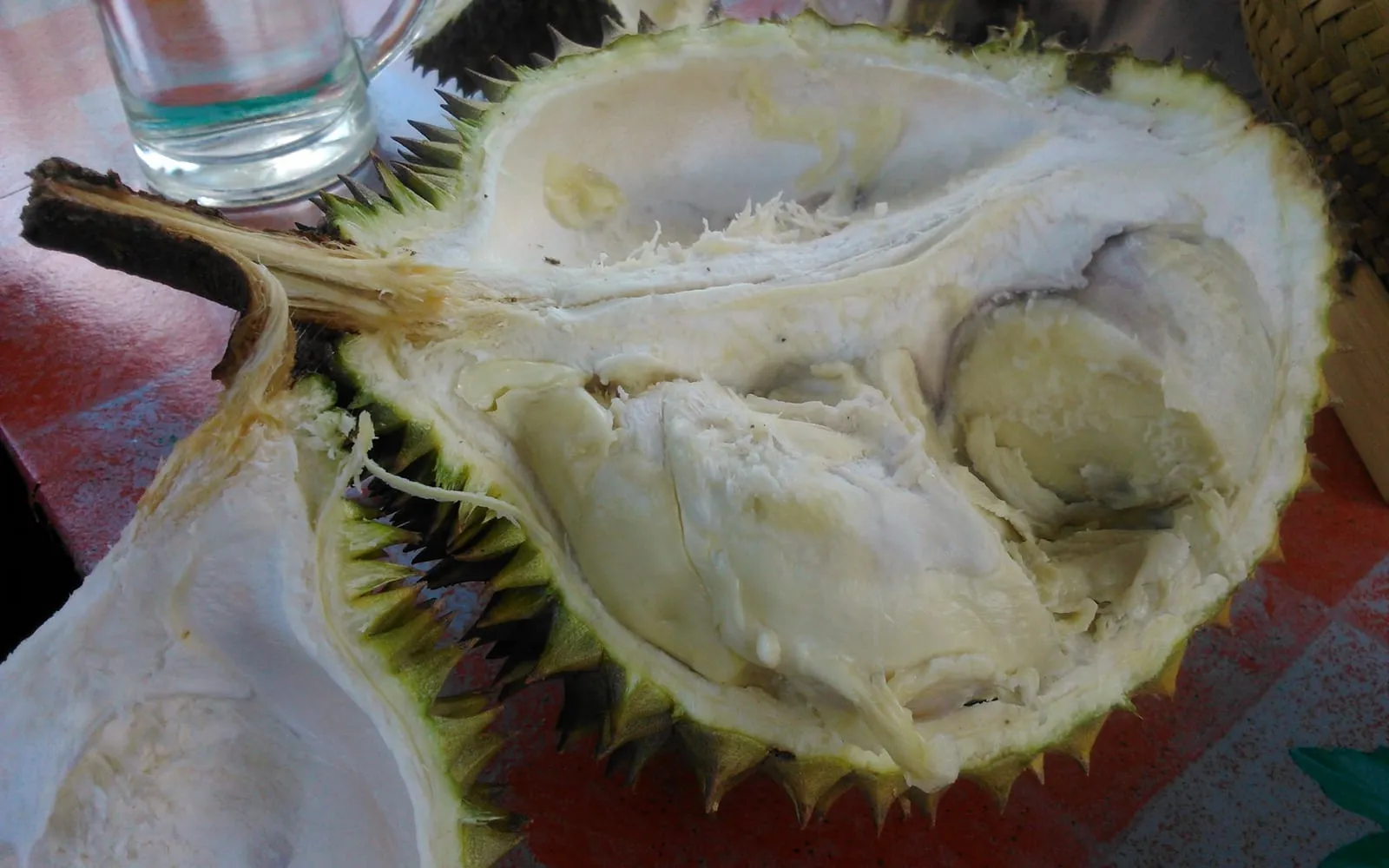
Opening one takes technique and gloves. There are faint seams running from the base, and a knife worked into a seam levers the fruit into segments.
Inside are five compartments holding one to several large seeds, each wrapped in a thick pale yellow to orange aril, which is the part eaten.
Texture is the surprise. Not fibrous or juicy but soft and dense, closer to a set custard than to fruit.
Ripeness is judged by smell and by shaking. A ripe one smells strongly and the seeds rattle slightly inside.
Where it is from
Durian is native to Borneo, Sumatra and the Malay peninsula, where wild Durio species grow in lowland rainforest and several are eaten locally.
Cultivation is centred on Thailand, Malaysia, Indonesia and the Philippines, and the fruit occupies a place in South East Asian culture that no European fruit matches, with named cultivars, connoisseurship and prices to match.
Musang King from Malaysia and Monthong from Thailand are the two best known cultivars, and a single premium Musang King fruit can cost more than a good meal.
Alfred Russel Wallace wrote the most quoted description in 1856, calling it worth a voyage to the East to experience, and his account did more than anything else to fix the fruit in the Western imagination.
Chinese demand transformed the trade in the 2010s. Malaysian and Thai growers converted large areas to durian, and frozen whole fruit now moves north in volume.
Temperate markets see frozen durian in South East Asian supermarkets and, occasionally, fresh fruit at a considerable price.
How it grows
Sow seed the day the fruit is eaten. Durian seed dies within days.
Wash the flesh off, sow flat and half buried at 25 to 30 deg C in acid humus-rich compost. Germination takes a week or two and is quick for a tropical tree.
Shade it heavily for the first years. Durian seedlings grow in deep forest shade and burn in direct sun.
Keep humidity very high and the temperature above 15 deg C at all times.
Water regularly and never allow the compost to dry.
Use rainwater and an acid mix.
Feed monthly from April to September.
Pot on carefully. The roots dislike disturbance.
Understand what a seedling gives. Durian is highly variable from seed, quality is unpredictable, and the tree takes eight to fifteen years to fruit. Commercial growers graft.
Accept that a temperate plant is a foliage subject. Fruiting requires a rainforest, bats or hand pollination, and thirty metres of head room.
Through the seasons
Winter is the season to survive. Hold above 15 deg C with humidity as high as possible, water steadily, and feed nothing.
Spring brings a growth flush as light and warmth return.
Early summer is the main growing period.
Midsummer is when mature trees flower in their native range, on the trunk and older branches.
Late summer is a second flush under glass.
Autumn is when to stop feeding and hold the plant warm as the light falls.
Care difficulty
Difficult, and fruiting outside the tropics is not a realistic goal.
Constant warmth and very high humidity are needed year round, with no cool rest of any kind.
Deep shade when young is a requirement, and a seedling in a sunny greenhouse scorches within days.
Phytophthora root rot is the disease that kills durians in orchards and in pots alike, and it follows any lapse in drainage.
Seedlings are variable and slow, taking eight to fifteen years to flower even in the tropics.
Pollination is by bats. Under glass there are none, and hand pollination of night-opening flowers thirty metres up is not a domestic proposition.
As a foliage plant with handsome bronze-backed leaves it grows steadily in a warm humid house, and that is the sensible ambition.
Watering
Water two or three times a week year round, keeping the compost evenly damp.
Never let it dry out and never let it stand wet. Both kill durian, and the second kills it faster.
Drain fully every time.
Use rainwater, since hard water brings iron shortage.
Keep humidity very high with misting, damp gravel and grouping.
Reduce watering a little in winter without letting the compost dry.
Use tepid water.
Warning signs, diseases and pests
Scorched brown leaf margins on a young plant mean direct sun or dry air.
Yellowing between green veins is iron shortage on hard water.
Leaf drop after a cold night is chill damage below 10 deg C.
Wilting in damp compost, with dark lesions at the stem base, is Phytophthora root rot. It is the main killer of durian and it is rarely reversible.
Fine webbing under the leaves is spider mite, which arrives when humidity falls.
Brown limpets on the stems are scale.
A plant that pauses for months between flushes is behaving normally.
Fruit falling from a mature tree is how durian is harvested rather than a problem, and it is the reason orchards are dangerous places in season.
Growing environment
A heated humid glasshouse. Nothing cooler will hold it.
Minimum 15 deg C, ideally 25 to 32 deg C, with no cool rest.
Very high humidity year round.
Deep shade when young, more light when mature.
Acid humus-rich free-draining compost.
pH from 5.0 to 6.5.
Rainwater rather than tap water.
Considerable head room if the plant is to be kept for many years, though root restriction in a pot holds it down.
Feeding
Feed monthly from April to September with an ericaceous liquid feed containing iron and magnesium.
Add sequestered iron at the first yellowing between the veins.
Stop feeding at the end of September.
Give nothing through winter.
Top-dress with leaf mould each spring rather than repotting often.
Repot only when necessary, since the roots resent disturbance.
Keep feeding moderate. Heavy nitrogen produces soft growth that scorches.
Troubleshooting
Why is it banned in hotels? The smell. Sulphur compounds in the flesh carry strongly and linger in soft furnishings and air conditioning, so Singapore’s transport network, many Thai hotels and most airlines prohibit it.
What does it taste like? A rich soft custard, of almonds and caramel with a savoury undertone. The texture surprises people more than the flavour.
Is it true you should not drink alcohol with durian? Yes, and the mechanism is understood. Sulphur compounds in durian inhibit the enzyme that clears acetaldehyde, so a heavy drink alongside it produces flushing, a racing heart and a severe hangover.
Can I eat the seeds? Not raw. Boiled or roasted they are eaten across South East Asia and are pleasant, similar to a chestnut.
How do I open one? Wear gloves. Find the faint seams running from the base, work a knife into one, and lever the fruit apart into segments.
How do I tell if it is ripe? Smell it, and shake it. A ripe fruit smells strongly and the seeds move slightly inside. In an orchard the fruit falls when ready, which is why the ground under a durian tree is a dangerous place.
Will it fruit outside the tropics? No. It needs a rainforest, bat pollination and thirty metres of head room, and even in the tropics a seedling takes eight to fifteen years.
My seedling scorched in the greenhouse. Durian seedlings grow in deep forest shade. Shade it heavily for its first few years.
Durian problem guides
Not sure what is wrong? See the common vegetable pests guide.