
Edible
Mangosteen
Garcinia mangostana
Also known as Purple mangosteen, Manggis, Queen of fruits
How to grow mangosteen, Garcinia mangostana. The queen of fruits, a tree with no known wild ancestor and no males at all, the fifteen-year wait, and what the rind supplements are doing.
At a glance
- Difficulty
- Difficult
- Water
- Two or three times a week year round, never drying out
- Light
- Deep shade when young, part shade when older
- Temperature
- Minimum 15 deg C, and it is damaged below 10 deg C
- Humidity
- Very high. Below 80 per cent it suffers
- Hardiness
- USDA 11-12, RHS H1b, hardy to 15 C
- Type
- Tender evergreen tree
- Height
- 6-25 m in the open, 1.5 m in a pot after many years
- Native to
- the Sunda islands, the Malay peninsula
- Best month
- July and August in the Northern Hemisphere, January and February in the Southern Hemisphere
Wet equatorial south-east Asia, with the narrowest requirements of any fruit here. It stops growing below about 20 deg C, dies at 4, and needs constant humidity with no dry season. Two centuries of attempts have failed to establish it much outside that band, and seedlings take eight to fifteen years to fruit.
Hardiness zones describe winter cold alone. Summer heat, humidity, rainfall and the length of the growing season decide as much, so treat the range as the outer limit rather than as a recommendation.
Every month named in this guide is for the temperate Northern Hemisphere. If you garden in the Southern Hemisphere, shift each one by six months, so July becomes January. Closer to the equator the wet and dry seasons matter more than the calendar, and the shift stops being a useful guide.
Edible, with limits
- Safe to eat
- The white segments inside the rind
- Do not eat
- The rind, which is the part sold as a supplement
- Harm from
- Eating it
- Affects
- People
The white flesh of a mangosteen is food and carries no known hazard. The purple rind is a different product. It contains xanthones, is intensely astringent, and is dried and sold as a supplement and as a juice on claims about cancer and inflammation that regulators in the United States and Europe have repeatedly acted against. Two specific harms are documented in case reports of people taking concentrated rind preparations: severe lactic acidosis requiring hospital treatment, and interference with blood thinners, since xanthones slow clotting. Anyone on warfarin or a similar drug should avoid the supplements. Eating the fruit itself, which is what almost everyone does, raises none of this. The rind also stains cloth a purple-brown that does not wash out.
Sources: RHS potentially harmful garden plants, ASPCA toxic and non-toxic plants
About
Mangosteen has a reputation few fruits could live up to and mostly does. The segments inside are white, glossy and slightly translucent, with a flavour that sits somewhere between lychee, peach and something acid that has no obvious comparison.
The tree is a botanical oddity. There are no male mangosteens. Every tree produces seed without fertilisation, so every mangosteen on earth is close to a clone, and no wild ancestor has ever been found.
It is also among the slowest and fussiest trees in cultivation. A seedling takes eight to fifteen years to fruit, wants deep shade for its first years, tolerates no dry season and no cool one, and dies readily if the drainage or the humidity falters. Growing one outside the tropics is a long project with a low success rate.
Appearance and character
A slow-growing evergreen tree, conical and strikingly symmetrical, with branches in neat horizontal tiers.
Leaves are opposite, thick, leathery and glossy dark green above, 15 to 25 cm long, with a paler yellow-green underside and a prominent midrib. New growth is pink to bronze.
All parts exude a yellow latex when cut, which is the gamboge that spoils fruit when it bleeds inside.
Flowers are 4 to 5 cm, fleshy, with four thick greenish red petals, borne singly or in pairs at the shoot tips. Every one is functionally female.
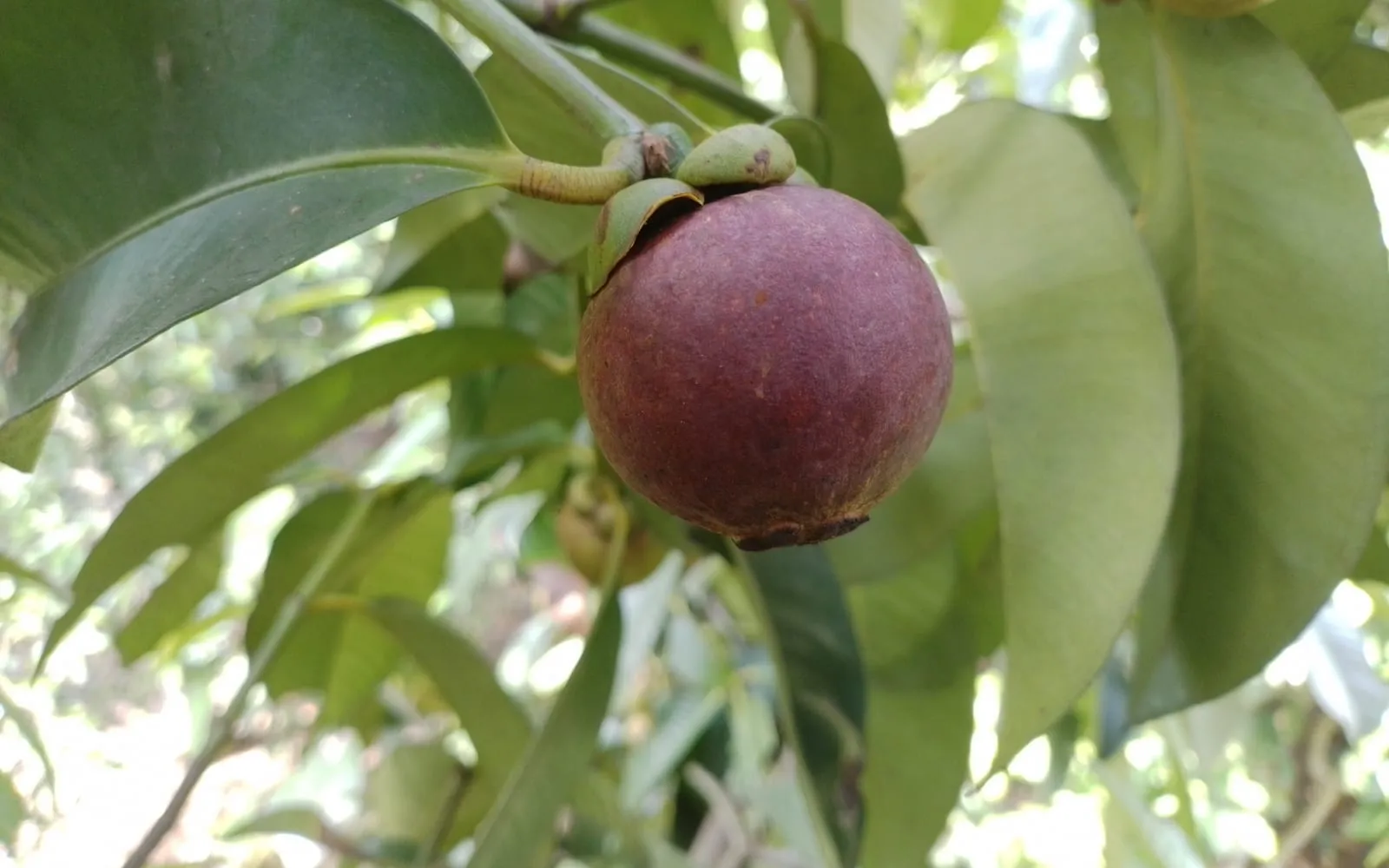
Fruit is round, 4 to 8 cm, with a thick, hard, deep purple rind and a persistent green calyx at the top like a small crown.
Cutting is done by scoring the rind around the middle and twisting the halves apart. The rind is 6 to 10 mm thick and stains everything it touches.
Inside are four to eight white segments arranged like a garlic bulb, one or two of them carrying a large seed and the rest seedless.
The number of petal-like lobes on the star at the base of the fruit matches the number of segments inside, which is a small pleasure for anyone who checks.
Where it is from
Mangosteen is native to the Sunda islands and the Malay peninsula, though the wild ancestor has never been identified with certainty and the species may have arisen as a hybrid in cultivation.
It has been grown across South East Asia for centuries and is bound up with the market season in Thailand, Malaysia and Indonesia, arriving in the same weeks as durian and rambutan.
Queen Victoria is often said to have offered a reward for a fresh mangosteen, which appears to be a Victorian story rather than a fact, though it captures how badly the fruit travelled before air freight.
Attempts to grow it outside the equatorial belt have mostly failed. It needs constant warmth, constant damp and no season at all, and plantings in Florida, Hawaii and Australia have been small and difficult.
Thailand, Indonesia and Malaysia supply most of the world trade. Temperate markets see fresh mangosteen occasionally in South East Asian groceries at a high price.
How it grows
Sow seed from a ripe fruit the same day. Mangosteen seed dies within days of drying and cannot be posted.
The seed is not a true seed. It is a nucellar embryo, formed without fertilisation, which is why every seedling is identical to the parent.
Sow at 25 to 30 deg C in an acid, humus-rich, moisture-retentive mix. Germination takes three to six weeks.
Shade it heavily. Young mangosteens grow in forest understorey and full sun scorches them for their first three or four years.
Keep humidity above 80 per cent. This is the requirement that defeats most attempts outside the tropics.
Never let it dry out and never let it stand wet. The root system is weak, sparse, and slow to repair damage.
Pot on carefully and rarely. Root disturbance sets the plant back badly.
Feed lightly. Half-strength ericaceous feed monthly through the growing season is enough.
Expect eight to fifteen years to fruit, and expect that only in a warm humid glasshouse run properly year round.
Through the seasons
Winter is the season that kills them. Hold above 15 deg C with humidity as high as can be managed, water steadily, and feed nothing.
Spring brings a growth flush. Mangosteen grows in slow bursts with long pauses between.
Early summer is the main growing period, with heat and humidity at their easiest to supply.
Midsummer is when a mature tree flowers, and fruit follows five to seven months later.
Late summer is a second growth flush in a warm house.
Autumn is the taper. Stop feeding, hold the watering steady, and start worrying about winter humidity.
Care difficulty
Difficult, and among the two or three hardest plants in this collection.
Humidity is the first obstacle. Below about 80 per cent the leaves scorch and the plant declines, and a heated greenhouse in January is far drier than that.
Constant warmth is the second. Minimum 15 deg C with no cool rest at all, and damage begins below 10 deg C.
The root system is the third. It is sparse, brittle and slow to regenerate, so repotting checks the plant for months and any lapse in drainage kills it.
Shade when young is a requirement rather than a preference.
Time is the fourth. Eight to fifteen years from seed to fruit, and a plant that is not thriving will take longer or never get there.
Anyone attempting it needs a heated humid glasshouse and a willingness to wait a decade. As a slow handsome foliage plant it is achievable, and that is the realistic goal.
Watering
Water two or three times a week year round, keeping the compost evenly damp at all times.
Never let it dry out. Mangosteen has no drought tolerance and the leaves scorch at the edges within days.
Never let it stand in water either. The roots rot readily.
Use rainwater. Hard water raises the pH and brings on the iron shortage this species is prone to.
Keep humidity above 80 per cent with misting, damp gravel, grouping and damping down.
Reduce watering slightly in winter without allowing the compost to dry.
Water with tepid water, since cold water at the roots checks it.
Warning signs, diseases and pests
Brown scorched leaf margins are the standard mangosteen complaint and mean dry air, direct sun on a young plant, or dry compost.
Yellowing between green veins is iron shortage from hard water or compost that is not acid enough.
Sudden leaf drop follows a cold spell below 10 deg C.
Fine stippling and webbing under the leaves is spider mite, which arrives the moment humidity falls.
Brown limpets on the stems are scale.
Wilting in damp compost is root rot, and this species recovers from it rarely.
A plant that sits and does nothing for months is often normal. Mangosteen grows in bursts with long pauses.
Yellow resin inside the fruit, staining the white segments, is gamboge. It comes from irregular watering during fruit development and it makes the fruit inedible.
Translucent hardened segments are a physiological disorder from waterlogging.
Growing environment
A heated humid glasshouse. There is no other option outside the tropics, indoors or out.
Minimum 15 deg C, ideally 25 to 30 deg C, with no cool rest.
Humidity above 80 per cent year round.
Deep shade for the first three or four years, then part shade.
Acid, humus-rich, moisture-retentive but free-draining compost.
pH from 5.0 to 6.0.
Rainwater rather than tap water.
Shelter from any draught, and grouping with other tropical plants to hold the humidity.
Feeding
Feed monthly from April to September with a half-strength ericaceous liquid feed.
Keep it light. Mangosteen is slow and heavy feeding does not speed it up.
Add sequestered iron at the first yellowing between the veins.
Include magnesium, which it runs short of in a pot.
Stop feeding at the end of September.
Give nothing through winter.
Top-dress with leaf mould rather than repotting, since root disturbance sets the plant back for months.
Troubleshooting
Why are there no male mangosteen trees? The species reproduces by apomixis, forming seed without fertilisation. Every flower is functionally female and every seedling is a clone of its parent, which is why there is so little genetic variation in the crop.
Can I grow one from a seed in a shop fruit? Only if the fruit is very fresh and you sow the same day. The seed dies within days of drying and cannot be posted.
How long until it fruits? Eight to fifteen years, and only under sustained heat and humidity. Outside the tropics that means a properly run glasshouse.
The leaf edges have gone brown. Dry air, direct sun on a young plant, or dry compost. Humidity below 80 per cent is the usual cause and it is the hardest thing to fix in a cool winter.
How do I open one? Score the rind around the middle with a knife without cutting into the flesh, then twist the halves apart. The rind is thick and stains badly.
How many segments will there be? Count the lobes on the flower star at the base of the fruit. The number matches the segments inside.
There is yellow resin in the flesh. Gamboge, from irregular watering during fruit development. The fruit is inedible; give steadier watering.
Is mangosteen juice good for me? The white flesh is food. The rind supplements marketed on health claims are a different matter, and case reports link concentrated rind preparations to severe lactic acidosis and to interference with blood thinners. Regulators have acted against the marketing claims more than once.
Mangosteen problem guides
Not sure what is wrong? See the common vegetable pests guide.