
Edible
Ketupa
Baccaurea dulcis
Also known as Tampoi, Cupa, Sweet baccaurea
How to grow ketupa, Baccaurea dulcis. The sweetest fruit in a genus of a hundred species, why its seed cannot be posted anywhere, and how to tell a tampoi from the half-dozen other things sold under that name.
At a glance
- Difficulty
- Difficult
- Water
- Two or three times a week year round
- Light
- Part shade when young, full sun when mature
- Temperature
- Minimum 15 deg C. Damaged below 12 deg C
- Humidity
- Very high
- Hardiness
- USDA 11-12, RHS H1b, hardy to 15 C
- Type
- Tender evergreen tree, dioecious
- Height
- 10-20 m in the open, 1.5-2 m in a pot
- Native to
- Sumatra, the Malay peninsula
- Best month
- June and July in the Northern Hemisphere, December and January in the Southern Hemisphere
Equatorial lowland forest with rain in every month and no season below 20 deg C. Anywhere with a cool dry period, however brief, is a glasshouse proposition rather than a garden one.
Hardiness zones describe winter cold alone. Summer heat, humidity, rainfall and the length of the growing season decide as much, so treat the range as the outer limit rather than as a recommendation.
Every month named in this guide is for the temperate Northern Hemisphere. If you garden in the Southern Hemisphere, shift each one by six months, so June becomes December. Closer to the equator the wet and dry seasons matter more than the calendar, and the shift stops being a useful guide.
Not known to be toxic
- Safe to eat
- The translucent segments inside the skin
- Do not eat
- The skin, which is not eaten, and the seeds
Ketupa is not toxic and nothing in it is listed as harmful to people or to cats and dogs. The part eaten is the aril, a white translucent jacket of flesh grown around each seed, and it is separated from the leathery rind with a thumbnail. Seeds are flat, hard and bitter, and Sumatran eaters spit them out rather than swallowing them. Fruit picked before it softens is sour and disappointing without being any danger. No adverse effect has been recorded for the species, though it should be said that a fruit eaten in one Indonesian province has never had reason to be studied.
Sources: ASPCA toxic and non-toxic plants, RHS potentially harmful garden plants
About
Baccaurea runs to roughly a hundred species across South East Asia, most of them eaten somewhere by somebody, and this one was named for tasting better than the rest. Dulcis is Latin for sweet. Sumatran growers agree with the botanist who gave it that name and rank the fruit above every other tampoi in the market.
What you eat is an aril. Each seed inside the fruit wears a jacket of white translucent flesh, and that jacket is the whole of the edible part, prised off the seed with the tongue and eaten in one piece. The texture is closer to a lychee than to anything with segments, and the flavour is sugar with a faint sourness underneath.
Two facts keep the species inside Sumatra. It is dioecious, so an orchard needs males that will never carry a crop, and its seed is recalcitrant, meaning it dies as it dries rather than going dormant. A seed posted out of Sumatra is dead on arrival, and that is why no temperate collection holds this tree.
Appearance and character
A dense-crowned evergreen reaching 10 to 20 m in forest, and no more than head height in a pot, where it grows slowly and stays furnished to the base.
The family is Phyllanthaceae, which puts ketupa alongside the emblic and the Antidesma berries rather than near any fruit a temperate grower would recognise. Nothing about the leaves suggests a fruit tree at all.
Leaves are alternate and obovate, 15 to 30 cm, leathery, glossy on the upper surface and dull beneath, with veins that stand proud enough to feel.
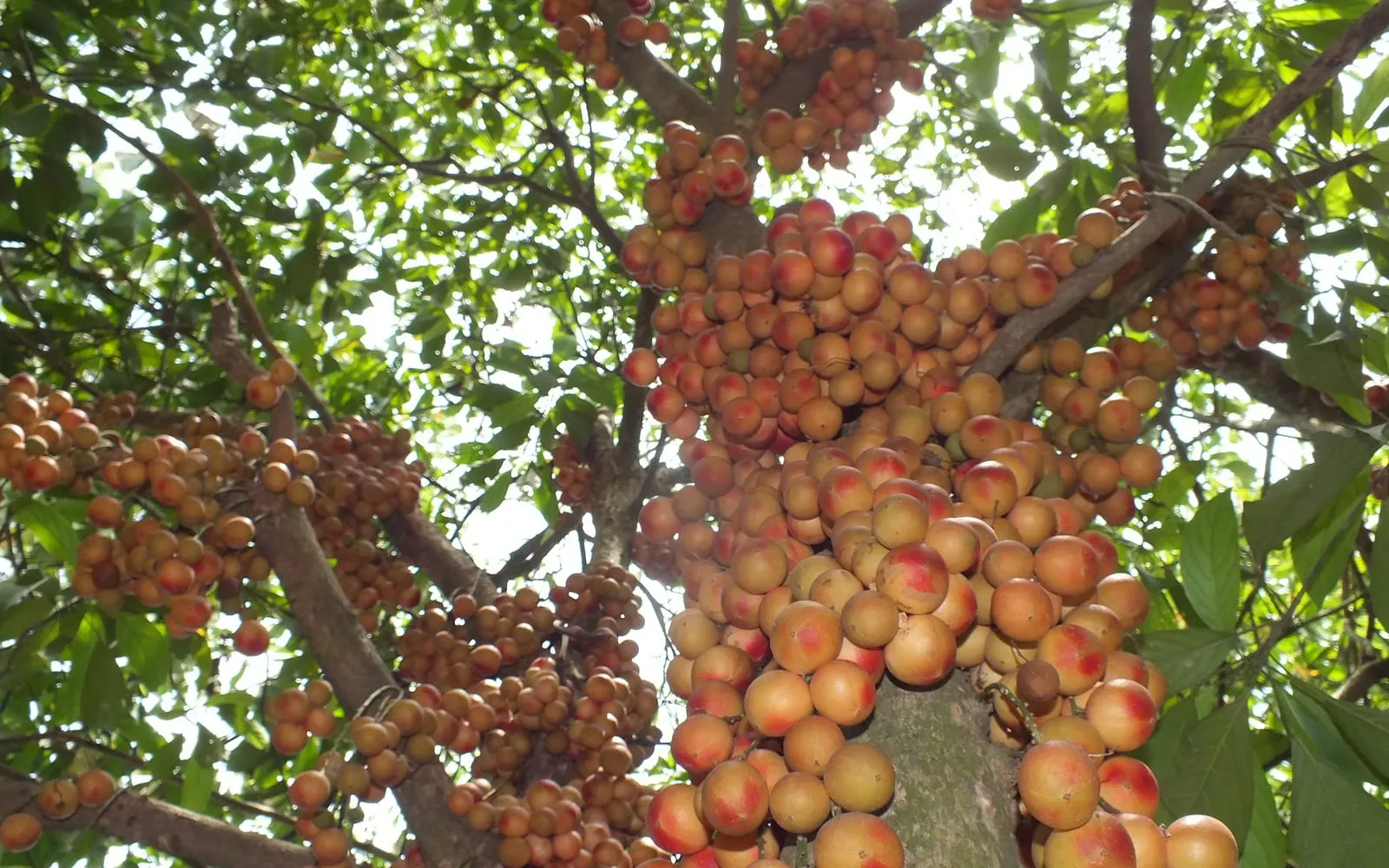
Flowering is ramiflorous. Slender drooping racemes emerge straight from the bark of the trunk and the older limbs, carrying dozens of small yellowish flowers that smell faintly sweet and draw flies and thrips rather than bees.
Male and female racemes look alike at a glance, and the difference is in the individual flower. A male carries a tuft of stamens and drops within days; a female carries a swollen green ovary and stays on the tree.
Fruit is round to slightly flattened, 2 to 4 cm, ripening from green through dull yellow to a pinkish tan, with a rind that stays thin and leathery rather than hardening.
Two to four seeds sit inside, each in its white aril, and the rind splits under thumb pressure once the fruit is soft.
Where it is from
Ketupa belongs to the lowland rainforest of Sumatra and the Malay peninsula, below about 500 m, on ground that never dries out.
Cultivation is a village matter. Trees stand in house compounds and on the edges of smallholdings through West Sumatra, Jambi and Riau, and the crop reaches town markets for a few weeks in the middle of the year before disappearing again.
Tampoi is the name it is sold under, and the name belongs to at least half a dozen other species as well. Baccaurea macrocarpa is the big orange tampoi of Borneo, B. angulata the red ridged one, and all of them share the label in one market or another. The Latin binomial is the only reliable way to say which fruit you mean.
No exporter handles it, no plantation grows it, and no breeding programme has selected it. A fruit that bruises in transit and ferments within four days has never had a commercial case made for it.
How it grows
Take seed from fruit you have just eaten and sow it the same day. Two or three days on a windowsill is enough to kill it.
Bottom heat of 25 to 30 deg C brings it up in three to eight weeks, in an acid mix that holds water without souring. Peat-free ericaceous compost cut with perlite works.
Raise at least six seedlings. Half will be male, sex cannot be read from a seedling, and the tree declares itself only when it first flowers.
Shade the first two or three years, then move it into as much light as the glasshouse gives. A young plant scorches where a mature one thrives.
Hold the temperature above 15 deg C in every month and keep the air close to saturated. Growth stops below 20 deg C and damage starts below 12 deg C.
Water two or three times a week, year round, with rainwater. Hard water yellows the leaves within a season.
Feed monthly from April to September with an ericaceous liquid feed, and stop completely once growth slows.
Fruit arrives six to eight years from seed where the conditions hold. Where they lapse each winter, it may never arrive at all.
Through the seasons
Winter is the season that decides whether the plant survives. Heat to 15 deg C as an absolute floor, keep the air damp, water without soaking, and withhold feed entirely.
Spring starts a flush of soft new leaves, bronze at first and hardening to green. Resume feeding as they expand.
Early summer is when a mature tree pushes racemes out of the bark, and the first sign is a row of green buds on wood that looked bare.
Midsummer swells the fruit, and this is the point at which a female tree needs the most water it will take all year.
Late summer ripens the crop in Sumatra, over about three weeks.
Autumn ends the feeding. Hold warmth and humidity and change nothing else.
Care difficulty
Difficult, and the difficulty is unusual in being about supply rather than skill.
Sourcing comes first. Seed cannot be posted because it dies in days, no nursery lists the plant outside South East Asia, and a grower who wants one realistically has to collect fruit in Sumatra and carry it home.
Warmth has to be constant. There is no cool rest in this species and a January night at 10 deg C costs leaves.
Humidity has to be high enough that a domestic conservatory will not do it. A heated glasshouse with damped floors and a misting line is the working minimum.
Water and compost both have to be acid, or iron chlorosis sets in and stays.
Sex is the last obstacle. Half the seedlings are male, they take years to declare, and a grower with space for one tree has even odds of a plant that flowers every summer and never fruits.
Watering
Two or three soakings a week keep the compost evenly damp, which is the state this species wants in every month of the year.
Never let the rootball dry. Baccaurea has no drought strategy and responds by dropping leaves it will not replace until spring.
Drain freely all the same. Damp is the target and waterlogged is root rot.
Use rainwater. Iron shortage on hard water arrives faster in this genus than in most tropical trees.
Hold humidity with damped gravel, grouped plants and a misting line rather than by hand-spraying, which raises it for ten minutes.
Ease off slightly in winter without letting the compost go dry, and use water at glasshouse temperature rather than cold from the tap.
Warning signs, diseases and pests
Yellowing between green veins is iron shortage on hard water.
Brown leaf edges mean dry air.
Leaf drop after a cold spell is chill damage below 12 deg C.
Fine webbing on the leaves is spider mite.
Brown limpets on the trunk and branches are scale.
White fluff in the leaf axils is mealybug.
Wilting in damp compost is root rot.
A mature tree that flowers and never fruits is male.
Sour flesh on a fruit that came off easily means it was picked before it softened.
Growing environment
A heated humid glasshouse, since nothing else outside the tropics holds the conditions through a winter.
A floor of 15 deg C, with 25 to 32 deg C wanted for active growth.
Humidity high in every month, not only in summer.
Shade for the first years, then full glasshouse light.
Rich, acid, moisture-retentive compost that still drains, at pH 5.0 to 6.0.
Rainwater in the can and leaf mould on the surface.
Company. Grouped tropical plants hold humidity around each other in a way a single specimen on a bench cannot.
Feeding
An ericaceous liquid feed containing iron, monthly from April to September.
Sequestered iron the moment the veins start to stand out green against a paler leaf, rather than waiting to see whether it worsens.
Nothing at all from October onwards, since feed given to a tree that is not growing sits in the compost and raises the salt level.
Leaf mould as a spring top-dressing, which suits the surface roots better than digging anything in.
Repot rarely. The roots resent disturbance and a check after potting can cost a season.
Keep the strength moderate throughout. This is a forest understorey tree and it is adapted to a slow trickle of nutrients rather than a feed.
Troubleshooting
How is it different from rambai? Sweeter, which is what the name records, and rounder. Rambai hangs its fruit in ropes up to 75 cm long, while ketupa carries shorter racemes in tighter clusters against the bark.
Do I eat the skin? No. Split the rind with a thumbnail, take out the seeds with their white jackets, and eat the flesh off each seed.
Do I need two trees? Yes, and probably six seedlings to get them. Only females fruit, and sex cannot be told until the tree flowers.
How long until it fruits? Six to eight years from seed, and only where the warmth and humidity have not lapsed in between.
Where do I get one? Realistically, from Sumatra in person. The seed dies within days of leaving the fruit, so it cannot be posted, and no nursery outside the region carries the plant.
What is tampoi? A market name shared by this species and several relatives, including the large orange Baccaurea macrocarpa and the red B. angulata. Ask for the Latin if you want a particular one.
The leaves went yellow between the veins. Iron shortage from hard water. Switch to rainwater, check the compost is still acid, and apply sequestered iron.
My fruit was sour. It was picked early. Ketupa softens before it sweetens, and a fruit that needed a tug was not ready.
Ketupa problem guides
Not sure what is wrong? See the common vegetable pests guide.