
Edible
Fenugreek
Trigonella foenum-graecum
Also known as Methi, Greek hay, Bird's foot
How to grow fenugreek, Trigonella foenum-graecum. Methi leaves in six weeks, ripening the seed in a cool summer, and the compound that makes it smell of maple syrup.
At a glance
- Difficulty
- Easy
- Water
- Weekly in dry weather
- Light
- Full sun
- Temperature
- Half-hardy. Sow after the last frost for seed
- Hardiness
- USDA 8-11, RHS H3, hardy to -5 C
- Type
- Hardy annual
- Height
- 30-60 cm
- Native to
- the Mediterranean, western Asia
- Best month
- May and September in the Northern Hemisphere, November and March in the Southern Hemisphere
Fast enough to cut as leaf within a month, which makes methi a crop for almost any climate with a warm spell. Seed is harder, needing three to four months and a dry ripening. It fixes its own nitrogen and is grown as a green manure on that basis across India.
Hardiness zones describe winter cold alone. Summer heat, humidity, rainfall and the length of the growing season decide as much, so treat the range as the outer limit rather than as a recommendation.
Every month named in this guide is for the temperate Northern Hemisphere. If you garden in the Southern Hemisphere, shift each one by six months, so May becomes November. Closer to the equator the wet and dry seasons matter more than the calendar, and the shift stops being a useful guide.
Edible, with limits
- Safe to eat
- The leaves, seeds and sprouted seed
- Do not eat
- Large medicinal doses of seed, particularly in pregnancy
- Harm from
- Eating it
- Affects
- People
Fenugreek is a food plant eaten as both leaf and seed across south Asia, the Middle East and north Africa, and it appears on neither the RHS list of potentially harmful garden plants nor the ASPCA list. The caution concerns concentrated use rather than cooking. Fenugreek seed in large medicinal doses is a uterine stimulant and standard references advise against it in pregnancy, and it can lower blood sugar, which matters for anyone on diabetes medication. It is also a legume and cross-reactivity with peanut and chickpea allergy is documented. One harmless side effect surprises people: eating a quantity of fenugreek makes sweat and urine smell of maple syrup, from a compound called sotolon, and it can last for a day or two.
Sources: RHS potentially harmful garden plants, ASPCA toxic and non-toxic plants
About
Fenugreek gives you two crops from one packet. The leaves, sold as methi, are ready six weeks after sowing and go into Indian cooking as a vegetable and a herb. The seeds are the spice, bitter and faintly sweet, used in curry powders, in pickles and in the Ethiopian and Yemeni kitchens.
The compound behind its smell is sotolon, and it is the same one that gives maple syrup and fenugreek their shared character. It is also why artificial maple flavouring is made from fenugreek, and why eating a lot of it makes you smell faintly of pancakes for a day.
Growing it in a cool climate is easy for leaf and less certain for seed. Leaves come readily from a succession of sowings; seed needs a warm summer, and a cool wet one produces pods that never fill.
Appearance and character
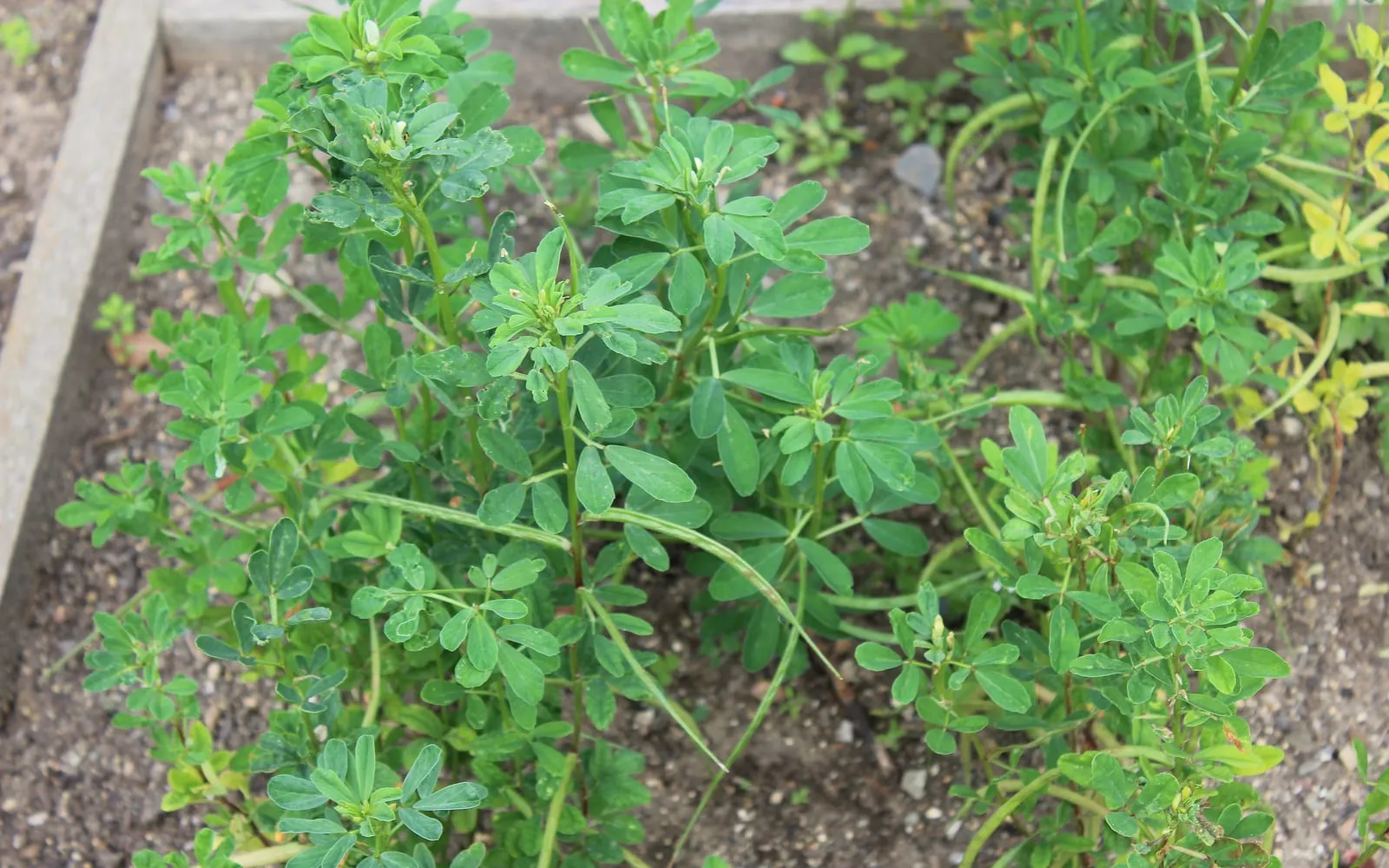
An upright branching annual, 30 to 60 cm, with a clover-like habit.
Leaves are trifoliate, with three oval toothed leaflets on a short stalk, mid green and slightly greyish.
Flowers are small pea flowers, 1 to 2 cm, white to pale yellow, sitting singly or in pairs in the leaf axils. They are easy to miss.
Pods are the distinctive part. Long, slender, curved and beaked, 5 to 10 cm, carried upright, and each holds ten to twenty seeds.
Seeds are small, hard, angular and mustard-yellow, with a groove across one corner.
The whole plant smells faintly of curry and maple, most noticeably when the leaves are crushed or the seed is toasted.
Where it is from
Fenugreek is native to the eastern Mediterranean and western Asia, and it is one of the oldest cultivated plants, with charred seeds found at Neolithic sites in Iraq dating to around 4000 BC.
Egypt used it. Fenugreek seed appears in Egyptian tombs and it was used in embalming and in bread.
The Latin name foenum-graecum means Greek hay, from its use as a fodder crop in the classical world, which is where the English name comes from.
Indian cooking uses both parts extensively. Methi leaves are a vegetable, dried methi is a seasoning, and the seed is in curry powders and in pickles.
Ethiopian cooking uses it as abish, Yemeni cooking as the base of the relish hilbeh, and it is grown commercially in India, Turkey, Egypt and Morocco.
India is by far the largest producer, chiefly in Rajasthan.
How it grows
Sow direct where it is to grow. The taproot resents disturbance.
For leaf, sow thickly in shallow drills from April to August, thin lightly, and cut the whole plants at 15 to 20 cm, about six weeks after sowing. Sow again every three weeks.
For seed, sow thinly in May at 1 cm deep and thin to 20 cm, in the sunniest position you have. The plants need the full season to ripen pods.
Choose free-draining ground in full sun. It is a legume and it will fix its own nitrogen, so a rich bed is unnecessary.
Water in dry weather while growing.
Do not feed it. Nitrogen produces leaf at the expense of pods.
Harvest seed in September when the pods have gone brown and dry. Cut whole plants and dry them head-down in paper bags.
It also works as a green manure, dug in before flowering to add nitrogen.
Through the seasons
Winter there is nothing. It is an annual.
Spring is the start of leaf sowings, from April, and the main seed sowing in May.
Early summer is the first leaf harvest, six weeks after sowing, and rapid growth on the seed crop.
Midsummer is continued leaf sowings and flowering on the seed crop.
Late summer is when the pods fill, and warmth through August decides the seed harvest.
Autumn is seed harvest, in September, cutting the plants as the pods brown.
Care difficulty
Easy for leaf and moderate for seed.
Leaf is straightforward. Sow thickly, cut at six weeks, sow again. A row gives a useful crop of methi within a month and a half.
Seed needs a warm summer. Fenugreek flowers late and the pods need weeks of warmth to fill, so a cool wet August produces empty pods. A south-facing bed or a polytunnel improves the odds.
Direct sowing is the requirement, since the taproot resents disturbance.
Slugs are the one serious pest and they take seedlings quickly.
Feeding is counterproductive. It is a legume and it makes its own nitrogen, so fertiliser gives you leaf where you wanted pods.
Watering
Water the seedbed before sowing and keep it damp until germination.
Water weekly in dry weather while the plants are growing.
Keep leaf crops evenly watered, since drying out toughens the leaves and pushes the plant towards flowering.
Stop watering once the pods start to brown.
Water at the base in the morning.
A container works if it is deep enough for the taproot, and needs watering twice a week in summer.
Warning signs, diseases and pests
Slugs clear a row of seedlings overnight. Protect a new sowing.
Aphids gather on the growing tips. Rub them off.
Root rot in cold wet ground kills plants at the base. Improve drainage.
Powdery mildew whitens the foliage in a dry late summer.
Pods that stay flat and never fill mean the season was too cool or too short. Sow earlier, or grow under cover.
Tough bitter leaves mean the plant is flowering or has been dry. Cut earlier and water better.
Yellowing on a crowded row means the plants need thinning.
Growing environment
Full sun. Fenugreek in shade is thin and sets little seed.
Free-draining soil of moderate fertility. As a legume it needs no rich bed.
Neutral to alkaline, around pH 6.5 to 8. It grows on chalk without complaint.
A vegetable bed suits it, and it doubles as a green manure crop.
For seed, the warmest sunniest bed you have, or a polytunnel.
For leaf, any sunny bed will do, and a windowsill tray of thickly sown seed produces methi in six weeks.
Feeding
None, and there is a specific reason. Fenugreek is a legume that fixes its own nitrogen through root nodules.
Adding nitrogen gives you a leafy plant with fewer pods, which is the opposite of what a seed crop wants.
Compost worked in the previous autumn is more than adequate.
A container plant takes a weak balanced feed every three weeks.
It is often grown as a green manure precisely because it adds nitrogen rather than needing it.
Troubleshooting
Can I grow methi from the seed in a spice jar? Yes, and it works well. Fenugreek seed sold as a spice is viable. Sow it thickly and cut the leaves at six weeks.
The pods never filled. The season was too cool. Fenugreek needs warmth through August to fill its seed. Sow earlier, use the sunniest bed, or grow under cover.
Why does it smell of maple syrup? Sotolon, the same compound that gives maple syrup its character. It is also why artificial maple flavouring is made from fenugreek.
My sweat smells of maple syrup. A harmless and well-documented effect of eating a quantity of fenugreek. It passes within a day or two.
The leaves are bitter. They were cut too late or the plant was dry. Cut at 15 to 20 cm, about six weeks after sowing, and keep the row watered.
Slugs ate the whole row. They find fenugreek seedlings fast. Protect new sowings.
Can I use it as green manure? Yes. Sow it thickly and dig it in before it flowers, and it adds nitrogen to the bed.