
Houseplant
Forskolin
Plectranthus barbatus
Also known as Makandi, Indian coleus, Coleus barbatus, Pashanabhedi
How to grow Plectranthus barbatus, the tuberous coleus behind forskolin. An easy tender perennial for a windowsill, blue flower spikes in autumn, and three names for one plant.
At a glance
- Difficulty
- Easy
- Water
- When the top of the compost dries in summer, sparingly in winter
- Light
- Bright light with some direct sun
- Temperature
- Tender. Above 10 deg C, and it grows best at 20 to 30
- Humidity
- Moderate
- Hardiness
- USDA 9-11, RHS H1c, hardy to 7 C
- Type
- Tender evergreen perennial from tuberous roots
- Height
- 50-100 cm
- Native to
- India, Nepal, east Africa, the Arabian peninsula
Dry subtropical hillsides from India to east Africa. It is grown for the tuberous root rather than the foliage, and the root needs a full season of warmth and a dry finish to bulk up. Outdoors year round in USDA 9 and warmer.
Hardiness zones describe winter cold alone. Summer heat, humidity, rainfall and the length of the growing season decide as much, so treat the range as the outer limit rather than as a recommendation.
Harmful if eaten
- Do not eat
- None identified. The tuberous root is the part used
- Harm from
- Eating it
- Affects
- People
The tuberous roots are pickled and eaten as a vegetable in parts of India, and the plant is used in Ayurvedic practice. It does not appear on the RHS list of potentially harmful garden plants and the ASPCA does not list it among plants toxic to dogs, cats or horses. The compound the plant is known for, forskolin, is pharmacologically active on the heart and blood vessels and lowers blood pressure, which is why it is studied and why it is sold as a supplement. That activity is the reason this is not marked as harmless. Anyone taking a forskolin supplement alongside blood pressure medicine, anticoagulants or heart medication should discuss it with their GP first, and the NHS page on herbal medicines explains why herbal products interact with prescriptions more often than people expect. Handling the plant or growing it carries no known risk.
Sources: NHS on herbal medicines, RHS potentially harmful garden plants, ASPCA toxic and non-toxic plants, LiverTox, Chinese and other Asian herbal medicines
About
This plant has three names and a supplement industry attached to the third. Botanically it has been Coleus forskohlii, then Plectranthus barbatus, and since a genus revision in 2019 many authorities have moved it back to Coleus barbatus. Supplement labels use Coleus forskohlii almost universally, and the app records Plectranthus barbatus, which is the name this guide follows.
The compound behind the interest is forskolin, isolated from the roots in the 1970s and much used in laboratory work because of what it does to a particular cellular signalling pathway. It became a supplement ingredient on the back of that, and the roots are now grown commercially in Gujarat and Tamil Nadu.
As a plant it is a good easy tender perennial and rather overlooked. Velvety aromatic leaves, upright growth to a metre, and spikes of pale blue flowers in autumn, which is a useful season for a windowsill plant to flower in. It is straightforward from cuttings and forgiving of neglect.
Appearance and character
The plant makes an upright branching subshrub, square-stemmed like every mint relative, becoming woody at the base with age. Stems and leaves carry a soft covering of fine hairs.
Leaves are opposite, oval to diamond-shaped, 5 to 12 cm long, with coarsely toothed margins, thick and velvety to the touch. Crushed, they release a strong camphor-like aroma that is the quickest way to identify the plant.
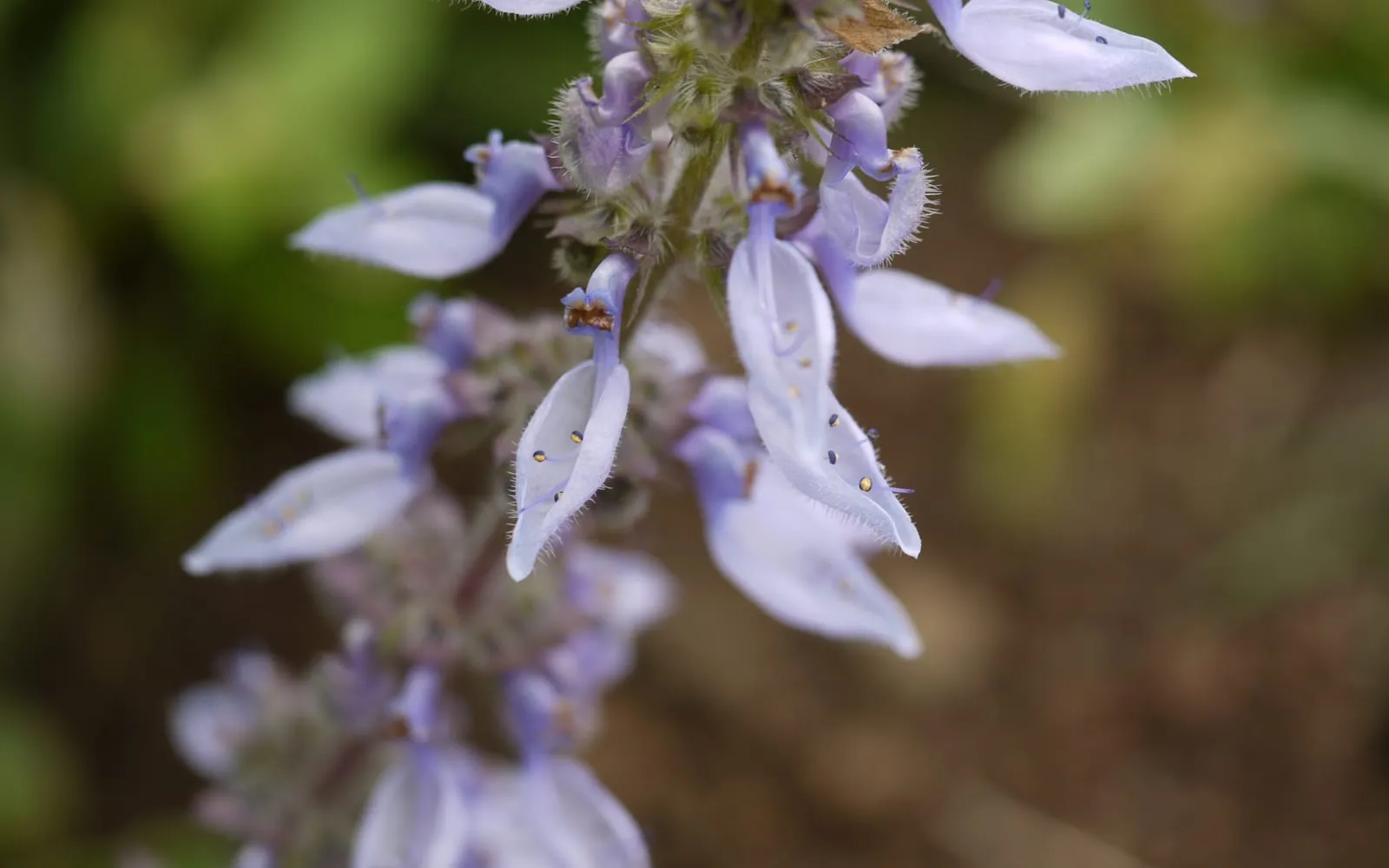
Flowers appear in autumn on upright spikes 15 to 30 cm long, held above the foliage, each flower about 2 cm long, pale blue to violet, two-lipped in the usual mint-family shape. Below ground the roots swell into orange-brown fleshy tubers, which is what separates this species from the ornamental plectranthus grown for foliage.
Where it is from
The species grows through the drier parts of India and Nepal, into the Arabian peninsula and east Africa, on rocky hillsides, in scrub and on dry open slopes. Its Sanskrit name pashanabhedi means rock-breaker, from where it grows.
That habitat sets its needs in cultivation. It is adapted to bright light, seasonal drought and sharply drained stony soil, and it dislikes wet roots more than almost anything else.
Cultivation for forskolin is concentrated in Gujarat, Tamil Nadu and Karnataka, where the crop is planted with the monsoon and the roots lifted five or six months later. Demand from the supplement market drove that from a wild-collected material to a field crop within about twenty years.
How it grows
Growth is fast in warmth. A cutting taken in spring makes a flowering plant by autumn, and the tubers develop through the season underneath.
The plant is evergreen in constant warmth and behaves as a short-lived perennial, becoming woody and less productive after two or three years. Most growers keep it going by taking cuttings each spring rather than nursing old plants.
Cuttings root with almost no effort. A non-flowering shoot 10 cm long, stripped of its lower leaves and pushed into gritty compost, roots in a fortnight in warmth, which is how the crop is propagated commercially as well.
Through the seasons
Take cuttings in April or May and grow them on in bright warmth. Pot up as they root and pinch the tips once or twice to build a bushy plant.
Through summer the plant can stand outdoors in a sheltered sunny spot once nights are above 12 deg C, which improves its colour and habit. Water when the compost surface dries and feed monthly.
Bring it in before the first frost. Flowering follows in autumn on a plant that has had a good summer. From November reduce water considerably and keep it above 10 deg C. Cut back by a third in March and repot.
Care difficulty
Easy, and the easiest of the tropical plants in this collection. It tolerates dry air, irregular watering, poor light for a while and cramped pots, and it roots from cuttings without any equipment.
The two failures are cold and wet. Below 10 deg C it deteriorates, and compost that stays wet in winter rots the tubers. Keeping it drier and warmer from November solves both.
Vine weevil is worth naming because the grubs eat the tubers directly, and the first sign is a plant that wilts and lifts out of the pot. Checking the compost when repotting each spring catches it.
Watering
Water in summer whenever the top of the compost dries, letting it drain fully. The plant is drought adapted and copes better with a missed watering than with a soggy pot.
Cut back hard from November. A plant resting in a cool bright room needs occasional water rather than a routine, and the tubers hold reserves.
Never leave it standing in water. Free drainage is the single most important thing in the compost, which is why grit is worth adding.
Warning signs, diseases and pests
Whitefly is the pest that finds every plectranthus indoors, clustering on leaf undersides and rising in a cloud when the plant is moved. Yellow sticky traps monitor it and a good wash knocks numbers down.
Mealybug collects in leaf axils as white fluff and red spider mite follows dry heat with fine stippling. Both respond to catching them early on a plant this size.
Wilting despite moist compost means root damage, either rot from overwatering or vine weevil grubs eating the tubers. Knock the plant out of its pot and look, since the two look identical above ground and need opposite responses.
Growing environment
Bright light with a few hours of direct sun. A south or west windowsill, a conservatory or a greenhouse all suit it, and poor light produces a drawn plant that flowers badly.
Temperature above 10 deg C at all times, ideally 20 to 30 in the growing season. It can go outside for the summer and must come in before autumn.
Compost should be loam-based with added grit, in a pot with good drainage. The plant comes from stony hillsides and its roots resent anything that holds water.
Feeding
A balanced liquid feed at half strength once a month from May to August. Overfeeding produces a soft leggy plant that flowers poorly.
Stop feeding from September. The plant is heading into its resting period and cannot use it.
Repot in spring into fresh gritty compost, cutting the plant back by a third at the same time. That does more for it than any feeding regime.
Troubleshooting
Is it Coleus or Plectranthus? Both, depending on the year. The plant was Coleus forskohlii, then Plectranthus barbatus, and a 2019 revision moved much of Plectranthus back into Coleus. Supplement labels use Coleus forskohlii, and this guide follows the app’s Plectranthus barbatus.
Is it the coleus grown for coloured leaves? No. That is Coleus scutellarioides, grown as a foliage bedding plant. This species has plain green velvety leaves, blue flower spikes and tuberous roots.
Can I grow it outdoors? For the summer only. It goes out once nights are above 12 deg C and comes in before the first frost.
How do I propagate it? Cuttings, which root in a fortnight in warmth. Take a 10 cm non-flowering shoot in spring, strip the lower leaves and push it into gritty compost.
My plant has gone woody and leggy. Normal after two or three years. Take cuttings, start again, and treat the old plant as expendable.
Are the roots edible? The tubers are pickled and eaten in parts of India. The compound in them is pharmacologically active, so eating a quantity is not the same thing as eating a vegetable, and anyone on heart or blood pressure medication should not experiment.
The plant wilted even though the compost is damp. Look at the roots. Either rot from overwatering or vine weevil grubs eating the tubers, and the two need opposite responses.
Forskolin problem guides
Not sure what is wrong? See the common houseplant pests guide.