
Houseplant
Gymnema
Gymnema sylvestre
Also known as Gurmar, Australian cowplant, Periploca of the woods
How to grow Gymnema sylvestre under glass. The leaf that switches off sweet taste for half an hour, why it needs a heated greenhouse, and what gurmar means.
At a glance
- Difficulty
- Difficult
- Water
- When the top of the compost dries in summer, rarely in winter
- Light
- Bright light with some direct sun
- Temperature
- Tender. Above 12 deg C at all times, ideally 22 to 30
- Humidity
- Moderate to high
- Hardiness
- USDA 10-12, RHS H1b, hardy to 10 C
- Type
- Tender evergreen woody climber
- Height
- 3-5 m under glass
- Native to
- central and southern India, tropical Africa, Australia
Dry forest in India, tropical Africa and northern Australia. It needs real heat and strong light to produce leaves worth having, and a dim windowsill gives thin growth. Outdoors year round in USDA 10 and warmer.
Hardiness zones describe winter cold alone. Summer heat, humidity, rainfall and the length of the growing season decide as much, so treat the range as the outer limit rather than as a recommendation.
Harmful if eaten
- Do not eat
- The milky sap, which is best kept off skin and out of eyes
- Harm from
- Eating it
- Affects
- People
The leaf is chewed in India and the dried leaf is sold as a food supplement, and LiverTox, the United States National Library of Medicine reference on drug-induced liver injury, carries a monograph on gymnema which records that it has been implicated in only rare instances of liver injury. The plant does not appear on the RHS list of potentially harmful garden plants, and the ASPCA does not list it among plants toxic to dogs, cats or horses. Two cautions remain. Gymnema is documented as lowering blood sugar, so anyone taking it alongside diabetes medication risks compounding that effect and should discuss it with whoever manages their treatment. And the plant is in the same family as the milkweeds and produces a milky latex when cut, which is a common skin and eye irritant across that group, so wash your hands after pruning it.
Sources: LiverTox, Gymnema, NHS on herbal medicines, RHS potentially harmful garden plants, ASPCA toxic and non-toxic plants
About
Chew a gymnema leaf and sugar stops tasting of anything for about half an hour. The effect is specific and startling. Sweetness disappears while salt, sour and bitter carry on working, so a teaspoon of sugar tastes of sand and a chocolate biscuit tastes of grease and flour. The compounds responsible, the gymnemic acids, block the sweet receptors on the tongue.
That property named the plant. Gurmar is Hindi for sugar destroyer, and the Sanskrit medical texts record its use in relation to what they called honey urine. Ayurvedic practice has used the leaf for two thousand years and the modern supplement trade sells it on the same basis.
The plant is a woody twiner from the dry forests of India, tropical Africa and Australia, and growing it outside the tropics means a heated greenhouse. It is a plant for someone who wants the experiment rather than a decorative climber, since neither the flowers nor the foliage are showy.
Appearance and character
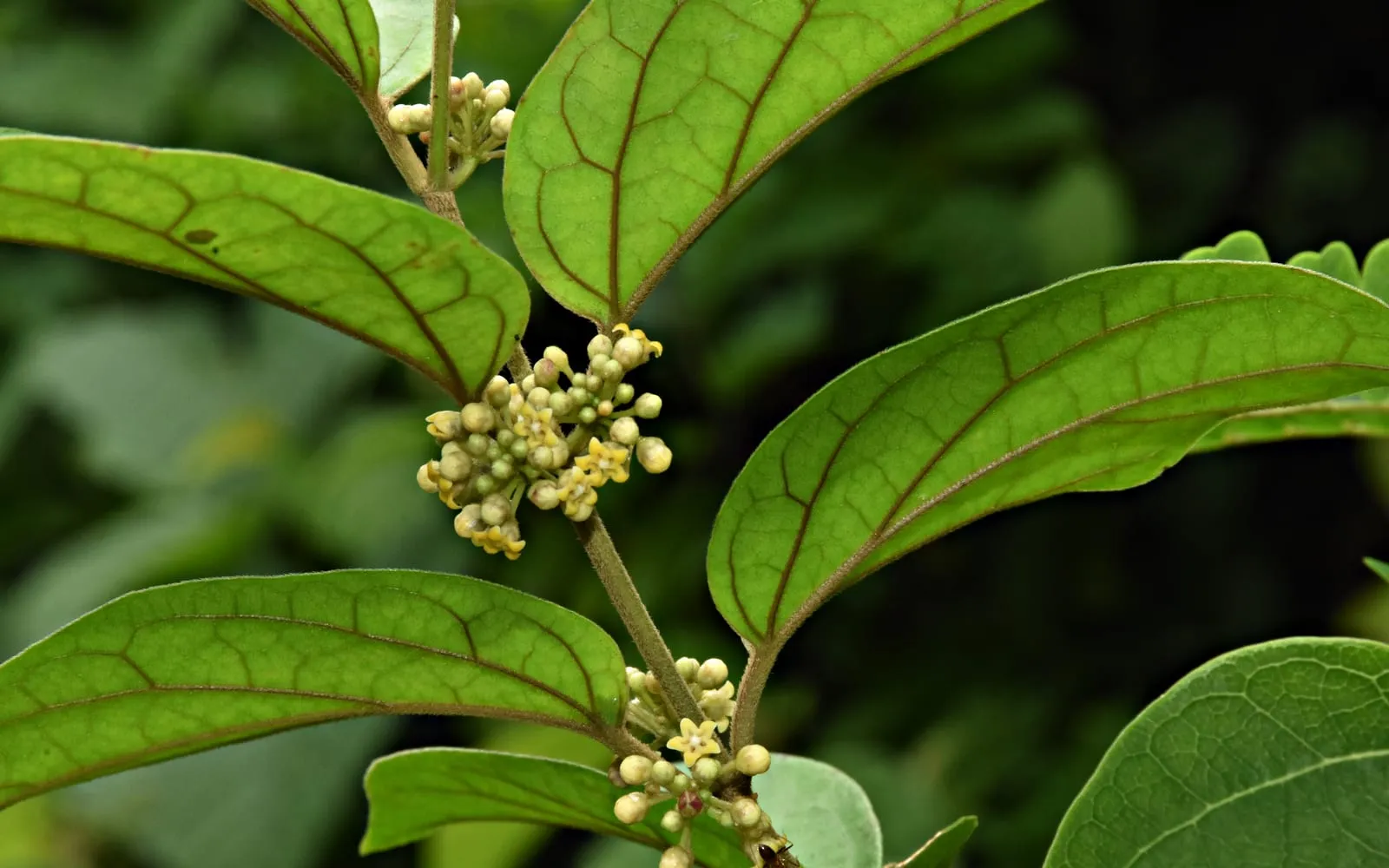
Stems twine and become woody at the base, reaching three to five metres under glass, covered in fine down when young. Cut any part and a white latex leaks out, which places the plant among the milkweeds.
Leaves are opposite, oval to elliptical, 3 to 6 cm long, pointed, soft and downy underneath, on short stalks. They are the part with the taste effect, and a single mature leaf is enough for a demonstration.
Flowers are small, about 5 mm across, pale yellow to greenish, in tight clusters from the leaf axils, and easy to miss. The fruit is a slender pointed follicle that splits to release flat seeds with a tuft of silky hairs, exactly as a milkweed does.
Where it is from
Gymnema sylvestre grows wild in central and southern India, Sri Lanka, parts of tropical Africa, Vietnam, Malaysia and northern Australia, climbing through dry and moist deciduous forest.
Indian production for the herb trade is centred in Madhya Pradesh, Andhra Pradesh and Tamil Nadu, and demand from the supplement market has pushed wild collection hard enough that cultivation programmes have been established in several states.
The climate it comes from is warm all year with a monsoon and a dry season. It has no cold tolerance whatever, which sets the growing conditions anywhere cooler before anything else is considered.
How it grows
It grows as a scrambling climber, twining through whatever it reaches. In a greenhouse border it makes several metres a season and needs wires or a frame from the start.
Propagation is by semi-ripe cuttings in summer with bottom heat, which is more reliable than seed. Seed is hard to source outside its range and germinates erratically at 25 deg C or above.
Growth is continuous in constant warmth and stalls below about 18 deg C. There is no dormancy to work with, so the plant either grows or sits, and a cold winter under glass means a plant that does nothing from November to March.
Through the seasons
Growth runs from May to September in a heated greenhouse. Water when the compost surface dries, feed monthly at half strength, and tie in new growth as it extends.
Take cuttings in July or August, three nodes long, into a free-draining mix with bottom heat at 25 deg C. Rooting takes four to six weeks.
From October, reduce water hard and stop feeding. Keep the minimum temperature above 12 deg C. Prune in March before growth restarts, cutting back long growth to a framework and wearing gloves against the latex.
Care difficulty
Difficult, mostly for reasons that have nothing to do with the plant’s temperament. A heated greenhouse running above 12 deg C all winter is expensive, and without one the plant does not survive.
Sourcing is the other obstacle. Neither seed nor plants are widely sold outside its native range, and material offered online is often mislabelled, so buying from a specialist collection is the reliable route.
Given heat, the plant is not fussy. It tolerates dry air better than most tropical climbers, wants no special compost and has no complicated feeding requirement.
Watering
Water freely through the summer whenever the top of the compost dries, letting the pot drain completely each time.
Reduce sharply from October. A plant sitting at 14 deg C through a cool winter needs very little, and wet compost at that temperature rots the roots within weeks.
The plant tolerates a spell of dryness better than a spell of wetness, which is the safer direction to err in when judging a winter watering.
Warning signs, diseases and pests
Mealybug is the usual problem under glass, collecting in leaf axils and along stems as white waxy fluff. Deal with it by hand on a plant of this size, since it spreads to everything else in the greenhouse if ignored.
Red spider mite follows dry heat, showing as fine pale stippling and later webbing. Damping down the greenhouse floor and misting the plant reduce it. Scale insects appear on older woody stems.
Yellowing leaves and stem dieback in winter usually mean cold, wet compost or both. The plant gives clear warning as it declines and recovers if the temperature and the watering are corrected before the roots go.
Growing environment
Bright light with a few hours of direct sun. A greenhouse border or a large pot in a conservatory both work, given a support to climb.
Temperature is the hard requirement. Above 12 deg C at all times, and 22 to 30 for active growth. This is a heated greenhouse plant outside USDA 10 and not a windowsill one.
Compost should be a loam-based mix with grit added for drainage. High humidity suits it and it copes with ordinary greenhouse air better than many tropical climbers.
Feeding
A balanced liquid feed at half strength, once a month from May to August. The plant is not hungry and overfeeding produces sappy growth that mealybug finds first.
Stop feeding from September. Growth slows as light falls and unused fertiliser does no good in cold compost.
Repot every second spring into fresh compost, which does more for a container plant than any feeding regime.
Troubleshooting
Does the leaf really block sweet taste? Yes. Chewing a leaf for a minute suppresses the perception of sweetness for twenty to thirty minutes, while salt, sour and bitter continue to work normally. It is the most reliable party trick in this collection.
Can I grow it outdoors in a cool climate? No. It has no frost tolerance and stops growing below about 18 deg C. It needs a heated greenhouse or a warm conservatory year round.
Where do I buy a plant? From a specialist tropical or medicinal plant nursery. It is not a garden centre plant outside the tropics and online seed is often mislabelled.
Is the white sap dangerous? It is a milkweed-family latex and irritates skin and eyes in that group generally. Wear gloves when pruning and wash your hands afterwards.
Can I take it if I am diabetic? That is a question for whoever manages your treatment rather than for a growing guide. Gymnema is documented as lowering blood sugar, which is why the combination needs medical advice rather than guesswork.
How do I propagate it? Semi-ripe cuttings in July or August with bottom heat at 25 deg C. Seed is unreliable and hard to obtain fresh.
Why is my plant doing nothing? Almost certainly too cold. Below 18 deg C it stops growing, and below 12 it deteriorates. There is no dormancy to wait out.
Gymnema problem guides
Not sure what is wrong? See the common houseplant pests guide.