
Houseplant
Shatavari
Asparagus racemosus
Also known as Wild asparagus, Satavar, Shatamull
How to grow Asparagus racemosus under glass. A thorny climbing asparagus with a hundred roots, scented white flowers, and the berries to keep away from pets.
At a glance
- Difficulty
- Moderate
- Water
- Regularly in summer, sparingly in winter
- Light
- Bright light with some direct sun
- Temperature
- Tender. Above 10 deg C, and it prefers 20 to 30
- Humidity
- Moderate
- Hardiness
- USDA 9-11, RHS H1c, hardy to 5 C
- Type
- Tender perennial climber from a cluster of tuberous roots
- Height
- 2-4 m under glass
- Native to
- India and Sri Lanka, the Himalayan foothills, tropical Africa, northern Australia
Dry forest and rocky ground across India, Africa and Australia. It dies back to its tuberous roots in the dry season and reshoots, so winter dieback in a cool room is dormancy rather than failure. Outdoors year round in USDA 9 and warmer.
Hardiness zones describe winter cold alone. Summer heat, humidity, rainfall and the length of the growing season decide as much, so treat the range as the outer limit rather than as a recommendation.
Harmful if eaten
- Do not eat
- The red berries, and the sap in some people
- Harm from
- Eating it and handling it
- Affects
- People, cats and dogs
The root is a food and a supplement in India, where young shoots are also eaten as a vegetable, and the plant has a long record of use. The caution comes from the genus rather than from a source that names this species. The ASPCA lists asparagus fern, Asparagus densiflorus, as toxic to dogs and cats, with berries that cause vomiting and diarrhoea and repeated sap contact that causes dermatitis, and the same pattern is reported across ornamental Asparagus species generally. Asparagus racemosus carries similar red berries, so the sensible position for a household with a curious dog or cat is to treat the fruit as off limits. The plant does not appear on the RHS list of potentially harmful garden plants. The other hazard is mechanical: the stems carry sharp recurved thorns that catch skin and clothing, which is what makes the plant awkward rather than dangerous to handle.
Sources: ASPCA, Asparagus fern, a related species in the same genus, RHS potentially harmful garden plants, ASPCA toxic and non-toxic plants, NHS on herbal medicines
About
Shatavari means she who has a hundred roots, and lifting a mature plant shows why. The crown sits above a dense cluster of finger-thick tuberous roots, sometimes dozens of them, radiating out and down. Those roots are the part used, and they are one of the most important items in Ayurvedic practice.
The plant above them is an asparagus, and anyone who has grown the ornamental asparagus fern will recognise it at once. Fine needle-like foliage on wiry scrambling stems, sprays of small scented white flowers, and red berries in autumn. The difference is the thorns, which are sharp, recurved and numerous.
Outside the subtropics it is a heated greenhouse plant. It has no frost tolerance, wants a long warm season, and takes two or three years to build the root cluster that gives it its name. As a foliage plant under glass it is graceful and easy given warmth.
Appearance and character
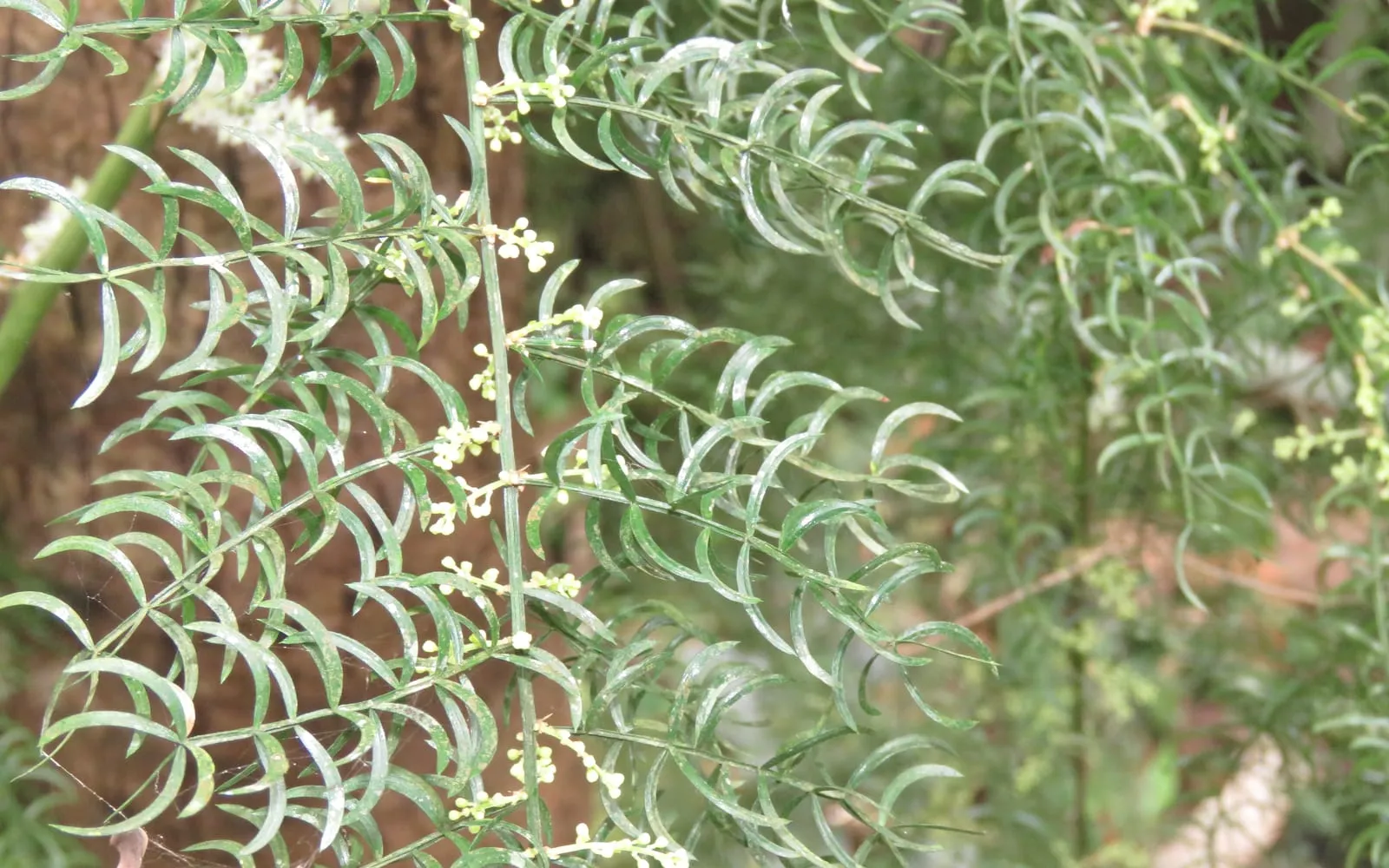
What look like leaves are not leaves. Asparagus species carry flattened stems called cladodes in place of true foliage, and in this species they are needle-fine and 1 to 3 cm long, borne in tufts of three to six along the stems, giving the plant its feathery texture.
The true leaves are reduced to small scales at the base of each tuft, and in this species many of them are modified into curved thorns. Those thorns are the thing to remember when handling the plant, since they hook into skin and clothing on the way past.
Flowers come in summer as short racemes of tiny white flowers with a strong sweet scent, in the leaf axils and at the stem tips. The berries that follow ripen through purple to red, about 6 mm across, and hold one to three hard black seeds.
Where it is from
Asparagus racemosus grows across India and Sri Lanka, into the Himalayan foothills to about 1500 m, and through tropical Africa and northern Australia. It occupies gravelly rocky ground, scrub and open forest, scrambling through other vegetation.
Its climate is warm with a distinct dry season, and the tuberous roots are a drought adaptation, storing water and starch through months without rain. That explains both the plant’s tolerance of dry air and its intolerance of a wet cold winter.
Wild collection for the herb trade has been heavy enough that the species is treated as at risk in parts of India, and cultivation programmes have been established in Madhya Pradesh, Maharashtra and elsewhere in response.
How it grows
Growth is from a crown that sends up new stems each season, scrambling through whatever support is available. Under glass a plant reaches two to four metres and needs wires, a frame or a large obelisk.
The root cluster builds over several years. A plant raised from seed is worth lifting at three years and improves after that, which is the timescale to plan for if the roots are the object.
Seed germinates readily at 25 deg C after soaking overnight, though it can take three to six weeks. Division of an established crown in spring is quicker and gives a plant that produces sooner.
Through the seasons
Sow in spring at 25 deg C after soaking the seed overnight, or divide an established crown in March. Pot into free-draining compost in a deep container, since the roots want depth.
Growth runs from May to September under glass. Tie in new stems as they extend, water regularly, feed monthly, and expect flowers on plants of two years and older.
From October, cut the watering right back and hold the minimum temperature above 10 deg C. In March, before growth restarts, cut out dead and damaged stems. Wear gauntlets. Lift and divide from the third year, taking roots at the same time.
Care difficulty
Easy given a heated greenhouse and impossible without one. The plant asks for little beyond warmth, light and free-draining compost, and it tolerates dry air better than most tropical plants.
The thorns make routine handling awkward. Tying in and pruning both need gauntlets, and siting the plant where nobody has to reach past it saves trouble.
Depth of pot is the other thing to get right. The tuberous roots want room to develop, and a plant in a shallow container never builds the cluster that makes it worth growing.
Watering
Water regularly through summer whenever the compost surface dries, letting the pot drain fully. The plant grows fast in warmth and takes a good deal of water while it does.
Cut back sharply from October. The tuberous roots store water and a plant resting at 12 to 15 deg C needs very little. Cold wet compost is the main killer of container specimens.
The plant tolerates a dry spell without complaint and shows drought as yellowing cladodes that drop. That is recoverable; rotted roots are not.
Warning signs, diseases and pests
Red spider mite is the main pest, and fine needle foliage in dry greenhouse heat is close to its ideal habitat. Look for dull greyish foliage and fine webbing between the cladodes, and damp the greenhouse down regularly.
Mealybug collects where stems meet and among dense growth, and scale insects settle on older woody stems. Both are awkward to reach among thorny growth, which is an argument for catching them early.
Yellowing and heavy cladode drop in winter usually means cold or overwatering. Reduce water, raise the temperature if you can, and wait for spring rather than feeding or repotting a struggling plant.
Growing environment
Bright light with a few hours of direct sun. A greenhouse or conservatory suits it, with a support for the scrambling stems.
Temperature should stay above 10 deg C at all times, and growth is best between 20 and 30. Below 15 the plant idles and below 10 it deteriorates.
Compost should be loam-based with added grit, in a deep pot. Free drainage matters more than richness, since the roots rot in anything that holds water.
Feeding
A balanced liquid feed monthly from May to August. The plant is moderately hungry in its growing season and needs nothing outside it.
Stop feeding from September and do not resume until growth restarts in spring. Fertiliser in cold compost damages the fine feeding roots.
Repot or top-dress each spring. A plant building a root cluster benefits more from fresh compost and a bigger pot than from any feeding programme.
Troubleshooting
Is it the same as edible asparagus? Same genus, different species. Asparagus officinalis is the vegetable. Asparagus racemosus is a tender climbing species grown for its tuberous roots, and its young shoots are eaten in India but it is not a spear crop.
Can I grow it outdoors here? No. It has no frost tolerance and needs a long warm season. It can stand outside in a sheltered spot from June to September and must come in before autumn.
Why is it so thorny? The thorns are modified leaves, and they are recurved, which means they catch on the way past rather than on the way in. Wear gauntlets when pruning or tying in.
When can I harvest roots? From the third year, in spring. Lift the crown, take a portion of the tuberous roots and replant the rest at once.
Are the berries dangerous? Treat them as off limits for pets. The ASPCA lists the related asparagus fern as toxic to dogs and cats, with berries causing vomiting and diarrhoea, and the same caution is sensible here.
Why has my plant gone yellow and dropped its foliage? Cold or overwatering in winter, or red spider mite in summer. Check the undersides for webbing first, then look at the temperature and the compost.
How do I propagate it? Divide an established crown in March, giving each piece roots and a growing point. Seed works too, soaked overnight and germinated at 25 deg C, though it takes longer to reach a useful size.
Shatavari problem guides
Not sure what is wrong? See the common houseplant pests guide.