
Houseplant
Guduchi
Tinospora cordifolia
Also known as Giloy, Heart-leaved moonseed, Amrita
How to grow Tinospora cordifolia under glass. The vine that drops aerial roots like strings, why Sanskrit calls it the nectar of immortality, and the 2021 hepatitis cluster.
At a glance
- Difficulty
- Difficult
- Water
- Regularly in growth, almost never when leafless
- Light
- Bright light with direct sun for part of the day
- Temperature
- Tender. Above 12 deg C, and it prefers 25 to 35
- Humidity
- Moderate to high
- Hardiness
- USDA 10-12, RHS H1b, hardy to 10 C
- Type
- Tender deciduous woody climber
- Height
- 5 m or more under glass
- Native to
- India, Sri Lanka, Myanmar
Deciduous forest across the Indian subcontinent, climbing high into trees and dropping aerial roots. It is deciduous in the dry season, so leaf loss in a cool winter is the plant behaving normally. Outdoors year round in USDA 10 and warmer.
Hardiness zones describe winter cold alone. Summer heat, humidity, rainfall and the length of the growing season decide as much, so treat the range as the outer limit rather than as a recommendation.
Toxic if eaten
- Do not eat
- The stem, which is the part taken as a supplement
- Harm from
- Eating it
- Affects
- People
Guduchi has a long record of use in Ayurvedic practice and it also has the most recent safety story in this collection. LiverTox, the United States National Library of Medicine reference on drug-induced liver injury, carries a monograph on Tinospora recording a cluster of cases of acute hepatitis in India in 2021 among people taking giloy preparations during the pandemic, some of them with features of autoimmune hepatitis and some severe. Indian regulators and professional bodies disputed the interpretation at the time, and the monograph sets out both sides. What is not disputed is that the reports exist and that they are recent. The plant does not appear on the RHS list of potentially harmful garden plants and the ASPCA does not list it, both of which reflect its absence from gardens here. Nobody should be preparing stems from a greenhouse plant, and anyone taking a guduchi supplement should tell their GP, particularly alongside any medication processed by the liver.
Sources: LiverTox, Tinospora, LiverTox, Chinese and other Asian herbal medicines, NHS on herbal medicines, RHS potentially harmful garden plants, ASPCA toxic and non-toxic plants
About
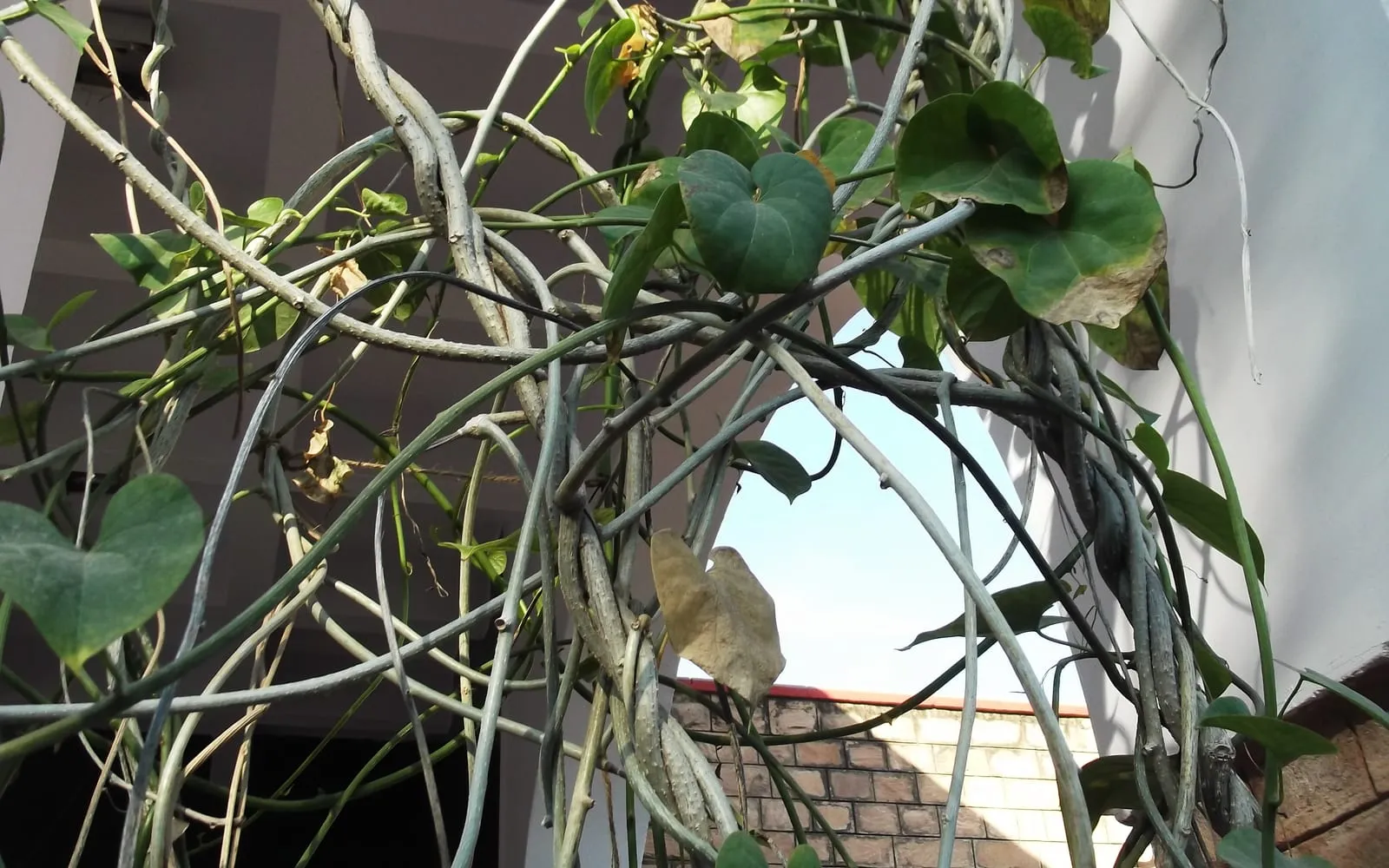
Guduchi grows aerial roots that hang from the stems like lengths of string, sometimes several metres of them, reaching down for the ground from wherever the vine has climbed to. In an Indian forest a mature plant looks as though it is raining roots, and the effect under glass on a well-grown specimen is one of the strangest things a heated greenhouse can produce.
Sanskrit calls it amrita, the nectar of immortality, and Ayurvedic practice ranks it among the most important herbs it has. The stem is the part used, cut into sections and dried or juiced. Under the name giloy it became one of the most sold herbs in India during the pandemic, which is the background to the liver injury reports the toxicity note describes.
Growing it outside the tropics means a heated greenhouse and a tolerance for a plant that loses its leaves and looks dead for months. It is deciduous in its dry season and does the same thing here, and the commonest way to kill it is to water it while it is doing so.
Appearance and character
The stems are the character of the plant. They are climbing and twining, and the bark on older growth is corky, grey-brown, and covered in raised warty protrusions called lenticels, which give it a distinctly reptilian look. Cut across, the wood shows a radiating pattern like the spokes of a wheel.
Aerial roots hang from the stems in quantity, thin, whitish and cord-like, growing downward from any height. In a greenhouse they will reach the floor and root if allowed, which is one route to propagating the plant.
Leaves are broadly heart-shaped, 5 to 15 cm long, on stalks attached at the notch of the leaf, thin-textured and bright green. Flowers are small, yellow, in drooping racemes and produced on leafless stems, with male and female flowers on separate plants. The fruit is a pea-sized red drupe.
Where it is from
Tinospora cordifolia grows through India, Sri Lanka and Myanmar, in deciduous forest and scrub, climbing high into trees. Indian practice attaches importance to which tree a vine is growing on, and material collected from neem trees is regarded as the best.
The climate is monsoon tropical, with a hot wet season and a hot dry one. The plant is deciduous through the dry months, which is when the stems are cut for the herb trade.
It is cultivated across India for that trade and is one of the plants promoted for farm cultivation to reduce wild collection. It is not established outside its native region other than in botanic collections.
How it grows
Growth is vigorous in warmth. The vine extends several metres in a season, and it needs a support and a good deal of headroom from the start.
The plant is dioecious, with male and female flowers on separate plants, so fruit needs two. Most greenhouse specimens are single plants raised from cuttings and will never fruit, which does not matter for a foliage plant.
Propagation is by stem cuttings, which is straightforward. A section of mature stem 20 to 30 cm long, half buried in warm free-draining compost, roots within a few weeks in the growing season. Aerial roots that reach compost root on their own.
Through the seasons
Growth restarts in late spring as the temperature rises. Water regularly, feed monthly at half strength, and tie in the extending stems.
Through summer the vine grows hard and the aerial roots appear. Trim it back if it is outgrowing the space, cutting to a node, and use the trimmings as cuttings.
From autumn the plant slows and drops its leaves, which is normal and not a symptom. Once it is leafless, stop watering almost completely and keep it above 12 deg C until spring. Watering a dormant leafless vine is what rots it.
Care difficulty
Difficult, for two reasons that compound. The plant needs a heated greenhouse running above 12 deg C all winter, and it needs to be left almost completely dry during the months when it looks dead.
Most losses happen in that leafless period, when a grower assumes the plant is failing and responds by watering it. The stems are storing what they need and compost that stays wet at 14 deg C rots the roots.
Given warmth and that restraint, the plant is vigorous and easy, roots from cuttings without effort and grows faster than most greenhouse climbers.
Watering
Water regularly through the growing season whenever the compost surface dries, letting the pot drain completely.
Stop almost entirely once the leaves fall. A leafless plant at 14 deg C needs a splash every few weeks at most, and many growers give it nothing from November to March.
Resume gradually as the first new shoots appear in spring, increasing as the plant leafs out. Starting too early is a common way to lose one.
Warning signs, diseases and pests
Mealybug is the usual greenhouse pest and hides in the leaf axils and among the corky bark, where it is hard to see and hard to reach. Check regularly and deal with it early.
Red spider mite follows dry heat and shows as dull stippled foliage with fine webbing. Damping down and misting reduce the pressure. Scale insects settle on older stems and look at first like part of the warty bark.
Leaf drop in autumn is normal behaviour rather than a warning sign. Leaf drop in midsummer means the plant is cold, dry at the root or under attack from mite, and each of those has a different fix.
Growing environment
Bright light with direct sun for part of the day, and plenty of vertical space. This is a forest climber that reaches the canopy, and a greenhouse border with wires to the roof suits it better than a pot on a bench.
Temperature must stay above 12 deg C at all times, and the plant grows properly between 25 and 35. It is a heated greenhouse subject anywhere cooler.
Compost should be loam-based and free-draining, in a deep pot or a border. The plant tolerates poor soil and does not tolerate standing water.
Feeding
A balanced liquid feed at half strength once a month through the growing season is enough for a vigorous vine.
Stop feeding as growth slows in autumn and give nothing at all through the leafless period.
Repot or top-dress in spring as growth restarts. A plant in a greenhouse border needs nothing beyond an annual mulch of compost.
Troubleshooting
My plant has dropped all its leaves. Is it dead? Probably not. Tinospora is deciduous through its dry season and does the same in a heated greenhouse in autumn. Keep it above 12 deg C, stop watering almost completely, and wait for spring.
Can I grow it outside? No. It has no frost tolerance and needs sustained warmth. A heated greenhouse is the only realistic setting outside USDA 10.
What are the strings hanging off it? Aerial roots. They grow downward from the stems looking for the ground, and they will root if they reach compost, which is one way to propagate the plant.
How do I take cuttings? Cut a section of mature stem 20 to 30 cm long and lay it half buried in warm free-draining compost during the growing season. It roots within a few weeks.
Why will it not fruit? Male and female flowers are on separate plants, so fruit needs two plants of opposite sex. Most greenhouse specimens are clones of one plant.
Is giloy the same thing? Yes. Giloy is the Hindi name for the same species, and it is what the supplement is sold as in India.
Why does the guide mention hepatitis? Because a cluster of acute hepatitis cases in India in 2021 was reported among people taking giloy preparations, and the LiverTox monograph on Tinospora sets out both those reports and the dispute about them. It is recent and it is documented, so the guide says so.
Guduchi problem guides
Not sure what is wrong? See the common houseplant pests guide.