
Edible
Starfruit
Averrhoa carambola
Also known as Carambola, Five-corner fruit, Belimbing manis
How to grow starfruit, Averrhoa carambola. The fruit that slices into stars, sweet and sour cultivars, and the reason anyone with kidney disease must never eat one.
At a glance
- Difficulty
- Moderate
- Water
- Twice a week in growth, less in winter
- Light
- Full sun with light shade in the fiercest heat
- Temperature
- Minimum 10 deg C. A mature tree takes a very light frost
- Humidity
- Moderate to high
- Hardiness
- USDA 10-11, RHS H1b, hardy to 2 C
- Type
- Tender evergreen tree
- Height
- 5-12 m in the open, 1.5-2 m in a pot
- Native to
- South East Asia
- Best month
- June, July and October in the Northern Hemisphere, December, January and April in the Southern Hemisphere
Wet tropical south-east Asia. It flowers several times a year in warmth and takes a brief light chill better than most tropical fruit. The fruit accumulates oxalic acid and caramboxin, which is a genuine hazard to anyone with reduced kidney function.
Hardiness zones describe winter cold alone. Summer heat, humidity, rainfall and the length of the growing season decide as much, so treat the range as the outer limit rather than as a recommendation.
Every month named in this guide is for the temperate Northern Hemisphere. If you garden in the Southern Hemisphere, shift each one by six months, so June becomes December. Closer to the equator the wet and dry seasons matter more than the calendar, and the shift stops being a useful guide.
Poisonous if eaten
- Safe to eat
- The ripe fruit, for people with normal kidney function
- Do not eat
- The whole fruit, for anyone with impaired kidneys
- Harm from
- Eating it
- Affects
- People
Starfruit is safe for people with healthy kidneys and dangerous for people without them. The fruit contains caramboxin, a neurotoxin that healthy kidneys clear and damaged ones do not. In people with chronic kidney disease, and particularly those on dialysis, eating starfruit or drinking the juice causes intractable hiccups, vomiting, confusion, agitation, seizures and death, sometimes after as little as one fruit or a single glass of juice. Cases have been reported repeatedly from Brazil, Taiwan, Malaysia and India, and the National Kidney Foundation advises anyone with kidney disease to avoid the fruit and its juice entirely. Starfruit is also high in oxalate, which adds a stone risk for susceptible people and means large quantities are unwise even with normal kidneys. Nothing about the appearance or the taste warns of any of this, so the warning has to be carried in words.
Sources: National Kidney Foundation on starfruit, RHS potentially harmful garden plants
About
Starfruit earns its name at the chopping board. The fruit has five deep longitudinal ridges, and a cross-slice is a five-pointed star, which is why it turns up as a garnish more often than as an ingredient.
There are two kinds. Sweet-type cultivars are larger, paler and mild enough to eat out of hand, and sour-type ones are smaller and sharper and go into chutneys, drinks and cooking. Check which type you are buying.
One warning has to come before anything else. Anyone with kidney disease must not eat starfruit or drink its juice. Healthy kidneys clear the neurotoxin the fruit contains and damaged ones cannot, and the outcome in dialysis patients has included seizures and death after a single serving.
Appearance and character
A rounded bushy evergreen tree, 5 to 12 m in the open and readily held to 1.5 m in a pot.
Leaves are pinnate, with five to eleven oval leaflets on each stalk, soft light green, and sensitive to touch and to darkness. They fold together at night and close when handled roughly, which is unusual and diagnostic.
Flowers are small, lilac to pink with darker centres, borne in clusters on the branches and often directly on older wood.
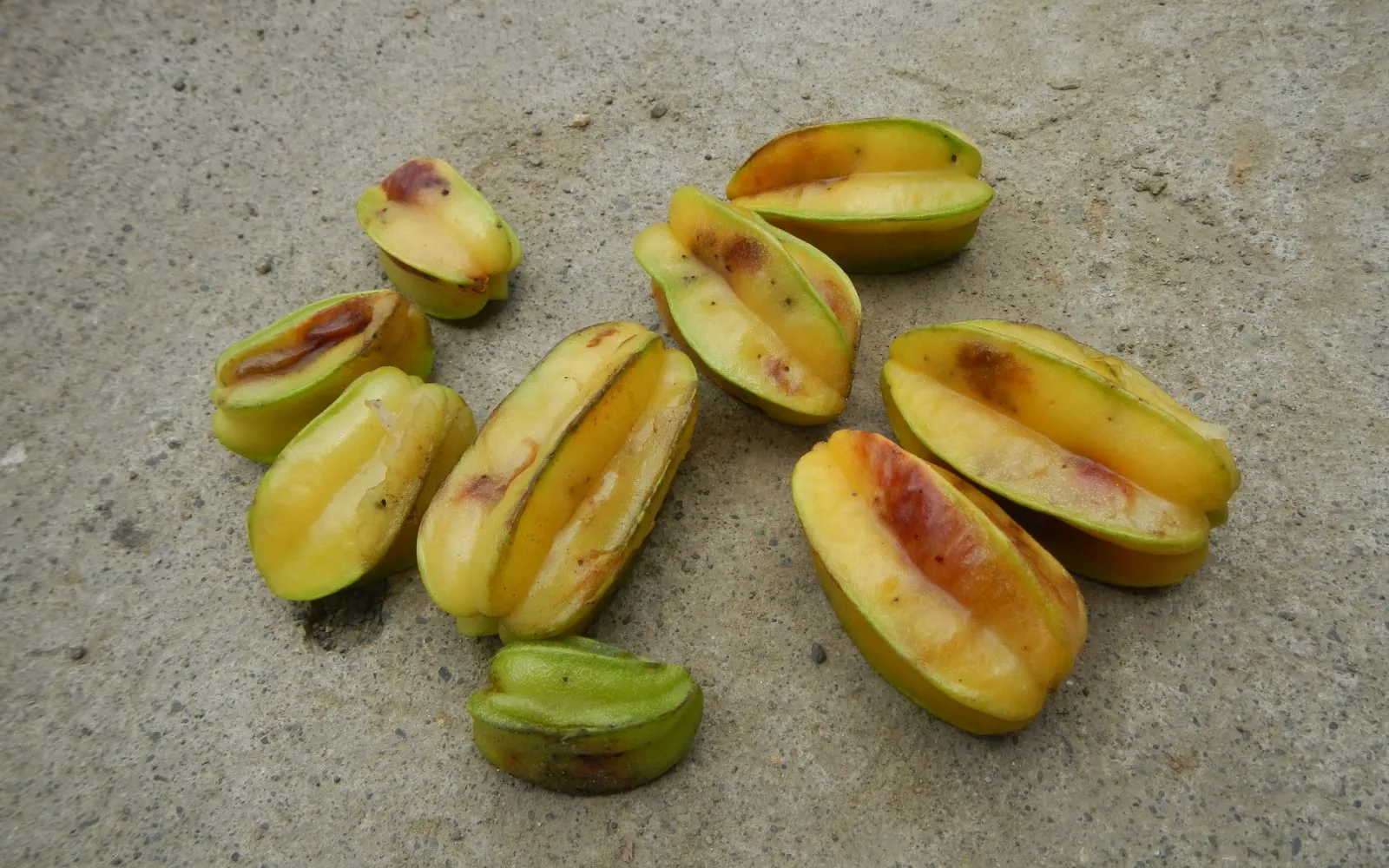
Fruit is 5 to 15 cm, oblong, with five deep ridges running its length, ripening from green to a waxy translucent yellow.
The whole fruit is eaten. The skin is thin and edible, the flesh is crisp and juicy, and a few small flat brown seeds sit in the centre.
Flavour runs from mildly sweet with a grape note in the sweet types to sharply acid in the sour ones.
The waxy skin browns at the ridge edges as the fruit ages, which is cosmetic.
Where it is from
Starfruit is native to South East Asia, probably to the Malay peninsula and Indonesia, though it has been cultivated so long that its wild origin is uncertain.
It spread early through South Asia, and India, Sri Lanka and Bangladesh have grown it for centuries, chiefly the sour types for cooking and preserving.
Chinese and Arab traders carried it west and east, and the Spanish and Portuguese moved it to the Americas.
Florida developed the sweet cultivars that dominate the export trade in the twentieth century, breeding for size, mildness and appearance, and those are the fruit a supermarket sells.
Malaysia, Taiwan, Brazil and Florida are the main commercial producers now. The Brazilian and Taiwanese case reports of poisoning in kidney patients came from places where the fruit is cheap and abundant.
How it grows
Sow seed from a ripe fruit, which germinates readily but loses viability in a few days.
Sow at 22 to 28 deg C in free-draining compost. Germination takes one to three weeks.
Buy a grafted plant if fruit is the aim. Seedlings are variable and take four to seven years, where a grafted plant crops in two or three.
Grow in full sun with a little shade from the hardest midday sun through glass.
Keep it above 10 deg C, and above 15 deg C for real growth.
Water twice a week in growth, less in winter.
Use slightly acid compost and rainwater, since starfruit shows iron shortage readily.
Feed monthly from April to September.
Prune lightly to shape. The tree branches low and makes a bushy plant without much help.
Expect two crops a year in a warm greenhouse, since starfruit flowers more than once in a season.
Through the seasons
Winter is a cool rest above 10 deg C, watered sparingly and unfed. Some leaf drop is normal.
Spring brings the growth flush and the first flowering. Repot and start feeding.
Early summer is fruit set from the spring flowers.
Midsummer is fruit swell, which takes about two months from flower to ripe fruit.
Late summer brings a second flowering in a warm house.
Autumn is a second harvest, then the taper. Stop feeding and reduce watering.
Care difficulty
Moderate, and among the more achievable tropical fruits under glass.
Cold tolerance is reasonable. A mature tree takes a very light frost and a pot plant needs only to be kept above 10 deg C.
Fruiting comes quickly on a grafted plant, in two or three years, and a warm greenhouse gives two crops a year.
Size suits a pot. The tree stays bushy and takes pruning well.
Iron shortage on hard water is the commonest complaint and is easily prevented with rainwater and acid compost.
Leaf drop after a cold or dry spell alarms new growers and is a normal response.
The safety issue is a matter of who eats the fruit rather than of growing it, and it needs to be understood before a plant is given to anyone.
Watering
Water twice a week in growth, keeping the compost evenly damp.
Reduce in winter, allowing the surface to dry between waterings.
Drain fully. Starfruit dislikes standing water.
Water steadily during fruit swell, since irregular watering causes drop and splitting.
Use rainwater where the tap water is hard.
Keep humidity moderate to high, which reduces leaf drop.
Mulch the pot surface in summer.
Warning signs, diseases and pests
Yellowing between green veins is iron shortage on alkaline compost or hard water, and this species shows it faster than most.
Sudden leaf drop follows a cold snap, a dry spell or a move. The plant usually refoliates.
Brown crisp leaf margins mean dry air or salt build-up.
Leaflets folding at night or when touched is normal behaviour rather than a symptom.
Brown limpets on the stems are scale.
Fine webbing under the leaves is spider mite.
Wilting in damp compost is root rot.
Fruit dropping small and green is irregular watering or too heavy a set.
Brown edges along the fruit ridges are cosmetic ageing.
Growing environment
A frost-free greenhouse or conservatory, standing outdoors for a warm summer.
Minimum 10 deg C, with 20 to 30 deg C for growth and fruit.
Full sun with light shade in the hottest glass.
Moderate to high humidity.
Free-draining slightly acid compost rich in organic matter.
pH from 5.5 to 6.5.
Rainwater in a hard water area.
A pot of 35 to 45 cm for a fruiting plant.
Feeding
Feed monthly from April to September with a balanced liquid feed containing iron.
Switch to a high-potash feed as fruit swells.
Add sequestered iron at the first yellowing between the veins.
Stop feeding at the end of September.
Give nothing through winter.
Top-dress or repot each spring.
Avoid heavy nitrogen, which produces leaf at the expense of fruit.
Troubleshooting
Who must not eat starfruit? Anyone with chronic kidney disease, and especially anyone on dialysis. Healthy kidneys clear the neurotoxin caramboxin and damaged ones do not, and cases of hiccups, seizures and death after a single fruit or glass of juice are documented in several countries.
Is it safe for everyone else? Yes, in normal amounts. It is high in oxalate, so anyone prone to kidney stones should not eat large quantities.
Sweet or sour, which have I got? Sweet-type fruit is larger, paler and mild. Sour-type is smaller, deeper yellow and sharp. Supermarkets sell the sweet types.
Do I peel it? No. The skin is thin and edible and the whole fruit is eaten, seeds aside.
The leaves fold up at night. Normal. Starfruit leaflets close in darkness and when handled, which is a family trait shared with the wood sorrels.
The whole tree dropped its leaves. Usually a cold snap, a dry spell or a move. It refoliates if the roots are sound.
The leaves are yellow between green veins. Iron shortage. Starfruit shows it faster than most. Use rainwater, slightly acid compost and sequestered iron.
How soon will it fruit? Two or three years from a grafted plant, four to seven from seed, and a warm greenhouse gives two crops a year.
Starfruit problem guides
Not sure what is wrong? See the common vegetable pests guide.