
Edible
Jabuticaba
Plinia cauliflora
Also known as Jaboticaba, Brazilian grape tree, Guaperu
How to grow jabuticaba, Plinia cauliflora. The Brazilian tree that fruits all over its trunk, the grape-like berries that last three days, and the fifteen-year wait from seed.
At a glance
- Difficulty
- Moderate
- Water
- Twice a week in growth, and it dislikes drying out
- Light
- Full sun to light shade
- Temperature
- Minimum 0 deg C. An established tree takes a light frost
- Humidity
- Moderate to high
- Hardiness
- USDA 9-11, RHS H1c, hardy to -1 C
- Type
- Tender to half-hardy evergreen tree
- Height
- 5-15 m in the open, 1.5 m in a pot after many years
- Native to
- southern Brazil
- Best month
- May, June and September in the Northern Hemisphere, November, December and March in the Southern Hemisphere
Subtropical southern Brazil. The fruit is borne directly on the trunk and main limbs rather than on shoots, and a mature tree flowers several times a year. Slow from seed, taking eight to twelve years to first fruit.
Hardiness zones describe winter cold alone. Summer heat, humidity, rainfall and the length of the growing season decide as much, so treat the range as the outer limit rather than as a recommendation.
Every month named in this guide is for the temperate Northern Hemisphere. If you garden in the Southern Hemisphere, shift each one by six months, so May becomes November. Closer to the equator the wet and dry seasons matter more than the calendar, and the shift stops being a useful guide.
Edible, with limits
- Safe to eat
- The white pulp inside the skin
- Do not eat
- The skin, which is high in tannins
- Harm from
- Eating it
- Affects
- People
Jabuticaba is not toxic and nothing in it is listed as harmful to people or to cats and dogs. The tough purple-black skin is high in tannins, and while it is eaten in Brazil, eating a great many skins at once is astringent and constipating. Most people squeeze the pulp out and discard the skin, and that is the standard advice for anyone eating a lot of them. The seeds are small, soft and swallowed with the pulp without concern. The fruit ferments within three or four days of picking, which is why Brazil turns the surplus into wine and liqueur rather than storing it.
Sources: ASPCA toxic and non-toxic plants, RHS potentially harmful garden plants
About
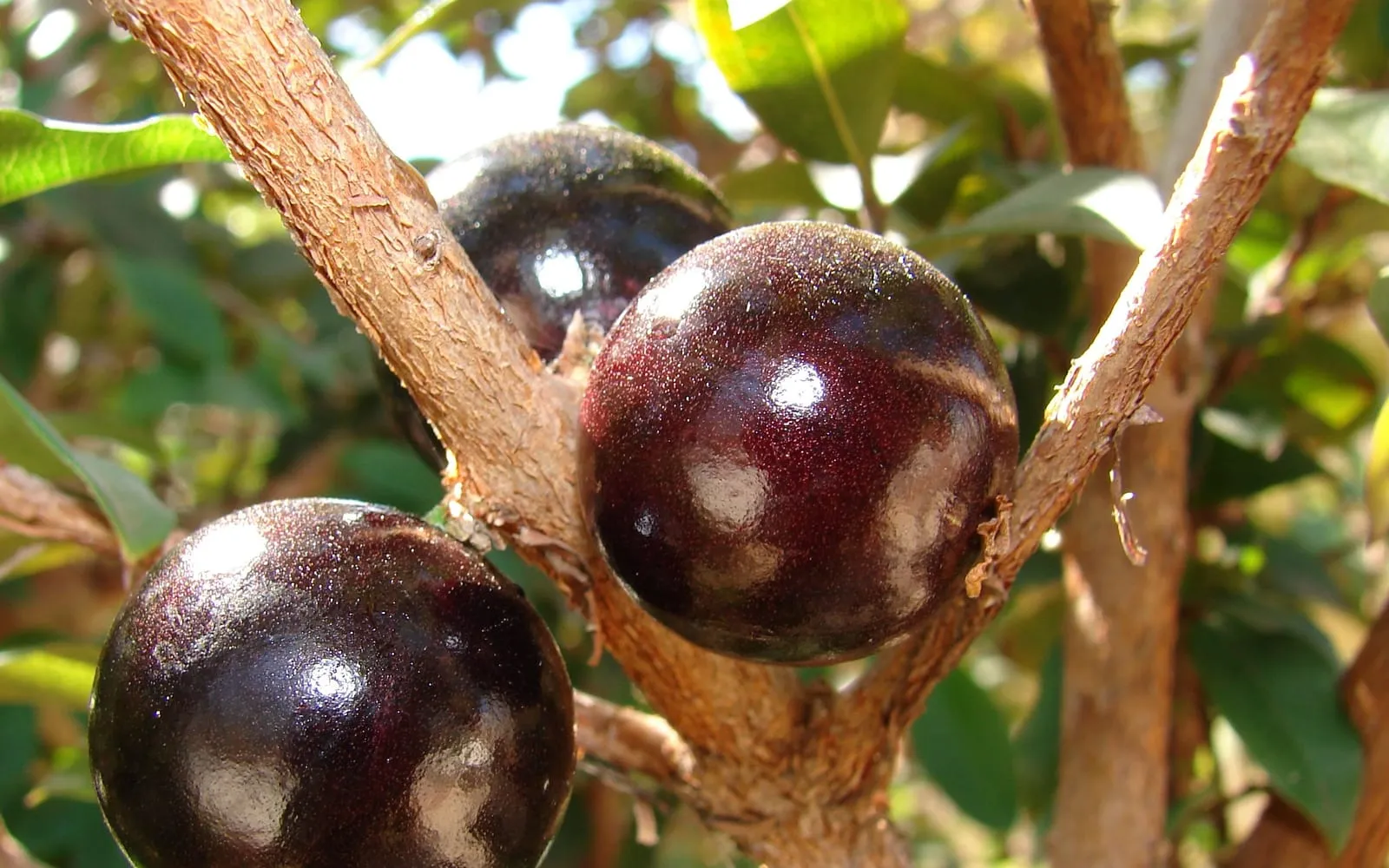
A jabuticaba in fruit looks wrong. Purple-black berries the size of grapes cover the trunk and the main branches from the ground upwards, packed so close that the bark disappears, and there is nothing on the twigs at all.
The fruit tastes close to a muscat grape, sweet and slightly resinous, with a tough skin and a soft white pulp. It lasts three or four days off the tree before it ferments, which is why almost nobody outside Brazil has eaten a fresh one.
The tree is the slowest thing in this collection. A seedling takes eight to fifteen years to fruit, and old specimens in Brazilian gardens are treated as heirlooms.
Appearance and character
A dense bushy evergreen tree, multi-stemmed, 5 to 15 m in the open and very slow to get there.
Bark is the tree’s best feature outside the fruiting season. Thin, smooth and peeling in patches to leave a mottled surface of cream, tan and grey-pink, much like a plane tree at small scale.
Leaves are opposite, lance-shaped, 3 to 10 cm, small, glossy dark green, and flushing salmon pink to red when young. The whole tree turns coppery when it flushes.
Flowers are borne directly on the trunk and main branches in dense clusters, small, white, and consisting almost entirely of stamens, so a flowering tree looks as though it has been dusted with white fur.
Fruit follows in the same places, round, 2 to 4 cm, ripening green through red to a deep glossy purple-black.
Skin is tough and thick, and the pulp inside is white, translucent and gelatinous with one to four small soft seeds.
A mature tree flowers and fruits several times a year, sometimes five or six, each cycle taking about a month from flower to ripe fruit.
Where it is from
Jabuticaba is native to the Atlantic forest of southern Brazil, in Minas Gerais, Sao Paulo, Rio de Janeiro and Rio Grande do Sul.
It has been cultivated in Brazil since before European contact, and the Tupi name gave the Portuguese one.
Brazil eats it fresh in season and turns the rest into jelly, wine and liqueur, since the fruit ferments within days.
The tree spread to Argentina, Paraguay and Bolivia, and colonial botanic gardens took it to the Philippines, Australia, California and Florida.
It has become a collector’s tree outside Brazil, grown as much for its mottled bark and its extraordinary fruiting habit as for the crop.
Temperate markets see the fruit almost never, since it does not survive shipping, and the plant is available from specialist nurseries.
How it grows
Sow seed from a ripe fruit. It germinates at 20 to 26 deg C in three to eight weeks and loses viability within weeks.
Expect several seedlings from one seed. Jabuticaba is often polyembryonic and most of the seedlings are clones of the parent.
Buy a grafted plant if you want fruit in a reasonable time, since seedlings take eight to fifteen years and grafted plants three to five.
Use ericaceous compost. This species hates lime and yellows badly on anything neutral.
Give full sun or light shade and keep it above freezing. An established tree takes a light frost, which makes it the hardiest fruit in this collection.
Water twice a week and never let it dry out.
Use rainwater.
Feed monthly from April to September with an ericaceous feed.
Prune lightly if at all. Growth is slow enough that shaping is rarely needed.
Through the seasons
Winter is a cool rest above freezing, watered moderately and unfed.
Spring brings a coppery growth flush and the first flowering on the trunk.
Early summer is fruit, about a month from flower.
Midsummer is a second flowering and fruiting cycle.
Late summer may bring a third.
Autumn is when to stop feeding and reduce watering as light falls.
A mature tree can run five or six cycles in a year in good conditions.
Care difficulty
Moderate, with one large caveat about time.
Cold hardiness is the best in this collection. An established tree takes a light frost and only needs to be kept from a hard one.
Acid compost is not optional. Jabuticaba yellows badly on lime and on hard water, and this is the commonest reason a temperate plant fails.
Watering must be steady. It has little drought tolerance.
Growth is very slow, which suits a pot and tests patience.
Fruiting is the real question. A seedling takes eight to fifteen years and a grafted plant three to five, so buy grafted if the fruit matters.
Once established it is undemanding and long-lived, and the mottled bark makes it worth keeping in the years before it fruits.
Watering
Water twice a week in growth, keeping the compost consistently damp.
Never let it dry out. Drought causes leaf drop and flower failure.
Reduce in winter without letting the compost dry.
Drain fully, since cold wet compost still rots roots.
Use rainwater. Hard water is the main cause of the yellowing this species suffers from.
Keep humidity moderate to high.
Mulch the pot surface with composted bark.
Warning signs, diseases and pests
Yellowing between green veins is iron shortage from lime or hard water, and this species shows it worse than anything else here.
Leaf drop follows drought.
Coppery new growth is normal and one of the tree’s pleasures.
Brown limpets on the trunk and branches are scale.
White fluff in the leaf axils is mealybug.
Fine webbing on the leaves is spider mite.
Wilting in damp compost is root rot.
A plant that grows and never flowers is usually too young. Seedlings take eight to fifteen years.
Fruit fermenting within days of picking is the species rather than a fault.
Growing environment
A cool greenhouse or conservatory, standing outdoors for the summer.
Minimum above freezing, with 22 to 30 deg C for growth and fruit.
Full sun to light shade.
Moderate to high humidity.
Ericaceous compost, rich and moisture-retentive.
pH from 5.0 to 6.0, and no higher.
Rainwater rather than tap water.
A pot of 35 to 45 cm, which a slow tree will occupy for years.
Feeding
Feed monthly from April to September with an ericaceous liquid feed containing iron.
Add sequestered iron at the first yellowing between the veins.
Stop feeding at the end of September.
Give nothing through winter.
Top-dress with composted bark or ericaceous compost each spring.
Repot every third year, since growth is slow.
Avoid lime in any form, including tap water in a hard water area.
Troubleshooting
Why does the fruit grow on the trunk? Cauliflory. Flowers and fruit are borne directly on the trunk and main branches rather than on the twigs, and a fruiting tree is covered from the ground upwards.
How long until it fruits? Eight to fifteen years from seed and three to five from a grafted plant. Buy grafted if the fruit is the point.
The leaves are yellow with green veins. Iron shortage from lime or hard water. Jabuticaba is strongly lime-hating. Use ericaceous compost, rainwater and sequestered iron.
How hardy is it? The hardiest fruit in this collection. An established tree takes a light frost, and it needs only to be kept from a hard one.
Do I eat the skin? You can, and it is tough and tannic. Most people squeeze the pulp out and discard the skin, particularly when eating a lot.
Why can I never buy the fruit? It ferments within three or four days of picking, so it does not ship. Brazil turns the surplus into jelly, wine and liqueur.
Several seedlings came from one seed. Normal. Jabuticaba is often polyembryonic and most of the seedlings are clones of the parent.
How often does it fruit? A mature tree runs several cycles a year, sometimes five or six, each taking about a month from flower to ripe fruit.
Jabuticaba problem guides
Not sure what is wrong? See the common vegetable pests guide.