
Edible
Red Mulberry
Morus rubra
How to grow red mulberry, Morus rubra. Telling it from white and black mulberry by its sandpapery leaf surface, why the fruit ripens a few berries at a time rather than all at once, and why fruit drop makes it a poor choice over a patio.
At a glance
- Difficulty
- Easy
- Water
- Regularly while establishing, then rarely once mature
- Light
- Full sun to part shade
- Temperature
- Fully hardy
- Hardiness
- USDA 4-8, RHS H6, hardy to -25 C
- Type
- Deciduous tree, living several decades
- Height
- Up to 20 m
- Native to
- eastern North America
Fully hardy through a severe winter, with no significant cold-related limitation across most of its native range. The main climatic influence is on fruiting rather than survival: a longer, warmer growing season extends the ripening period and increases the total crop, since fruit on this species ripens gradually over weeks rather than all at once.
Hardiness zones describe winter cold alone. Summer heat, humidity, rainfall and the length of the growing season decide as much, so treat the range as the outer limit rather than as a recommendation.
Skin irritant
- Safe to eat
- The ripe fruit
- Do not eat
- The unripe fruit and the milky sap
- Harm from
- Eating it and handling it
- Affects
- People
The ripe fruit is food, eaten fresh, dried or cooked into preserves, and carries no toxin of concern. As with the other mulberry species, the milky latex sap in the leaves, stems and unripe fruit contains irritant compounds, and eating a quantity of unripe berries causes stomach upset, while the sap can irritate skin and eyes on contact. Neither the RHS nor the ASPCA lists Morus rubra as harmful, and the ASPCA does not record mulberry generally as toxic to cats or dogs. Wash your hands after pruning or handling cut stems, and treat green, unripe fruit as unpleasant rather than dangerous: it is astringent and unappetising well before it is eaten in any quantity likely to cause real trouble.
Sources: RHS potentially harmful garden plants, ASPCA toxic and non-toxic plants
About
Red mulberry is a hardy fruiting tree native to eastern North America. The leaves are usually rough on the upper surface, which helps distinguish it from black and white mulberry, though hybrids can make identification less clear.
The fruit ripens gradually over several weeks rather than all at once. That makes it better for fresh picking through the season than for a single large harvest. Choose the site carefully, because a mature tree becomes broad and fruit drop can stain paths and patios.
Appearance and character
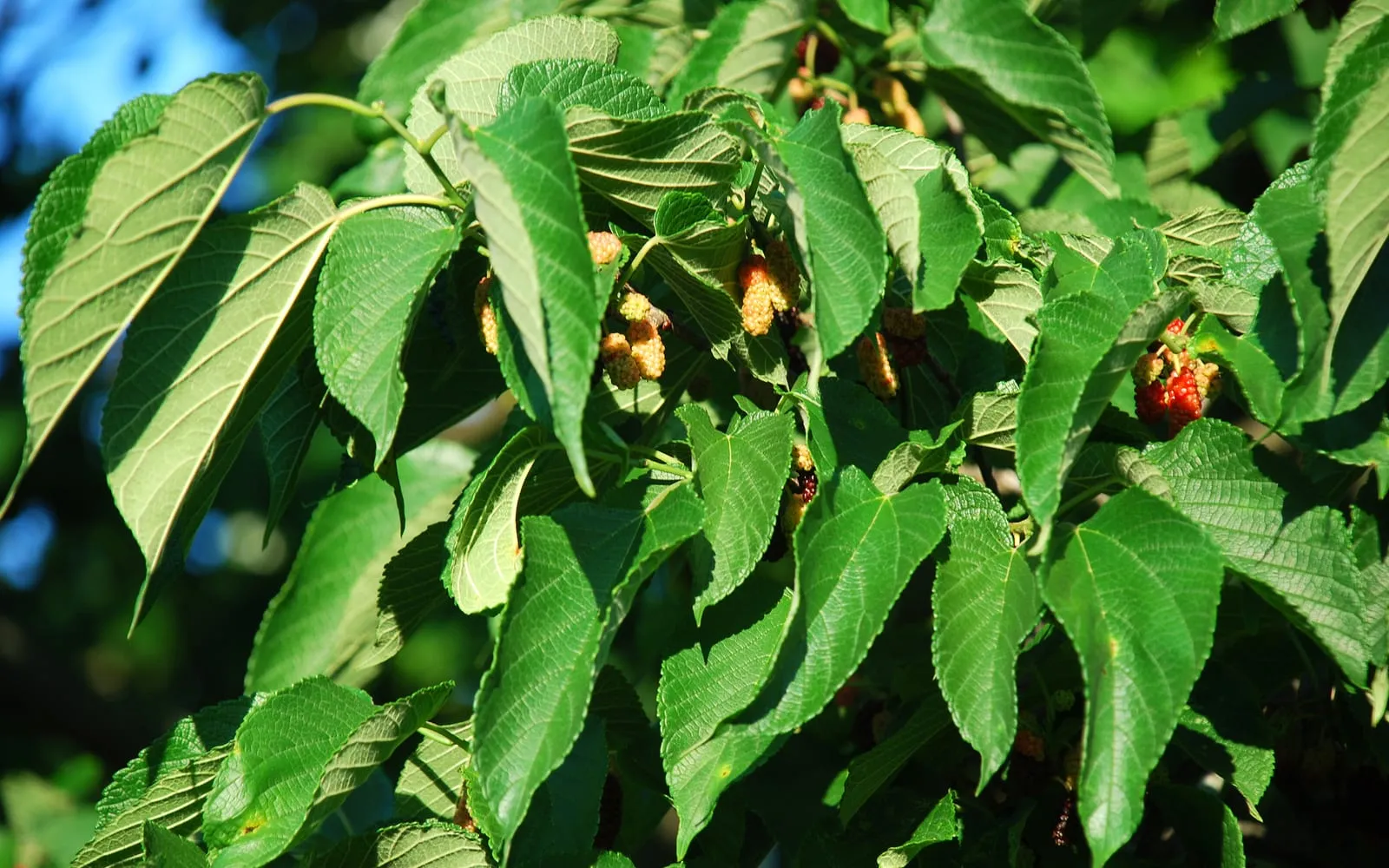
Leaves are large, ovate and frequently two- or three-lobed, up to 18 cm long, with a texture that is scabrous and rough above and softly pubescent beneath, both features useful for telling this species apart from its relatives.
Bark is greyish brown, breaking into irregular, scaly plates on mature trunks, with a distinctive orange inner bark visible where the surface is scraped or damaged.
Fruit resembles an elongated blackberry, 2 to 3 cm long, ripening from green through red to a dark, almost black purple when fully ready, with sweet, juicy flesh once ripe and a notably staggered ripening pattern across a single tree’s crop.
Growth forms a broad, rounded, spreading crown over time, reaching up to 20 m in ideal conditions though often smaller in cultivation, providing significant shade once mature.
Where it is from
Morus rubra is native to eastern North America, from the Great Lakes region south through much of the eastern and central United States, growing in rich woodland soils and often found along stream banks and in fertile bottomland.
It has hybridised extensively with the introduced white mulberry, Morus alba, wherever the two species grow near each other, to the point that pure red mulberry is now considered threatened by genetic swamping from its more vigorous, widely planted relative across parts of its native range, a conservation concern separate from anything a home gardener needs to manage. Check the source carefully, since a plant sold as red mulberry may in practice carry some white mulberry ancestry.
How it grows
Plant in moist, fertile soil where possible, though it tolerates a wide range of soil conditions reasonably well once established, reflecting its natural occurrence across varied woodland sites.
Choose the planting position with the tree’s eventual size and the mess of dropping ripe fruit both in mind. A mature tree casts a wide, dense shade and drops a considerable amount of soft, staining fruit through summer, which makes it a poor choice directly over a patio, path or parked car.
Prune minimally, removing dead, damaged or crossing branches in winter dormancy; this species does not need or particularly benefit from heavy formative pruning once a young tree’s basic framework is established.
Net a small or young tree if birds are taking most of the crop before you can, or plant it and accept that wildlife will take a significant share, which for a species so valuable to birds is, for many gardeners, part of its appeal rather than a drawback.
Through the seasons
Spring brings inconspicuous flowers, followed by the start of fruit development on pollinated trees.
Summer brings the long, staggered harvest, with ripe fruit available in small quantities over many weeks rather than all at once.
Autumn brings yellow leaf colour before leaf fall, and is a suitable time to plant a new bare-root or container-grown tree.
Winter is dormant. The tree is fully hardy and needs no protection; this is also the season for any necessary pruning.
Care difficulty
Easy, and one of the more tolerant and undemanding fruiting trees for a garden with room for its eventual size. It adapts to a wide range of soils, needs little routine feeding, and largely looks after itself once established. The main practical consideration is planning for its size and for the fruit drop, rather than any ongoing cultivation challenge.
Watering
Water regularly through the first two growing seasons while the root system establishes, a deep soak rather than frequent light watering.
Once established, it generally tolerates dry spells well and needs no supplementary watering except during a severe or prolonged drought, when a deep soak helps support fruit development through summer.
Warning signs, diseases and pests
Popcorn disease is a fungal infection specific to mulberry fruit, causing individual berries to swell into pale, distorted, popcorn-like structures rather than developing normally. Affected fruit should be removed and destroyed rather than composted, and fallen infected fruit cleared from the ground, since the fungus overwinters in fruit debris.
Bacterial leaf spot shows as small, dark, angular lesions on the foliage, generally a cosmetic issue on an established tree rather than a serious threat. Removing badly affected leaves and improving air circulation around a young tree helps limit it.
Birds are drawn strongly to the ripe fruit and often take the majority of a crop before a gardener gets to it, which for most people growing this species for wildlife value is an accepted trade rather than a problem to solve.
Growing environment
Full sun to part shade suits it well, with full sun generally producing the best fruiting, though the tree tolerates a fair amount of shade without serious decline.
Moist, fertile soil produces the best growth and fruiting, though the species tolerates a wide range of soil types reasonably well once established, a reflection of its adaptability across varied native habitats.
Give it plenty of room. A mature tree’s broad, spreading crown and significant eventual size mean it needs to be sited with long-term space in mind rather than close to a building, path or patio it might later overshadow or drop fruit onto.
Feeding
A balanced, general-purpose fertiliser applied once a year is enough where soil is poor, but on reasonable ground this species typically needs no supplementary feeding.
A mulch of well-rotted compost applied in spring, kept clear of the trunk, supplies adequate general fertility for most soils without the need for additional fertiliser.
Troubleshooting
The fruit ripens a few berries at a time rather than all together. This is entirely normal for the species. Expect to harvest in small batches over several weeks through summer rather than gathering one large crop at once, and pick individual ripe berries as they darken fully.
Some berries look pale, swollen and distorted rather than developing normally. Popcorn disease, a fungal infection specific to mulberry. Remove and destroy affected fruit rather than composting it, and clear fallen infected fruit from the ground each season.
I am not sure whether my tree is red, white or black mulberry. Check the leaf texture first: red mulberry has a distinctly rough, sandpapery upper surface, where white and black mulberry leaves are smoother and glossier. Bear in mind the species hybridise readily where they grow near each other, so a tree may show mixed characteristics.
Birds are stripping the tree before I can pick any fruit. Net a young or small tree if you want to guarantee a harvest for yourself, or accept the trade, since this species is valued by many gardeners specifically for the wildlife it supports through a long summer fruiting season.
Is the sap dangerous to handle? Mildly irritant rather than dangerous. Wear gloves for pruning if you have sensitive skin, and wash off any sap that gets on your hands or, particularly, in your eyes.