
Edible
Brazil Nut
Bertholletia excelsa
Also known as Para nut, Castanha-do-Para, Amazon nut, Cream nut
How to grow the Brazil nut, Bertholletia excelsa. Its rainforest pollination, agouti seed dispersal, selenium content and limits as a crop.
At a glance
- Difficulty
- Difficult
- Water
- Twice a week in growth, less in winter
- Light
- Shade when young, full sun when mature
- Temperature
- 24-30 deg C, with nothing below 15
- Humidity
- High. It is a rainforest tree
- Hardiness
- USDA 11-12, RHS H1b, hardy to 15 C
- Type
- Tender evergreen tree
- Height
- 50 m in the Amazon, 2-3 m in a pot
- Native to
- the Amazon basin, Brazil, Bolivia, Peru
- Best month
- May in the Northern Hemisphere, November in the Southern Hemisphere
Undisturbed Amazon rainforest, and it is the one tree here that has defeated plantation growing. Flowers are opened only by large-bodied orchid bees, and those bees need the surrounding wild forest, so cleared plantations flower and set nothing. Almost all the world crop is still gathered from wild trees.
Hardiness zones describe winter cold alone. Summer heat, humidity, rainfall and the length of the growing season decide as much, so treat the range as the outer limit rather than as a recommendation.
Every month named in this guide is for the temperate Northern Hemisphere. If you garden in the Southern Hemisphere, shift each one by six months, so May becomes November. Closer to the equator the wet and dry seasons matter more than the calendar, and the shift stops being a useful guide.
Edible, with limits
- Safe to eat
- The kernel
- Do not eat
- None, though the selenium content makes quantity the issue
- Harm from
- Eating it
- Affects
- People
Brazil nuts are food and the caution is about dose rather than poison. They are the richest common dietary source of selenium by a wide margin, and a single nut can supply more than the recommended daily intake, sometimes several times over depending on the soil the tree grew in. Selenium is essential in small amounts and toxic in large ones, and chronic excess causes selenosis, with brittle hair and nails, a garlic odour on the breath, rashes and, at high doses, nerve damage. British and American dietary guidance both advise limiting Brazil nuts to a small number a day rather than eating them by the handful. They also carry naturally occurring radium taken up from deep soil, at levels far below any health concern but high enough that they are the most radioactive food in an ordinary diet. Brazil nut is a standard tree nut allergen and reactions can be severe. The ASPCA advises against feeding nuts to cats and dogs generally.
Sources: NHS guidance on food allergy, ASPCA people foods to avoid feeding your pets, RHS potentially harmful garden plants
About
Brazil nuts resist farming because they depend on a chain no plantation has managed to reproduce. Almost every Brazil nut sold anywhere comes from a wild tree in standing Amazon rainforest, gathered by hand.
The flower has a hooded lip that has to be levered open by an insect strong enough to do it, which in practice means large-bodied orchid bees and a few carpenter bees. Those bees depend on orchids elsewhere in the forest, so clearing the forest to plant the tree removes the pollinators. Plantations flower and set almost nothing.
The seed has the same problem at the other end. Nuts come packed 10 to 25 in a woody sphere the size of a coconut, called an ourico, with a wall too thick for almost any animal to open. The agouti, a large forest rodent with chisel teeth, gnaws in, eats some and buries the rest, and its forgotten caches are how the tree reproduces.
That makes the Brazil nut an unusual commodity. Its trade depends on the forest staying standing, and Brazilian law protects the tree from felling.
Appearance and character
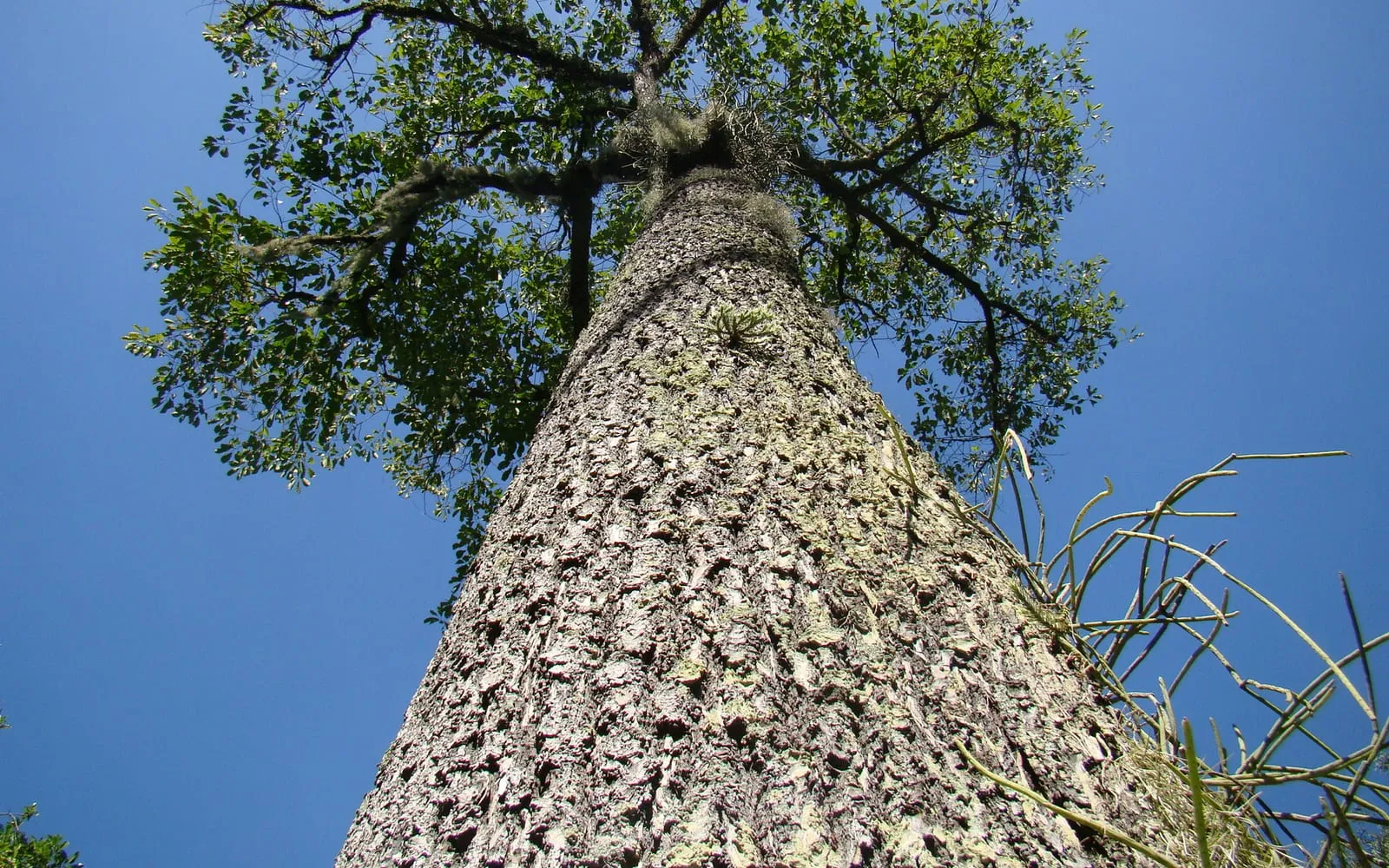
One of the largest trees in the Amazon, reaching 50 m with a straight unbranched trunk of 1 to 2 m diameter and a crown that emerges above the general canopy.
Bark is greyish and shallowly fissured, and the lower trunk is clean of branches for 20 m or more in a forest-grown tree.
Leaves are large and leathery, 20 to 35 cm long, oblong with wavy margins and a prominent midrib, alternate along the shoots.
Flowers are cream-white, 3 cm across, in upright panicles at the ends of the branches. Each has six petals and a hood formed from the staminal ring that covers the stamens, which is the structure only a strong bee can lift.
The fruit is the ourico, a woody capsule 10 to 15 cm across weighing up to 2 kg, falling from 40 m without warning. Nut gatherers do not work on windy days.
Inside, 10 to 25 seeds are packed like orange segments, each in its own hard three-sided brown shell.
The kernel inside that shell is the cream-coloured nut sold in shops, high in fat and among the largest edible seeds in trade.
Where it is from
Bertholletia excelsa grows in non-flooded terra firme rainforest across the Amazon basin, in Brazil, Bolivia, Peru, Colombia, Venezuela and the Guianas.
Trees grow scattered rather than in stands, though they sometimes cluster in groves that appear to be the legacy of pre-Columbian human planting.
Indigenous Amazonians used the nut long before contact and the distribution of trees along old settlement sites suggests they moved it deliberately.
Commercial trade began in the eighteenth century out of Para, which is where the old English name Para nut comes from.
Bolivia now exports more Brazil nuts than Brazil, and gathering supports tens of thousands of forest households across the basin, which is a large part of the argument for keeping the forest.
How it grows
Sow a fresh nut in its individual shell, which needs cracking carefully or filing to help water in. Shop-bought shelled nuts will not grow.
Germination is slow and erratic, taking six months to a year and a half, and it tests anyone’s patience.
Sow at 25 to 30 deg C in deep pots of free-draining compost, kept evenly damp.
Give shade for the first years. This is a forest tree that germinates in deep shade and waits for a gap in the canopy.
Grow in a heated greenhouse or conservatory outside the tropics, above 15 deg C at all times.
Keep humidity high, since dry air browns the leaf margins.
Water evenly through the growing season and reduce in winter without drying out.
Feed monthly from April to September.
Pot on into progressively larger containers and accept that the plant will outgrow any greenhouse eventually.
Expect no fruit. The tree takes 10 to 30 years to flower in the forest and depends on pollinators that do not exist outside its range.
Through the seasons
Spring is for repotting, resuming feeding, and sowing any fresh nuts you have.
Summer is the main growth period, and the months to keep humidity up and the sun off young plants.
Autumn is when to reduce feeding as growth slows.
Winter is a warm humid rest above 15 deg C, with the tree keeping its leaves.
Any month may bring germination from a nut sown a year earlier, which is why old pots are worth keeping rather than emptying.
Care difficulty
Difficult, and difficult before you even have a plant.
Germination takes six months to eighteen months and often fails.
The tree needs 15 deg C as an absolute minimum, high humidity, and eventually more room than any greenhouse has.
Young plants want shade rather than sun, which reverses the usual advice.
Fruit is out of the question, since the tree needs orchid bees, agoutis and several decades.
As a foliage plant it is handsome, with large glossy leaves, and that is the whole realistic goal.
Watering
Water twice a week through the growing season.
Keep the compost evenly damp and never let it dry out completely.
Reduce in winter without letting the root ball go dry.
Keep humidity high with misting, damp gravel or grouping plants together.
Use rainwater in a hard water area.
Drain fully every time, since the roots will not sit in water.
Warning signs, diseases and pests
Brown crisp leaf margins mean dry air.
Fine speckling with webbing is red spider mite, which arrives whenever the greenhouse air dries out.
White waxy fluff in the leaf axils is mealybug.
Brown limpets on the stems are scale.
Leaf drop after a cold night is chill damage below 15 deg C.
Yellowing with a wilt that does not recover overnight is root rot from cold wet compost.
Bleached patches on a young plant in direct summer sun are scorch, and it wants shade.
A nut that has sat for a year without germinating may still be alive, and the pot is worth keeping.
Growing environment
A heated humid greenhouse or a large conservatory.
Shade when young, brighter light as it matures.
Minimum 15 deg C year round, with 24 to 30 deg C for growth.
High humidity.
Deep free-draining compost with organic matter.
A large deep pot, and progressively larger ones.
Rainwater in a hard water area.
Feeding
Feed a balanced liquid feed monthly from April to September.
Reduce through winter without stopping entirely.
Avoid heavy nitrogen, which produces soft growth prone to scorch.
Top dress with fresh compost each spring.
Keep the feed weak rather than strong, since the plant grows slowly under glass.
Feed nothing to a plant that is standing still because it is cold.
Troubleshooting
Why can Brazil nuts not be farmed? The flower needs a large orchid bee strong enough to lift its hood, and those bees need orchids elsewhere in the forest. Clear the forest to plant an orchard and the pollinators go with it, so plantations set almost no fruit.
What is the agouti’s role? The nuts come packed inside a woody capsule too tough for almost anything to open. The agouti gnaws through, eats some and buries the rest, and its forgotten caches are how new trees start.
How many should I eat? A small number a day. Brazil nuts are the richest common source of selenium and one nut can exceed the recommended daily intake. Chronic excess causes selenosis.
Are they radioactive? They contain naturally occurring radium taken up by the tree’s deep roots, at levels far below any health concern. They are the most radioactive food in an ordinary diet, which sounds worse than it is.
Can I grow one from a shop-bought nut? No. Shop nuts have been shelled, dried and often heat-treated at some point, so they are dead. Look for a fresh nut still in its own hard shell.
Nothing has germinated after six months. That is normal. Brazil nut seed takes six to eighteen months and is erratic. Keep the pot warm and damp.
Will it ever fruit? No, not outside the tropics. It takes decades and needs pollinators that live only in the Amazon.
Should young plants have full sun? No. It is a forest tree that germinates in shade and waits for a canopy gap. Give young plants shade and increase the light slowly.
Is Brazil nut a common allergen? Yes, it is one of the standard tree nut allergens and reactions can be severe.
Brazil Nut problem guides
Not sure what is wrong? See the common vegetable pests guide.