
Edible
Avocado
Persea americana
Also known as Alligator pear, Palta, Aguacate
How to grow avocado, Persea americana. Germinating stones, pollination groups, fruiting limits indoors and persin safety for pets.
At a glance
- Difficulty
- Difficult
- Water
- Weekly in growth, letting the surface dry between times
- Light
- Full sun, with light shade from the fiercest midday glass
- Temperature
- Mexican-race cultivars take a light frost. Most are damaged below 4 deg C
- Humidity
- Moderate
- Hardiness
- USDA 9-11, RHS H1c, hardy to -2 C
- Type
- Tender evergreen tree
- Height
- Up to 20 m in the tropics, 2 m in a pot
- Native to
- southern Mexico, Central America
- Best month
- March and April in the Northern Hemisphere, September and October in the Southern Hemisphere
Central America, and the race decides the hardiness. Mexican types take about -6 deg C and ripen in a shorter season, Guatemalan types about -4, and West Indian types are damaged near 0. A tree sold only as avocado tells you none of this, so buy by cultivar. Flowers open female then male, so two trees of opposite type set far more fruit.
Hardiness zones describe winter cold alone. Summer heat, humidity, rainfall and the length of the growing season decide as much, so treat the range as the outer limit rather than as a recommendation.
Every month named in this guide is for the temperate Northern Hemisphere. If you garden in the Southern Hemisphere, shift each one by six months, so March becomes September. Closer to the equator the wet and dry seasons matter more than the calendar, and the shift stops being a useful guide.
Toxic to pets if eaten
- Safe to eat
- The ripe flesh, for people
- Do not eat
- Leaves, bark, skin and stone, which carry persin
- Harm from
- Eating it
- Affects
- Cats, dogs and horses
Avocado contains persin, a fungicidal compound present throughout the plant and concentrated in the leaves, bark, skin and stone. The animals it harms seriously are birds, rabbits, goats, sheep, cattle and horses, in which it damages heart muscle and causes swelling of the head and neck. Horses have died after browsing avocado leaves, so the tree should never be planted in a paddock. Cats and dogs are far more resistant, and the ASPCA describes mainly mild stomach upset in them. The real danger to a dog is mechanical: an avocado stone is exactly the size and shape to lodge in the gut and several dogs a year need surgery for one. People eat the flesh without difficulty, and the small number who react to avocado are usually latex-sensitive, since avocado shares proteins with natural rubber latex.
Sources: ASPCA toxic and non-toxic plants, RHS potentially harmful garden plants
About
The avocado stone suspended on cocktail sticks over a jam jar is the first plant a great many children ever grew. It works, it makes a handsome glossy tree, and it will not give you an avocado.
Two things stand between a seedling and a crop. Seedlings take a decade or more to flower and produce fruit unlike the parent, and the flowers themselves need a partner, because avocado opens as a female in one session and as a male in another, on a schedule that stops a single tree pollinating itself.
Fruit ripens off the tree rather than on it. An avocado can hang for months without softening and starts to ripen only once picked, which is why a greengrocer sells rocks and you take them home to wait.
Appearance and character
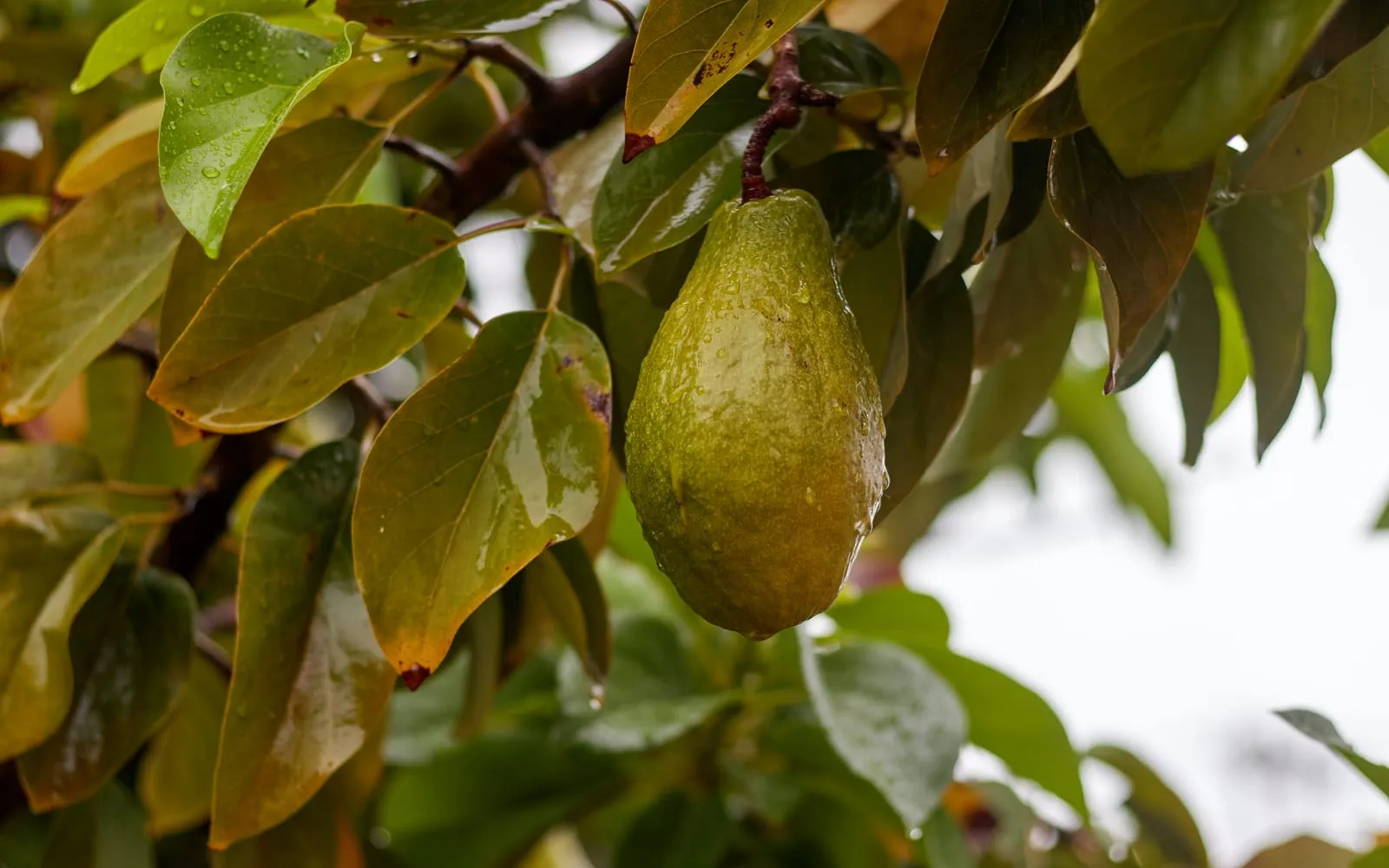
An evergreen tree to 20 m in the open, easily held at 2 m in a pot, upright as a youngster and spreading with age.
Leaves are alternate, 10 to 25 cm, oval to lance-shaped, dark green above and paler below, leathery. Crushed leaves of the Mexican race smell strongly of aniseed, which separates that group from the others in seconds.
Bark is grey-brown and rather corky on an older trunk.
Flowers are small, greenish yellow and borne in large branched sprays, hundreds of them, of which a tiny fraction sets.
The fruit is a single-seeded berry, botanically, despite the size. Skin runs from thin and green and glossy in the West Indian race to the thick pebbly purple-black of a ripe Hass.
Flesh is pale green to yellow, buttery, and unusual among fruit for being fatty rather than sugary.
The stone is large, round to conical, and splits into two halves along a seam.
Where it is from
Avocado is native to south-central Mexico and Central America, where wild trees still grow in cloud forest.
Its domestication is old. Stones found in caves in Puebla date back to roughly 10,000 years ago, and selection for larger flesh and smaller seed was under way in Mesoamerica long before European contact.
The name comes through Spanish from the Nahuatl word for the fruit. The English “alligator pear” was an eighteenth century attempt at the same thing from the skin texture.
Three races underpin every modern cultivar. The Mexican race is the most cold tolerant and carries the aniseed leaf scent, the Guatemalan has thick skin and ripens late, and the West Indian is the most tropical and the least hardy. Hass is a Guatemalan and Mexican cross, raised from a chance seedling in California in the 1920s, and every Hass tree on earth is grafted from that one plant.
Mexico still grows more than any other country by a wide margin, with the state of Michoacan alone supplying much of the world trade.
How it grows
Sprout a stone in water or in compost, whichever you prefer. Both work.
For the jam jar, push three cocktail sticks into the stone’s middle, sit it broad end down with the base in water, and wait four to eight weeks. Change the water weekly.
For compost, plant the stone with the pointed end up and the top third proud of the surface, and keep it warm and damp.
Pot into free-draining compost as soon as the root is a few centimetres long, and give it a deep pot.
Cut the seedling back hard. A stem left alone makes a bare whip two metres tall with a tuft on top. Pinch it out at about 30 cm and again at each stage, and you get a branched plant.
Keep it above 5 deg C at the very least, and above 10 deg C for growth. Mexican cultivars such as Bacon and Fuerte tolerate a touch of frost, which is why they are the ones tried in the mildest corners of Cornwall.
Buy a grafted plant if you want fruit, and buy two of different flowering types if you want a reasonable set.
Never let it sit in wet compost. Phytophthora root rot is what kills avocados, in orchards and in pots alike.
Through the seasons
Winter is the risk period. Keep the plant dry-ish, frost free, and in as much light as you have.
Early spring is the time to repot, prune for shape, and start feeding as new growth appears.
Spring brings flowering on a mature grafted tree, in long sprays that open over several weeks.
Early summer is the main growth flush and the point at which fruitlets that were going to drop have dropped.
Midsummer is peak growth. Feed monthly and water regularly.
Late summer is when to stop feeding and let the growth harden.
Autumn is when fruit on a Hass-type reaches full size, though it may hang until spring before it is picked.
Care difficulty
Difficult for fruit and easy for foliage.
Frost is the first limit. Most cultivars are damaged below about 4 deg C, and only the Mexican race takes a light frost unharmed.
Root rot is the second. Avocado has less tolerance of wet roots than almost any other fruit tree, and a heavy compost in a cool room is fatal.
Seedlings take ten to fifteen years to flower and give fruit unlike the parent.
The flowering habit defeats a single tree. Avocado shows synchronous dichogamy, opening female in one session and male in another, and cultivars fall into type A and type B on opposite schedules. Two trees of opposite type set far more fruit than one of either.
Salt and hard water burn the leaf tips faster than on most species.
As a house or conservatory foliage plant, cut back to keep it branched, it is straightforward and long-lived.
Watering
Water thoroughly once a week in growth, then let the top few centimetres dry.
Drain fully every time. Standing water is the single biggest cause of loss.
Reduce to a fraction of that through winter, giving only enough to stop the compost drying out completely.
Use rainwater where the tap water is hard, since avocado shows salt burn on the leaf tips readily.
Flush the pot through with plenty of water every couple of months to wash out accumulated salts.
Keep humidity moderate. Very dry heated air brings spider mite.
Mulch the surface of a large pot to steady the moisture.
Warning signs, diseases and pests
Brown crisp leaf tips and margins are salt burn, from hard water or too much feed. Flush the pot and switch to rainwater.
Yellowing between the veins on young leaves is iron or zinc shortage.
Wilting that does not respond to watering, with dull grey-green leaves and a thinning canopy, is Phytophthora root rot. Check the roots. Healthy ones are white and brittle; affected ones are brown and sloughing.
Sudden leaf drop after a cold night is frost or chill damage.
Fine stippling and webbing under the leaves is spider mite in dry air.
Brown limpets along the stems are scale insects.
A tall bare stem with leaves only at the top means it was never pruned. Cut it back by half in spring and it will branch.
Flowers followed by no fruit at all is usually the flowering type problem rather than anything wrong with the plant.
Laurel wilt kills a tree fast, wilting the foliage to reddish-brown while it stays attached to the branch rather than dropping, with dark staining inside the wood. Spread by an ambrosia beetle native to Asia, it has established across the southeastern United States since the early 2000s and reached Florida’s commercial avocado groves by 2011. There is no cure; never move firewood from an affected area, and report a suspected case outside the US or Asia immediately.
Growing environment
A conservatory, a heated greenhouse or a bright room indoors. Outdoors only in the mildest coastal south west, and only Mexican-race cultivars.
Minimum 10 deg C for growth, and no lower than 4 deg C for most cultivars.
Full sun, with a little shade from the hardest midday sun through glass.
Free-draining compost with a third grit, in a deep pot. Never a heavy wet mix.
pH from 6.0 to 7.0.
Shelter from wind, which tears the large leaves.
Good air movement to keep spider mite down.
Feeding
Feed monthly from April to September with a balanced liquid feed.
Choose one containing iron and zinc, both of which avocado runs short of in a pot.
Stop feeding at the end of September.
Give nothing through winter.
Repot every second spring into fresh free-draining compost.
Avoid heavy nitrogen, which pushes soft growth that scale and mite find first.
Add sequestered iron if the young leaves yellow between the veins.
Troubleshooting
Will my jam jar avocado ever fruit? Realistically no. Seedlings take ten to fifteen years to flower, need a partner of the opposite flowering type, and give fruit unlike the parent. Buy a grafted plant if fruit is the point.
What are type A and type B? Avocado flowers open as female in one session and as male in another. Type A cultivars are female in the morning and male the following afternoon; type B is the reverse. One of each nearby gives a far better set than either alone.
My plant is a bare stick with leaves on top. It was never pinched. Cut it back by half in early spring and it will branch from the buds below the cut.
Why is a shop avocado rock hard? It ripens only after picking. Leave it at room temperature, with a banana in the bag if you are in a hurry, and it will soften in a few days.
The leaf tips have gone brown and crisp. Salt build-up from hard water or over-feeding. Flush the pot through and use rainwater.
Is avocado poisonous to dogs? The flesh causes mild stomach upset at worst. The genuine danger is the stone, which is the right size to block a dog’s intestine and often needs surgery.
Can I plant one where the horses are? No. Persin in the leaves damages the hearts of horses, cattle, sheep and goats, and browsing avocado has killed horses.
The whole plant wilted and watering made it worse. Root rot. Check for brown sloughing roots, cut back the watering, and repot into a much grittier mix if anything is left to save.
Avocado problem guides
Not sure what is wrong? See the common vegetable pests guide.
- Root rot from Phytophthora, which is the disease that kills avocados
- Spider mite in dry heated air
- Scale insects on the stems and leaf undersides
- Waterlogging, which this species tolerates less than almost any fruit tree
- Laurel wilt, established across the southeastern US and a serious threat to commercial groves there