
Edible
Brazil Cherry
Eugenia brasiliensis
Also known as Grumichama, Grumixama, Brazilian cherry
How to grow grumichama, Eugenia brasiliensis. The Brazilian cherry that tastes like a real one, how it differs from its resinous cousin the Surinam cherry, and the slow growth that comes with it.
At a glance
- Difficulty
- Moderate
- Water
- Weekly in growth, and it dislikes drying out
- Light
- Full sun to light shade
- Temperature
- Minimum around minus 2 deg C once established
- Humidity
- Moderate to high
- Hardiness
- USDA 10-11, RHS H1b, hardy to 2 C
- Type
- Tender to half-hardy evergreen shrub or small tree
- Height
- 5-15 m in the open, 1.5 m in a pot
- Native to
- coastal Brazil
- Best month
- May and June in the Northern Hemisphere, November and December in the Southern Hemisphere
The Atlantic forest of southern Brazil, subtropical rather than equatorial, so it takes a light frost once established. Fruit ripens within a month of flowering, which is fast for a myrtle.
Hardiness zones describe winter cold alone. Summer heat, humidity, rainfall and the length of the growing season decide as much, so treat the range as the outer limit rather than as a recommendation.
Every month named in this guide is for the temperate Northern Hemisphere. If you garden in the Southern Hemisphere, shift each one by six months, so May becomes November. Closer to the equator the wet and dry seasons matter more than the calendar, and the shift stops being a useful guide.
Not known to be toxic
- Safe to eat
- The ripe flesh
- Do not eat
- The seeds, which are not eaten
Grumichama is not toxic and nothing in it is listed as harmful to people or to cats and dogs. The fruit is mild, sweet and free of the resinous quality that makes its relative the Surinam cherry divisive, and it is eaten fresh and made into jam and jelly in Brazil. The one or two seeds at the centre are hard and are discarded rather than chewed. Unripe fruit is sour rather than harmful. Unlike the Surinam cherry, this species has not become an invasive problem anywhere it has been introduced, which is worth noting given the family record.
Sources: ASPCA toxic and non-toxic plants, RHS potentially harmful garden plants
About
Grumichama is the Eugenia for people who did not get on with the Surinam cherry. The fruit is dark purple-black, cherry-sized, and tastes close to a sweet cherry with none of the resinous note that divides opinion on its relative.
The tree is neat and slow. A dense conical evergreen with glossy leaves and white flowers, it takes a light frost, stays small enough for a large pot, and looks respectable in the years before it crops.
Slowness is the price. Where a Surinam cherry fruits in two years, a grumichama takes four to six, and the tree takes decades to reach any size.
Appearance and character
A dense upright evergreen shrub or small tree with a neat conical outline, 5 to 15 m in the open and very slow to get there.
Bark is smooth, pale grey-brown, flaking in thin patches.
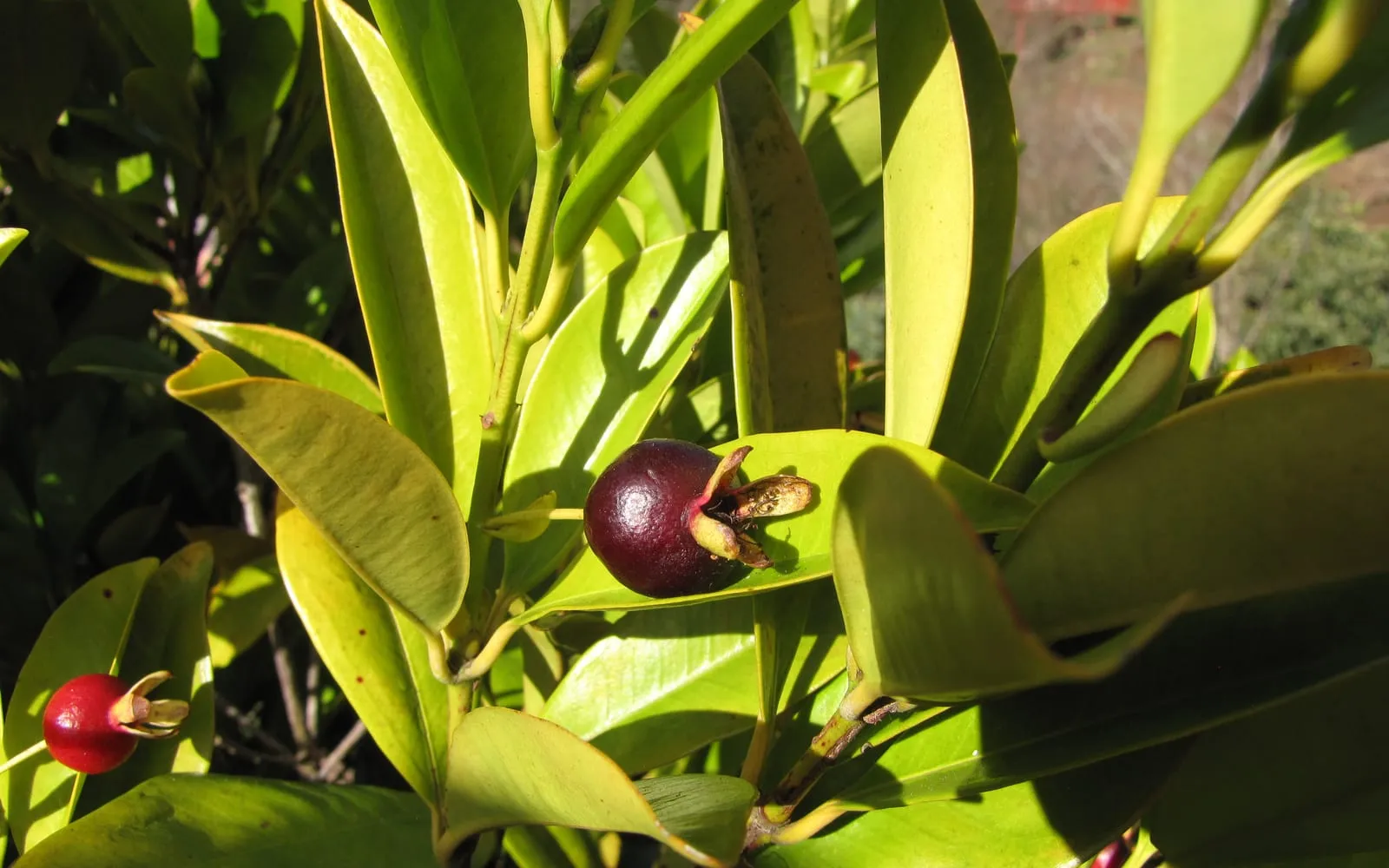
Leaves are opposite, elliptic to oblong, 5 to 15 cm, thick, leathery and glossy dark green above, and noticeably larger and heavier than a Surinam cherry’s. New growth flushes bronze.
Flowers are white, 2 to 3 cm, with four petals and a large boss of long white stamens, borne singly or in small groups on short stalks in the leaf axils, and they are pretty enough to justify the plant on their own.
Fruit is round and slightly flattened, 1.5 to 2.5 cm, ripening green through red to a deep purple-black, with the four calyx lobes persisting at the tip as a small crown.
There are no ribs, which separates it from the Surinam cherry at a glance.
Flesh is white to purple, soft, juicy and sweet, with one or two hard seeds.
Where it is from
Grumichama is native to the coastal Atlantic forest of southern Brazil, from Bahia south to Santa Catarina, in the same forests as the jabuticaba.
Brazil grows it in gardens and small orchards and eats it fresh or as jam, and grumixama is a familiar name in the south of the country.
It was carried to Florida, Hawaii and Australia by collectors in the nineteenth and twentieth centuries and is grown there by enthusiasts.
Unlike the Surinam cherry it has not escaped and naturalised, and it appears on no invasive species lists.
There is no commercial trade in the fruit. It is soft, bruises and keeps for a few days.
Temperate growers keep it as a conservatory shrub from specialist nurseries.
How it grows
Sow seed from a ripe fruit. It germinates at 20 to 25 deg C in four to eight weeks and loses viability within a few weeks.
Use ericaceous compost. This species yellows on lime and on hard water.
Grow in full sun or light shade.
Keep it frost free in a pot, though an established plant in the ground takes a couple of degrees of frost.
Water weekly in growth and never let it dry out.
Use rainwater.
Feed monthly from April to September with an ericaceous feed.
Prune lightly if at all, since growth is slow and the natural shape is good.
Expect fruit in four to six years from seed, and the fruit develops in about a month from flower.
Through the seasons
Winter is a cool frost-free rest, watered moderately and unfed.
Early spring is the time to repot and start feeding.
Late spring brings the white flowers, which are the plant’s best moment.
Early summer is fruit, about a month from flower.
Midsummer is harvest.
Autumn is when to stop feeding and reduce watering.
Care difficulty
Moderate, and easier than most of these plants.
Cold tolerance is good. An established plant takes a couple of degrees of frost and a pot needs only to be kept frost free.
Acid compost is needed, since the species yellows badly on lime and hard water.
Steady watering is needed. It has little drought tolerance.
Size suits a pot, given how slowly it grows.
Fruiting takes four to six years, which is slower than the Surinam cherry and faster than the jabuticaba.
The flowering and the neat evergreen habit carry the plant through the waiting years.
Watering
Water weekly in growth, keeping the compost consistently damp.
Never let it dry out.
Reduce in winter without letting the compost dry.
Drain fully.
Use rainwater, since hard water causes the yellowing this species is prone to.
Keep humidity moderate to high.
Mulch the pot surface with composted bark.
Warning signs, diseases and pests
Yellowing between green veins is iron shortage from lime or hard water.
Leaf drop follows drought.
Bronze new growth is normal.
Brown limpets on the stems are scale.
White fluff in the leaf axils is mealybug.
Blackened tips after a cold snap are frost damage. Cut back in spring.
Wilting in damp compost is root rot.
Sour fruit means it was picked before it turned fully dark.
Slow growth is the species rather than a fault.
Growing environment
A cool greenhouse or conservatory, standing outdoors for the summer.
Minimum around minus 2 deg C for an established plant, frost free in a pot.
Full sun to light shade.
Moderate to high humidity.
Ericaceous compost, rich and moisture-retentive but free-draining.
pH from 5.0 to 6.0.
Rainwater rather than tap water.
A pot of 30 to 40 cm, which a slow plant will occupy for years.
Feeding
An ericaceous liquid feed carrying iron, once a month while the plant is in growth.
Sequestered iron the moment the veins begin to stand out green against a paler leaf, rather than waiting to see how far it goes.
Nothing after September, and nothing through the winter.
Ericaceous compost or composted bark as a spring top-dressing.
A repot every third year. This is a slow plant and disturbing the roots more often costs more growth than it gains.
No lime, in any form, ever. That rules out tap water in a hard-water district, mushroom compost, and the bonemeal people reach for out of habit when planting.
Troubleshooting
How is it different from a Surinam cherry? No ribs on the fruit, larger and heavier leaves, larger white flowers, and a mild sweet cherry flavour without the resinous note. It is also slower and slightly less hardy.
How soon will it fruit? Four to six years from seed, which is slower than a Surinam cherry and much faster than a jabuticaba.
The leaves are yellow between the veins. Iron shortage from lime or hard water. Use ericaceous compost, rainwater and sequestered iron.
How hardy is it? An established plant takes a couple of degrees of frost. A pot should be kept frost free.
Is it invasive like the Surinam cherry? No. Grumichama has not escaped or naturalised anywhere it has been introduced and appears on no invasive lists.
Why can I never buy the fruit? It is soft, bruises and keeps for a few days, so there is no trade in it.
Can I eat the seeds? No, they are hard and are discarded.
It has barely grown in two years. Grumichama is slow. The flowers and the neat evergreen habit are what make it worth keeping in the meantime.
Brazil Cherry problem guides
Not sure what is wrong? See the common vegetable pests guide.