
Outdoor plant
Boneset
Eupatorium perfoliatum
Also known as Feverwort, Agueweed, Thoroughwort
How to grow Eupatorium perfoliatum in a damp border. The joined leaves that name it, the fever it was named for, and telling it from the white snakeroot that poisoned milk.
At a glance
- Difficulty
- Easy
- Water
- In dry spells, since it dislikes drying out
- Light
- Full sun to light shade
- Temperature
- Fully hardy, to about minus 30 deg C
- Hardiness
- USDA 3-8, RHS H7, hardy to -30 C
- Type
- Hardy herbaceous perennial
- Height
- 1-1.5 m
- Native to
- the wet meadows and stream sides of eastern North America
- Best month
- May in the Northern Hemisphere, November in the Southern Hemisphere
Damp ground is the requirement, since it grows naturally in wet meadow and along stream edges and sulks in a dry border. Cold suits it. Seed needs a cold stratification, and the plant is one of the better late-season nectar sources for insects.
Hardiness zones describe winter cold alone. Summer heat, humidity, rainfall and the length of the growing season decide as much, so treat the range as the outer limit rather than as a recommendation.
Every month named in this guide is for the temperate Northern Hemisphere. If you garden in the Southern Hemisphere, shift each one by six months, so May becomes November. Closer to the equator the wet and dry seasons matter more than the calendar, and the shift stops being a useful guide.
Toxic if eaten
- Do not eat
- The whole plant, and the fresh plant more than the dried
- Harm from
- Eating it
- Affects
- People and horses
Boneset was a standard domestic remedy across North America for two centuries and is treated more cautiously now. The plant contains pyrrolizidine alkaloids, a class of compound that damages the liver cumulatively, and the same class is why comfrey, ragwort and coltsfoot are all treated as they are. The concentrations reported in Eupatorium perfoliatum are low, and the caution that follows is against sustained internal use rather than against having the plant in a garden. The plant does not appear on the RHS list of potentially harmful garden plants, and the ASPCA does not list it among plants toxic to dogs, cats or horses, although livestock poisoning from pyrrolizidine-containing plants in general is well documented. The identification point matters more than any of this. White snakeroot, Ageratina altissima, grows in the same woods, carries similar flat white flower heads, and contains tremetol, the toxin behind milk sickness, which killed Abraham Lincoln's mother. Boneset's fused perfoliate leaves separate the two at a glance.
Sources: NC State Extension, Eupatorium perfoliatum, RHS potentially harmful garden plants, ASPCA toxic and non-toxic plants, NHS on herbal medicines
About
Boneset is named for a fever rather than for a bone. Dengue was known as break-bone fever from the pain it causes, and boneset was the plant American households reached for when someone had it, which is how a wetland daisy relative acquired a name that sounds orthopaedic. It was in the United States Pharmacopoeia into the twentieth century and was among the most used domestic remedies on the continent.
As a garden plant it deserves more attention than it gets outside North America. It makes a stout upright clump to a metre and a half, topped from August by wide flat heads of small dull-white flowers that butterflies, hoverflies and bees work heavily, at a season when a damp border can look tired.
The identification character is unmistakable and gives the plant its scientific name. Each pair of opposite leaves is fused at the base, so the stem appears to grow straight through a single long leaf. Perfoliatum means through the leaf, and no other plant you are likely to meet does it this way.
Appearance and character
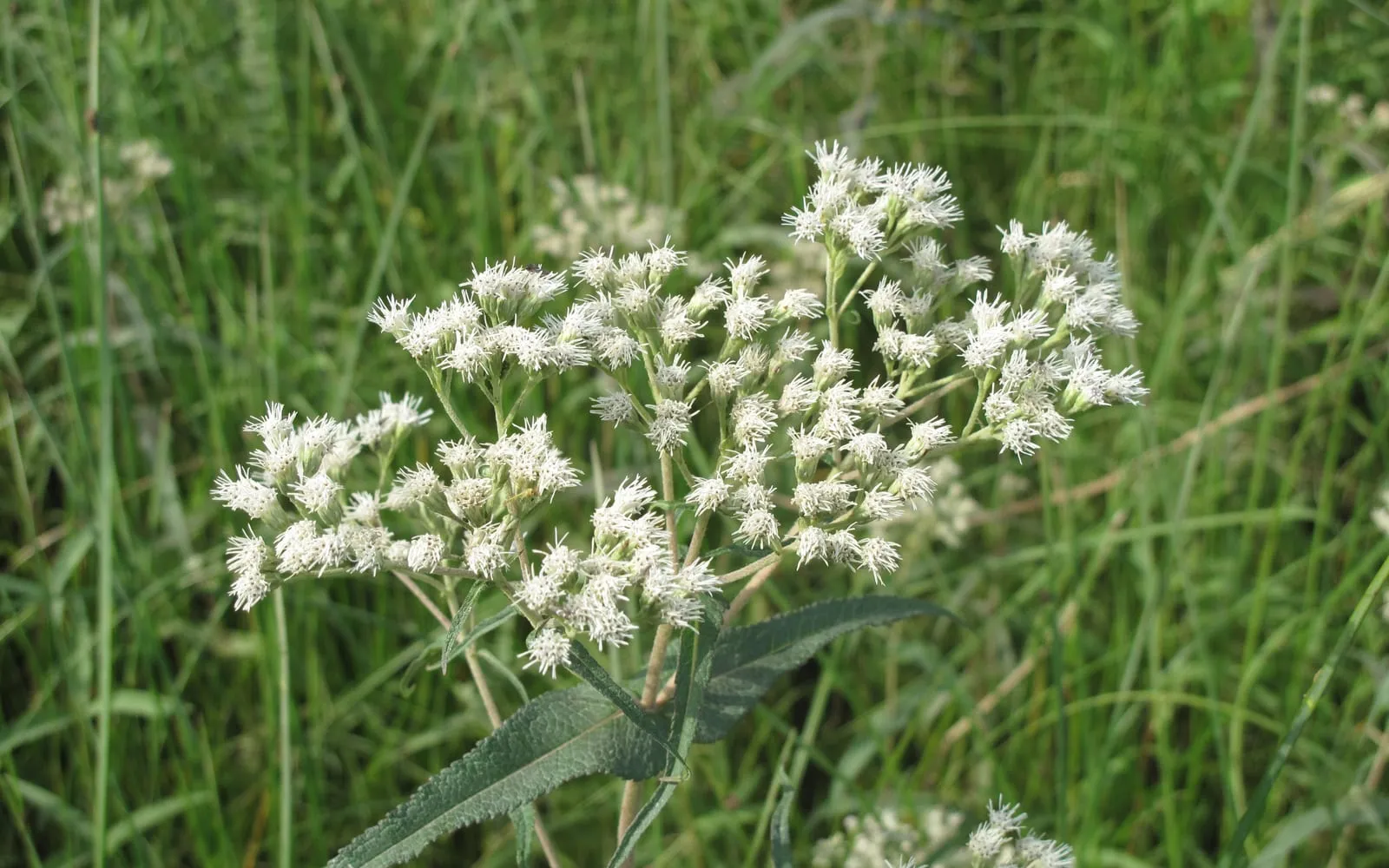
Stems are stout, round, densely hairy and usually unbranched until the flower head, rising to 1.5 m from a fibrous crown. The hairiness is noticeable to the touch and gives the whole plant a slightly grey cast.
The leaves are the plant’s signature. Each pair is joined at the base around the stem, forming what looks like one long tapering leaf 10 to 20 cm from tip to tip, wrinkled, toothed and rough. Nothing else in a border does this.
Flower heads open from August to October in flat-topped clusters 10 to 20 cm across, each head holding fifteen or so small dull-white disc florets with no ray petals, so the effect is of froth rather than of daisies. Seed heads follow and carry small tufted seeds that disperse on the wind.
Where it is from
Boneset grows across eastern North America from Nova Scotia to Florida and west to Texas and Manitoba, in wet meadows, marsh edges, ditches, stream sides and damp thickets. It is a plant of open wet ground rather than of woodland.
Those origins explain both its strength and its limit in a garden. It is hardy to about minus 30 deg C, so cold is never a consideration, and it wants soil that stays damp through the summer.
It reached European gardens as a medicinal plant and remains uncommon there. The related Eupatorium cannabinum, hemp agrimony, is a native British wetland plant with a similar habit and pink flowers, and it is a good substitute for anyone who cannot find boneset.
How it grows
The plant emerges in April, extends through May and June, and flowers from August into October, which is a long season at a useful time of year.
Growth is from a fibrous crown that widens slowly into a clump. It does not run or sucker, so it stays where it is put, and an established clump can be divided in spring.
Seed sets freely and germinates after a cold winter, so a few seedlings appear around a mature plant in a damp border. That is easily managed and is the simplest way to increase the plant.
Through the seasons
Plant in May, or divide an established clump in spring as growth starts, into damp ground at 60 cm spacing. Water through the first summer.
Growth runs through spring and early summer with nothing to do beyond keeping slugs off the young shoots. Flowering starts in August and runs into October, and it needs no deadheading.
Cut the dead stems down in late winter rather than in autumn. The stems hold seed for birds and give overwintering insects somewhere to be, and a February cut costs the garden nothing.
Care difficulty
Easy, in the right soil. Boneset asks for damp ground and full sun to light shade, and it gives back a long flowering season with no staking and no feeding.
The failure to avoid is drought. On light sandy soil in a dry border it struggles, flowers poorly and mildews, and no amount of watering quite compensates for a soil that will not hold moisture.
It is one of the better plants for the difficult wet corner most gardens have, alongside a pond or in a bed that stays soggy in winter.
Watering
Water in dry spells through the growing season, especially in the first summer and on light soil. This is a wetland plant and it shows drought stress quickly.
An established clump in properly damp ground needs nothing. A mulch of garden compost in spring conserves more moisture than watering supplies.
Winter wet is no problem at all, which sets it apart from most of the plants in this collection. Boneset grows in ground that other perennials would rot in.
Warning signs, diseases and pests
Slugs graze the emerging spring shoots and rarely do lasting damage to a plant this vigorous.
Powdery mildew is the disease to expect, and it follows dry soil rather than wet weather. A plant coated in white bloom by August is telling you it is short of water at the root, and mulching is a better response than spraying.
Aphids gather on the flowering stems in early summer and are dealt with by the hoverflies the plant attracts in quantity. Leaf spotting appears on stressed plants in a wet season and does no lasting harm.
Growing environment
Full sun for the best flowering, though it tolerates light shade. In shade it grows taller, flowers less and may need support.
Soil should be damp to wet, and it takes heavy clay and seasonal waterlogging without complaint. Rich soil is not necessary and moisture-holding soil is.
Hardiness is not a consideration. The species survives minus 30 deg C and needs no winter protection anywhere it is likely to be grown.
Feeding
A mulch of garden compost each spring is all it needs, and it does more for moisture retention than for nutrition.
Fertiliser produces tall soft growth that flops in a summer storm. On any reasonable soil the plant needs nothing.
Where a clump is thin and flowering poorly, look at moisture and light before reaching for a feed. Neither of those is corrected by fertiliser.
Troubleshooting
Why is it called boneset if it has nothing to do with bones? Because dengue was known as break-bone fever, and the plant was the household remedy for it. The name records the fever rather than any use in setting fractures.
How do I tell it from white snakeroot? By the leaves. Boneset’s opposite leaves are fused around the stem so it appears to pass through one long leaf. White snakeroot has separate stalked leaves and is toxic, containing the tremetol behind milk sickness.
Will it grow in a dry border? Poorly. It is a wetland plant and it mildews and sulks in dry ground. Hemp agrimony, the British native relative, is not much more tolerant.
When does it flower? August to October, which is one of its main recommendations. The flat white heads are heavily worked by hoverflies and bees late in the season.
Does it spread? It forms a clump that widens slowly and does not run. It self-seeds modestly in damp open ground, and seedlings are easy to remove.
Can I make tea from it? The plant contains pyrrolizidine alkaloids, which damage the liver cumulatively, and modern guidance is against sustained internal use for that reason. Growing it is a different matter from taking it.
When should I cut it back? Late winter. Leaving the stems standing gives seed to birds and shelter to overwintering insects, and the plant does not mind.