
Outdoor plant
Turtlehead
Chelone glabra
Also known as White Turtlehead, Balmony, Snakehead
How to grow white turtlehead, Chelone glabra, a late-summer perennial with hooded white flowers loved by bumblebees, for soil that never dries out.
At a glance
- Difficulty
- Moderate
- Water
- Keep the soil moist at all times
- Light
- Full sun to partial shade
- Temperature
- Very hardy, surviving hard winters unharmed
- Hardiness
- USDA 3-8, RHS H7, hardy to -34 C
- Type
- Upright herbaceous perennial
- Height
- Up to 1.2 m
- Native to
- Eastern North America
Fully hardy through severe winters, dying back to the ground each year and returning in spring. Water matters more than cold. It comes from wet meadows and streambanks and needs soil that stays reliably damp, so it struggles in a hot, dry border and thrives at a pond edge or in a rain garden. It tolerates full sun only where the roots never dry out, and takes light shade happily.
Hardiness zones describe winter cold alone. Summer heat, humidity, rainfall and the length of the growing season decide as much, so treat the range as the outer limit rather than as a recommendation.
Not known to be toxic
Turtlehead is not listed as toxic by the ASPCA or the RHS, and no harmful compound is recorded in it. The bitter foliage gave it the old name balmony and a history of use as a herbal tonic, but it is not considered poisonous to people or pets, and a child or animal that chewed a leaf would meet only a strong bitterness. It is safe to plant beside a pond or path used by children.
Sources: RHS potentially harmful garden plants, ASPCA toxic and non-toxic plants
About
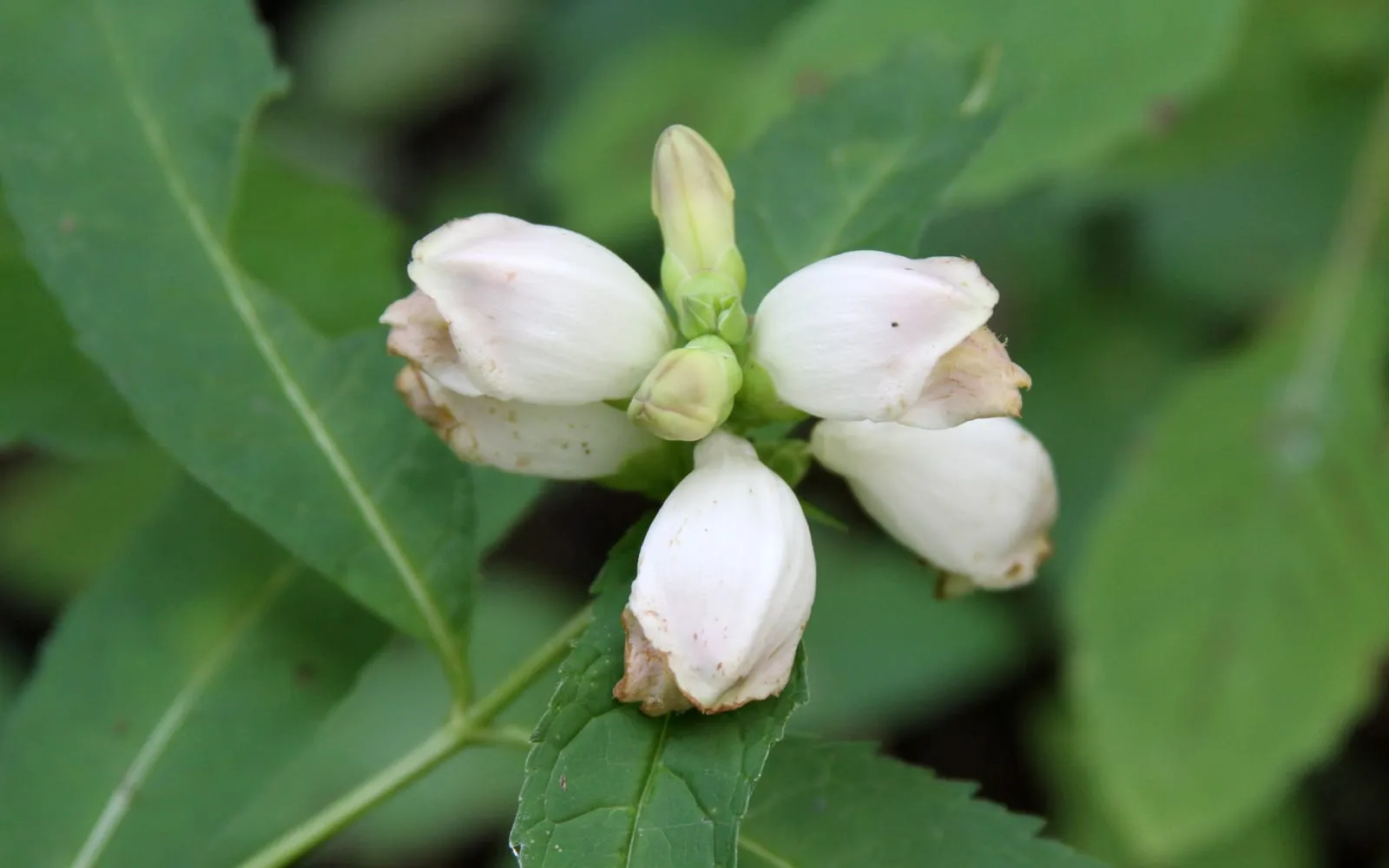
Turtlehead flowers in late summer and into autumn, when much of the border is going over, carrying dense heads of white two-lipped flowers on stiff upright stems. Each flower is closed and hooded, and with a little imagination it looks like the head of a turtle with its mouth held shut, which is where both the common name and the botanical name Chelone come from.
It is a plant for damp ground. In the wild it grows along streams and in wet meadows across eastern North America, and in the garden it belongs at a pond edge, in a bog bed or in a border that never dries out. In consistently damp soil, it is a reliable, long-lived, upright perennial that needs very little.
It is valuable for wildlife as well as flowers. Bumblebees have to force their way into the closed blooms to reach the nectar, and in its native range it is a main food plant for the caterpillars of the Baltimore checkerspot butterfly.
Appearance and character
The flowers open from late summer through autumn in tight terminal spikes. Each bloom is a two-lipped tube around three centimetres long, white and sometimes flushed pink at the tip, packed closely enough to form a solid column of white.
Leaves are lance-shaped, sharply toothed and glossy dark green, held in opposite pairs up the length of the stems, giving the plant a neat, upright, well-clothed look from spring onwards.
The habit is clump-forming and steadily spreading, sending up a stand of stiff stems from a slowly creeping rhizome, reaching around a metre to a metre and twenty in good moist soil.
Stems are strong and self-supporting in the open, so the plant rarely needs staking, though it can lean towards the light in too much shade.
Where it is from
Chelone glabra grows across eastern North America, from Canada down to the south-eastern United States, in wet meadows, marshy ground, streambanks and the edges of swamps and ponds. It is a plant of consistently wet, fertile, sunny to lightly shaded ground.
Grow it in consistently damp soil. It has no drought tolerance to speak of, so the nearer you can get to permanently moist soil, the better it performs. In dry ground the leaves scorch and mildew.
How it grows
Plant in spring or autumn in fertile, humus-rich soil that stays reliably moist, in full sun or partial shade. The wetter the position, within reason, the more sun it will take; in a drier border it needs shade and heavy mulching to cope.
Work plenty of organic matter into the ground before planting, and mulch generously afterwards, since both feeding and moisture retention matter to a plant that does badly if it dries out.
Pinch out the growing tips in early summer, when the stems are around thirty centimetres tall, if you want a bushier plant with more flowering stems and a little less height. This is optional and gives a denser display.
Cut the dead stems down in late winter or early spring, and lift and divide congested clumps every few years in spring to keep them vigorous. Turtlehead divides easily and this is the simplest way to increase it.
Through the seasons
Spring brings the new shoots pushing up, a point to watch for slugs, and the time to divide clumps and mulch.
Summer is leafy growth, the stems building height and the buds forming at the tips. Keep the soil moist throughout.
Late summer to autumn is the flowering, the white hooded heads opening as other perennials fade, feeding late bumblebees.
Winter the plant dies back to the ground and rests. Cut the old stems down before growth restarts.
Care difficulty
Moderate, and the only real demand is moisture. Where the soil stays damp, turtlehead is easy, hardy, long-lived and largely pest-free, and it needs no staking or fussing. The difficulty is entirely in a dry garden, where keeping the ground moist enough can take constant watering, and the plant may still perform poorly. Match it to the right spot and it looks after itself.
Watering
Keep the soil moist at all times. Most failures come from letting the roots dry out.
In a border instead of a bog, water generously in any dry spell, and lay a thick mulch to hold moisture in the ground. A plant grown at a pond margin or in naturally wet soil needs little or no extra watering, so those positions suit it best.
Warning signs, diseases and pests
Powdery mildew is the commonest problem, a white dusty coating on the leaves that appears in dry summers and dry soil. It usually means the roots are short of water, so improving moisture and air flow does more than spraying.
Slugs and snails graze the soft new shoots in spring and can set a clump back before it gets going. Protect the emerging growth in the vulnerable weeks.
Scorched, browning leaf edges in summer point straight to dry soil. There is no treatment beyond correcting the moisture; a plant kept properly damp does not do it.
Growing environment
Full sun suits it only where the soil is permanently moist, such as a pond edge or bog bed, where sun gives the sturdiest stems and the best flowering. In drier ground, partial shade reduces the moisture stress.
The soil should be fertile, rich in organic matter and consistently damp to wet. Heavy soils that hold water are ideal here, unlike for most border perennials, and only free-draining, drought-prone ground is a real problem.
A pond margin, a rain garden, a bog bed or a low, damp corner all suit it, and it pairs well with other moisture-lovers such as astilbe and hosta, which enjoy the same consistently moist conditions.
Shelter is rarely needed, since the stems are strong, though a plant in deep shade may lean and benefit from a more open position.
Feeding
A spring mulch of garden compost or leaf mould supplies enough for the year on most soils, and it also helps the ground hold the moisture the plant depends on.
On a poor soil, a single application of a balanced general fertiliser in spring supports strong growth. Avoid heavy feeding, which produces soft, mildew-prone growth without improving the flowers.
Troubleshooting
The leaves have a white dusty coating. Powdery mildew, and on turtlehead it almost always means the soil has been too dry. Improve the moisture and mulch well, instead of reaching first for a spray.
The leaf edges are browning and crisp. The soil is drying out. This is a wet-ground plant with no real drought tolerance. Water generously and mulch, or move it somewhere damper.
It flops or leans over. Usually too much shade. In good light with moist soil the stems stand up on their own. Move it to a brighter spot, or pinch the shoots in early summer for a shorter, sturdier plant.
When does it flower? Late summer and autumn, which is much of its value, since it fills the gap as earlier perennials finish. If yours is not flowering, suspect dry soil or too much shade.
Can I grow it in a pot? Yes, if you keep it permanently moist, which in a container means frequent watering or standing the pot in a saucer of water through summer. It is easier in the ground in a damp spot. For a similar upright native perennial on moist soil, see Culver’s root.