
Outdoor plant
Wild Ginger
Asarum canadense
Also known as Canadian snakeroot, Canada wild ginger, Indian ginger
How to grow Asarum canadense as woodland ground cover. The maroon flower hidden at soil level, the rhizome that smells of ginger, and why it is not a culinary substitute.
At a glance
- Difficulty
- Easy
- Water
- Through the first summer, then in dry spells
- Light
- Partial to deep shade
- Temperature
- Fully hardy, to about minus 30 deg C
- Hardiness
- USDA 3-7, RHS H7, hardy to -30 C
- Type
- Hardy herbaceous perennial from a shallow rhizome
- Height
- 15-20 cm
- Native to
- the deciduous woodlands of eastern North America
- Best month
- April in the Northern Hemisphere, October in the Southern Hemisphere
A slow ground cover for moist woodland shade, and it takes drier shade than most once established. Cold is no obstacle. Despite the name and the scent it is no relation to ginger and it contains aristolochic acid, which damages the kidneys and causes cancer, so it should not be eaten.
Hardiness zones describe winter cold alone. Summer heat, humidity, rainfall and the length of the growing season decide as much, so treat the range as the outer limit rather than as a recommendation.
Every month named in this guide is for the temperate Northern Hemisphere. If you garden in the Southern Hemisphere, shift each one by six months, so April becomes October. Closer to the equator the wet and dry seasons matter more than the calendar, and the shift stops being a useful guide.
Toxic if eaten
- Do not eat
- The rhizome and the leaves, which contain aristolochic acid
- Harm from
- Eating it and handling it
- Affects
- People
This is the one plant in the wave whose historic use is straightforwardly out of date. Asarum canadense is in the birthwort family and contains aristolochic acid, which the International Agency for Research on Cancer classifies in Group 1, meaning carcinogenic to humans, and which causes irreversible kidney damage. The evidence came from Belgium in the 1990s, where a slimming preparation containing an Aristolochia species caused kidney failure and urinary tract cancers in a large number of patients, and from Balkan endemic nephropathy, traced to aristolochic acid in flour. Regulators in Britain, the European Union and the United States restricted aristolochic acid-containing plants in consequence. The rhizome smells and tastes of ginger and has a long record of use, and none of that record survives what is now known. NC State Extension lists the species and notes that contact with the leaves causes dermatitis in some people. As a garden ground cover it is excellent and carries no risk to anyone who does not eat it, which is the position this guide takes.
Sources: NC State Extension, Asarum canadense, IARC list of classifications, RHS potentially harmful garden plants, ASPCA toxic and non-toxic plants
About
Wild ginger is one of the best ground covers for deep shade and one of the few plants that will carpet the ground under a beech. It makes a dense low mat of paired heart-shaped leaves, spreading by a shallow rhizome, and once established it suppresses weeds and asks for nothing.
The name comes from the rhizome, which smells strongly of ginger when broken and was used as a substitute for it by settlers and by indigenous peoples across its range. The plant is not related to culinary ginger at all, and the smell is a coincidence of chemistry rather than a family resemblance.
That use has not aged well. The plant is in the birthwort family and contains aristolochic acid, a documented kidney toxin and a Group 1 carcinogen, so the historic culinary and medicinal uses are recorded here as history rather than as suggestions. As a plant to look at and to cover difficult ground it remains excellent.
Appearance and character
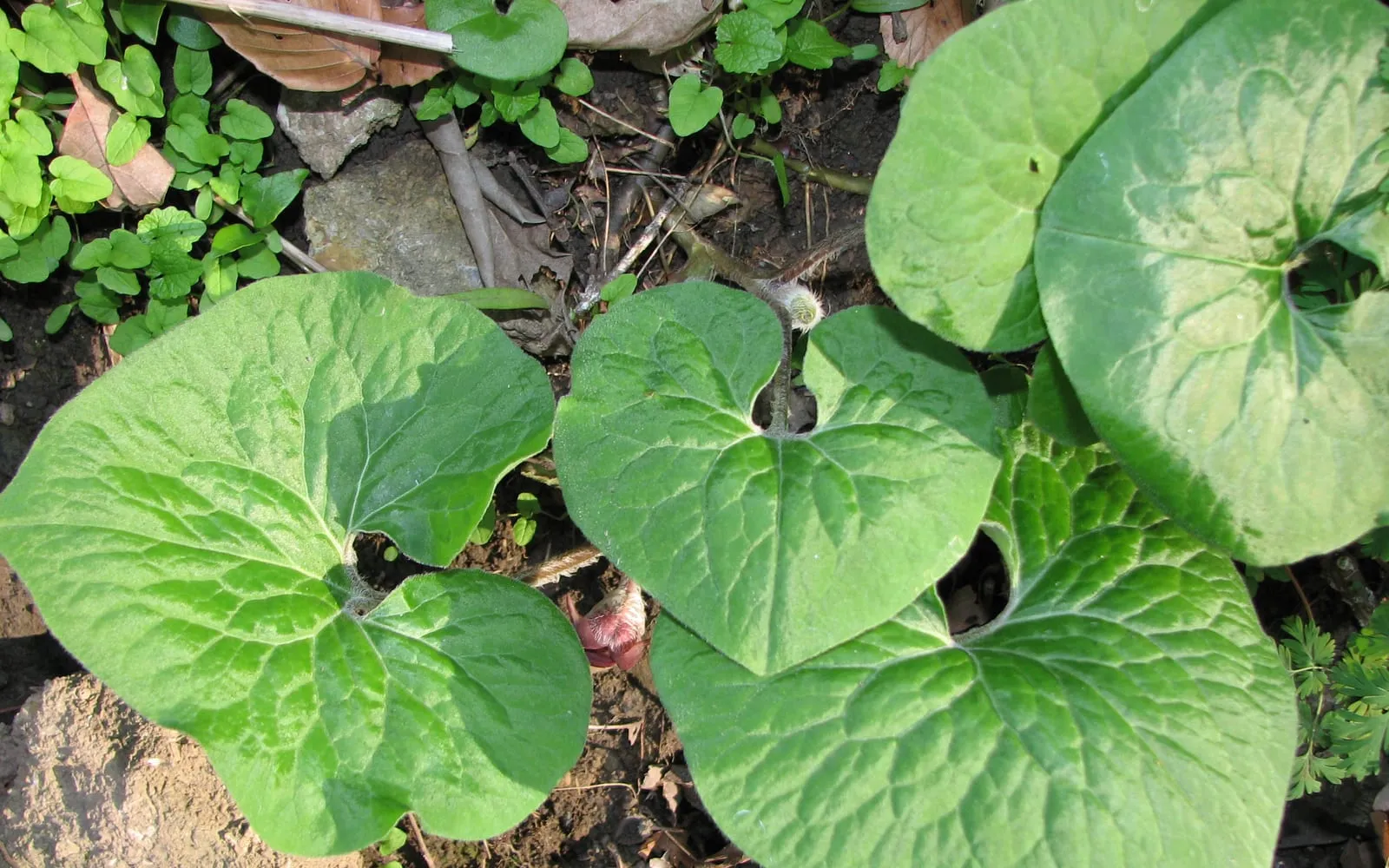
Each shoot carries two leaves on long hairy stalks rising directly from the rhizome. The blades are broadly heart-shaped to kidney-shaped, 7 to 15 cm across, softly hairy, deep matt green, and held roughly horizontal so a colony reads as a continuous surface.
The flower is the plant’s oddity. A single dull maroon-brown bell about 3 cm across sits at ground level between the two leaf stalks, often half buried in leaf litter, opening in April and May. Most people who grow the plant have never seen one without deliberately looking.
The rhizome runs horizontally in the top few centimetres of soil, pale, jointed and aromatic, rooting as it goes. Snap a piece and the ginger smell is immediate and strong.
Where it is from
Asarum canadense grows across eastern North America from Quebec and Ontario south to Georgia and west to Missouri, in rich deciduous woodland with deep leaf litter, often on slopes and often in the same woods as goldenseal and American ginseng.
It is a plant of shade and of undisturbed leafy soil, and it does not colonise open or compacted ground. Where it grows it can carpet large areas.
Two relatives turn up in the nursery trade more often than this one. The European Asarum europaeum, asarabacca, is a similar plant with glossy evergreen leaves, and several east Asian species are grown for their marbled foliage. All of them contain aristolochic acid.
How it grows
The rhizome creeps at a few centimetres a year, branching as it goes, so a planted clump thickens into a patch over three or four seasons and eventually into a carpet.
Leaves emerge in April, unfurling from a tight bud, and hold through until the first hard frosts, at which point the plant dies back completely. It is deciduous, unlike its European cousin.
Flowering is in April and May at ground level. Seed is set in a fleshy capsule and carries an elaiosome, an oily appendage that ants eat, so ants disperse the seed a short distance. That is a slow route to new plants, and division in spring is much quicker.
Through the seasons
Plant in April into shaded ground improved with leaf mould, 25 to 30 cm apart, and water through the first summer while the rhizome establishes.
Leaves come through in April, flowers open at ground level almost at once, and the plant holds its foliage through the summer with nothing to do. Keep it watered in a drought, since the leaves brown at the edges when it dries.
Mulch with leaf mould in autumn after the foliage dies down. Divide established patches in early spring, cutting the rhizome into pieces with a growing point on each and replanting at once.
Care difficulty
Easy once established and slow to get there. The plant needs shade, leafy soil and moisture through its first two summers, and after that it looks after itself indefinitely.
The mistake to avoid is planting it in dry shade under a conifer or against a wall. It will survive there and never spread, and the point of the plant is the carpet it makes.
Buy several plants rather than one. Covering ground with a species that spreads a few centimetres a year takes a long time from a single division.
Watering
Water through the first summer after planting to establish the rhizome, and in prolonged dry spells after that.
An established patch under a leaf mould mulch handles most summers on its own. Browning leaf margins in July are the sign that it wants water.
Waterlogging is the one soil condition it dislikes. The rhizome sits shallow and rots in ground that stays saturated, so a woodland soil that drains is what to aim for.
Warning signs, diseases and pests
Slugs and snails graze the new leaves as they unfurl in April, and the damage shows all season because each shoot carries only two leaves. Grit and a patrol on damp evenings are worth it in that month.
Vine weevil matters in containers, where the grubs eat the rhizome over winter. In open ground it is rarely a problem.
Brown crisp leaf margins mean drought or too much sun. Both are cultural and both are corrected by moving the plant or improving the soil, since neither responds to anything applied to the leaves.
Growing environment
Partial to deep shade under deciduous trees. This is a woodland floor plant and sun scorches it, particularly in dry soil.
Soil should be moist, humus-rich and leafy, from acid to neutral, with free drainage. Work leaf mould in before planting and mulch each autumn.
Hardiness is not a consideration. The plant survives minus 30 deg C, and temperate winters are well inside its tolerance.
Feeding
Leaf mould laid on in autumn is the whole programme. It feeds the plant, keeps the soil cool and moist, and replicates what falls on it in a wood.
Manufactured fertiliser is unnecessary and produces soft growth that slugs find first.
Where the soil is thin and dry, more organic matter is the answer rather than more feed. Moisture is what limits this plant in a garden.
Troubleshooting
Can I use the rhizome as a ginger substitute? No. The plant contains aristolochic acid, which causes irreversible kidney damage and which the International Agency for Research on Cancer classifies as carcinogenic to humans. The historic use is recorded here as history.
Is it safe to grow in a garden? Yes. The risk is from eating it, not from having it. Some people get dermatitis from handling the leaves, so wear gloves when dividing it if your skin is sensitive.
Where is the flower? At ground level, between the two leaf stalks, often under the leaf litter. It is a dull maroon bell about 3 cm across and opens in April.
How fast does it spread? A few centimetres a year. Plan on three or four seasons before a planted group closes up, and buy several plants rather than relying on one to cover an area.
Will it grow in dry shade? It survives and does not spread. For ground cover in dry shade under a tree, epimedium is the better choice.
Is it the same as asarabacca? No, but they are close relatives. Asarum europaeum is the European species, evergreen and glossy-leaved, and it is the one more often sold in Europe. It contains the same compounds.
How do I propagate it? Divide in early spring, cutting the shallow rhizome into pieces each with a growing point, and replant at once with plenty of water.