
Outdoor plant
Trumpet Vine
Campsis radicans
Also known as Trumpet Creeper, Cow Itch Vine
Practical guidance for growing trumpet vine, Campsis radicans, including its vigorous suckering growth, hummingbird flowers, aerial-root climbing, hard pruning, and skin-irritant sap.
At a glance
- Difficulty
- Easy
- Water
- Regular watering while establishing, then drought-tolerant
- Light
- Full sun for the heaviest flowering; tolerates part shade with fewer flowers
- Temperature
- Root-hardy well below what the RHS rating alone suggests
- Hardiness
- USDA 4-9, RHS H4, hardy to -8 C
- Type
- Deciduous woody climber
- Height
- 8-12 m
- Native to
- eastern North America
The two scales pull in different directions here, and the gap is the useful part. The RHS rating reflects a vine grown against a warm wall for the sake of ripening its wood and coaxing it to flower, which is a cautious, garden-specific number. Growers across its native range report a woody rootstock that survives being killed to the ground by a winter far colder than that rating implies and resprouting vigorously the following spring, which is closer to what the USDA range describes. A hard winter costs the top growth rather than the plant.
Hardiness zones describe winter cold alone. Summer heat, humidity, rainfall and the length of the growing season decide as much, so treat the range as the outer limit rather than as a recommendation.
Harmful if eaten
- Do not eat
- Sap and leaves, on contact; foliage and seed pods if eaten in quantity
- Harm from
- Eating it and handling it
- Affects
- People, cats and dogs
Trumpet vine is not listed on the ASPCA's toxic plant database for dogs, cats or horses, and eating a small amount of leaf or flower causes at most mild stomach upset, occasional vomiting, soft stools and extra drooling. The greater everyday hazard is contact rather than ingestion: the sap, and to a lesser extent the leaves and flowers, contains compounds that irritate skin on contact, giving the vine its common nickname of cow itch vine. Reactions range from a few minutes of mild redness to a more persistent rash in sensitive people, similar to a nettle sting rather than anything more serious. Wearing gloves and long sleeves when pruning or training the vine avoids the problem for anyone who reacts to it.
Sources: RHS potentially harmful garden plants, ASPCA toxic and non-toxic plants
About
Trumpet vine covers a wall, fence or arbour faster than almost anything else planted for the purpose, hanging clusters of large orange-red trumpet-shaped flowers through summer that draw hummingbirds from a considerable distance. Few climbers deliver that much colour and movement for so little encouragement.
The same vigour that makes it so easy to establish also makes it easy to regret. It spreads by suckering roots as readily as by seed, and a plant given free rein against a wooden structure or a neighbouring shrub can outgrow the space allotted to it within a few seasons. Planning where the roots are allowed to run matters as much as choosing where to plant it.
Appearance and character
Leaves are large and pinnately compound, made up of seven to eleven toothed, pointed leaflets arranged along a central stalk, giving the foliage a coarse, ferny texture in contrast to the woody, muscular stems beneath it.
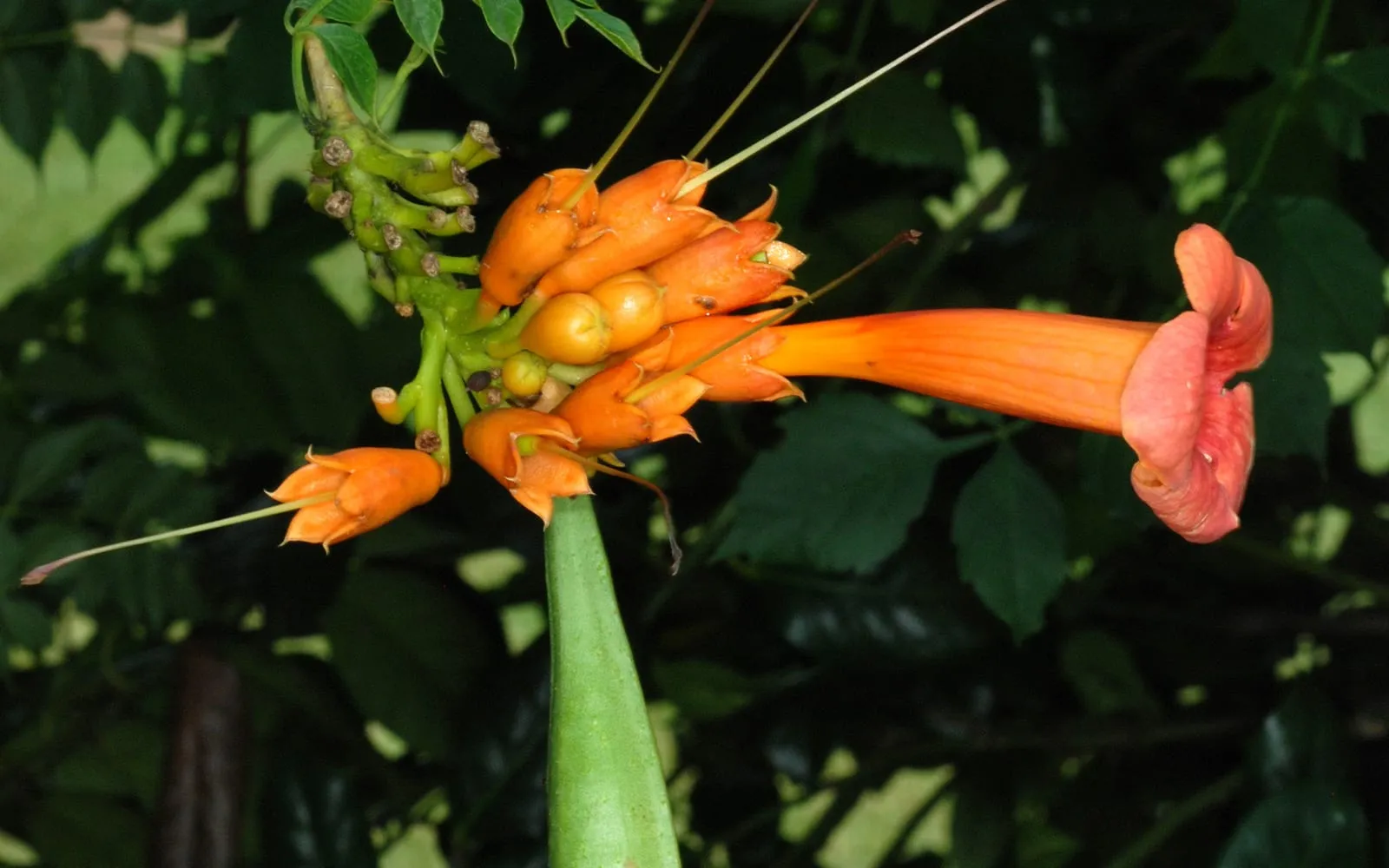
Flowers open in clusters at the shoot tips from midsummer into autumn, each one a flared trumpet 6 to 9 cm long in shades of orange, red or, in some cultivars, yellow. They produce little scent but a great deal of nectar, and a mature vine in flower draws hummingbirds and large bees throughout the day.
Long, bean-like seed pods follow flowering on a plant left unpruned, splitting open in autumn or winter to release flat, papery, wind-dispersed seeds, one of the two routes, alongside suckering roots, by which the vine spreads beyond where it was planted.
Where it is from
Campsis radicans is native to the woodland edges, fence lines and riverbanks of the southeastern and eastern United States, climbing into the tree canopy by aerial roots that grip bark and any other rough surface they meet.
Its native habit is to scramble unchecked through open woodland, and that explains its behaviour in a garden. A gardener growing it against a house or a fence has to provide the restraint it does not have on its own.
How it grows
Plant in any reasonably drained soil in full sun, against a sturdy support strong enough to carry real weight once the vine matures. A wooden trellis or a weak fence is often not strong enough for a plant this heavy at full size.
Aerial roots grip masonry, bark and rough wood without help, but a young plant benefits from being tied in loosely at first until those roots take hold. Avoid letting it climb painted woodwork or guttering it might damage as it thickens.
Control suckers by cutting them off at ground level as soon as they appear, well before they grow into new stems, since an established plant can throw up new growth metres from the parent vine through its questing roots.
Prune hard in late winter, since flowers form on the current season’s growth. Cutting the previous year’s growth back to a framework of two or three buds encourages a stronger flush of flowers than leaving the vine to grow unchecked.
Through the seasons
Winter is for hard pruning, cutting the previous season’s growth back to a permanent framework before growth resumes.
Spring brings vigorous new growth from the pruned framework, quickly covering the support again.
Summer is the flowering season, from midsummer into early autumn in most climates, and the busiest time for hummingbirds and bees at the flowers.
Autumn ripens the seed pods on any growth left unpruned, and is a good time to check for and remove any unwanted suckers before winter dormancy.
Care difficulty
Easy, to the point that restraint rather than encouragement is the real skill involved. It establishes readily in poor soil, tolerates drought once rooted in, and needs no feeding on reasonable ground. Controlling its spread through suckers and seed, and pruning hard enough each winter to keep flowering strong rather than sparse and high up out of sight, are the two tasks that separate a well-kept vine from an unruly one.
Watering
Water regularly through the first growing season while the roots establish, then rely on rainfall in most climates. Established plants tolerate real drought and rarely need supplementary watering except in a prolonged dry spell.
Container-grown plants, sometimes used to restrict the roots and slow the suckering habit, need far more consistent watering than anything given free rein in open ground.
Warning signs, diseases and pests
Aphids cluster on flower buds and soft new shoot tips, sometimes in large numbers, though the vine’s vigour usually outpaces any lasting damage they cause. A strong jet of water dislodges most infestations.
Leaf spot appears as small dark blotches in humid weather, mostly cosmetic and rarely a problem on a vine this vigorous.
Powdery mildew can coat leaves late in the season, particularly where air circulation is poor against a wall. It is unsightly rather than dangerous on an established plant.
Scale insects sometimes settle on older, woody stems, feeding on sap and leaving a sticky residue. Treat a heavy infestation with horticultural oil.
Growing environment
Full sun gives the heaviest flowering; a vine grown in significant shade produces plenty of leaf but comparatively few flowers.
Almost any soil suits it, including poor, dry or compacted ground, which is part of why it has become a self-sustaining weed in some places outside its native range.
A strong, permanent support is the one real environmental requirement, since the vine’s weight and the force of its aerial roots can damage weaker structures over time.
Feeding
Little to none is usually needed. This is a vine that grows too readily on average soil, and extra fertility can encourage even more vigorous, harder-to-control growth.
Where growth stalls badly on very poor soil, an occasional light feed of a balanced fertiliser in spring is enough to correct it.
Troubleshooting
It has taken over more space than I wanted. Prune hard in late winter, cutting back to a framework you can maintain, and dig out or cut off any suckers appearing beyond where you want the plant. Repeated control over a season or two brings a vigorous vine back within bounds.
Why has it grown for years without flowering? Too much shade, or too much nitrogen-rich feeding, both push leafy growth at the expense of flowers. Move it into fuller sun if possible, and stop feeding it altogether.
New shoots keep appearing metres away from the main plant. Suckering roots, spreading underground from the parent vine. Cut each one off at ground level as soon as it appears, and expect to repeat the task for a season or two before the root system gives up sending out new shoots in that direction.
My skin reacted after pruning it. The sap is a mild skin irritant for some people, giving the vine its cow itch vine nickname. Wear gloves and long sleeves next time, and wash any exposed skin promptly if it does touch bare skin.
Is it safe to grow where a dog chews fallen leaves? Broadly yes. It is not on the standard toxic plant lists, and the worst a pet typically experiences from eating a small amount is a mild, short-lived stomach upset.