
Outdoor plant
American Spikenard
Aralia racemosa
Also known as Life-of-man, Petty morel, Indian root
How to grow Aralia racemosa in a shaded border. A herbaceous perennial the size of a shrub, dark purple berry clusters, and a root that smells of liquorice.
At a glance
- Difficulty
- Easy
- Water
- Through the first two summers, then in dry spells
- Light
- Partial to full shade
- Temperature
- Fully hardy, to about minus 30 deg C
- Hardiness
- USDA 3-8, RHS H7, hardy to -35 C
- Type
- Hardy herbaceous perennial from a thick aromatic root
- Height
- 1-2 m tall and as much across
- Native to
- the rich woodlands of eastern North America
- Best month
- April in the Northern Hemisphere, October in the Southern Hemisphere
A woodland plant that wants moist rich shade and dies back to a thick aromatic root each winter, reaching two metres in a season from nothing. Cold is no obstacle. Seed needs a cold stratification and germinates unevenly over two years.
Hardiness zones describe winter cold alone. Summer heat, humidity, rainfall and the length of the growing season decide as much, so treat the range as the outer limit rather than as a recommendation.
Every month named in this guide is for the temperate Northern Hemisphere. If you garden in the Southern Hemisphere, shift each one by six months, so April becomes October. Closer to the equator the wet and dry seasons matter more than the calendar, and the shift stops being a useful guide.
Harmful if eaten
- Do not eat
- The berries, which are not a food
- Harm from
- Eating it
- Affects
- People
American spikenard has a long record of use among indigenous peoples of eastern North America and among settlers, with the aromatic root as the part used. The plant does not appear on the RHS list of potentially harmful garden plants, and the ASPCA does not list it among plants toxic to dogs, cats or horses. The berries are the part to know about in a garden. They are dark purple, held in showy clusters at a child's eye level, and they are reported as causing stomach upset if eaten in quantity, so they are worth pointing out to children as something to leave rather than something to try. Some sources treat the ripe fruit as edible in small amounts and others do not, and where sources disagree the safer instruction is the one to give. Anyone taking the root as a supplement alongside prescribed medication should mention it to their GP, as the NHS advises for herbal products generally.
Sources: RHS potentially harmful garden plants, ASPCA toxic and non-toxic plants, NHS on herbal medicines
About
American spikenard is a herbaceous perennial that behaves like a shrub. It dies to the ground each winter and rebuilds itself every spring into a mound two metres tall and as much across, with large divided leaves on arching reddish stems. In a shaded border it does the job of a large shrub and can be moved or removed in a way a shrub cannot.
The root is thick, aromatic and smells of liquorice and camphor when cut. It was used across eastern North America as a remedy for coughs and as a flavouring, and it is one of the plants that gave rise to old-fashioned root beers alongside sassafras and sarsaparilla.
The case for it is the foliage and the fruit. The leaves are handsome and the berry clusters in autumn are a deep purple-black on red stalks and thoroughly ornamental until the blackbirds find them, which takes about a week.
Appearance and character
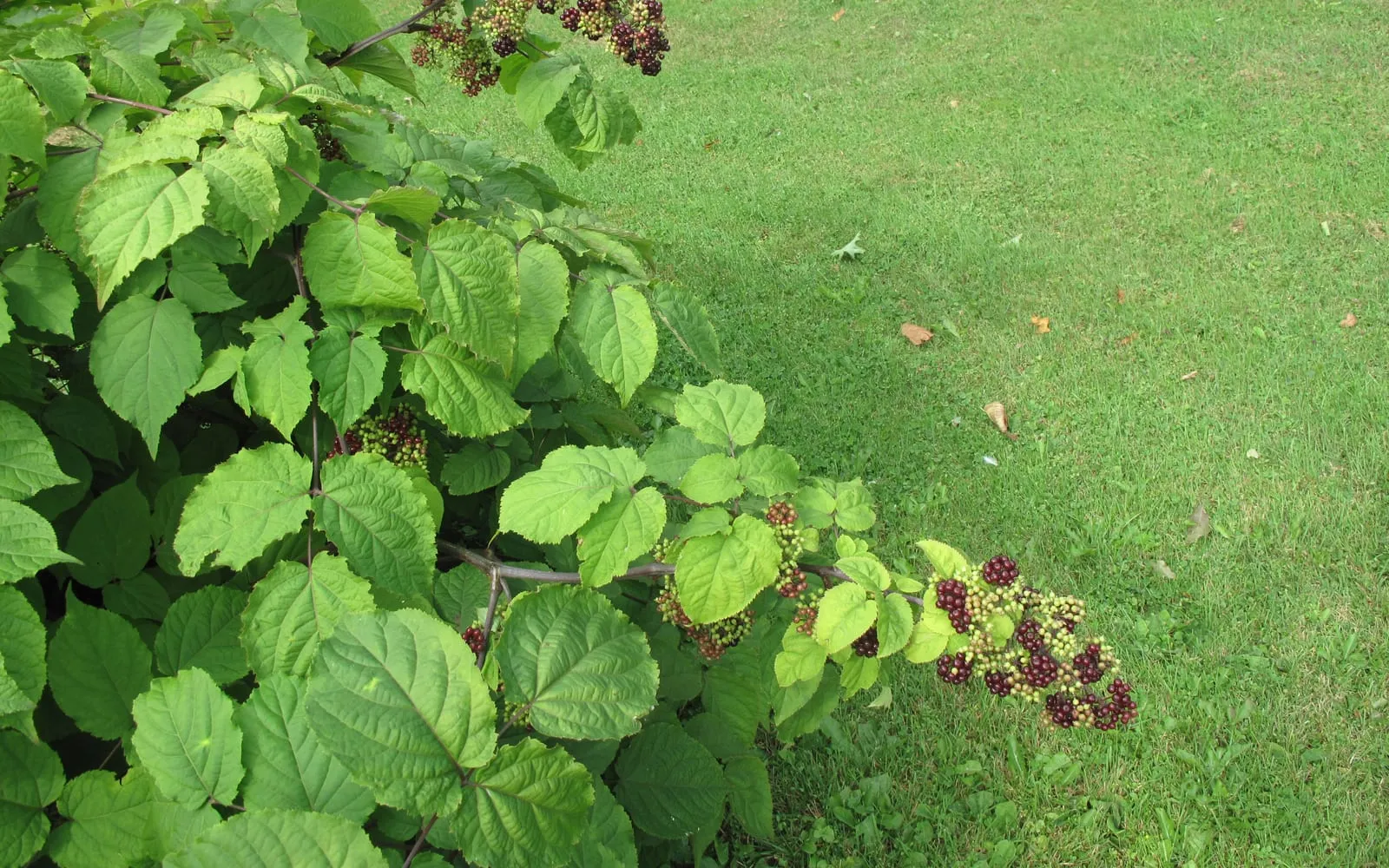
Growth is from a crown at ground level. Stems rise reddish-green and much branched, and each carries very large compound leaves, twice divided, up to 80 cm long overall, with oval pointed leaflets 6 to 15 cm long and toothed margins. The overall texture is bold rather than fine.
Flowers open in July in long branched panicles at the stem tips and in the upper leaf axils, each individual flower tiny, greenish-white, in small rounded umbels. The whole spray is 20 to 40 cm long and reads as a froth above the leaves.
Berries follow from late August in dense clusters, ripening through red to a deep purple-black, on stalks that flush red as the fruit colours. That contrast is the plant’s best ornamental moment.
Where it is from
The species grows through eastern North America from Quebec to Georgia and west to Manitoba and Arizona, in rich moist woodland, on shaded slopes, in ravines and along woodland edges. It favours the same rich leafy soil as ginseng and goldenseal and is often found with them.
It is a plant of shade and of soil with a deep organic layer, and it does not grow in open dry ground. Where the conditions suit it can form substantial colonies.
The rest of the genus behaves differently. Aralia elata, the Japanese angelica tree, and Aralia spinosa are woody, spiny and suckering, and Aralia cordata is the Japanese udo grown as a vegetable. This species is herbaceous and thornless.
How it grows
The plant rebuilds itself annually from a thick perennial root. Shoots emerge in late April, expand fast through May, and the plant reaches full size by the end of June, which is a considerable performance from a crown at ground level.
Flowering follows in July and fruit ripens from late August into September. The top collapses after the first hard frosts and the plant overwinters as root.
Propagation is by seed, which needs a warm period and then a cold one and germinates in the second spring, or by careful division of the crown in early spring. Root cuttings taken in winter also work.
Through the seasons
Plant in April into shaded ground improved with leaf mould, allowing two metres of space. Water through the first two summers while the root system develops.
Shoots come through in late April and the plant reaches full size by the end of June. Flowering runs through July and berries ripen from late August. There is no staking, pruning or deadheading to do.
Cut the collapsed stems away in late autumn or early spring. Mulch with leaf mould or compost each spring. Divide in early spring if the clump needs reducing, though a mature root is a substantial digging job.
Care difficulty
Easy given shade, moisture and room. The plant is fully hardy, needs no support despite its size, and has no significant pests once past the seedling stage.
Space is the thing people underestimate. A two-metre mound appearing every summer from a crown that looks like nothing in March will swamp anything planted too close to it.
Establishment takes two years. The plant is slow in its first season while the root builds and then arrives at full scale rather suddenly in its third.
Watering
Water through the first two growing seasons after planting, which is when the root system is developing and the plant is most vulnerable.
An established plant on moisture-retentive soil under a leaf mould mulch handles most summers. It has a great deal of leaf and it wilts visibly in a drought, which is a clear signal to water it deeply.
The plant dislikes waterlogged ground in winter, so moist and draining is the combination rather than wet.
Warning signs, diseases and pests
Slugs go for the emerging shoots in April, which are thick, soft and appetising. Damage then sets the plant back for the season, so grit and vigilance in that month are worthwhile.
Aphids gather on the flowering stems in July and are of no consequence on a plant this size.
Leaf scorch, appearing as brown crisping at the leaflet margins, means too much sun or too little moisture. Both are cultural. Root rot in waterlogged ground is the only disease likely to kill an established plant.
Growing environment
Partial to full shade. This is a woodland plant and it scorches in open sun, particularly on dry soil. Dappled shade under high canopy is ideal.
Soil should be deep, rich in organic matter, moisture-retentive and free-draining, from acid to neutral. Dig in leaf mould or compost before planting, since the plant will be in place for many years.
Shelter helps. Large soft leaves shred in strong wind, and a sheltered shaded corner shows the plant at its best.
Feeding
A mulch of leaf mould or garden compost each spring is enough. The plant makes a lot of growth each year and responds to organic matter more than to fertiliser.
A general-purpose feed in March supports a plant on thin soil. Nothing is needed where the ground gets an annual mulch.
Soil improved before planting does more for a large perennial than anything applied to it later, since the roots are in place and undisturbed by then.
Troubleshooting
How big does it get? One to two metres tall and as much across, every year, from a crown at ground level. Allow two metres of space in every direction.
Is it a shrub? No. It is herbaceous and dies to the ground each winter, then rebuilds itself the following summer, which is what makes it useful where a shrub would be too permanent.
Can I eat the berries? Treat them as off limits. Sources disagree about the ripe fruit and stomach upset is reported from eating them in quantity, so the safer instruction is the one to follow.
Why has it not appeared this spring? Check the timing before worrying. It emerges in late April, later than most perennials, and looks like nothing at all in March.
Is it related to ginseng? Yes, both are in the Araliaceae, alongside ivy and the fatsia. Aralia racemosa was used in some of the same ways and is a much easier plant to grow.
Will it grow in sun? It survives and scorches. Shade is where it belongs, and it is one of the more useful large plants for a shaded border.
How do I propagate it? Divide the crown in early spring, which is heavy work on a mature plant, or take root cuttings in winter. Seed needs a warm period and then a cold one and germinates in the second spring.