
Edible
Pandan
Pandanus amaryllifolius
Also known as Fragrant screwpine, Daun pandan, Bai toey
How to grow pandan, Pandanus amaryllifolius. The fragrant screwpine leaf of south-east Asian cooking, growing it from a sucker, and keeping it warm through a cool winter.
At a glance
- Difficulty
- Moderate
- Water
- Two or three times a week in summer, weekly in winter
- Light
- Bright indirect light or dappled sun
- Temperature
- Damaged below 12 deg C and killed below about 7 deg C
- Humidity
- High. It suffers in dry heated air
- Hardiness
- USDA 10-12, RHS H1b, hardy to 12 C
- Type
- Tender evergreen perennial shrub
- Height
- 1-2 m
- Native to
- Southeast Asia
- Best month
- June and July in the Northern Hemisphere, December and January in the Southern Hemisphere
Wet tropical south-east Asia. The culinary form is a sterile cultigen that has never been recorded flowering or setting seed, so every plant in cultivation is a cutting of the same clone. Constant warmth and humidity.
Hardiness zones describe winter cold alone. Summer heat, humidity, rainfall and the length of the growing season decide as much, so treat the range as the outer limit rather than as a recommendation.
Every month named in this guide is for the temperate Northern Hemisphere. If you garden in the Southern Hemisphere, shift each one by six months, so June becomes December. Closer to the equator the wet and dry seasons matter more than the calendar, and the shift stops being a useful guide.
Not known to be toxic
- Safe to eat
- The leaves, used to flavour and then removed
Non-toxic. Pandan leaf is used across south-east Asia to flavour rice, cakes and puddings, and it appears on neither the RHS list of potentially harmful garden plants nor the ASPCA list. The leaf is usually knotted and dropped into the pan, then lifted out before serving, since it is fibrous rather than because it is harmful. Note that this is Pandanus amaryllifolius, the one species in the genus grown for its leaf flavour. Other screwpines produce large fruit, some of which need careful preparation, and none of them is what a recipe calling for pandan leaf means.
Sources: RHS potentially harmful garden plants, ASPCA toxic and non-toxic plants
About
Pandan is the vanilla of south-east Asia, in the sense that it does the same job in sweet cooking. The leaf is knotted and simmered with rice, or blended and strained into cakes and puddings, and it gives a sweet grassy scent and a green colour to a great many dishes from Malaysia to Thailand.
The compound behind the smell is 2-acetyl-1-pyrroline, which is the same compound that makes basmati and jasmine rice smell the way they do. A pandan leaf dropped into an ordinary pot of rice pushes it in that direction, which is exactly why cooks do it.
It is one of the more forgiving tropical plants to keep outside the tropics, provided it stays warm and humid. It never flowers in cultivation, so it is grown entirely from suckers, and a healthy clump supplies more leaf than a household will use.
Appearance and character
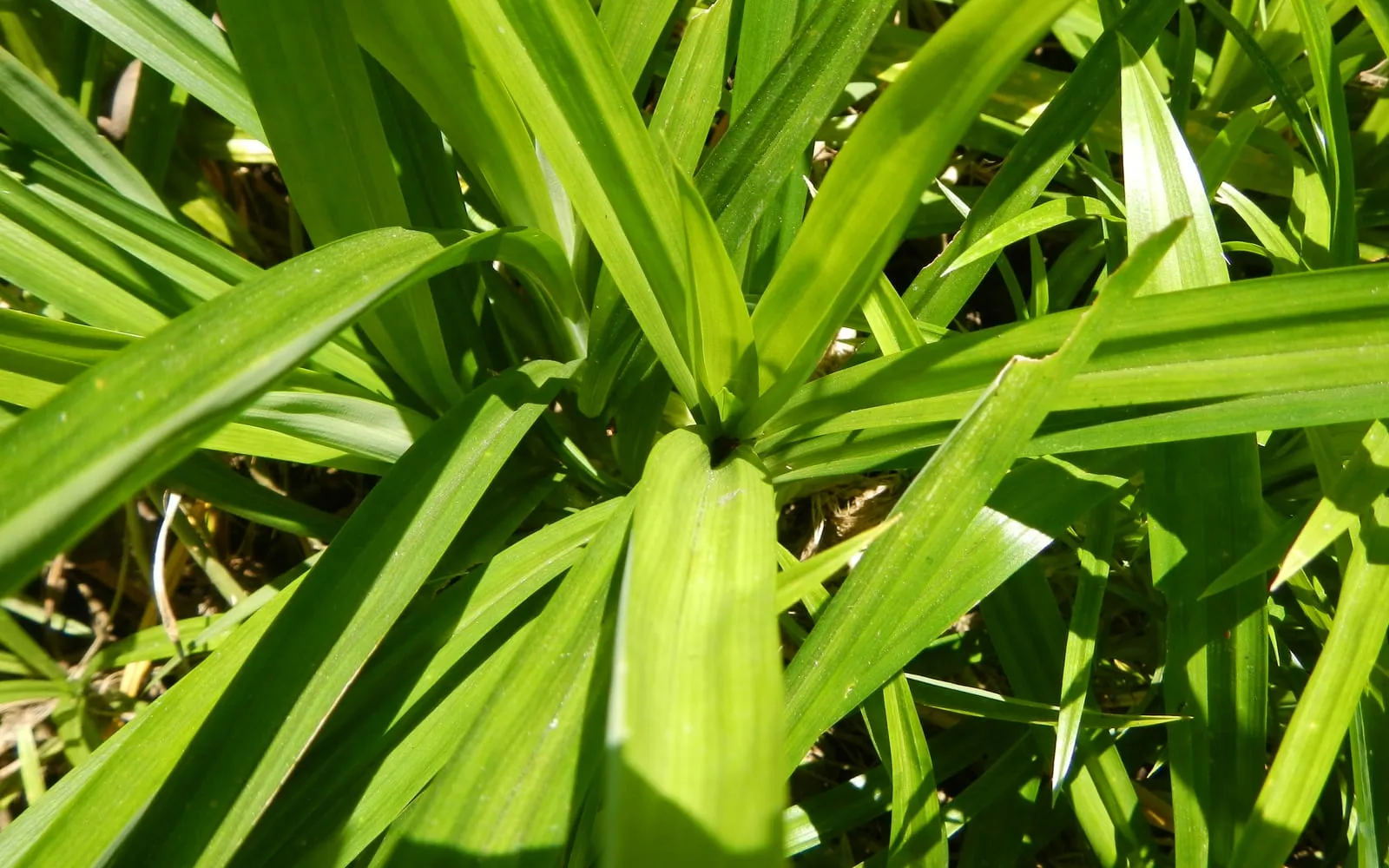
An upright clump of long strap-shaped leaves, 1 to 2 m tall, widening steadily as it suckers.
Leaves are 40 to 80 cm long and 3 to 5 cm wide, glossy bright green, folded along the midrib into a shallow V, and arranged in a spiral around the stem. That spiral is what gives the family the name screwpine.
Unlike most Pandanus, this species has no spines along the leaf margins, which is one way to know you have the right plant.
Stems are short and thick, and older plants throw out stilt-like aerial roots from the base that prop the clump up.
The scent is the whole point and it is stronger in a cut leaf than a growing one. Bruising or tearing a leaf releases it.
It rarely flowers in cultivation and no seed is produced, so every plant in circulation descends from a division.
Where it is from
Pandan is native to south-east Asia and its exact wild origin is uncertain, because the plant has been carried around the region and propagated by hand for so long.
It is sterile in cultivation. Male flowers are rare, female ones have never been reliably recorded, and the whole cultivated population is therefore clonal.
Its culinary role across the region is wide. Malaysia and Indonesia use it in kuih and in coconut desserts, Thailand wraps chicken in the leaves before frying, Vietnam colours cakes with it, and Sri Lanka and southern India cook it with rice and curry.
The green colour in pandan chiffon cake and in kaya, the coconut jam of Malaysia and Singapore, comes from the leaf, though commercial versions generally use colouring and essence.
Frozen and dried leaves are sold in Asian grocers, and the frozen ones keep far more of the aroma than the dried.
How it grows
Start from a sucker or a rooted offset, which is the only practical route since the plant does not set seed.
Detach a sucker with some roots attached in spring, or root a suckered shoot in water or damp compost with bottom heat.
Pot into rich free-draining compost in a pot of at least 25 cm.
Grow it warm, humid and bright, out of direct midday sun. A conservatory, greenhouse or a bathroom windowsill all work, and a dry heated living room does not.
Keep it above 12 deg C at all times. Below that the leaves brown and the plant stops.
Water regularly through the growing season and less in winter, never letting it sit wet.
Feed fortnightly from May to August.
Harvest whole leaves from the outside of the clump, cutting them at the base with a knife.
Repot every second or third spring, dividing off suckers at the same time.
Through the seasons
Winter is indoor survival above 12 deg C. Water less, keep the humidity up and expect little growth.
Spring brings new growth from April. Repot, divide and start feeding.
Early summer is when it accelerates. It can go outside in a shaded sheltered spot from late June if the nights are warm.
Midsummer is peak growth and the best harvest.
Late summer is when suckers appear, which are next year’s plants.
Early autumn brings it back inside, in September, before the nights cool.
Care difficulty
Moderate, and easier than most tropical plants of its kind.
Warmth is the main requirement. Below 12 deg C the leaves brown and the plant stops, so it needs a heated space through winter.
Humidity is the second and the one most often missed. Dry heated indoor air in winter browns the leaf tips and brings on spider mite. A humidity tray, a grouped planting or a bathroom position all help.
Overwatering in winter rots the base, as it does with most tender plants.
Light needs balancing. It wants bright conditions and it scorches in direct midday sun through glass.
Given warmth, humidity and reasonable light it grows steadily and lives for many years, producing suckers you can pass on.
Watering
Water two or three times a week in summer, keeping the compost evenly damp.
Water weekly in winter, letting the surface dry between times.
Never let it stand in water, and empty the saucer.
Use tepid water in winter and rainwater where the tap water is hard.
Raise the humidity rather than watering harder if the leaf tips brown. Stand the pot on a tray of damp gravel, or group it with other plants.
Mist occasionally in a dry heated room, which discourages spider mite.
Warning signs, diseases and pests
Brown leaf tips mean dry air, and it is the commonest complaint. Raise the humidity.
Brown patches and general deterioration mean cold. Below 12 deg C the plant suffers steadily.
Spider mite shows as fine pale stippling with webbing in the leaf axils, and it takes hold in dry heated air. Raise the humidity and use a predatory mite.
Mealybug sits as white waxy fluff in the leaf bases. Dab it out with a cotton bud.
Scale insects appear as brown limpets on the leaf undersides with sticky honeydew below.
Soft brown rot at the base is root rot from cold wet compost.
Pale washed-out leaves mean too much direct sun through glass.
Growing environment
Bright indirect light or dappled shade. Direct midday sun through glass scorches the leaves.
Warmth throughout. Minimum 12 deg C, and 20 deg C or more for good growth.
High humidity. This is a plant of humid tropical understorey and it shows the difference immediately.
Rich, moisture-retentive, free-draining compost in a substantial pot.
pH from 5.5 to 7.
A conservatory, heated greenhouse or a humid bathroom windowsill all suit it. A dry centrally heated living room does not.
Feeding
Feed a balanced liquid feed fortnightly from May to August.
A feed with reasonable nitrogen suits it, since leaf is the crop.
Stop feeding from September and give nothing through the winter.
Repot into fresh compost every second or third spring rather than feeding an exhausted one.
A slow-release fertiliser worked into the compost in spring is an easier alternative to liquid feeding.
Troubleshooting
The leaf tips went brown. Dry air, almost always. Raise the humidity with a gravel tray or by grouping plants together.
How do I use it? Knot a leaf and simmer it with rice or coconut milk, then lift it out. For colour and a stronger flavour, blend leaves with water and strain.
Does it flower? Almost never in cultivation, and it sets no seed. Every plant comes from a division, which is why you cannot buy pandan seed.
Is it the same as the screwpine with the big fruit? No. Those are other Pandanus species. This one is grown for its leaf and it has no spines on the leaf margins.
It stopped growing over winter. Normal below about 15 deg C. Keep it above 12 deg C and it will pick up in spring.
Can I use dried pandan leaf? It keeps far less of the aroma than fresh or frozen. Frozen leaves from an Asian shop are much better than dried.
How do I get more plants? Detach suckers with roots attached in spring. A healthy clump produces them steadily.