
Edible
Chayote
Sechium edule
Also known as Vegetable pear, Christophine, Chocho, Mirliton, Choko
How to grow chayote, Sechium edule. Planting the whole sprouting fruit, why a short season ends before it flowers, and the parts of the plant nobody sells you.
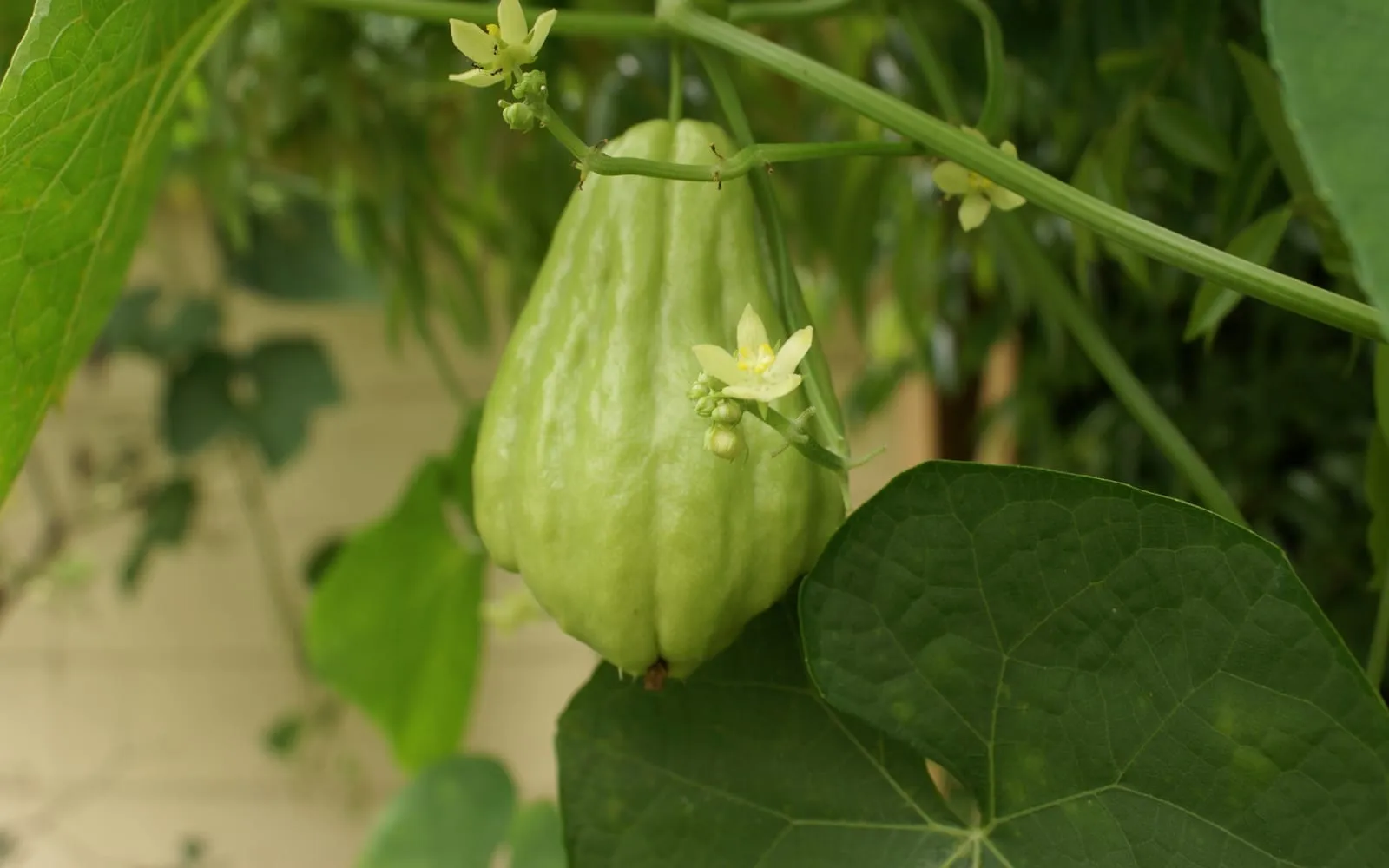
At a glance
- Difficulty
- Difficult
- Water
- Two or three times a week through summer, daily under glass in a heatwave
- Light
- Full sun, and the warmest wall or greenhouse you have
- Temperature
- Grows above 15 deg C, stops below 12, dies at the first frost
- Humidity
- Moderate. It sulks in dry heat and scorches under glass without ventilation
- Hardiness
- USDA 9-11, RHS H1b, hardy to 5 C
- Type
- Tender perennial climber, grown as an annual where frost comes
- Height
- 10-12 m of growth in a single season
- Native to
- southern Mexico, Guatemala
- Best month
- April and May in the Northern Hemisphere, October and November in the Southern Hemisphere
The whole fruit is planted, since the single large seed germinates inside it and cannot be separated. It needs 120 to 150 frost-free days and short days to flower, which puts the crop in late autumn and makes frost the usual reason it fails outside the subtropics. Where winter stays above 5 deg C the root survives and the vine returns for years.
Hardiness zones describe winter cold alone. Summer heat, humidity, rainfall and the length of the growing season decide as much, so treat the range as the outer limit rather than as a recommendation.
Every month named in this guide is for the temperate Northern Hemisphere. If you garden in the Southern Hemisphere, shift each one by six months, so April becomes October. Closer to the equator the wet and dry seasons matter more than the calendar, and the shift stops being a useful guide.
Skin irritant
- Safe to eat
- The fruit, the single seed, the young shoots and the tuberous root
- Do not eat
- None, though the raw sap dries and cracks the skin on your hands
- Harm from
- Handling it
- Affects
- People
Chayote is food, and no part of it is poisonous. The one complaint people make is about the sap. Peeling a raw fruit coats your fingers in a clear liquid that dries to a tight film and can leave the skin cracked and peeling for a day or two, and cooks in the Caribbean peel it under running water or wear gloves for that reason. Peeling it after boiling avoids the problem, and the skin on a young fruit is thin enough to leave on. Neither the RHS nor the ASPCA lists Sechium edule as harmful, and the cooked fruit is safe for cats and dogs in small amounts, though it offers them nothing.
Sources: RHS potentially harmful garden plants, ASPCA toxic and non-toxic plants
About
Chayote is the pale green pear-shaped fruit sold as chayote or christophine, sitting in the world vegetable section next to the yams. It is the only widely eaten member of its genus and one of very few cucurbits with a single seed.
That seed is the plant’s oddity. It has no hard coat and no dormancy, and it germinates inside the fruit while the fruit is still attached to the vine. Buy one that has sat in a warm kitchen for a fortnight and you will find a shoot pushing out of the flower end.
Growing it at high latitude is a gamble rather than a project. The vine grows with frightening speed and covers a greenhouse by August, then waits for the day length to drop below about twelve hours before it will flower. At 50 degrees that happens around the equinox, and the frost arrives before the fruit does.
Appearance and character
A perennial climber that behaves like a runaway annual, throwing 10 m or more of growth from a single planted fruit in one season.
The leaves are broad and roughly heart-shaped with three to five shallow lobes, 10 to 25 cm across, harsh to the touch on both sides. Forked tendrils come from the leaf axils and grip anything within reach, including other leaves on the same plant.
Male and female flowers are separate and both are small, greenish white and easy to overlook. Males come in loose sprays along the stem and open first; females sit singly, each with a miniature fruit already formed behind the petals.
The fruit is the reason to grow it. Most cultivars give a smooth pale green pear 10 to 20 cm long with a deep vertical crease down one side and a puckered mouth at the flower end. Others are ivory white, dark green, or covered in soft spines.
Cut one across and you find crisp white flesh, faintly sweet, closer to a marrow than to anything else, and a single flat almond-shaped seed in the middle. The seed is edible and the best part, with a texture like a soft broad bean.
Under the ground an established plant builds a starchy tuber that can reach several kilograms. In Central America it is dug and eaten under the name chinchayote, and in a short season it never gets the chance.
Where it is from
Chayote comes from the wet middle-altitude forests of southern Mexico and Guatemala, where the wild forms are small, bitter and spiny. Nobody has found a convincing wild population of the cultivated form.
The Aztecs grew it, and the name is theirs. Chayote comes from Nahuatl chayohtli, and it travelled under that name into Spanish and then into most of the world.
Spanish and Portuguese ships carried it out of Mesoamerica in the eighteenth century, first to the Caribbean and then to Brazil, and from there it went everywhere warm. It reached the Antilles as christophine, Louisiana as mirliton, Australia as choko, India as chow chow, and Reunion as chouchou.
Brazil, Mexico, Costa Rica and China now grow most of the world crop. Chinese production is mostly for the young shoots rather than the fruit, which are sold as long tender tips and cooked like a leafy green.
How it grows
Plant the whole fruit. There is no way to separate the seed from it without killing the seed, so the fruit goes into the ground entire.
Choose a mature fruit with a firm skin and, ideally, a shoot already showing. Lay it in a large pot on its side at about 45 degrees, sprouting end up, with a third of the fruit above the compost. Buried flat and level it rots.
Start it indoors in March or April at 20 deg C. It will root in three or four weeks and then grow away quickly.
Plant out after the last frost into the border of a greenhouse or polytunnel, or against a sunny wall in a mild district. Outdoors in a cool climate it will grow and never fruit.
Give it something enormous to climb. Strong wires, a pergola, or the whole roof of a greenhouse. It will fill whatever it is given.
Feed and water hard from midsummer. The growth rate is only sustained by both.
Pinch the leading shoot once it reaches the top of its support to bring on the side shoots, which is where the female flowers sit.
Expect fruit from September in a good year under glass. Cut them at 10 to 15 cm while the skin is still soft enough to mark with a thumbnail.
In a frost-free greenhouse the root survives the winter and grows away again in spring, and a second-year plant fruits earlier and more heavily than a first.
Through the seasons
March and April are for starting a fruit in a pot indoors, on its side, somewhere warm.
May is planting out under glass once the nights are above 10 deg C.
June and July are pure growth. Tie in, pinch the leader, and keep the water going.
August brings the first male flowers and, in a hot year, the first females.
September is the fruiting month at high latitude, driven by the shortening day rather than by the temperature.
October is the last chance to cut fruit before the first frost takes the vine to the ground.
Winter is dormancy. Cut the dead top growth away, keep the root barely damp and frost free, and it will shoot again in April.
Care difficulty
Difficult in a short season, and easy anywhere with a longer warm one.
Nothing about the plant is fussy. The problem is arithmetic, since it needs about five frost-free months before it will even start to flower.
Day length controls flowering, so a warm summer does not bring it forward.
The vine needs more space than most people have under glass, and it shades everything beneath it.
Slugs will remove a young plant in one night.
Overwintering the root is the single change that turns a failure into a crop.
Watering
Water two or three times a week from planting out, increasing as the vine grows.
Under glass in July, water daily.
Soak the root zone rather than wetting the leaves, since wet foliage in still air invites mildew.
Mulch thickly to hold moisture at the root.
Reduce watering sharply from October as the plant slows.
Keep the dormant root barely damp through winter, never wet.
A plant that wilts at midday and recovers by evening is short of water at the root rather than suffering in the heat.
Warning signs, diseases and pests
White dusty patches on the upper leaf surface from August are powdery mildew, which every cucurbit gets and which chayote tolerates better than most.
Fine pale stippling on the leaves with webbing in the axils is red spider mite, which follows dry still greenhouse air.
Clouds of small white insects rising when you brush the leaves are whitefly.
A young shoot cut through at ground level overnight is slug damage.
Yellowing lower leaves with a wilt that does not recover overnight suggests root rot from cold wet compost.
Male flowers in quantity with no females at all means the day is still too long, so wait rather than feeding harder.
Small fruit that yellows and drops means the female flower was never pollinated, which happens under glass where no insects get in.
Growing environment
A greenhouse, polytunnel or conservatory border where summers are cool.
Full sun with good ventilation.
Minimum 12 deg C, and growth only above 15.
Deep rich soil with plenty of organic matter dug in before planting.
A support strong enough for a plant that will weigh a great deal by September.
Room for 10 m of growth in each direction.
Shelter from wind, which shreds the large soft leaves.
Feeding
Dig in well-rotted manure or garden compost before planting.
Feed fortnightly with a high-potash tomato feed from the end of June.
Switch nothing to high nitrogen once the vine is growing, since it produces leaves at the expense of flowers.
Mulch in July to feed and to conserve water at once.
Stop feeding at the end of September.
Feed nothing to the dormant root.
Troubleshooting
Why has my chayote covered the greenhouse and produced nothing? The day length is still too long. Chayote is a short-day plant and will not set flower buds until the day drops below about twelve hours, which at 50 degrees means late September. A first-year plant often runs out of season before it gets there.
Can I plant just the seed? No. The seed has no protective coat and dies within hours of being taken out of the fruit. Plant the whole fruit.
Which way up does it go? On its side at an angle, with the wrinkled flower end tilted upwards and about a third of the fruit standing proud of the compost.
The fruit I bought has a shoot coming out of it. Is it spoiled? No, that is the plant doing what it does. A sprouting fruit is the best possible planting material.
Do I eat the seed? Yes, and it is the best of it. Cook the fruit with the seed in and eat it, or scoop it out and fry it separately.
Why did my hands peel after I prepared one? The raw sap. Peel it under running water, wear gloves, or boil the fruit whole and peel it afterwards.
Is choko the same thing? Yes. Choko in Australia and New Zealand, christophine in the French Caribbean, mirliton in Louisiana, chow chow in India, all one species.
What does it taste like? Very little on its own. Firm, faintly sweet, somewhere between marrow and water chestnut, and it takes on whatever it is cooked with.
Can I keep the plant for a second year? Yes, and you should. Cut the top growth off after it dies back and keep the root frost free and barely damp. A second-year plant flowers earlier and crops far better.
Chayote problem guides
Not sure what is wrong? See the common vegetable pests guide.