
Outdoor plant
Barrenwort
Epimedium grandiflorum
Also known as Horny goat weed, Bishop's hat, Yin yang huo, Fairy wings
How to grow Epimedium grandiflorum, a reliable ground cover for dry shade. When to cut the old leaves off, the spurred flowers in April, and where horny goat weed came from.
At a glance
- Difficulty
- Easy
- Water
- Through the first two summers, then rarely
- Light
- Partial to deep shade
- Temperature
- Fully hardy, to about minus 20 deg C
- Hardiness
- USDA 5-8, RHS H6, hardy to -20 C
- Type
- Hardy herbaceous perennial, semi-evergreen
- Height
- 20-40 cm
- Native to
- the woodlands of Japan, Korea and north-east China
- Best month
- March in the Northern Hemisphere, September in the Southern Hemisphere
One of the few plants that thrives in dry shade under trees, which is the hardest position most gardens have to fill. Cold does not trouble it. Cutting the old foliage away in late winter is worth doing, since the new leaves and the flowers come together and the old growth hides both.
Hardiness zones describe winter cold alone. Summer heat, humidity, rainfall and the length of the growing season decide as much, so treat the range as the outer limit rather than as a recommendation.
Every month named in this guide is for the temperate Northern Hemisphere. If you garden in the Southern Hemisphere, shift each one by six months, so March becomes September. Closer to the equator the wet and dry seasons matter more than the calendar, and the shift stops being a useful guide.
Harmful if eaten
- Do not eat
- None identified. The leaves are the part used in Chinese practice
- Harm from
- Eating it
- Affects
- People
Epimedium does not appear on the RHS list of potentially harmful garden plants, and the ASPCA does not list it among plants toxic to dogs, cats or horses. It is a standard ground cover in temperate gardens and has no record of harm in that setting. The name to explain rather than the hazard is horny goat weed, which comes from a story about a Chinese goatherd noticing the effect of the leaves on his flock, and which attaches to supplements made from the leaf rather than to the plant in a border. Those supplements contain icariin, and the caution that matters is that products sold on that reputation have repeatedly been found adulterated with prescription-only erectile dysfunction drugs, which is a supply chain problem rather than a plant problem. Anyone taking a supplement of this kind alongside prescribed medication, particularly nitrates for heart conditions, should say so to their GP.
Sources: RHS potentially harmful garden plants, ASPCA toxic and non-toxic plants, NHS on herbal medicines, MHRA register of traditional herbal registrations
About
Dry shade under a tree defeats most perennials, and epimedium grows there. It spreads slowly into a solid mat, holds handsome foliage most of the year and flowers in April before anything above it has come into leaf.
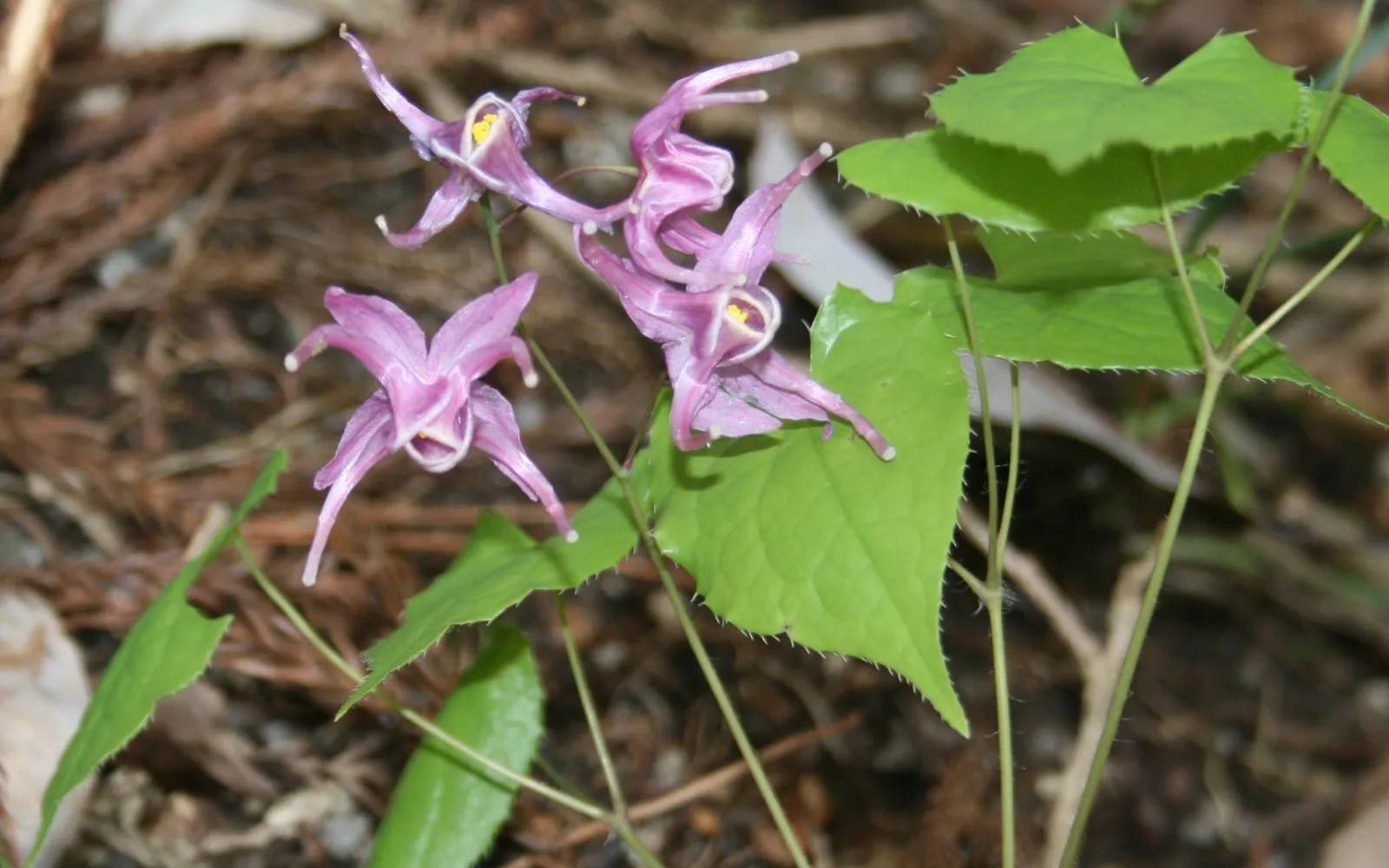
The flowers are the reason to grow it. Each is small, 3 to 5 cm across, held on a wiry stem above the leaves, with four long spurs projecting backwards like a columbine, in white, yellow, pink or violet depending on the cultivar. A clump in flower looks like a swarm of small insects hovering.
The other name it carries is horny goat weed, and it comes from the Chinese tradition where the leaves of several Epimedium species are used and where the name yin yang huo carries the same implication. That reputation has made the genus a supplement ingredient, which is a different plant in a different form from the one covering the ground under your hedge.
Appearance and character
Leaves are compound, usually with three or nine leaflets, each heart-shaped with a pointed tip and a finely spined margin, held on thin wiry stalks. New growth in spring comes through copper, bronze or red-flushed before turning green, which is one of the plant’s best moments.
Epimedium grandiflorum is deciduous or semi-evergreen depending on the winter, and the old leaves persist in a tatty state until cut. Named cultivars vary widely. Lilafee has violet flowers over dark bronze new growth, Rose Queen is deep pink, and Nanum is a dwarf a third of the size.
The flower is the family signature. Four petals extend into long curved spurs that hold nectar, surrounded by four petal-like sepals, giving the whole thing the look of a bishop’s mitre, which is where another of the common names comes from. Flowering runs through April and into May.
Where it is from
Epimedium grandiflorum is native to Japan, Korea and north-east China, growing in deciduous woodland and on shaded rocky slopes with leaf litter and free drainage. It is one of around sixty species in the genus, most from China, with a smaller group in the Mediterranean and the Caucasus.
The Chinese species used in herbal practice include Epimedium brevicornu, sagittatum and koreanum along with this one, and material in trade is a mixture. A reader who has come across the genus in that context has met a mixture of species rather than this one.
The plant reached temperate gardens in the nineteenth century and has been a standard for shade ever since. The great expansion in what is available came after the 1990s, when collecting in China introduced dozens of new species and the genus stopped being a handful of ground cover clones.
How it grows
The plant spreads by short rhizomes at or a little below the surface, extending a few centimetres a year, so a clump thickens outward slowly and never becomes invasive. Ten years turns one plant into a mat a metre across.
Flowering stems and new leaves emerge together in April from the rhizome tips. The flowers open as the leaves unfurl, which is why cutting the old foliage away in February matters: leave it and the flowers are lost inside a mass of last year’s leaves.
Roots are fibrous and dense, and an established clump competes successfully with tree roots, which is the quality that makes the plant so useful. Establishing it in that position takes two summers of watering.
Through the seasons
Plant in March or in autumn, into ground improved with leaf mould, 30 to 40 cm apart for ground cover. Water through the first two summers while the roots get down.
Cut the old leaves off in February, before the flower stems emerge. Shears at ground level over the whole clump is the method, and doing it late means cutting the flower buds off with the leaves.
Flowering runs April into May. After that the plant makes its new foliage and asks for nothing. Mulch with leaf mould in spring after cutting back. Divide established clumps in autumn or after flowering.
Care difficulty
Easy, and easier still if the one piece of timing is right. Cut the old foliage in February and the plant does everything else on its own.
The establishment period is the only demanding part. Dry shade under a mature tree is a hostile place for a new plant, and an epimedium put there and left unwatered usually fails. Two summers of attention buys decades of independence.
Slow growth is the trade-off. A newly planted clump takes three or four years to look like ground cover, and buying more plants is the only way to speed it up.
Watering
Water regularly through the first two growing seasons after planting, especially in dry shade where tree roots take most of what falls.
An established clump needs nothing in an average summer. The plant is drought tolerant once its root system is in place, which is unusual among shade plants.
Water in a prolonged drought if the foliage starts to brown at the edges, and mulch with leaf mould in spring, which conserves more moisture than watering adds.
Warning signs, diseases and pests
Vine weevil is the main pest, and it matters most in containers, where the grubs eat the roots through the winter and the plant lifts out of the compost in spring. In open ground the damage is usually the adults’ notching of leaf margins, which is cosmetic.
Slugs and snails graze new spring growth and can spoil the flowering display. Grit and vigilance in April cover it.
Two problems affect the leaves. Wind scorch browns evergreen foliage over a hard winter, which cutting back in February resolves. Leaf and bud eelworm produces dark blotches between the veins that spread through a clump in wet summers, and the response is removing affected leaves and improving air movement, since nothing available to a gardener treats it.
Growing environment
Partial to deep shade. The plant grows in more sun in a cool moist garden and scorches in sun with a dry root, so shade is the reliable choice.
Soil should be humus-rich and free-draining, from acid to slightly alkaline. Epimedium tolerates poor dry soil once established, which is the whole point of it, and it establishes much faster in ground improved with leaf mould.
A position out of cold drying winds keeps semi-evergreen leaves presentable through the winter. The plant itself is unbothered by exposure.
Feeding
A mulch of leaf mould each spring after cutting back is all the feeding it needs and the best thing you can do for it.
Fertiliser is unnecessary on any reasonable soil. A plant in a container benefits from a slow-release feed in spring, since compost in a pot is exhausted within a year.
Where a clump is growing under a hungry tree and looking thin, more leaf mould and water will do more than fertiliser, because the limit there is moisture rather than nutrients.
Troubleshooting
When should I cut the old leaves off? February, before the flower stems come through. Shear the whole clump at ground level. Cut later and you remove the flower buds along with the foliage.
Why did my plant flower poorly? Old foliage left in place is the commonest reason, since the flowers open inside it and are never seen. Deep dry shade with no establishment watering is the other.
Will it grow in dry shade? Yes, and it is one of the best plants for it once established. Give it two summers of watering after planting and it will look after itself under a tree after that.
Is it invasive? No. It spreads by short rhizomes at a few centimetres a year, so it makes ground cover slowly and stays where it is put.
Is horny goat weed the same plant? The name refers to Epimedium, though supplements are made from several species and the material in trade is mixed. Products sold on that reputation have often been found adulterated with prescription drugs, which is a reason to be careful about buying them rather than about growing the plant.
How do I propagate it? Divide the clump in autumn or straight after flowering, using a spade through the rhizome mat, and replant the pieces at once with plenty of water.
The leaves have dark blotches between the veins. Probably leaf and bud eelworm, which spreads in wet summers. Remove affected leaves, thin nearby planting to improve airflow, and avoid overhead watering. There is no chemical control available to gardeners.