
Outdoor plant
Mexican Orange Blossom
Choisya dumosa
Also known as Starleaf Mexican Orange
How to grow Mexican orange blossom, Choisya dumosa. Why alkaline soil that its better-known relative Choisya ternata resents does not trouble this one, and the extra drought and cold tolerance that comes from its native desert limestone.
At a glance
- Difficulty
- Easy
- Water
- Water while establishing; drought tolerant once settled in
- Light
- Full sun to light shade; afternoon shade in hot, dry climates
- Temperature
- Tolerates moderate frost once established
- Hardiness
- USDA 7-9, RHS H4, hardy to -12 C
- Type
- Evergreen aromatic shrub
- Height
- 0.6-1.5 m
- Native to
- the southwestern United States, Mexico
Grows naturally at moderate elevation on limestone slopes in the Chihuahuan desert, a habitat with real winter cold and only occasional rain, which makes it noticeably hardier and more drought tolerant than the better-known Choisya ternata sold as a garden shrub. Its native limestone soil also means it copes with alkaline ground that its lime-shy relatives resent, though it still needs sharp drainage rather than a heavy, wet clay.
Hardiness zones describe winter cold alone. Summer heat, humidity, rainfall and the length of the growing season decide as much, so treat the range as the outer limit rather than as a recommendation.
Not known to be toxic
Choisya dumosa does not appear on the RHS list of potentially harmful garden plants or the ASPCA's toxic plant database, and no poisoning reports are recorded against the genus. The foliage carries aromatic oils typical of the citrus family it belongs to, released as a strong scent when a leaf is crushed, and eating a large quantity of any strongly aromatic plant can upset a cat, dog or person's stomach in the way many pungent leaves do, but this is a general caution rather than a documented toxin specific to Choisya. It can be grown without factoring pets or children into the decision.
Sources: RHS potentially harmful garden plants, ASPCA toxic and non-toxic plants
About
Mexican orange blossom is a compact, rounded evergreen shrub grown for finely divided, aromatic foliage and clusters of white, fragrant flowers that share the orange-blossom scent of its better-known relative, Choisya ternata. It stays smaller and denser than that more widely planted species, and its origin on desert limestone slopes gives it real tolerance of cold, drought and alkaline soil.
It is an easy shrub for a sunny, well-drained spot, needing only routine watering while young and an occasional light trim to keep its naturally neat, rounded form.
Appearance and character
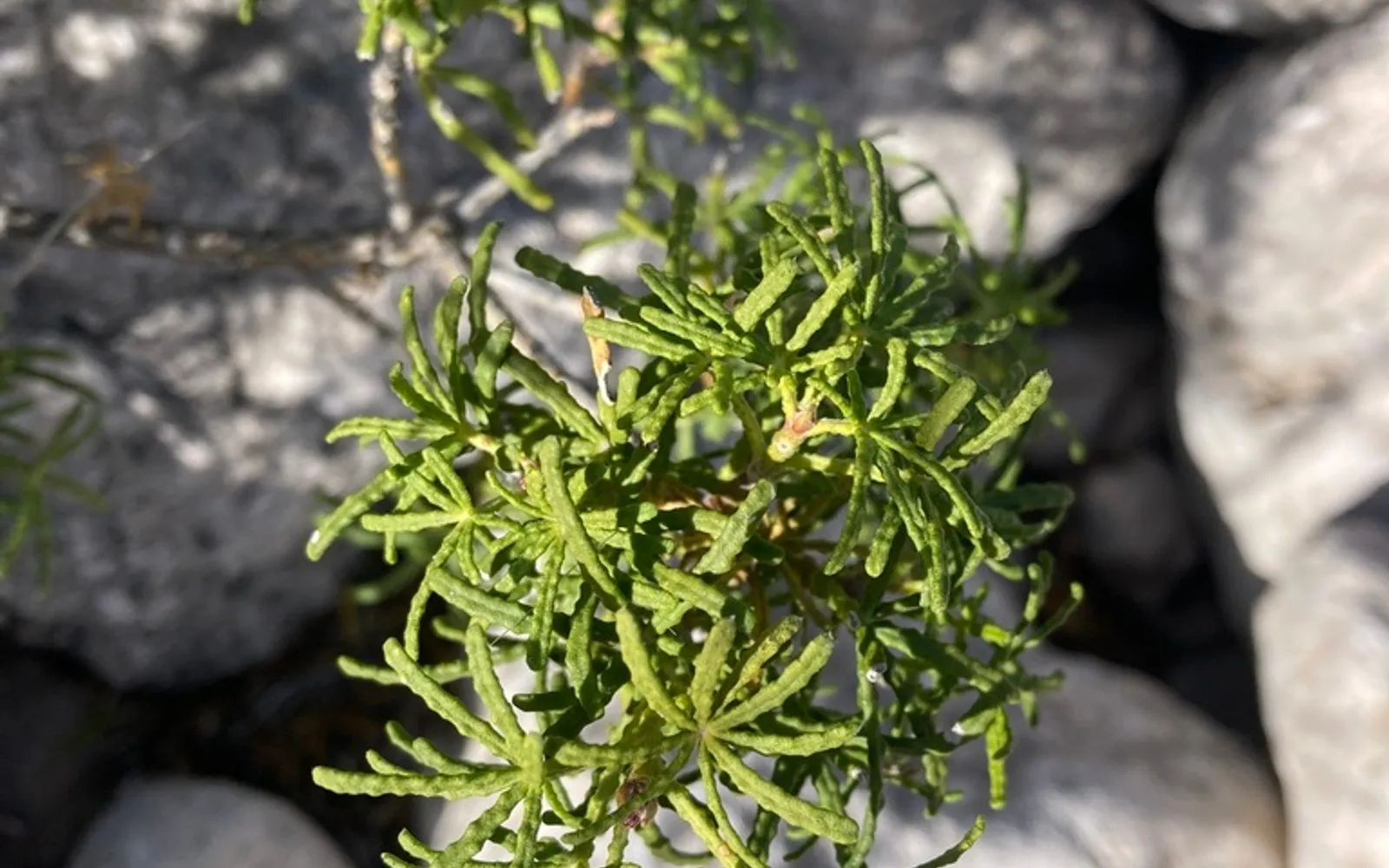
The leaves are palmately divided into narrow, almost needle-like leaflets that spread from a single point like fingers, giving the whole plant a soft, feathery texture quite different from the broad, glossy, three-lobed leaves of Choisya ternata. Crushed between the fingers, they release the same strong citrus scent common throughout the Rutaceae family it belongs to.
Small, star-shaped, white flowers open in dense clusters in spring, and in its dry native habitat can appear again sporadically after summer rain. Each flower carries a sweet, orange-blossom fragrance that scents the air around the plant on a still day.
The overall habit is dense and rounded, naturally forming a tidy mound without much pruning, which along with its compact size suits it well to a smaller border or a spot near a path where its fragrance can be appreciated at close range.
Where it is from
Choisya dumosa is native to the Trans-Pecos region of Texas, parts of New Mexico, and adjacent northern Mexico, where it grows on rocky, often limestone slopes at moderate elevation within the Chihuahuan desert. That setting brings a real winter, with occasional hard frost, alongside long dry spells through summer.
Growing on limestone gives it a natural tolerance for alkaline soil that many other aromatic shrubs, including its lime-shy relative Choisya ternata, do not share, and its desert upbringing makes it markedly more drought tolerant once it has a season or two to root in.
How it grows
Plant in full sun to light shade, in soil that drains freely; it tolerates poor, rocky or alkaline ground far better than rich, damp soil. In a hot, dry summer climate, some afternoon shade helps keep the foliage looking fresh, while a cooler, wetter climate suits full sun better for compact growth and the best flowering.
Water regularly through the first growing season while the roots establish, then reduce watering markedly. An established plant handles extended dry periods well and is far more likely to suffer from overwatering in heavy soil than from drought.
Prune lightly after the main spring flowering to maintain its naturally rounded shape and to encourage a second, lighter flush of flowers. It tolerates a harder cut if it becomes leggy, though this sacrifices some of the current season’s flowers.
Give it space to reach its mature width, since a shrub crowded by neighbours loses the open, airy form that shows off its feathery foliage to best effect.
Through the seasons
Spring brings the main flowering display, along with the season’s strongest flush of new growth. Prune lightly once flowering has finished.
Summer is quieter, with drought tolerance at its most useful during any hot, dry spell, and a possible second, lighter flowering after rain in its native climate.
Autumn is a good time to plant a new shrub in a mild climate, giving roots a season to establish before the following summer’s heat.
Winter brings dormancy and, in a marginal climate, the period when frost tolerance matters most. Established plants tolerate moderate cold without protection.
Care difficulty
Easy. Once planted in well-drained soil and given a season to establish, it needs no regular feeding and no staking, and it needs only a light annual trim to stay tidy. Its main requirement, sharp drainage, is easy to provide from the outset and rarely causes problems for a gardener who avoids planting it in a low, wet spot.
Watering
Water regularly through the first growing season, letting the soil dry somewhat between waterings rather than keeping it constantly damp, since this species is naturally adapted to a dry climate and does not want permanently moist roots even while establishing.
Once settled, water only during an extended dry spell. In climates with reasonable summer rainfall, an established plant often needs no supplemental watering at all.
Warning signs, diseases and pests
Aphids cluster on soft new spring growth, distorting young leaves and excreting sticky honeydew. Light infestations are usually controlled by natural predators; wash off heavier ones with a strong jet of water.
Scale insects appear as small, flat, brownish bumps on the woody stems, sapping the plant’s vigour over time. Treat with horticultural oil where numbers build up.
Root rot follows waterlogged or heavy soil, showing as wilting and yellowing foliage despite apparently adequate watering. Improving drainage before replanting is the only real remedy, since there is no treatment for roots that have already rotted.
Leaf spot occasionally appears as small brown or black marks on the foliage where plants are crowded together with poor air movement. Thinning nearby growth to improve airflow usually resolves it.
Growing environment
Full sun gives the densest growth and the strongest flowering in most climates, while light or afternoon shade helps prevent scorching where summers are intensely hot and dry.
Well-drained soil is essential, and this species is unusually forgiving of soil that runs alkaline, thanks to its native limestone habitat. What it will not tolerate for long is heavy, slow-draining ground that stays wet after rain.
Reasonable shelter from the coldest winter winds helps protect the evergreen foliage in a marginal climate, though established plants otherwise need little protection.
Feeding
Feeding needs are modest. A single application of a balanced general- purpose fertiliser in spring is usually sufficient, and on reasonable garden soil even that is optional.
Avoid heavy or repeated feeding, which pushes soft, leafy growth at the expense of the plant’s naturally dense, compact habit and can make new growth more vulnerable to frost damage.
Troubleshooting
The shrub looks sparse and leggy rather than dense and rounded. Most often too much shade or too little pruning. Moving it to a sunnier spot where possible, and trimming lightly after each flowering flush, both encourage the compact habit this species is grown for.
Leaves have yellowed and some stems have died back. Check the soil drainage first, since root rot from wet ground is the most likely cause. There is no recovery for roots that have already rotted; improving drainage on any replacement planting is the only fix.
It has not flowered as heavily as expected. Usually too much shade, a hard prune at the wrong time of year that removed the flowering wood, or a young plant that has not yet reached flowering maturity. Checking light levels and pruning timing usually points to the cause.
Can it survive a hard frost? Established plants tolerate moderate frost well, reflecting their origin on a cold desert plateau, though a young or recently planted specimen is more vulnerable until its roots are well established. A dry mulch around the base over its first couple of winters offers useful extra protection.
Does it need regular watering like most garden shrubs? No, and treating it that way is more likely to cause problems than to help. Once established, it is a drought-tolerant shrub, needing only infrequent, deep watering rather than the frequent light watering many garden shrubs expect.