
Edible
Breadnut
Brosimum alicastrum
Also known as Maya Nut, Ramon, Ojoche
How to grow breadnut, Brosimum alicastrum. Why it is a fig-family tree rather than a true nut, its likely role as a Maya staple crop, the latex sap that irritates skin, and roasting the seed into a flour substitute.
At a glance
- Difficulty
- Difficult
- Water
- Regularly while establishing; drought-tolerant once mature
- Light
- Full sun to partial shade when young
- Temperature
- Frost-tender; needs consistent tropical warmth
- Hardiness
- USDA 10-12, RHS H1c, hardy to 5 C
- Type
- Evergreen tropical tree, long-lived
- Height
- 20-40 m
- Native to
- Central America, the Caribbean
A lowland tropical tree from the seasonally dry forests of Central America and the Caribbean, it survives a pronounced dry season on deep roots that reach groundwater far below the shallow limestone soils it often grows in. That drought tolerance is a genuine strength once established, but it comes with no frost tolerance at all, and the tree needs warmth every month of the year to survive.
Hardiness zones describe winter cold alone. Summer heat, humidity, rainfall and the length of the growing season decide as much, so treat the range as the outer limit rather than as a recommendation.
Skin irritant
- Safe to eat
- Ripe fruit pulp eaten fresh; seeds roasted, boiled or ground into flour
- Do not eat
- The milky latex sap released from cut bark or broken leaves
- Harm from
- Handling it and sap in the eyes
- Affects
- People
Breadnut is a member of the fig and mulberry family, Moraceae, and like most of that family it exudes a milky latex sap wherever the bark or a leaf is cut or torn. That sap can irritate skin and eyes on contact in the way many Moraceae latexes do, so wash it off promptly rather than leaving it to dry. The seed inside the ripe fruit, often called the nut, is not eaten raw but is a genuine food once roasted, boiled or ground into flour, a use with a very long history across its native range. Neither the RHS harmful garden plants index nor the ASPCA toxic plant index lists Brosimum alicastrum specifically, so this assessment rests on the documented behaviour of its latex and its long-standing use as a prepared food rather than on a dedicated toxicology entry.
Sources: RHS potentially harmful garden plants, ASPCA toxic and non-toxic plants
About
Breadnut is a large evergreen tree of the Central American and Caribbean lowlands, a relative of the fig and the mulberry rather than of any true nut tree, despite the name it is usually sold under. Its seed, roasted or ground into flour, was a staple food of the ancient Maya, and it remains part of the diet in parts of Mexico and Central America today.
Archaeologists have found breadnut remains in storage pits at Maya sites in numbers too large to explain as incidental foraging, and dense stands of the tree still grow around the ruins of Maya cities across the Yucatan and Peten, a pattern researchers read as evidence of deliberate management rather than coincidence. Whether the Maya actively cultivated groves of it or favoured a tree already abundant nearby remains debated, but the tree’s calorie density and its tolerance of the region’s thin limestone soil both made it a plausible reserve crop for a civilisation that also depended heavily on maize.
Appearance and character
A mature tree develops a tall, straight trunk, often flared or buttressed at the base in the way many large tropical forest trees are, supporting a dense, rounded canopy well above the surrounding vegetation.
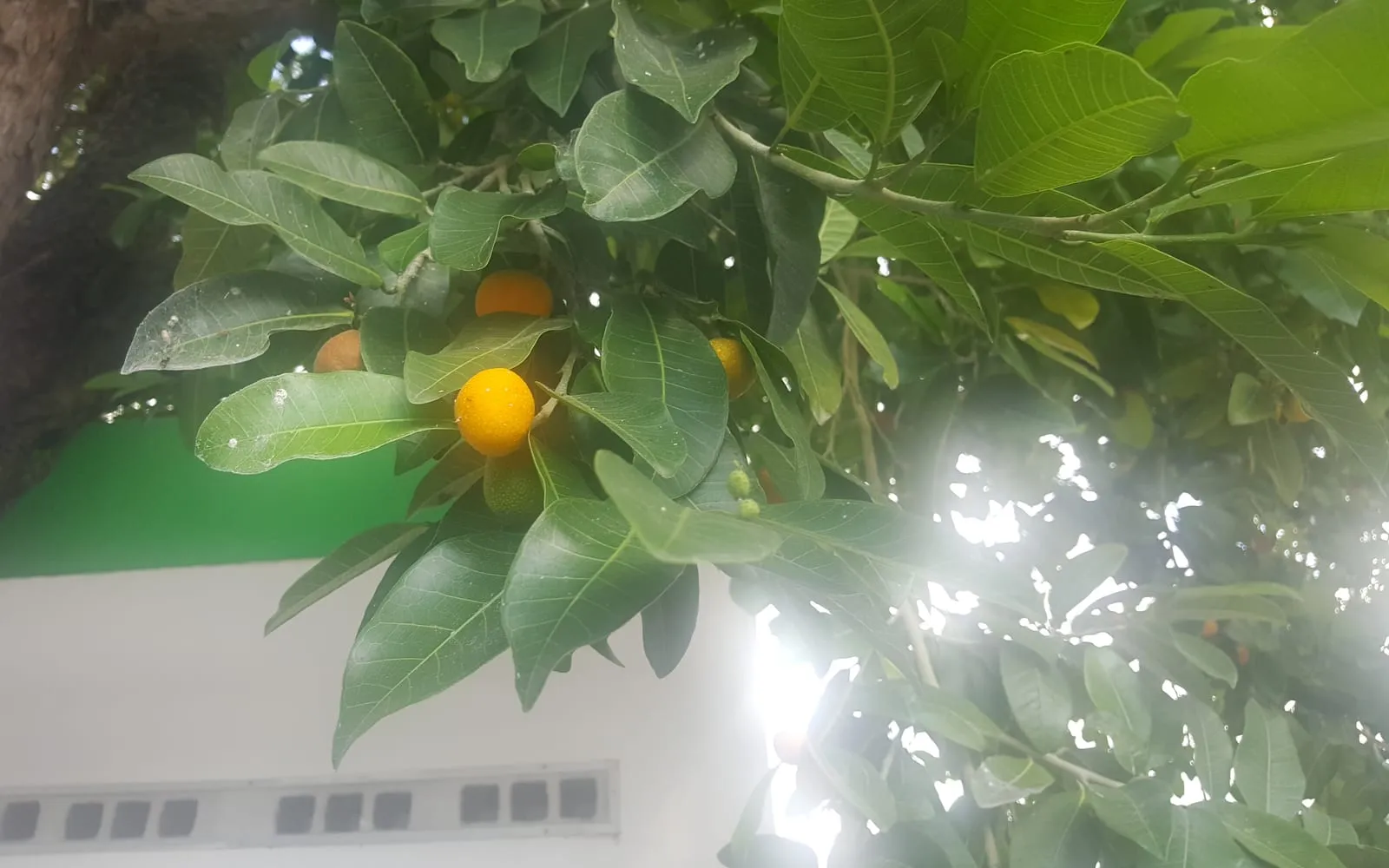
Leaves are glossy, elliptic and alternate, and like the bark they release a milky latex when cut or torn, a family trait shared with figs, rubber trees and mulberries. Small, inconspicuous flowers are followed by round, orange fruit about 2 cm across when ripe, sweet and edible fresh, each containing a single large seed.
That seed, roughly the size of a chestnut, is what most people mean by breadnut. Fresh from the fruit it is starchy and mild, and once dried it can be stored for months, roasted, boiled, ground into flour for bread and tortillas, or used as a coffee substitute, all uses recorded across its range for centuries.
Where it is from
Brosimum alicastrum grows wild across Mexico, Central America and parts of the Caribbean, often on the thin, rocky limestone soils that characterise much of the Yucatan Peninsula, ground too poor for many other large trees to establish on at all.
Its native forest is seasonally dry rather than constantly wet, with a pronounced dry period each year that the tree survives on deep roots reaching down to groundwater far below the shallow topsoil. That combination of drought tolerance and tolerance of poor limestone ground is a large part of why researchers think the Maya valued it: a tree that performs reliably on land too thin for maize is a valuable reserve in a region where seasonal drought regularly threatened the staple grain crop.
How it grows
Plant in well-drained soil in full sun, though a young tree tolerates and often benefits from partial shade in its first few years, mirroring the protection it would get from an established forest canopy in the wild.
It is remarkably adaptable to poor ground once its root system has developed, tolerating shallow, rocky or nutrient-poor soil that would struggle to support many other large trees, though a young specimen still benefits from decent soil and consistent watering while that root system is being built.
Give it plenty of room. This is a large forest tree at maturity, and it is not suited to a small garden or a confined planting pit, whatever its early tolerance of difficult ground.
Propagate from fresh seed, which loses viability quickly once dried and germinates best sown soon after the fruit ripens. Growth is moderate in the early years and the tree is long-lived, with specimens across its native range known to survive for centuries.
Through the seasons
The wet season drives the main flush of vegetative growth and, on an established tree, flowering and the start of fruit development.
The dry season is where the species shows its real strength, drawing on deep roots to keep functioning while shallower-rooted neighbours struggle, a resilience built into the tree by the seasonally dry forest it evolved in.
Fruit ripening follows flowering and continues over an extended period rather than in one sharp flush, providing food for wildlife, and historically for people, across a longer window than a single-harvest crop would.
Any unusually cool period, where cultivation takes the tree outside its natural range, slows growth noticeably and makes any risk of frost the single greatest threat the tree faces.
Care difficulty
Difficult, mainly because of its eventual size and its complete intolerance of frost, both of which restrict it to consistently tropical or warm subtropical conditions. Within that climate, the tree is considerably easier than its imposing mature size suggests, tolerant of poor soil and real drought once established.
A young tree needs more attentive care, consistent watering and some shade, than the resilient adult it eventually becomes, and the gap between those two states is where most difficulty in growing it lies.
Watering
Water regularly through the first several years while the tree develops the deep root system its drought tolerance depends on, particularly during any dry season in its early life.
Once established, it needs comparatively little supplemental water, since its native forest experiences a real annual dry season and the tree is adapted to survive it on deep-rooted reserves. Extra water during a prolonged drought still helps growth and fruiting, but is not essential for the tree’s survival the way it is for a young specimen.
Warning signs, diseases and pests
Leaf spot appears as small brown or black lesions on the foliage in humid, still conditions with poor airflow. It rarely threatens a mature tree and is best managed by improving circulation and removing badly affected leaves.
Scale insects colonise the stems and leaf undersides, appearing as small, immobile brown or grey bumps that sap the plant’s vigour over time. Horticultural oil applied to the affected areas is the standard treatment.
Mealybug shows as small white, cottony tufts among new growth. Wipe them away with a damp cloth or treat with horticultural soap.
Root rot follows soil that stays waterlogged rather than well-drained, which this species tolerates poorly despite its tolerance of both drought and poor limestone ground. Good drainage at planting time is the main prevention.
Growing environment
Full sun suits a mature tree best, though young trees establish more easily with some shade, echoing the shelter of a forest canopy they would have in the wild.
Well-drained soil of almost any fertility suits it, including the thin, rocky limestone ground it is naturally associated with across much of its range. Waterlogged soil is the one condition it does not tolerate well.
Consistent tropical or near-tropical warmth is essential. Growth slows noticeably below around 15 deg C, and any real frost is likely to kill the tree outright, particularly a young specimen without the size and reserves of a mature one.
Space matters at maturity. A full-grown tree develops a wide canopy and a substantial trunk, and it needs planting where that eventual scale will not conflict with buildings or other large trees.
Feeding
Feed a young tree with a balanced fertiliser or well-rotted compost twice a year, supporting the establishment of the deep root system it depends on for its later drought tolerance.
Once established, feeding is rarely necessary. A mature tree draws on a deep, extensive root system and generally finds enough nutrition in ordinary ground, including the thin limestone soil it tolerates naturally, without further intervention.
Troubleshooting
Is breadnut a nut? No. It is a member of the fig and mulberry family, Moraceae, and what is called the nut is a large seed inside a fleshy fruit rather than a true botanical nut. The name reflects how the roasted, ground seed has traditionally been used, as a bread-flour substitute, rather than its botanical classification.
Sap from a cut branch is irritating my skin. That is the tree’s latex, a trait shared across the fig and mulberry family. Wash the sap off promptly with soap and water, and wear gloves when pruning or taking cuttings to avoid repeated contact.
How do I prepare the seed to eat it? Roast or boil the fresh or dried seed until it softens, then eat it directly or grind it into a flour used in bread, porridge or a coffee-like drink. It is not eaten raw.
My young tree is struggling in full sun. Provide some shade for the first few years. A young breadnut tree establishes better with the partial cover it would naturally get under an existing forest canopy, moving into full sun tolerance only once its root system has developed.
Why do dense stands of this tree grow around ancient Maya ruins? Researchers read the pattern as evidence that the Maya favoured, and very possibly actively planted or protected, breadnut around their settlements, valuing its drought tolerance and its use as a reserve food source on land too thin for reliable maize harvests.