
Edible
Chinese Spinach
Amaranthus tricolor
Also known as Callaloo, Een choy, Bayam, Tampala
How to grow Chinese spinach, Amaranthus tricolor. The heat-loving amaranth leaf, sowing into warm soil, cutting for repeat crops, and the red pigment that colours the pan.
At a glance
- Difficulty
- Easy
- Water
- Every few days in warm weather
- Light
- Full sun
- Temperature
- 20-30 deg C. Growth stalls below 15 deg C and frost kills it
- Hardiness
- USDA 10-11, RHS H1c, hardy to 2 C
- Type
- Tender annual
- Height
- 30-90 cm
- Native to
- Tropical Asia, probably India
- Best month
- June in the Northern Hemisphere, December in the Southern Hemisphere
Fast enough to cut within 30 days of sowing and unbothered by the heat that finishes European greens, so it fills the midsummer gap in any climate warm enough to sow it. Growth stalls below 15 deg C. Amaranthus species seed prolifically and several are serious arable weeds, so cut before it flowers.
Hardiness zones describe winter cold alone. Summer heat, humidity, rainfall and the length of the growing season decide as much, so treat the range as the outer limit rather than as a recommendation.
Every month named in this guide is for the temperate Northern Hemisphere. If you garden in the Southern Hemisphere, shift each one by six months, so June becomes December. Closer to the equator the wet and dry seasons matter more than the calendar, and the shift stops being a useful guide.
Edible, with limits
- Safe to eat
- The leaves and young stems, cooked
- Harm from
- Eating it
- Affects
- People and horses
Chinese spinach is a food crop eaten daily across Asia, Africa and the Caribbean, and it is safe cooked in ordinary quantities. Neither the RHS nor the ASPCA lists Amaranthus tricolor by name, though the ASPCA does list other Amaranthus species as toxic to horses and cattle. Two points explain that. Amaranth leaves contain oxalic acid at a level comparable to spinach, so the same caution applies for anybody prone to kidney stones, and cooking in plenty of water and discarding it removes much of it. More important for livestock, amaranths are strong nitrate accumulators, particularly when grown on heavily manured ground or after drought, and nitrate poisoning of cattle, pigs and sheep grazing pigweed is well documented. That is a grazing hazard rather than a kitchen one, and the practical advice for a gardener is to avoid heavy nitrogen feeding and not to let livestock graze the bed. The red-leaved varieties carry betalain and betacyanin pigments, which colour cooking water deep pink and are harmless.
Sources: ASPCA toxic and non-toxic plants, RHS potentially harmful garden plants
About
Chinese spinach is the leaf amaranth grown across Asia, Africa and the Caribbean, and it does the same job for a hot summer that orach and New Zealand spinach do. It thrives in the heat that bolts every European leaf crop, and it grows fast enough to give three cuts from one sowing.
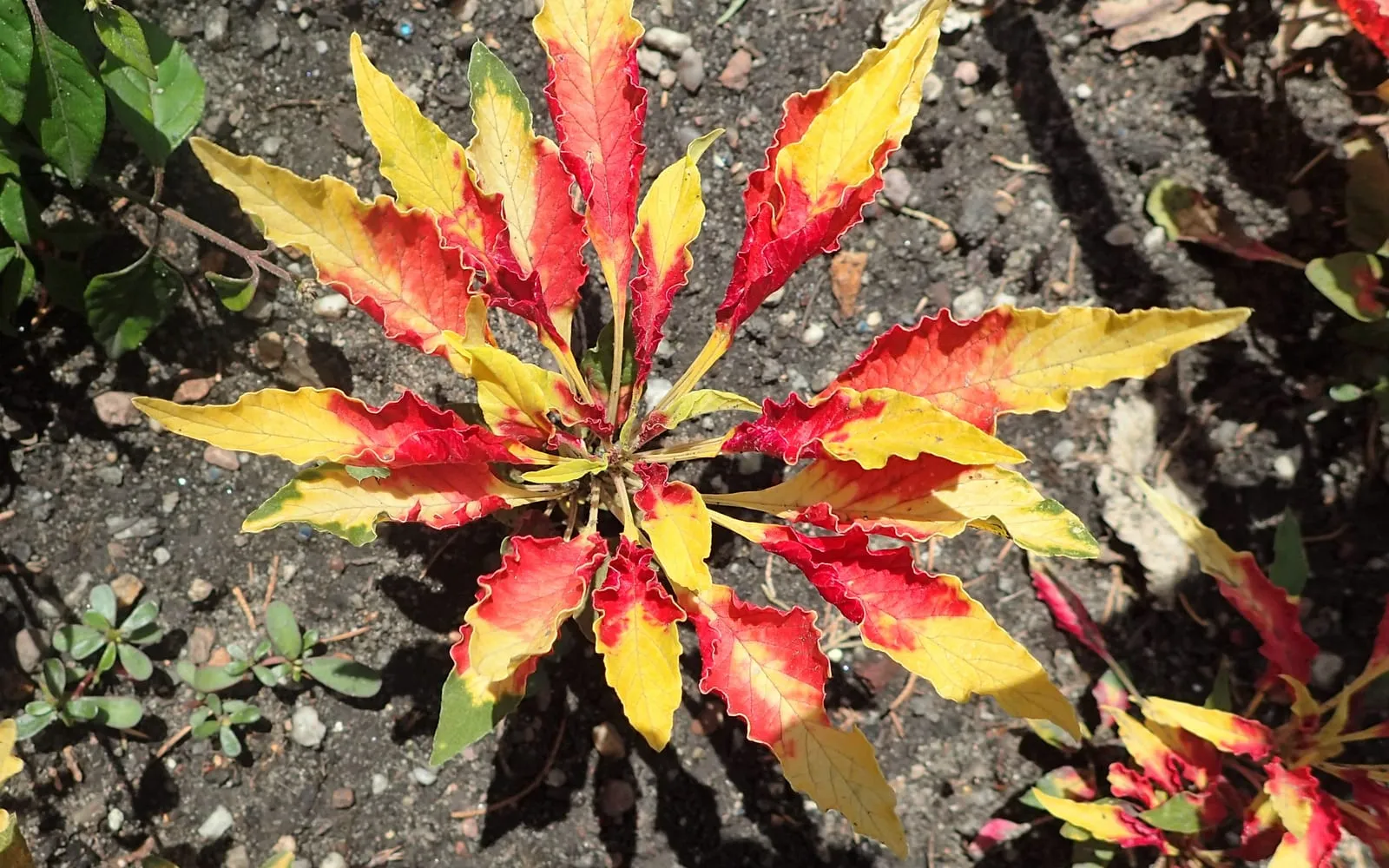
The red-leaved varieties are the ones most gardens grow, and they earn their place twice over. The plant is ornamental in its own right, with leaves splashed crimson and gold, and the pigment bleeds into the pan and turns a stir-fry deep pink.
The one requirement is warmth at sowing. Amaranth seed sits and rots in cold soil, and June is the month rather than April.
Appearance and character
An upright branching plant, 30 cm as a cutting crop and up to 90 cm if allowed to run.
Leaves are broadly oval to lance-shaped, smooth, and held on long stalks. Colour runs from plain green through bronze to varieties splashed with crimson, gold and green in the same leaf, which is where tricolor comes from.
The red pigment concentrates around the leaf base and the midrib in most varieties.
Flowers are small and green in dense clusters in the leaf axils, and they are inconspicuous compared with the ornamental amaranths.
Seed is tiny, black and shiny, and produced in enormous quantity.
Flavour cooked is mild and earthy, closer to spinach than to chard, with a softer texture than either and none of spinach’s metallic edge.
Where it is from
Amaranthus tricolor is native to tropical Asia, probably India, and is grown throughout the tropics as a leaf vegetable.
It is one of the most widely eaten green vegetables in the world and carries a different name almost everywhere. Cantonese has een choy, Malay and Indonesian have bayam, much of the Caribbean has callaloo, and older English seed catalogues sold it as tampala.
The genus has an entirely separate history in the Americas, where Amaranthus cruentus and Amaranthus caudatus were staple grain crops of the Aztec and Inca worlds.
Europe has grown the ornamental amaranths for centuries and the leaf ones hardly at all, which is a gap the recent interest in Caribbean and South Asian cooking has started to close.
Caribbean callaloo is worth a note, since the word means different plants in different islands. In Jamaica it usually means this amaranth, and in Trinidad it usually means taro leaves.
How it grows
Sow direct into warm soil. Amaranth needs at least 15 deg C to germinate and does best above 20 deg C, so late May and June are the sowing months.
Sow thinly at 1 cm deep in rows 30 cm apart. Thin to 10 cm for a cutting crop and 25 cm for full plants.
Germination takes five to ten days in warm soil.
Cut from six weeks. Take the top 10 to 15 cm of each shoot, which keeps the plant branching and tender.
Expect three or four cuts before the plant coarsens and runs to flower.
Sow every three weeks from late May to July for a continuous supply.
Pull the plants before the seed sets. Amaranths seed prolifically and the seedlings are hard to distinguish from the weedy pigweeds they resemble.
Through the seasons
Spring is too cold to sow. Seed sown in April into cold soil rots.
Early summer is the sowing window, from late May once the soil has reached 15 deg C. Under cover it can be sown a fortnight earlier.
Summer is the season, and this is the crop that keeps producing through the heat that ends spinach and lettuce. Cut every fortnight and feed after each cut.
Late summer takes the last sowing in July for a September crop.
Autumn ends it. The first frost kills the plant. Pull the plants before the seed ripens and follow with garlic or a green manure.
Care difficulty
Easy in a warm summer and hopeless in a cold one, and the sowing date is the main lever.
Soil temperature is the difficulty. Wait for June. Everything about this crop gets easier once the soil is properly warm.
Cutting regularly keeps the leaves tender. An uncut plant coarsens and runs to flower.
Slugs and flea beetle both attack the seedlings and neither troubles an established plant.
Self-seeding is worth avoiding, since the seedlings look much like the pigweed that turns up in every vegetable bed.
Feeding needs a light hand, because heavy nitrogen raises the nitrate content of a crop that already accumulates it.
Watering
Water every few days in warm weather to keep the leaves tender.
A dry plant coarsens and runs to flower sooner, and drought followed by a downpour is the condition that concentrates nitrate most.
Water immediately after each cut, which drives the regrowth.
Water at the base rather than over the leaves.
Mulch after thinning to hold moisture and keep the soil warm.
Container growing works in a pot 25 cm deep, and it needs watering daily in hot weather.
Warning signs, diseases and pests
Cold soil is the main cause of failure and shows as seed that never comes up. Wait for 15 deg C and preferably 20.
Slugs graze seedlings off at ground level. Water in the morning and patrol on damp evenings.
Flea beetle shot-holes the young leaves. The damage is cosmetic on an established plant. Fine mesh from sowing protects seedlings.
Aphids cluster on the growing tips and are dealt with by predators.
Coarse tough leaves mean the plant is running to flower or has not been cut often enough.
Damping off collapses seedlings sown into cold wet compost.
Self-sown seedlings the following year are the main nuisance, and they look much like common pigweed.
Growing environment
Full sun. Chinese spinach needs heat and light and is unproductive in shade.
Fertile, moisture-retentive but free-draining soil.
Neutral to slightly acid soil, pH 6 to 7.
Warm soil at sowing, which in a cool climate means waiting until late May or June.
A sheltered south-facing bed, a raised bed that warms early, or a polytunnel all extend the season usefully.
Rotate with beetroot, chard and orach on three years, since all are in the Amaranthaceae.
Feeding
Work garden compost into the bed before sowing.
Feed with a nitrogen-rich liquid feed after each cut, at normal dilution rather than strong. The crop is leaf, so nitrogen drives it, and amaranths accumulate nitrate when overfed.
Stop feeding three weeks before the last cut.
Never use fresh manure, which is the classic setup for nitrate accumulation in this genus.
On good ground the compost dug in at sowing is enough.
Troubleshooting
Nothing germinated. Cold soil. Amaranth needs 15 deg C at minimum and does best above 20. Sow from late May.
Tough, coarse leaves. The plant has run to flower or has not been cut often enough. Take the top 10 to 15 cm of each shoot every fortnight.
Small round holes in the leaves. Flea beetle. Cover seedlings with fine mesh. The damage does not matter once the plant is established.
The stir-fry went bright pink. Betalain pigment from a red variety. Harmless, and the reason many people grow the coloured forms.
Seedlings I cannot identify coming up next year. Self-sown amaranth, which looks much like pigweed. Pull the plants before the seed sets.
The plants collapsed at the base. Damping off, from sowing into cold wet soil. Sow later.
Can I eat it raw? Better cooked. The oxalate content and the texture both favour a pan, and cooking in plenty of water removes much of the oxalate.
Is this callaloo? In Jamaica, yes. In Trinidad, callaloo usually means taro leaves, so the word depends on the island.
Chinese Spinach problem guides
Not sure what is wrong? See the common vegetable pests guide.