
Houseplant
Earth Star
Cryptanthus bivittatus
Also known as Starfish Plant
How to grow earth star, Cryptanthus bivittatus. Why it roots in soil rather than needing a tank bromeliad's water cup, how brighter light deepens its pink-bronze stripes, and why the rosette fades once it has produced pups.
At a glance
- Difficulty
- Easy
- Water
- When the top of the mix has dried, roughly every one to two weeks
- Light
- Bright light, including some direct sun, for the strongest colour
- Temperature
- 15-27 deg C. Below 10 deg C causes lasting damage
- Humidity
- Average room humidity is tolerated, though higher humidity deepens colour
- Hardiness
- USDA 10b-11, RHS H1b, hardy to 7 C
- Type
- Evergreen terrestrial bromeliad
- Height
- 15-25 cm across; 5-10 cm tall
- Native to
- Brazil
A forest-floor bromeliad from the understorey of eastern Brazil, rooted in leaf litter and thin soil rather than growing as an epiphyte the way many of its relatives do. It needs filtered warmth without extremes and takes a wider range of light than most houseplants, since a plant kept in brighter light grows more compact and more colourful, while one kept dim stays green and loose. It has no frost tolerance at any life stage.
Hardiness zones describe winter cold alone. Summer heat, humidity, rainfall and the length of the growing season decide as much, so treat the range as the outer limit rather than as a recommendation.
Not known to be toxic
Cryptanthus carries no documented toxic compounds and does not appear on the RHS list of potentially harmful garden plants. The ASPCA's toxic and non-toxic plant list does not carry an entry for this genus specifically, and no bromeliad in general cultivation is known to cause more than mild, transient stomach upset if chewed, the same nuisance reaction many houseplants can trigger through sheer fibre content rather than any toxin. A cat or dog that bites into the stiff, faintly serrated leaf edge is more likely to be put off by the texture than harmed by it, and there is nothing in this plant that calls for keeping it away from pets or children on safety grounds.
Sources: RHS potentially harmful garden plants, ASPCA toxic and non-toxic plants
About
Earth star grows flat against the compost rather than reaching upward, its leaves spreading out in a symmetrical star that gives the plant its name. Unlike the tank-forming bromeliads sold alongside it, it roots in soil rather than living as an epiphyte, which makes it one of the easier bromeliads to fit into an ordinary houseplant routine.
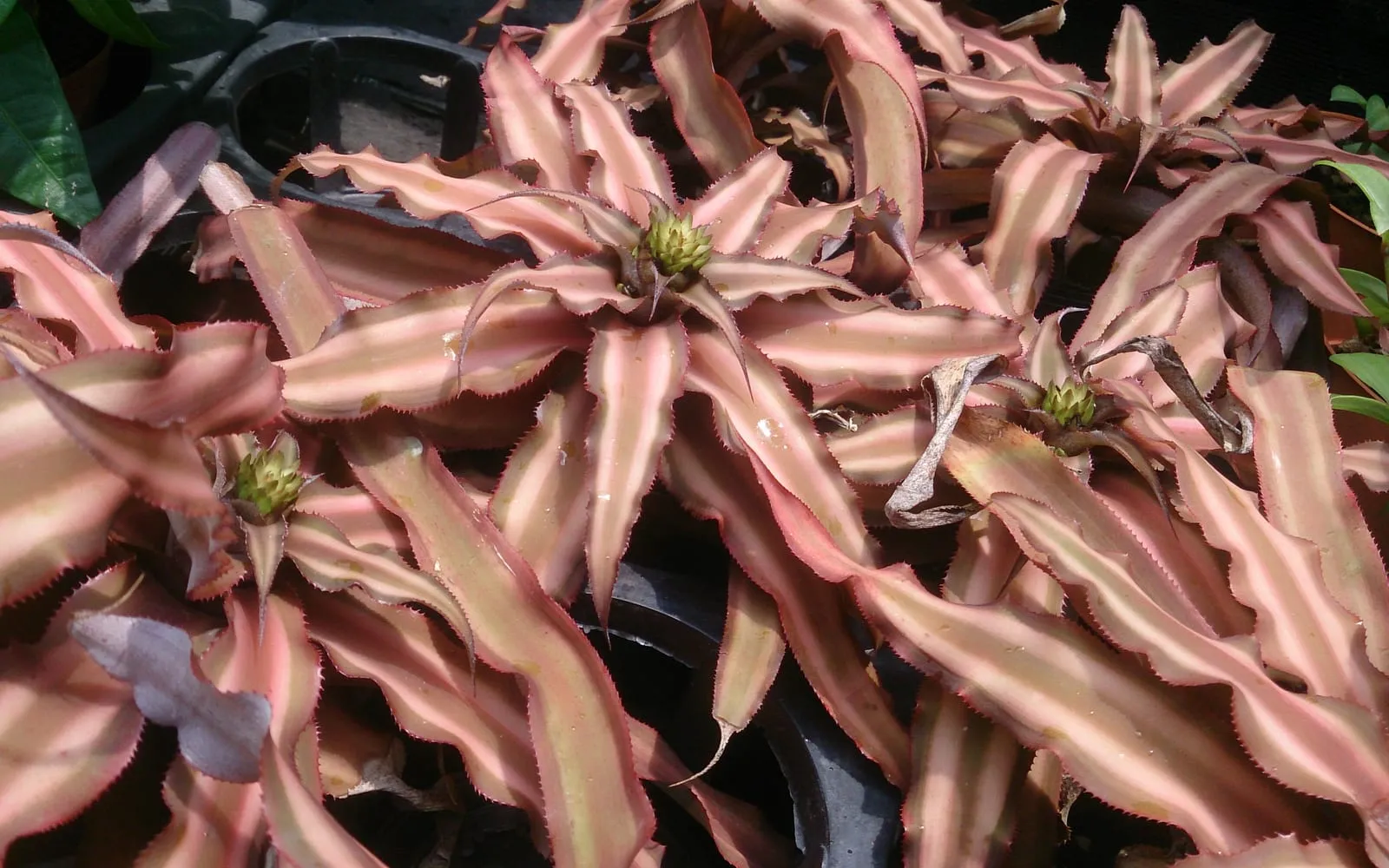
Grow it for colour. The wavy leaves carry two pale longitudinal stripes down a background that shifts from green through copper to a deep pink-bronze depending on how much light the plant gets, and a specimen kept bright develops a far more saturated colour than the same plant grown dim.
Appearance and character
A dense, flattened rosette of stiff, wavy-margined leaves, 15 to 25 cm across and rarely more than 10 cm tall, with a faintly serrated edge that is more textural than sharp.
The two cream to pale pink stripes that run the length of each leaf give the species its botanical name, bivittatus, meaning two-striped. Between them the leaf ground colour ranges from olive green in low light to a coppery pink-bronze in bright conditions, and the underside carries a fine silvery scurf typical of the bromeliad family.
Small white flowers form deep in the centre of the rosette, mostly hidden among the innermost leaves, and are a minor feature next to the foliage colour that is the main draw. As with many bromeliads, the rosette that flowers eventually declines afterwards, with new offsets, commonly called pups, appearing around the base to continue the plant.
Where it is from
Cryptanthus bivittatus grows in the understorey of the Atlantic Forest in eastern Brazil, rooted in thin soil and leaf litter on the forest floor rather than perched on branches the way many of its bromeliad relatives do.
That ground-dwelling habit is what makes it more forgiving of ordinary potting compost than an epiphytic bromeliad, since its roots evolved to handle actual soil rather than bark and moss. Light reaching the forest floor varies from deep shade to bright dappled patches where gaps in the canopy let sun reach the ground. The plant still shows that range today: it survives in low light but colours up strongly only where it gets brighter conditions closer to that canopy gap.
How it grows
Pot it in a light, free-draining mix, a bromeliad or orchid blend, or a general houseplant compost cut with extra perlite, in a wide, shallow pot that suits its flat root system better than a deep one.
Growth is slow and largely lateral. The rosette widens gradually rather than gaining height, and a healthy plant sends out offsets around its base once it reaches a reasonable size, each one a small new rosette attached by a short stem.
Detach offsets once they have several leaves of their own and a visible root or two, and pot them separately in the same light mix. They establish readily and are the standard way to propagate the plant, since named colour forms do not come reliably true from seed.
The parent rosette that flowers gradually fades over the following months once its offsets are established, which is the normal life cycle for this genus rather than a sign anything has gone wrong.
Through the seasons
Spring restarts active growth. Begin monthly feeding and repot any offsets that have rooted well enough to pot on their own.
Summer is the strongest growing period. Water regularly as the mix dries, and give the plant its brightest position of the year for the best leaf colour.
Autumn slows growth gradually. Reduce feeding towards the end of the season as the plant’s demand for nutrients drops.
Winter is a rest. Water more sparingly, keep the plant away from cold windowsills and draughts, and stop feeding until spring.
Care difficulty
Easy, and one of the more forgiving bromeliads for a beginner precisely because it grows in soil rather than needing the central water-holding cup that tank bromeliads rely on.
Light is the main lever available for improving how the plant looks. Too little and the leaves stay green and loosen into a more open, less symmetrical shape; bright conditions, including some direct sun, tighten the rosette and bring out the strongest colour. Watering is the other consideration, since the flat rosette and shallow roots do not tolerate compost that stays wet for long.
Watering
Water when the top of the mix has dried, typically every one to two weeks, adjusting for light and temperature through the year.
Water the compost and give the small central cup a light splash rather than filling it the way a tank bromeliad needs, then let any excess drain away freely. A wide, shallow pot with good drainage holes matters more here than for most houseplants.
Overwatering shows as a soft, yellowing base to the rosette faster than underwatering shows as anything at all, since the thick leaves hold enough reserve water to tolerate a missed watering for some time.
Warning signs, diseases and pests
Mealybug hides in the tight leaf bases near the centre of the rosette, showing as small white, cottony tufts. Remove them with a cotton bud dipped in diluted alcohol, working carefully between the leaves.
Scale insects appear as small, flat brown discs on the underside of older, outer leaves. Treat the same way as mealybug and check the plant regularly, since scale is easy to miss until numbers build up.
Root rot follows a mix that stays wet for too long, showing as a softening, discoloured base to the rosette while the outer leaves still look fine. Cut back on watering and repot into fresh, free-draining mix if it has already started.
Fungus gnats breed in constantly damp compost and are more a nuisance than a real threat to the plant, though their larvae can nibble fine roots in large numbers. Letting the mix dry out properly between waterings clears them.
Growing environment
Bright light suits it best, including some direct sun in the morning or evening, which is what produces the deepest leaf colour. A plant kept in low light survives but stays greener and looser than one grown brighter.
Keep the room between about 15 and 27 deg C. Growth slows below 15 deg C, and any exposure near 10 deg C or below causes lasting damage to the foliage.
Average room humidity is tolerated well, one of the reasons this species suits an ordinary living room better than many of its bromeliad relatives, though higher humidity does deepen the colour further for a grower who wants to chase the best possible result.
A light, free-draining mix suits the shallow root system. A bromeliad or orchid blend works well, as does a general houseplant compost with extra perlite added.
Feeding
Feed monthly through spring and summer with a balanced liquid feed diluted to around a quarter of the strength recommended on the label, since this species needs very little to support its slow, low growth.
Stop feeding entirely from autumn through winter, when growth slows and unused fertiliser only builds up as salts in the mix.
Over-feeding pushes soft, oversized, pale green growth that loses the tight, colourful rosette shape this plant is grown for, so restraint matters more than generosity here.
Troubleshooting
The leaves have lost their colour and gone plain green. Not enough light. Move it somewhere brighter, including an hour or two of direct sun if the position allows, and new growth should come in with stronger colour within a few weeks.
The centre of the rosette has gone soft and mushy. Water sitting in the central cup or a mix that stays too wet. Check for offsets that can be saved separately, then adjust watering and improve drainage for the future.
Small new rosettes are appearing around the base. Normal offsets, commonly called pups. Let them grow several leaves and a root or two of their own before detaching and potting them separately.
The original rosette is fading after producing offsets. Expected. Cryptanthus rosettes decline naturally once they have produced offsets, and the pups continue the plant. Remove the fading rosette once its pups are established.
Can I grow it mounted like other bromeliads instead of in soil? It can be mounted, but it grows more easily and more reliably potted in a light mix, since it is a ground-dwelling species rather than a true epiphyte and its roots are adapted to soil contact rather than open air.
Earth Star problem guides
Not sure what is wrong? See the common houseplant pests guide.