
Houseplant
Silver Vase Plant
Aechmea fasciata
Also known as Urn Plant, Silver Vase Bromeliad
Practical guidance for growing silver vase plant, Aechmea fasciata, including central cup watering, pups after flowering, silver banding, bright light, humidity, and non-toxic houseplant care.
At a glance
- Difficulty
- Moderate
- Water
- Keep the central cup topped up with fresh water, tipped out and refilled every couple of weeks; water the potting mix only when it dries out
- Light
- Bright indirect light, with an hour or two of gentle morning sun
- Temperature
- 15-27 deg C, away from draughts and cold glass
- Humidity
- 50% or higher, helped by grouping plants or a pebble tray
- Hardiness
- USDA 10-11, RHS H1b, hardy to 10 C
- Type
- Evergreen epiphytic bromeliad; each rosette flowers once, then dies
- Height
- 30-50 cm; the flower spike adds up to 45 cm
- Native to
- Brazil
A bromeliad from the humid coastal forest of eastern Brazil, wedged into tree bark or rock where its roots hold on rather than feed it. Warmth and steady humidity matter more than the zone number, since the plant takes almost all its water and a share of its nutrients through the leaf cup rather than the roots. It has no frost tolerance and stalls below about 15 deg C.
Hardiness zones describe winter cold alone. Summer heat, humidity, rainfall and the length of the growing season decide as much, so treat the range as the outer limit rather than as a recommendation.
Not known to be toxic
Aechmea fasciata carries no toxic compounds and does not appear on the RHS list of potentially harmful garden plants or the ASPCA's list of plants toxic to cats and dogs. A pet that chews a leaf tip may find the stiff, faintly saw-toothed edge unpleasant to bite but gets no poisoning from it. The one real hazard is mechanical rather than chemical: the leaf margins carry small spines sharp enough to scratch skin or a curious nose, so position it out of the path of a boisterous cat or a toddler at face height rather than out of any concern about toxicity.
Sources: RHS potentially harmful garden plants, ASPCA toxic and non-toxic plants
About
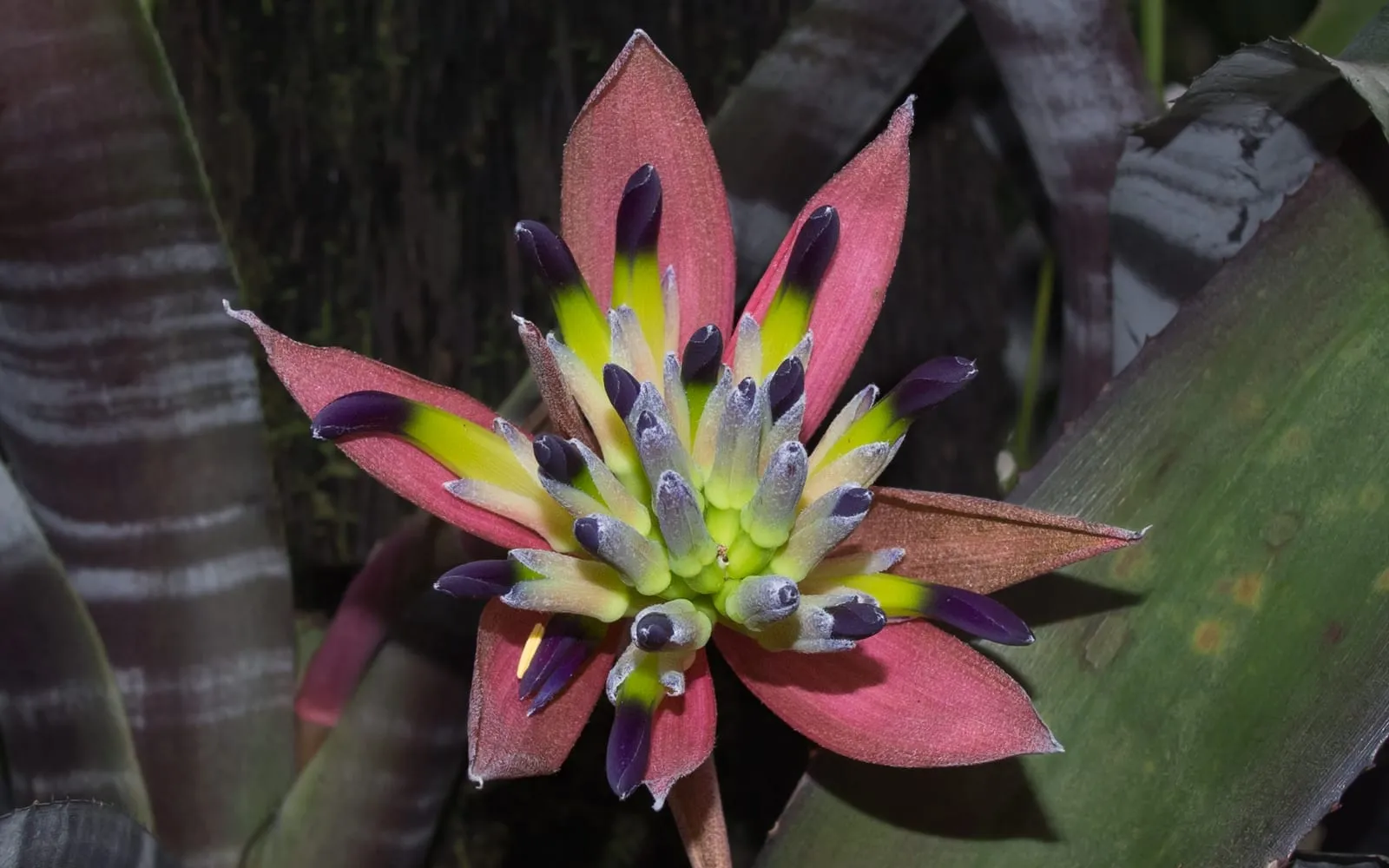
Silver vase plant grows as a rosette of stiff, arching leaves that overlap at the base to form a watertight cup. That cup, not the potting mix, is where the plant drinks, a habit left over from its life wedged into tree bark rather than rooted in soil. A pink, spear-shaped flower spike rises from the centre and holds its colour for months, with small blue-violet flowers opening along its sides for a few weeks in the middle of that run.
Each rosette flowers only once. After the spike fades, the parent leaves decline slowly while offsets called pups form around its base, and those pups are the plant’s future rather than the original rosette.
Appearance and character
Leaves are broad, strap-shaped and silvery grey, banded across their width with dusty grey scales called trichomes that give the whole rosette a frosted, powdery look. The bands are most vivid on new growth and fade somewhat as a leaf ages, though they never disappear entirely.
The flower spike is the plant’s best-known feature: a cone of bright pink, overlapping bracts shaped like a squat pineapple, with small tubular flowers in blue-violet emerging from between the bracts a few at a time. The pink bracts stay showy for two to three months even after the individual flowers have finished, which is most of what a buyer is paying for.
A mature plant reaches 30 to 50 cm across, wider than it is tall, with the flower spike standing clear of the foliage at the centre.
Where it is from
Aechmea fasciata is native to the Atlantic coastal forest of eastern Brazil, where it grows as an epiphyte, lodged in the crook of a tree branch or on a rock face with its roots doing little more than anchoring it in place.
Rainfall in that forest is frequent but does not sit in the soil for long, which is why the plant evolved a cup at the centre of its leaves to catch and hold water between showers. Fine scales on the leaf surface absorb water and dissolved nutrients directly, a shortcut that lets the plant thrive with almost no functioning root system at all.
Light filters through a forest canopy rather than falling in full sun, and indoors that translates to bright indirect light rather than a spot on a bare windowsill.
How it grows
Pot it in a coarse, open mix built for orchids or bromeliads rather than ordinary compost, since a dense mix stays wet around roots designed only to grip. A small pot suits it well; the anchoring roots need little room.
Fill the central cup with water and keep it topped up, emptying and refreshing it every couple of weeks rather than letting it turn stagnant. Water the mix itself only when it has dried out, which will be far less often than the cup needs attention.
The plant is monocarpic. Once the flower spike appears, that rosette will not produce another after it fades, however well it is grown from then on. Pups appear around the base over the following months, usually once the spike is a few months old, and each pup grows into a flowering rosette of its own in one to three years.
Detach a pup once it reaches roughly a third the size of the parent and has some roots of its own, and pot it separately in the same coarse mix. Leaving several pups attached to the ageing parent works too, and produces a clustered clump rather than a single vase.
Through the seasons
Spring brings the start of active growth in an established pup. Begin monthly feeding and check whether it needs repotting into fresh mix.
Summer is the main growing season, and the best time to detach and pot up any pups that have reached a workable size.
Autumn slows growth. Reduce feeding towards the end of the season and keep the cup topped up as heating starts to dry the air indoors.
Winter is a rest. Water the mix sparingly, keep the plant away from cold glass and draughts, and stop feeding until spring returns.
Care difficulty
Moderate, mainly because its watering differs from most houseplants. Heavy watering into the compost can rot the roots, while an empty central cup leaves the plant short of water.
Once that watering habit is in place, it needs little else. It tolerates missed feeds and average room humidity far better than it tolerates a dry cup, and the long-lasting flower spike means there is little day-to-day fuss involved in keeping it looking good.
Watering
Keep the central cup filled with water at all times, using rainwater or filtered water where the tap supply is hard, since mineral deposits can mark the leaves at the base of the rosette. Tip the cup out and refill it every couple of weeks so the water does not turn stale or stagnant.
Water the potting mix only once it has dried out, checking with a finger before adding more, since roots sitting in constantly wet mix are more likely to rot than roots left slightly dry.
In a cool room over winter, let the cup run a little lower and check it less obsessively, since the plant uses far less water at lower light and temperature.
Warning signs, diseases and pests
Mealybug settles into the base of the leaves where they overlap and inside the cup itself, showing as small white, cottony tufts. Remove them with a cotton bud dipped in surgical spirit, working carefully around the leaf bases.
Scale insects appear as small, flat brown discs on the undersides of the stiff outer leaves. Treat the same way as mealybug, or wipe them off with a damp cloth.
Fungus gnats breed in a potting mix that stays wet, particularly around the base where fallen debris collects. Let the mix dry out between waterings and remove any decaying leaf litter to break the cycle.
Root and crown rot follow a mix or cup left stagnant for too long, showing as a soft, discoloured base and leaves that pull away easily. There is little to be done for the parent rosette once rot sets in badly, so focus on any pups nearby and adjust the watering habit for the next generation.
Growing environment
Bright indirect light suits it best, with an hour or two of gentle morning sun bringing out the strongest silver banding on the leaves. Deep shade produces a plainer green rosette and a smaller flower spike.
Keep the room between 15 and 27 deg C. Growth stalls below about 15 deg C, and the plant should never sit against cold window glass in winter.
Humidity of 50% or more keeps the leaf tips from browning. Grouping it with other plants, standing the pot on a tray of damp gravel, or keeping it out of the direct line of a heating vent all help in a dry room.
A coarse, open mix around the roots and a small pot both matter more than they would for an ordinary houseplant, since the anchoring roots do so little of the plant’s actual feeding.
Feeding
Feed monthly through spring and summer with a balanced liquid houseplant feed diluted to a quarter of the strength on the label, added to the cup water or misted directly onto the leaves rather than poured into the mix.
Full-strength feed can scorch the fine absorbing scales on the leaf surface, so err on the weak side rather than the strong one.
Stop feeding entirely once the flower spike appears, since that rosette has already set its course, and stop again for winter, resuming only once spring growth restarts on any pups.
Troubleshooting
The flower spike has faded. Is the plant dying? Not immediately, and this is normal rather than a fault in your care. The parent rosette will decline slowly over the following months while pups form at its base; those pups carry the plant forward, so leave them attached or pot them up once they have roots of their own.
No pups have appeared months after flowering. Give it more time. Pups often start a few months after the flower spike opens and can take a year or more to reach a separable size, especially in cooler or lower-light conditions.
The leaf tips are turning brown and crispy. Low humidity, most often from a heated room in winter. Raise humidity with a pebble tray or by grouping plants together, and keep the central cup topped up.
Can I make a plant without a spike flower faster? A ripe apple sealed in a bag with the plant for a week or two releases ethylene gas, which can trigger an unflowered rosette that has reached mature size to send up a spike. It will not work on a young, still-small plant.
Should I remove the pups or leave them attached? Either works. Leaving several pups on the parent produces a fuller, multi-headed clump over time; detaching them once they have roots gives you separate plants to pot or give away.
Silver Vase Plant problem guides
Not sure what is wrong? See the common houseplant pests guide.