
Houseplant
Pencil cactus
Euphorbia tirucalli
Also known as Firesticks, Milk bush, Pencil tree, Aveloz
How to grow pencil cactus, Euphorbia tirucalli. Not a cactus, the seriously caustic sap, and why 'Firesticks' needs full sun to keep its colour.
At a glance
- Difficulty
- Easy
- Water
- When the compost has dried out completely, and rarely in winter
- Light
- Full sun, and the coloured cultivars need it to hold their colour
- Temperature
- 15 to 27 deg C, and never below 10 deg C
- Hardiness
- USDA 10-12, RHS H1b, hardy to 10 C
- Type
- Evergreen succulent shrub or small tree, long lived and fast growing
- Height
- 1-2 m indoors, and 9 m in the wild
- Native to
- Eastern and southern Africa, and widely naturalised in the tropics
- Best month
- November in the Northern Hemisphere, May in the Southern Hemisphere
Dry Africa, from Angola and Mozambique north to the Horn, and it is a tree of 9 m where nothing stops it. Outdoors year round in USDA 10 and warmer. The caustic latex is the reason it is grown as a hedge in its home range and the reason to wear gloves anywhere else.
Hardiness zones describe winter cold alone. Summer heat, humidity, rainfall and the length of the growing season decide as much, so treat the range as the outer limit rather than as a recommendation.
Every month named in this guide is for the temperate Northern Hemisphere. If you garden in the Southern Hemisphere, shift each one by six months, so November becomes May. Closer to the equator the wet and dry seasons matter more than the calendar, and the shift stops being a useful guide.
Poisonous if eaten
- Do not eat
- The milky sap in all parts
- Harm from
- Handling it and eating it
- Affects
- People, cats and dogs
Pencil cactus produces one of the most caustic saps of any plant sold as a houseplant on sale, and this should be understood before buying one. The milky latex contains diterpene esters including phorbol esters, and contact with skin causes immediate burning, redness, swelling and blistering that can take weeks to resolve. Contact with the eyes causes severe pain, inflammation of the cornea and temporary blindness, and cases requiring hospital treatment are well documented in the medical literature, some with lasting visual impairment. The sap is under pressure and squirts when a stem is cut, which is how eye injuries happen. Eating any part causes intense burning of the mouth and throat, vomiting and diarrhoea. The ASPCA lists Euphorbia tirucalli as toxic to cats and dogs, and the RHS lists Euphorbia as a severe skin and eye irritant and harmful if eaten. Phorbol esters are also tumour promoters in laboratory studies. Always wear gloves and eye protection when cutting or repotting, work at arm's length, wash your hands afterwards, and rinse the eyes with copious water and get urgent medical care if any sap reaches them. It is not a suitable plant for a household with small children or with pets that chew.
Sources: RHS potentially harmful garden plants, ASPCA toxic and non-toxic plants
About
Pencil cactus is not a cactus, and the difference matters because cacti do not bleed caustic latex and this does.
It is a Euphorbia, related to poinsettia, crown of thorns and castor oil plant, and the milky sap it produces is among the most aggressively irritant of any plant sold as a houseplant on sale. Cutting a stem releases it under pressure, and eye injuries from that are documented in medical journals, some with lasting damage.
None of which makes it a bad plant, and it makes it one to buy knowingly. Gloves and eye protection whenever you cut it, working at arm’s length, and a position out of reach deal with the risk entirely.
The plant itself is striking and very easy. A dense mass of smooth green stems the thickness of a pencil, almost leafless, branching repeatedly, and growing fast in a sunny window.
The cultivar ‘Firesticks’, also sold as ‘Sticks on Fire’, turns coral, orange and red at the stem tips in strong light and cool conditions, and it is the form most often sold now. In poor light it stays plain green.
It tolerates neglect, drought, dry air and central heating, and it lives for decades.
Appearance and character
An evergreen succulent shrub reaching 1 to 2 m indoors, and 9 m in the wild.
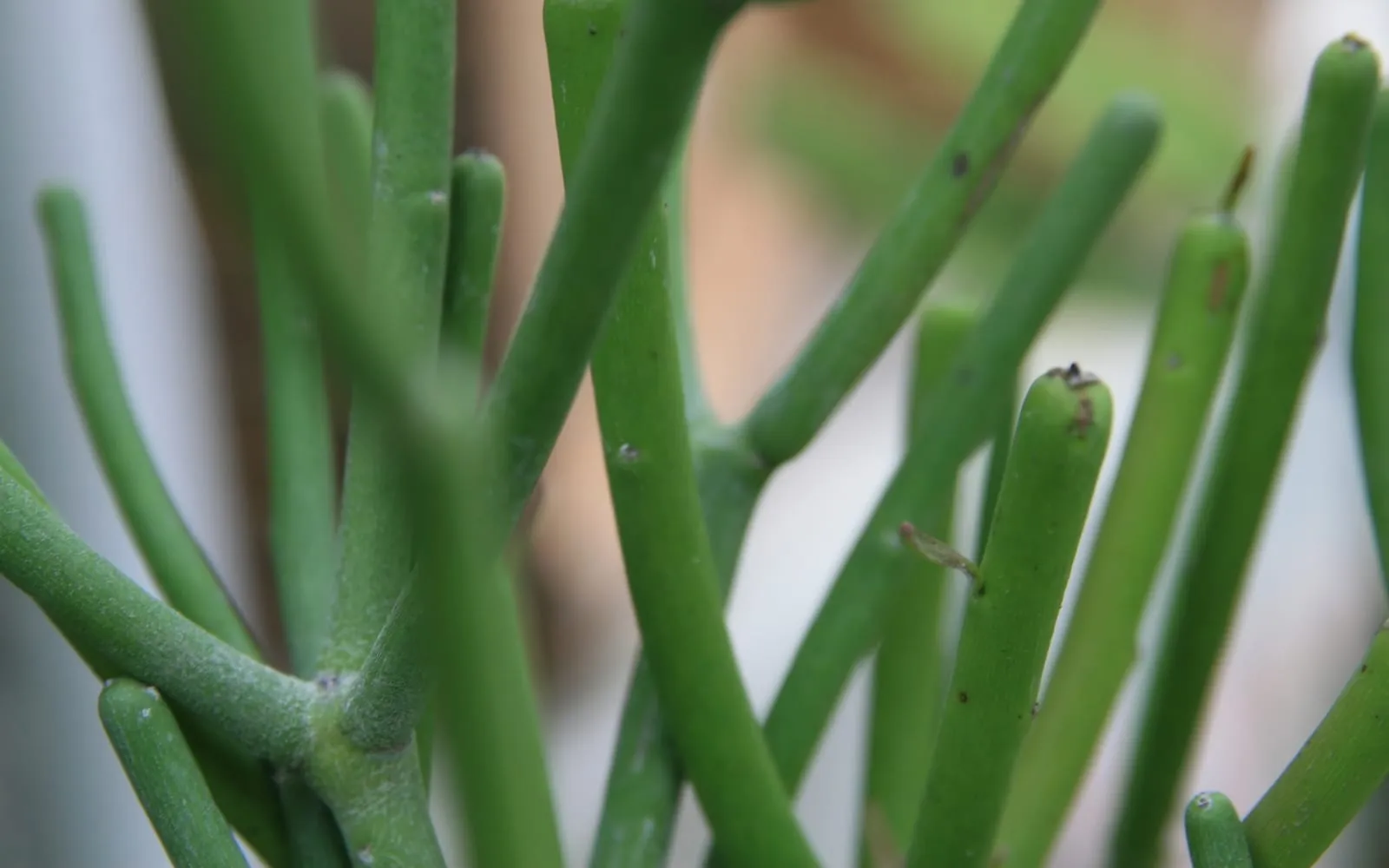
Stems are the whole plant. Smooth, cylindrical, pencil-thick, bright green, branching repeatedly into a dense tangled mass with no spines.
Leaves are tiny, narrow and shed almost immediately, appearing only briefly at the tips of new growth, so the plant appears leafless.
Photosynthesis happens in the green stems, which is why they are the colour they are.
‘Firesticks’ and ‘Sticks on Fire’ colour coral, orange, pink and red at the stem tips in strong light and cool temperatures, greening again in shade and warmth.
Flowers are tiny, yellow-green and inconspicuous, at the stem tips, and are rarely produced indoors.
Every part bleeds copious white latex when cut or broken, under pressure.
Growth is fast for a succulent, and an indoor plant puts on 15 to 30 cm a year in good conditions.
The stems become woody and grey-brown at the base with age.
Where it is from
Eastern and southern Africa, from Ethiopia and Somalia south to South Africa, growing in dry scrub and semi-desert, and it is naturalised widely across the tropics.
It is in Euphorbiaceae alongside poinsettia, crown of thorns, cassava, castor oil plant and the rubber tree, and the caustic latex is a family characteristic.
The leafless green-stemmed form is an adaptation to drought, reducing the surface area through which water is lost while keeping photosynthesis going in the stems.
It is planted as a living hedge and a stock barrier across parts of Africa and India, precisely because animals will not browse it.
The latex has been used traditionally as a fish poison, an arrow poison and a folk remedy, and it is also the subject of a long-running and unsupported claim as a cancer treatment under the name aveloz. The sap is a tumour promoter in laboratory studies rather than a treatment.
The plant was investigated in the 1980s as a potential source of hydrocarbons for fuel, since the latex is rich in them.
It is invasive in parts of Australia, Hawaii and Florida, where discarded plants have naturalised.
How it grows
Grow it in full sun. The coloured cultivars need direct light to develop and hold their colour, and the plain green species grows more compactly in strong light.
Pot it into cactus compost, or into loam-based compost with a third of its bulk in grit. The mix matters less than the drainage holes, which want to be generous.
Choose the pot for ballast rather than for room. A metre of green stems above a small rootball topples at a touch, so a heavy clay pot barely wider than the roots beats a light plastic one with space to spare.
Let the compost dry right through before watering, then water until it runs from the base and tip the saucer out.
That works out around every two or three weeks in summer and every four to six in winter, though the compost is what to read rather than the calendar. There is no foliage here to wilt and warn you, so the plant gives away nothing until the stems begin to shrivel.
Nothing standing in water at any point.
Above 10 deg C, out of draughts and off cold window glass.
Dry air suits it, and a centrally heated room in February is closer to its native conditions than most houseplants would tolerate.
A weak feed every six or eight weeks from April to September, and none at all through the winter.
Wear gloves and eye protection whenever you cut, prune or repot it. The sap squirts under pressure from a cut stem and eye injuries are documented. Work at arm’s length, keep your face away, and wash your hands afterwards.
Prune in spring to control the size and shape, cutting stems back to a branching point.
Dab the cut ends with a damp cloth or dip them in cold water to stop the bleeding, and dispose of the cuttings carefully rather than leaving them where a child or animal might pick them up.
Repot every two or three years in spring.
Propagate from stem cuttings in spring or summer. Wearing gloves and eye protection, cut a stem 10 to 15 cm long, rinse the cut end under cold water to stop the latex, let it dry and callus for a week, then pot it into gritty compost and water sparingly until it roots.
Site it out of reach and away from anywhere people brush past.
Stand it outside in a sheltered sunny spot through July and August in a warm summer, and bring it in before the nights turn cold.
Through the seasons
Winter is a rest period. Water every four to six weeks, stop feeding, and keep it above 10 deg C in the brightest position available. Cool bright conditions bring out the best colour on ‘Firesticks’.
Spring starts into growth, and this is pruning, repotting and propagating season.
Summer is the main growth period, watering every two to three weeks and feeding every six to eight.
Autumn slows down, and this is the point to stop feeding and reduce watering.
Care difficulty
Easy to grow and hazardous to handle, which is an unusual combination.
The plant itself asks for very little. Bright light, gritty compost, sparing watering, no humidity and a minimum temperature of 10 deg C.
Overwatering is the one thing that kills it.
The difficulty is the sap, which turns every pruning and repotting job into something requiring gloves, eye protection and care, and which makes siting it a real decision in a household with children or animals.
Losing the colour on ‘Firesticks’ is a light problem rather than a health one.
Watering
Water when the compost has dried out completely, giving enough to run through the pot, then draining fully.
Every two to three weeks in summer and every four to six weeks in winter is realistic in a heated house.
Push a finger well into the compost and water only when it is dry all the way down.
Never let it stand in water at any time of year.
Overwatering shows as yellowing stems, soft blackening at the base and collapse, and it is usually fatal by the time it is noticed.
Underwatering shows as wrinkled shrivelled stems, and it corrects quickly.
Use tepid water rather than cold.
Warning signs, diseases and pests
Soft blackening at the base with stems collapsing is root rot from overwatering. There is usually no recovery. Take cuttings from healthy top growth.
Yellowing stems is usually overwatering.
Wrinkled shrivelled stems is underwatering and corrects within a week or two.
‘Firesticks’ losing its coral and red colour and turning plain green is insufficient light or too much warmth. Move it into full sun and a cooler position.
Long thin stretched growth with wide gaps is insufficient light.
Pale scorched patches is sudden exposure to strong sun after a period in low light. Increase the light gradually.
White cottony masses in the stem joints is mealybug, which is the commonest pest. Wipe them off with a cotton bud dipped in alcohol, wearing gloves.
Brown limpet-like bumps on the stems is scale insect.
A top-heavy plant falling over is normal as it grows. Use a heavy pot and repot into a wider one.
Growing environment
Full sun. A south or west-facing windowsill, a conservatory or a bright porch, and the coloured cultivars need direct light to hold their colour.
Cactus compost, well drained, in a pot chosen to stop the plant falling over rather than to give the roots room.
Between 15 and 27 deg C, and nothing below 10 deg C. Bright cool winter conditions are what bring ‘Firesticks’ up to coral, and a warm dim corner turns the same plant plain green within a season.
Dry air, no misting.
Reckon on 60 cm to a metre of spread once it is established indoors, and remember that this is a small tree in East Africa rather than a windowsill plant, so it keeps going up.
It suits a sunny windowsill, a conservatory, a bright porch or a south-facing corner, and it is a striking architectural plant in the right setting.
Site it out of reach. The sap is severely irritant to skin and eyes, the ASPCA lists it as toxic to cats and dogs, and it is not a suitable plant for a household with small children or with animals that chew.
Grow it with other sun-loving succulents that want the same treatment. Cacti, aloe, agave, echeveria and jade plant all share the light and the sparing watering.
Choose ‘Firesticks’ for the coral and red colouring, accepting that it needs full sun and cool conditions to show it.
Feeding
Feed weakly every six to eight weeks from April to September with a balanced or cactus feed at half strength.
Do not feed from October to March.
Do not overfeed. Rich conditions produce soft floppy green growth and reduce the colour on ‘Firesticks’.
Repot every two or three years in spring into fresh gritty compost.
Loss of colour is a light problem before it is a nutrient one.
Troubleshooting
Is it a cactus? No. It is a Euphorbia, related to poinsettia and crown of thorns. Cacti do not produce caustic latex and this does, which is the practical reason the distinction matters.
How dangerous is the sap? Severely irritant. It causes burning and blistering on skin, and contact with the eyes causes intense pain, corneal inflammation and temporary blindness, with documented cases of lasting damage. It squirts under pressure from a cut stem. Always wear gloves and eye protection, work at arm’s length, and rinse the eyes with copious water and get urgent medical care if any gets in.
My ‘Firesticks’ has gone green. Not enough light, or too much warmth. It needs full direct sun and cool conditions to develop and hold the coral and red colouring.
How often should I water it? When the compost has dried out completely, roughly every two to three weeks in summer and every four to six in winter.
The base has gone soft and black. Root rot from overwatering, and usually fatal. Take cuttings from healthy top growth.
How do I take cuttings? Wearing gloves and eye protection, cut a stem 10 to 15 cm long, rinse the cut end under cold water to stop the latex, let it callus for a week, then pot it into gritty compost and water sparingly until it roots.
Is it safe around pets and children? No. The ASPCA lists it as toxic to cats and dogs and the sap is severely irritant to skin and eyes. It is not a suitable plant for a household with small children or with animals that chew plants.
When should I prune it? In spring, cutting stems back to a branching point. Dab the cut ends with a damp cloth to stop the bleeding and dispose of the cuttings carefully.
It is getting too big and falling over. Normal as it grows. Use a heavy pot, repot into a wider one, and prune it back in spring.
Pencil cactus problem guides
Not sure what is wrong? See the common houseplant pests guide.