
Houseplant
Foxtail Fern
Asparagus densiflorus
Also known as Myers Fern, Asparagus Fern
Practical guidance for growing foxtail fern, Asparagus densiflorus, including plume-shaped stems, tuberous roots, bright light, drought tolerance, and toxicity to cats and dogs.
At a glance
- Difficulty
- Easy
- Water
- When the top few centimetres of compost dry out
- Light
- Bright indirect light to some direct sun; tolerates light shade
- Temperature
- 15-27 deg C
- Humidity
- Average room humidity; tolerant of dry air
- Hardiness
- USDA 9-11, RHS H2, hardy to -3 C
- Type
- Evergreen tuberous-rooted perennial, not a true fern
- Height
- Plumes to 60-90 cm
- Native to
- South Africa
A grassland and scrub perennial from South Africa's summer-rainfall regions, surviving on water stored in a mat of tuberous roots through a dry season. Established plants in mild climates take a light, brief frost when the soil around those tubers stays dry, which is why the zone range sits higher than the true cold-hardiness of the top growth alone. Grown as a houseplant almost everywhere outside that range, since a hard freeze kills the foliage back to the tubers or further.
Hardiness zones describe winter cold alone. Summer heat, humidity, rainfall and the length of the growing season decide as much, so treat the range as the outer limit rather than as a recommendation.
Toxic if eaten
- Do not eat
- The berries most of all, and the sap from the stems and foliage
- Harm from
- Eating it and handling it
- Affects
- People, cats and dogs
The ASPCA lists asparagus fern as toxic to cats and dogs. The small red berries that follow the tiny white flowers are the main hazard, causing vomiting, diarrhoea and abdominal pain if eaten, and repeated skin contact with the sap can cause an allergic dermatitis in both people and pets, most often on the hands after regular pruning or repotting. The fine, needle-like foliage is unpleasant rather than dangerous to chew in small amounts, but a cat or dog that gets into the berries specifically should be watched for gastrointestinal upset, and a vet contacted if symptoms are more than mild. Wearing gloves when trimming an established plant avoids the skin irritation for anyone with sensitive skin.
Sources: ASPCA (Asparagus Fern, Asparagus densiflorus), RHS potentially harmful garden plants
About
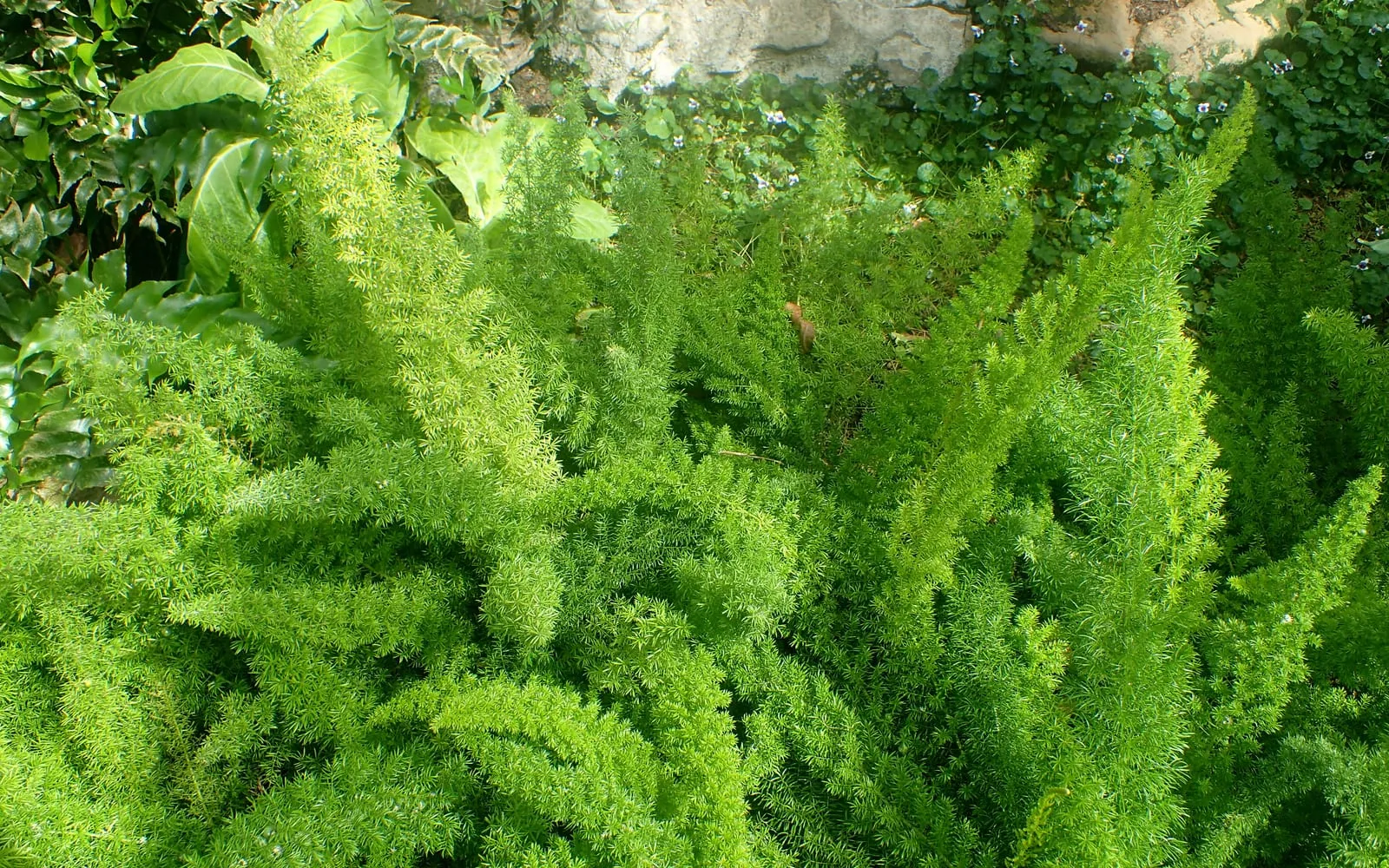
Foxtail fern is not a fern at all, despite the name and the feathery look. It belongs to the asparagus family, and its soft green plumes are made of tiny flattened stems called cladodes rather than true fern fronds, packed densely along upright to arching stalks that curve outward into a shape like a fox’s brush.
Underground, a mat of fleshy, water-storing tuberous roots gives the plant real drought tolerance, a trait more typical of a succulent than of a delicate fern. That storage organ is also why the plant tolerates inconsistent watering far better than its lacy appearance suggests.
Appearance and character
Each stem is densely packed with short, needle-like cladodes in bright, fresh green. The spiral arrangement makes the stalk look like a single soft, plume-shaped brush rather than a collection of individual leaves.
Small white flowers appear along the stems, easy to miss against the foliage, followed by round berries that ripen from green to bright red. The berries are decorative in their own right and persist for weeks once coloured.
A mature clump sends up new stems from the base each growing season, building into a dense, rounded mound of arching plumes 60 to 90 cm across in a large pot, though it stays considerably more compact in a small one.
Beneath the compost, the tuberous roots form a thick, congested mass over time, eventually filling and even cracking a pot that has held the plant for several years without repotting.
Where it is from
Asparagus densiflorus is native to the coastal grassland and scrub of South Africa, an area with a distinct wet and dry season rather than constant rainfall through the year.
The tuberous roots are the plant’s answer to that dry season, storing enough water to carry the top growth through weeks without rain. Wild plants often grow in fairly poor, sandy soil in open or lightly shaded positions, tolerant of considerable neglect once established.
That background is why the species handles a missed watering or two so much more gracefully than many other popular houseplants, and why it copes reasonably well with the average dry air of a heated room, a condition that troubles most plants marketed as ferns.
How it grows
Plant it in free-draining general houseplant compost. It is not particular about soil type, tolerating anything from a standard potting mix to a slightly sandier blend, provided water does not sit around the tubers for long.
Give it bright indirect light or a few hours of gentle direct sun. It also tolerates considerably more shade than most sun-loving houseplants, though growth slows and the plumes thin out somewhat in low light.
Water thoroughly, then let the top few centimetres of compost dry before watering again, leaning towards underwatering rather than overwatering if in doubt, since the tuberous roots handle drought far better than they handle rot.
Repot every couple of years once the tuberous roots have filled the pot, moving up one size into fresh compost. A congested root mass can be divided at this point, since the plant produces multiple growing points from the base that separate cleanly with some root attached to each.
Trim out any yellowed or damaged stems at the base at any time, cutting them off cleanly rather than pulling, which can disturb neighbouring healthy stems.
Through the seasons
Spring brings the start of active growth and new stems from the base. Begin monthly feeding and repot or divide if the tuberous roots have filled the pot.
Summer is the main growing season, with the fastest production of new foliage and, on a mature plant, the appearance of small white flowers.
Autumn slows growth gradually. Reduce feeding towards the end of the season.
Winter is a quieter rest. Water more sparingly, since the tuberous roots hold enough reserve to see the plant through reduced watering at lower light and temperature, and stop feeding until spring.
Care difficulty
Easy, and among the most forgiving plants covered in these guides. The tuberous roots buffer the plant against irregular watering, average room humidity causes no trouble at all, and it tolerates a fairly wide range of light levels without serious complaint.
The two things worth minding are overwatering, since the tubers can rot in compost that never dries out, and the fine, slightly sharp foliage, which some people find irritating to bare skin during pruning or repotting and is best handled with light gloves.
Watering
Water thoroughly until it runs from the drainage holes, then let the top few centimetres of compost dry out before watering again, checking with a finger rather than watering to a strict schedule.
The tuberous roots store enough water to carry the plant through an occasional missed watering without visible harm, so when in doubt, wait rather than water again.
Reduce watering further over winter, when the plant is using noticeably less at lower light and temperature, and compost that stays wet at that point is far more likely to cause rot than drought is to cause damage.
Warning signs, diseases and pests
Mealybug tucks itself among the dense stems where it is hard to spot, showing as small white, cottony tufts once numbers build up. Treat with a cotton bud dipped in surgical spirit or a horticultural soap spray.
Scale insects settle on the older, slightly woodier base of the stems, appearing as small brown bumps. Treat the same way as mealybug.
Root rot follows compost kept too wet around the tuberous roots, showing as stems that yellow and collapse from the base even though the plant looks otherwise unaffected above. Unpot it, cut away any soft, mushy tubers, and repot into fresh, free-draining compost, watering more cautiously afterwards.
Spider mite can appear in hot, dry indoor air, particularly near heating in winter, showing as fine speckling on the foliage. Raising humidity slightly and rinsing the plant under a tap helps control it.
Growing environment
Bright indirect light to a few hours of gentle direct sun suits it best, though it also tolerates lower light better than most plants sold as foliage houseplants, growing more slowly and a little less densely as a result.
An average room temperature between 15 and 27 deg C is fine year round. It has no need for anything warmer, and established outdoor plants in mild climates take a light, brief frost when the soil stays dry.
Average room humidity is entirely adequate. This is one plant that needs no pebble tray, no grouping with other humidity-loving species, and no special attention on that front at all.
Free-draining compost matters more than any particular fertility, since the tuberous roots are far more vulnerable to sitting wet than they are to running dry.
Feeding
Feed monthly through spring and summer with a balanced liquid houseplant feed at the strength stated on the label.
Stop feeding over autumn and winter, when growth slows considerably and the plant draws on its tuberous roots rather than on fresh fertiliser.
A congested, rootbound plant benefits more from repotting into fresh compost than from extra feeding, since the tubers eventually crowd out most of the compost a feed would otherwise reach.
Troubleshooting
Whole stems have turned yellow and collapsed at the base. Root rot from compost that has stayed too wet. Unpot the plant, cut away any soft, mushy tuberous roots, and repot into fresh, free-draining compost, then water more cautiously.
The plant has cracked its pot. The tuberous roots have outgrown it, which is normal on a plant left too long without repotting. Move it into a pot one or two sizes larger, or divide the root mass into two or more plants.
Growth looks thin and sparse compared with when I bought it. Usually too little light. Move it somewhere brighter, though allow a few months for new, denser growth to replace the thinner older stems.
Small red berries have appeared. Should I remove them? Not necessary for the plant’s health, though they contain viable seed and are best kept away from a cat or dog that samples houseplants, since they are the part most linked to poisoning cases.
Can I grow it outdoors over summer? Yes, in a lightly shaded to sunny spot once night temperatures stay reliably above about 10 deg C, brought back indoors well before the first frost of autumn.
Foxtail Fern problem guides
Not sure what is wrong? See the common houseplant pests guide.