
Houseplant
Spotted Dumb Cane
Dieffenbachia seguine
Also known as Dieffenbachia maculata
How to grow spotted dumb cane, Dieffenbachia seguine. Why a bitten leaf can swell the tongue enough to affect speech and breathing, and why it needs a shelf out of reach rather than just supervision around children and pets.
At a glance
- Difficulty
- Easy
- Water
- When the top third of the compost has dried, roughly weekly in summer
- Light
- Bright, indirect light; tolerates medium and low light well
- Temperature
- Above 15 deg C
- Humidity
- Moderate to high; benefits from extra humidity
- Hardiness
- USDA 10b-12, RHS H1b, hardy to 15 C
- Type
- Evergreen tropical perennial
- Height
- 60-150 cm
- Native to
- tropical South America
A warm, shaded tropical understory plant with no cold tolerance at all. Growth slows sharply below 18 deg C and the plant is damaged well before frost, so it lives as a houseplant everywhere outside the wet tropics.
Hardiness zones describe winter cold alone. Summer heat, humidity, rainfall and the length of the growing season decide as much, so treat the range as the outer limit rather than as a recommendation.
Poisonous if eaten
- Do not eat
- Every part, and the stem sap most of all
- Harm from
- Eating it, handling it and sap in the eyes
- Affects
- People, cats and dogs
Dumb cane is named for the speech difficulty that can follow a bite. The tissue is packed with calcium oxalate raphides, microscopic needles held under pressure, and chewing any part fires them into the lips, tongue and throat along with enzymes that make the injury worse. Pain is immediate and severe, the tongue swells, and speech becomes difficult, sometimes for several days. In a small child or a small pet, that swelling occasionally threatens the airway, which is why this species is treated more seriously than most houseplants: difficulty breathing, drooling that will not stop, or a visibly swelling mouth needs urgent medical attention rather than a wait-and-see approach at home. Something cold to suck or sip eases the immediate pain. Sap in the eye is painful and can scratch the cornea, so flush the eye with water for fifteen minutes and get it checked. The pain stops almost everyone after a single bite, which is why serious cases are uncommon despite how often the plant is grown. Wear gloves to repot or take cuttings, and keep it off low tables and the floor where a toddler or a cat can reach it.
Sources: RHS potentially harmful garden plants, ASPCA toxic and non-toxic plants
About
Spotted dumb cane is an easy foliage houseplant, but its toxicity matters. Every part contains calcium oxalate crystals that cause immediate pain and swelling if the plant is chewed. It should be kept out of reach of small children and pets.
The plant itself is tolerant and useful in bright indirect to medium light. Large, patterned leaves grow from thick cane-like stems, and older plants drop lower leaves as the stems lengthen.
Appearance and character
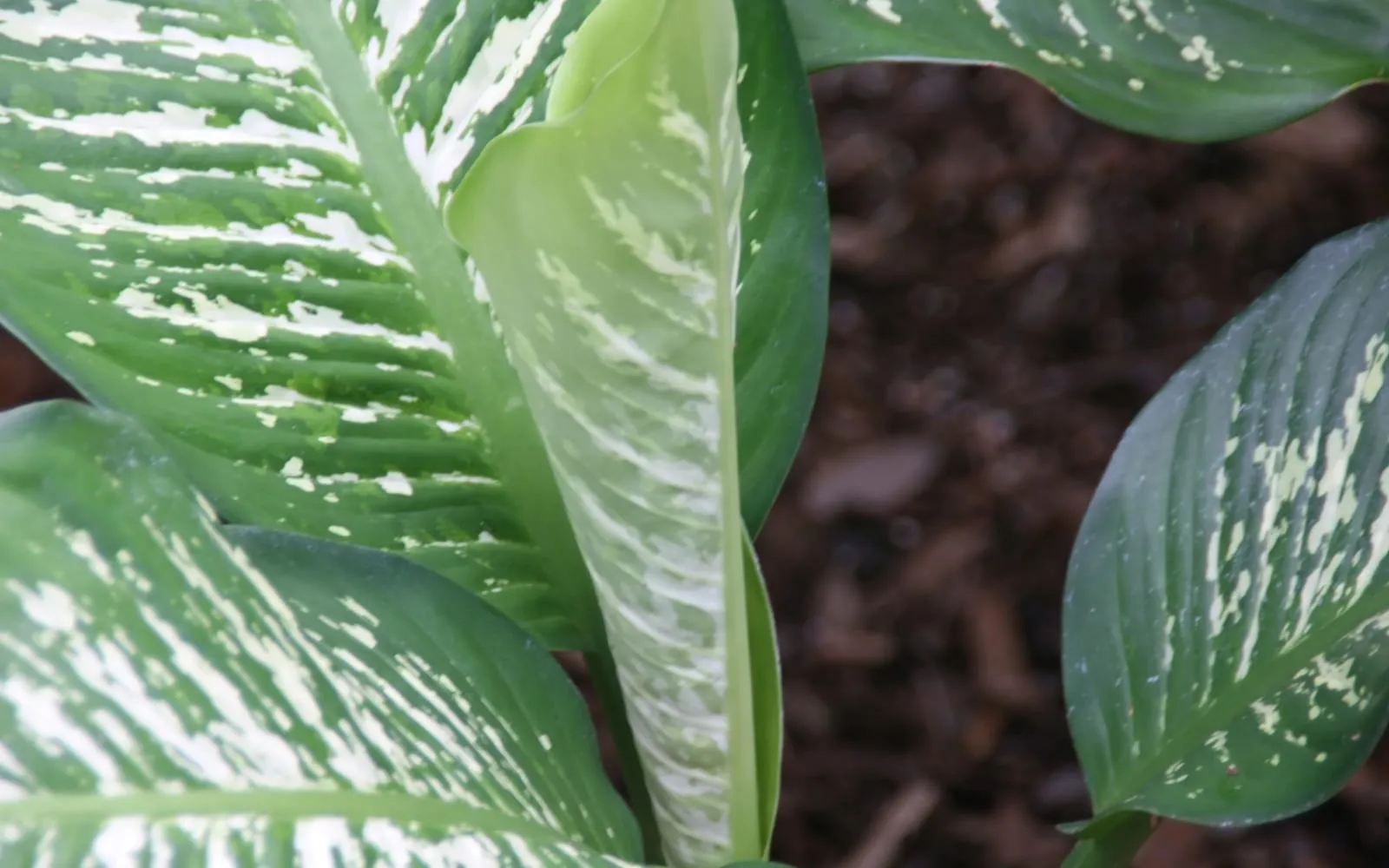
Leaves are broad and oval with a pointed tip, 20 to 45 cm long, held on thick petioles that sheath a central stem. The blade is boldly splashed with cream to pale green over a darker green ground, a pattern that varies between plants and gives the species its “spotted” name.
The stem thickens into a cane over time, marked with the pale rings left by fallen lower leaves, and a mature plant loses its lowest leaves as it grows, ending up with a bare lower stem and a crown of foliage at the top, not unlike a small palm in silhouette.
Left unchecked it reaches 60 cm to 1.5 m indoors, upright and clumping rather than trailing or climbing, and a plant that has grown leggy and bare at the base can be cut back hard to force fresh growth lower down the stem.
Where it is from
Dieffenbachia seguine, still widely sold as Dieffenbachia maculata, comes from the understory of tropical forests in South America, growing in warm, humid, low-light conditions beneath a dense canopy.
That origin is why it tolerates the dim corners of a room better than most large-leaved houseplants and why it has no frost tolerance whatsoever: a forest floor in the tropics never sees cold, only shade, and the plant has never needed to evolve any defence against it.
How it grows
Pot it in a free-draining houseplant compost, and choose a pot with good drainage, since the roots are prone to rot in compost that stays wet for long.
Repot every two years or when it becomes rootbound, moving up one pot size in spring as new growth resumes.
Propagate from stem cuttings, or by air layering an old, bare cane: wound the stem lightly, wrap the wound in damp moss and plastic, and wait for roots to form before cutting the rooted top away from the rest of the plant. A bare cane left in the original pot after this often resprouts new growth of its own from further down.
Wipe dust from the large leaves occasionally with a damp cloth, both for appearance and because a dusty leaf photosynthesises less efficiently in what is often already a low-light position.
Through the seasons
Spring is the best time to repot, take cuttings, and cut back any leggy stems to encourage fresh growth from lower down.
Summer is the main growing season. Water and feed on the regular schedule and keep humidity up if the air is dry.
Autumn slows growth gradually as light levels drop.
Winter is a rest. Water less often, since the compost stays damp for longer, and stop feeding until spring; keep it well away from cold windowsills and draughts through this period.
Care difficulty
Easy in terms of general care, tolerant of the low light and inconsistent humidity of an ordinary room better than most large-leaved houseplants. The real difficulty with this species has nothing to do with keeping it alive and everything to do with where you put it, since its toxicity is more serious than that of most houseplants and it needs a position out of reach of small children and pets rather than merely watched.
Watering
Water when the top third of the compost has dried out, typically weekly in summer and less often in winter. Water thoroughly until it drains from the pot, then let it drain fully and never leave it standing in water.
It recovers reasonably well from a missed watering but dislikes both extremes for long: compost that dries out completely and stays that way causes lower leaves to yellow and drop, while compost kept constantly wet leads to root rot.
Warning signs, diseases and pests
Spider mite thrives in warm, dry indoor air, showing as fine pale speckling on the leaves and faint webbing in bad cases. Raising humidity and wiping leaves down regularly helps prevent it.
Mealybug shows as small white, cottony tufts in the leaf axils and along the cane. Wipe it away with a damp cloth or treat with horticultural soap.
Scale insects occasionally appear as small, flat, brownish bumps on older stems, treated the same way as mealybug.
Root rot follows compost kept too wet, showing as yellowing leaves and a generally unhappy plant despite damp compost, since the roots that should be taking up water have already failed. Unpot it, cut away soft, brown roots, and repot into fresh, drier compost.
Growing environment
Bright, indirect light gives the strongest leaf markings, though it tolerates medium and even fairly low light well, one of the reasons it is popular for offices and shaded rooms.
Keep it above 15 deg C, and ideally well above that. Growth slows noticeably below 18 deg C, and prolonged cold below the stated minimum causes lasting damage.
Moderate to high humidity keeps the leaves at their best; dry, centrally heated air causes browning at the leaf edges over time, though the plant otherwise tolerates it without serious harm.
Position it deliberately out of reach of small children and pets, on a high shelf or in a room they do not have unsupervised access to, given the severity of its toxicity if chewed.
Feeding
Feed with a balanced liquid houseplant fertiliser at half the strength on the label, once a month through spring and summer.
Stop feeding in autumn and winter, when growth has slowed and unused fertiliser accumulates as salts in the compost rather than being taken up by the plant.
Troubleshooting
Someone has bitten a leaf. What do I do? Rinse the mouth out and offer cold water or something cold to eat, which soothes the burning. Watch closely for swelling of the mouth or throat, drooling that will not stop, or difficulty breathing or swallowing, and seek urgent medical care if any of these appear, since they signal the airway may be affected.
The lower leaves keep yellowing and dropping. Often nothing more than age. It is normal for this species to shed its lowest leaves as it grows, leaving a bare cane below a crown of foliage; this becomes a problem only if it happens faster than new leaves are forming above.
The stem has grown tall and bare at the base. Cut it back hard in spring, to whatever height suits the space; it reliably resprouts new growth from the cut cane, and the removed top can often be rooted as a new plant.
The leaf markings have faded to plain green. Usually too little light. Move it somewhere brighter and new growth should come in with stronger variegation.
Is it safe to keep if I have young children? It can be, positioned well out of reach on a high shelf in a room they are supervised in, but its severity is a genuine reason to choose a different, non-toxic houseplant for a room where a toddler plays unsupervised.
Spotted Dumb Cane problem guides
Not sure what is wrong? See the common houseplant pests guide.